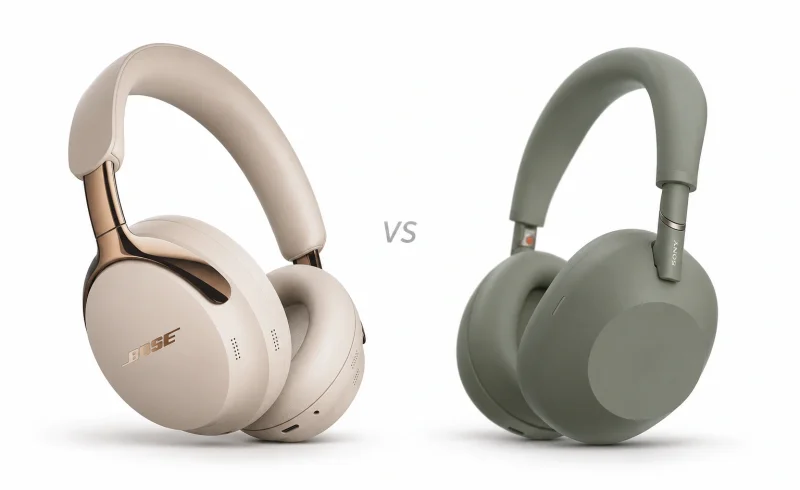
Bose QuietComfort Ultra Headphones (2nd Gen) vs Sony WH-1000XM6: comfort or sound and calls?
TL;DR
The Sony WH-1000XM6 is the better fit for most listeners who want adjustable sound and a headset for noisy calls. The Bose QuietComfort Ultra Headphones (2nd Gen) makes more sense if glasses, ear pressure or listening through a USB-C cable shape your day.
Noise cancellation is close enough that comfort can settle the choice. Bose led TechRadar's café and traffic tests, while Sony blocked more high-frequency noise in TechGearLab's measurements. Sony's clearest wins are sound customization and noisy calls.
US prices as of November 14, 2026.
| Feature | Bose QuietComfort Ultra Headphones (2nd Gen) | Sony WH-1000XM6 |
|---|---|---|
| Design | Closed-back, over-ear, folding | Closed-back, over-ear, folding |
| Weight | Approx. 264 g | Approx. 254 g |
| Rated music runtime, ANC on | Up to 30 h | Up to 30 h |
| Full charging time | Up to 3 h | Approx. 3.5 h |
| Bluetooth version | 5.4 | 5.3 |
| Bluetooth codecs | SBC, AAC, aptX Adaptive | SBC, AAC, LDAC, LC3 |
| Multipoint connections | 2 devices | 2 devices |
| App equalizer | 3 bands | 10 bands |
| Digital audio through USB-C | Yes | No |
| Headphone-side analog socket | 2.5 mm | 3.5 mm |
| Analog listening without battery power | No | Yes |
| Ambient sound mode | Aware with ActiveSense | Ambient Sound and Quick Attention |
| US price | $449.00 at Bose | $379.99 at Sony |
Bose's 30-hour rating assumes Immersive Audio is off.
📑 Table of Contents
Sony gives you more room to tune the sound
What Hi-Fi?'s Harry McKerrell finds the XM6 more detailed, rhythmically precise and natural in its direct sound comparison. SoundGuys' Christian Thomas also expects more listeners to prefer Sony. TechGearLab leans the other way by a hair, scoring Bose 8.6/10 and Sony 8.5/10 for sound.
Sony's 10-band equalizer lets you change a narrower part of the sound than Bose's three bass, midrange and treble controls. A bass line that crowds a vocal is a reason to use that extra control. For comparisons of their tuning, the SoundGuys sound-quality chapter (09:17) pairs listening impressions with frequency-response measurements.
Noise cancellation changes with the noise around you
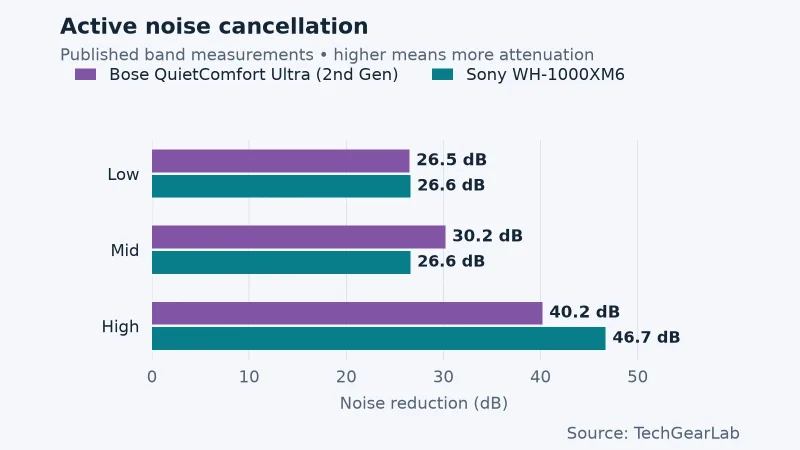
Neither pair wins across every kind of noise. TechGearLab measured Bose at 26.5, 30.2 and 40.2 dB reduction in its low, mid and high bands; Sony reached 26.6, 26.6 and 46.7 dB. The low-band result is effectively level, Bose leads in the middle band, and Sony leads in the high band.
Bose gets a small nod for chaotic everyday noise in TechRadar's direct listening tests. Matt Bolton scored Bose 5/5 against Sony's 4.5/5 for both traffic and café noise; a hair dryer reversed that result, at 4.5/5 versus 5/5, and both scored 5/5 against a microwave. What Hi-Fi? also prefers Bose's maximum Quiet mode, SoundGuys calls the overall difference hard to notice, and RTINGS gives Sony a slight isolation edge. For a noisy café, Bose is the more consistent listening recommendation; for a general commute, the results are too close to overrule fit.
Bose is easier to wear through a long session
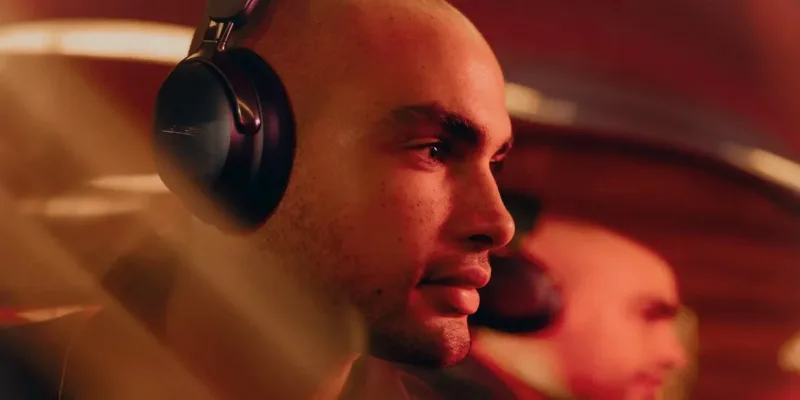
TechGearLab's Rachael Lamore scored its comfort 9.5/10 against Sony's 6.8/10 in the Bose review. Some of the team's Sony wearers developed pressure points, including where glasses met the pads, and RTINGS also found Bose comfortable on more heads. For glasses wearers and anyone sensitive to pressure around the ears, that makes Bose the safer pick.
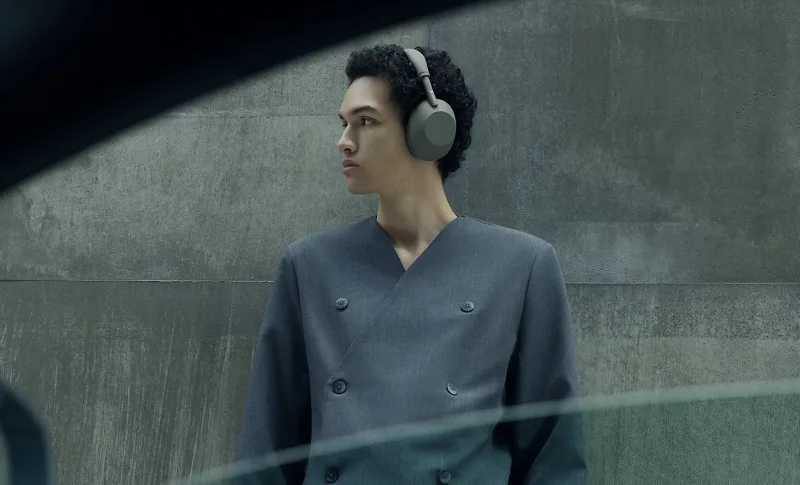
Sony's earcup interior deserves attention if your ears often press against headphone padding. SoundGuys found the pads thin enough for the internal microphone to touch some ears; Avery Cheng's comfort chapter (02:41) discusses wearing fit. Both designs fold into a supplied case for travel.
If even a folded over-ear case is too bulky for your bag, our Galaxy Buds 3 Pro, Liberty 4 Pro and Bose Ultra Open comparison covers earbuds and an open-ear design.
Battery life is a draw
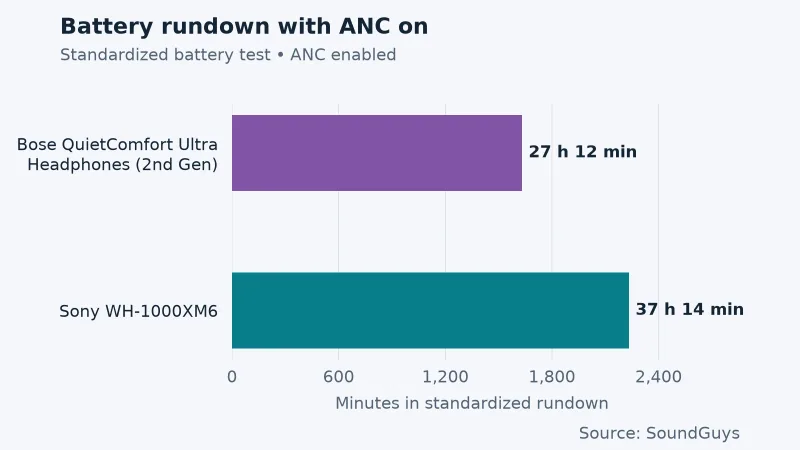
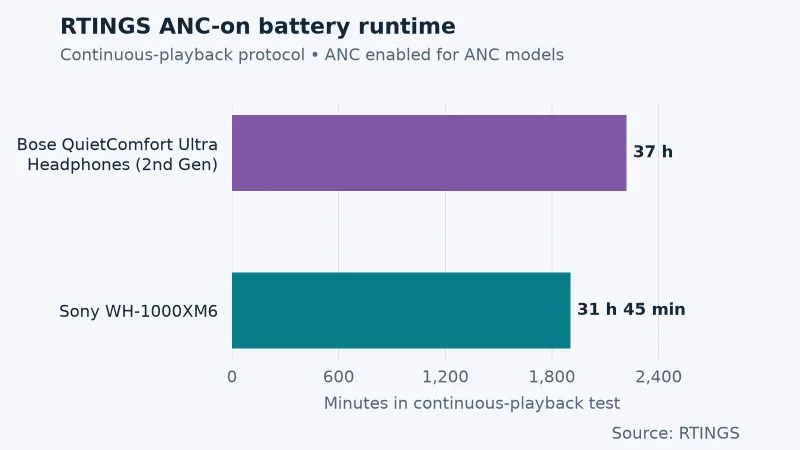
SoundGuys recorded 37 hours 14 minutes for Sony and 27 hours 12 minutes for Bose in its standardized ANC-on rundown. RTINGS got the opposite order: 37 hours for Bose and 31.75 hours for Sony. Either way, both comfortably cover a long flight.
Bose's own claim falls to 23 hours with ANC and Immersive Audio on, so the 30-hour headline is the wrong figure for someone who leaves spatial processing enabled.
Bose makes USB listening simpler
Plug the Bose into a USB-C laptop or compatible phone and one cable carries the music and charges the battery at the same time. Sony's USB-C port charges the headphones but does not accept audio; wired listening uses its analog socket.
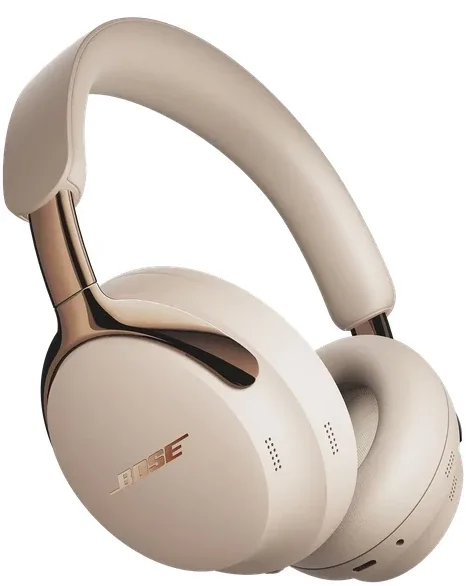
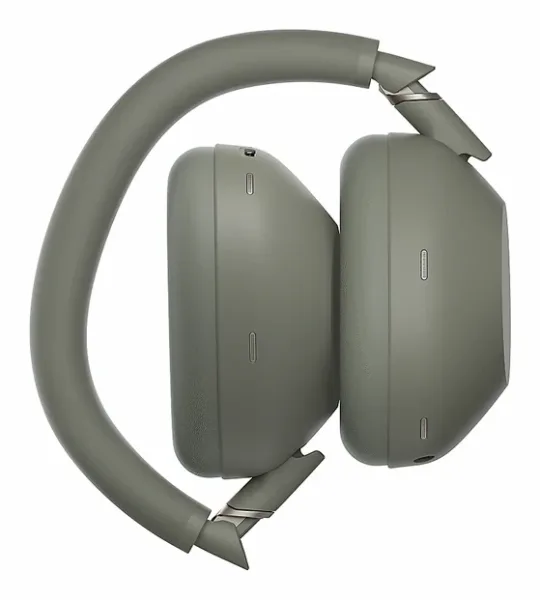
With a dead battery, only the Sony keeps playing: its analog connection works passively, while Bose's analog playback needs power. On an aircraft with a headphone socket, that distinction can matter more than the Bluetooth codec list. Bose uses the supplied 2.5-to-3.5 mm cable; Sony uses 3.5 mm at both ends.
An iPhone uses AAC with either pair. On a compatible Android source, Sony adds LDAC, while Bose's aptX Adaptive features require a compatible Snapdragon Sound source. Sony is the simpler route to LDAC for an Android listener already using that codec.
Sony puts more controls on the earcup
Holding a palm over the right earcup activates Quick Attention, lowering playback and bringing in surrounding sound, so a quick word with a flight attendant needs no button hunt. Swipes handle volume and tracks. Bose uses a volume strip and physical buttons, with broader sound adjustments in its app.
Bose firmware 8.2.20 removed button switching between paired Bluetooth sources, moving that action into the app. Both can connect to two devices at once, so switching between a phone and a laptop does not require pairing from scratch.
Sony has the edge for calls in noisy places
TechGearLab scored the Sony 8.8/10 for call quality against Bose's 8.0/10, describing effective background-noise suppression on a subway platform and in an office. RTINGS also leans toward Sony for frequent calls, while finding Bose adequate for ordinary conversations.
Bose can also serve as a USB calling headset for a PC after its firmware 8.2.20 update, reported by SoundGuys' Adam Birney. Analog playback disables its built-in microphone.
Final Verdict
For most listeners, the Sony WH-1000XM6 is the better fit for music and calls: its finer sound tuning and higher noisy-call scores make it more versatile, while Bose suits listeners who put comfort or USB-C audio first.
- Music tuning and noisy calls: Sony WH-1000XM6, for finer EQ control and better call scores.
- Glasses and long listening sessions: Bose QuietComfort Ultra Headphones (2nd Gen), for its more accommodating fit.
- Digital listening at a desk: Bose QuietComfort Ultra Headphones (2nd Gen), for audio and charging over USB-C.
- Analog listening after the battery runs out: Sony WH-1000XM6, for passive playback.