
Samsung Galaxy Buds 3 Pro vs Soundcore Liberty 4 Pro vs Bose Ultra Open Earbuds: Picking Your Audio Sidekick
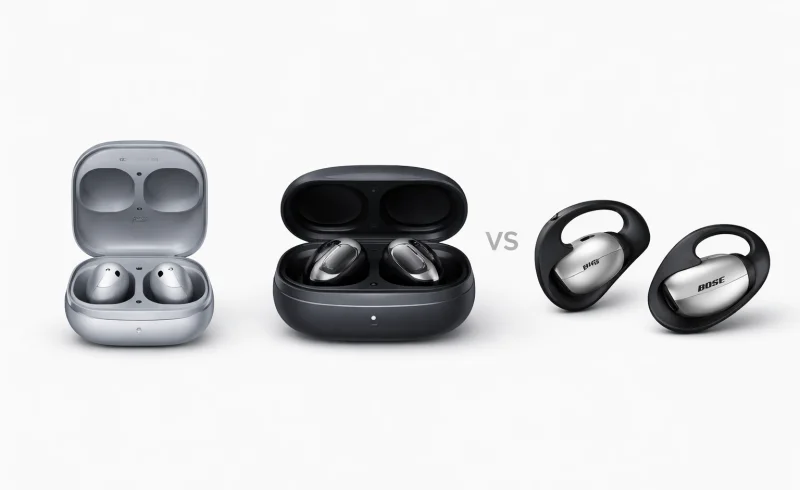
Compare Samsung Galaxy Buds 3 Pro, Soundcore Liberty 4 Pro, and Bose Ultra Open Earbuds for noise canceling, sound, comfort, battery, durability, and value—plus who each is best for.
TL;DR
Quick Decision
- If you live in the Samsung Galaxy ecosystem and want seamless integration → choose Samsung Galaxy Buds 3 Pro.
- If you love to tinker with audio settings and prioritize battery life → choose Soundcore Liberty 4 Pro.
- If you need to hear your surroundings and can't stand in-ear tips → choose Bose Ultra Open Earbuds.
- For a standard in-ear ANC experience without brand lock-in, either the Samsung or Soundcore models will work well.
Key Differentiators This choice is a fundamental trade-off between ecosystem, control, and design. The Galaxy Buds 3 Pro offer their best experience almost exclusively to Samsung phone users, making them a weak cross-platform pick. The Liberty 4 Pro swaps that seamless integration for deep, app-based customization and superior battery specs. The Bose Ultra Open Earbuds aren't even in the same category—they sacrifice all noise isolation for open-ear comfort and situational awareness, making them useless for noisy commutes.
Who Should NOT Buy Either If your top priority is bulletproof reliability and you're wary of reported charging or connectivity quirks, you should look at other established brands in the TWS category instead.
| Feature | Bose Ultra Open Earbuds | Soundcore Liberty 4 Pro | Samsung Galaxy Buds 3 Pro |
|---|---|---|---|
| Design | |||
| Form Factor | Open-ear | In-ear | In-ear |
| Battery | |||
| Fast Charging | 10 min = up to 2 h playtime | 5 min = 4 h playtime | |
| Playback Time (Earbuds) | Up to 7.5 h | Up to 10 h | Up to 7 h (ANC off) / 6 h (ANC on) |
| Playback Time (With Charging Case) | Up to 27 h | Up to 40 h | Up to 30 h (ANC off) / 26 h (ANC on) |
| Durability | |||
| Water Resistance | IPX4 | IPX5 | IP57 |
| Connectivity | |||
| Audio Codec | Qualcomm aptX Adaptive | SBC, AAC, LDAC | Samsung Seamless Codec (up to 24-bit/96kHz) |
| Bluetooth Version | 5.3 | 5.3 | 5.4 |
| Noise Control | |||
| Active Noise Cancellation | No | Yes | Yes |
📑 Table of Contents
Noise control
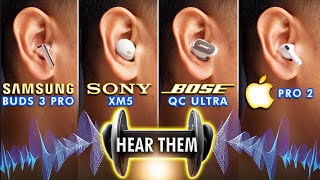
Samsung Galaxy Buds 3 Pro are classic in-ear buds with Active Noise Cancellation: Yes, and they offer three noise control modes: Ambient sound, Adaptive, and Active noise cancelling (per manual). That mode granularity matters in practice because it gives you a «set-and-forget» option (Adaptive) and a full isolation option (ANC) for commutes and flights.
Soundcore Liberty 4 Pro are also in-ear with Active Noise Cancellation: Yes, so they target the same noisy-environment use cases as Samsung. The key difference is less about «having ANC» and more about how much you want to manage it: Soundcore’s positioning leans toward app-driven control and tuning, which can be a plus if you’re willing to tweak, but less universal if you just want the most straightforward default behavior.
Conclusion: Samsung Galaxy Buds 3 Pro have the edge on noise control as a system because they pair in-ear ANC with explicit, three-mode switching (Ambient/Adaptive/ANC), making them easier to adapt to changing environments without constant fiddling.
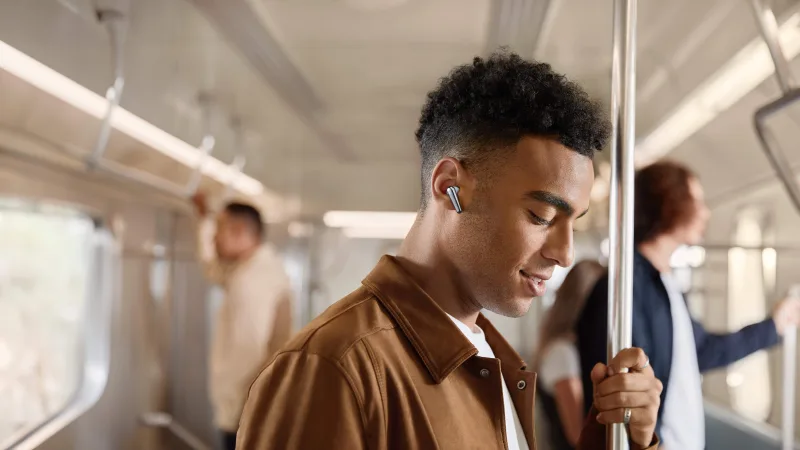
Samsung Galaxy Buds 3 Pro remain the better pick specifically for loud spaces, but there’s an important real-world caveat: multiple reviewers report charging issues (including buds not charging), plus random disconnects and audio cut-outs. If your earbuds don’t reliably charge or stay connected, «good ANC on paper» can become irrelevant on the days you need it.
Bose Ultra Open Earbuds, by design, are open-ear and list Active Noise Cancellation: No, so they don’t compete on isolation. Bose’s cuff-style approach is explicitly about situational awareness—a feature outdoors or in social offices, but a structural limitation for subway, airplane, or any environment where you need the noise floor to drop.
Conclusion: For max noise reduction, Bose Ultra Open Earbuds are not the right tool, while both Samsung and Soundcore are purpose-built for it; Bose only «wins» if your priority is hearing your surroundings rather than blocking them.
Winner: Samsung Galaxy Buds 3 Pro
Sound & codecs
Samsung Galaxy Buds 3 Pro lean into high‑res playback primarily inside Samsung’s own ecosystem. On paper they support Samsung Seamless Codec (up to 24‑bit/96kHz), and a retailer listing also notes SSC HiFi/UHQ delivering 24‑bit/96kHz—useful if you’re on Galaxy hardware that can actually negotiate those modes. That means the «best» codec experience is less universal and more contingent on your phone/tablet being in the Galaxy stack.
Soundcore Liberty 4 Pro prioritize broad compatibility across Android devices by supporting SBC, AAC, and LDAC. The inclusion of LDAC is the key differentiator here because it’s a widely supported high‑bitrate option on many non‑Samsung Android phones, giving you a clearer upgrade path beyond SBC/AAC without brand lock-in. This fits Soundcore’s positioning around customization and «maximum features for the money,» where codec support is part of the value argument.
Conclusion (codecs): Liberty 4 Pro have the edge for cross‑platform hi‑res flexibility (LDAC), while Galaxy Buds 3 Pro can win for Galaxy owners specifically thanks to 24‑bit/96kHz SSC/UHQ being designed to work best within Samsung’s ecosystem.
Samsung Galaxy Buds 3 Pro are also fundamentally an in‑ear design, which typically yields more consistent perceived bass and detail because the seal reduces the impact of outside noise. Combined with the fact they include ANC (and three noise control modes: Ambient, Adaptive, and Active noise cancelling), their tuning is more likely to translate similarly from a quiet room to a commute. The practical upside is more predictable tonal balance at lower volumes.
Bose Ultra Open Earbuds, by contrast, are explicitly open‑ear with a cuff-style design that «does not cover the ear,» and they use Bose’s OpenAudio approach that allows air circulation. The trade-off is inherent: because there’s effectively no isolation (and no ANC), perceived bass and detail will vary much more with the environment—great for awareness, weaker for immersion. Codec-wise, they list Qualcomm aptX Adaptive, but codec advantages matter less if ambient sound is the limiting factor.
Conclusion (sound consistency): Galaxy Buds 3 Pro win for consistent, immersive sound in more places, while Bose Ultra Open win only if you prioritize environmental awareness over isolation-dependent bass and detail.
Winner: Tie — Soundcore Liberty 4 Pro are the most codec-flexible for non-Samsung devices (LDAC), while Samsung Galaxy Buds 3 Pro are the stronger choice for consistently immersive listening thanks to the in‑ear + ANC foundation; Bose Ultra Open are a deliberate trade-off where open‑ear awareness outweighs sound consistency.
Comfort & fit
Samsung Galaxy Buds 3 Pro use an in-ear form factor designed around achieving a stable seal, which is foundational for immersive listening and effective ANC. The fit is tip-dependent, and the manual explicitly notes ear tips must be attached before wearing, underscoring that «seal-first» approach.
Soundcore Liberty 4 Pro are also in-ear, with the same general comfort trade-off: you get physical isolation and stability, but some users will feel ear-canal pressure over long sessions. In practice, Soundcore leans into adjustability via software (EQ profiles, hearing tests), but comfort is still primarily determined by tips and insertion depth.
Conclusion: Between these two, comfort is broadly similar because both are in-ear; the choice is less about fit philosophy and more about whose overall tuning/controls you prefer.
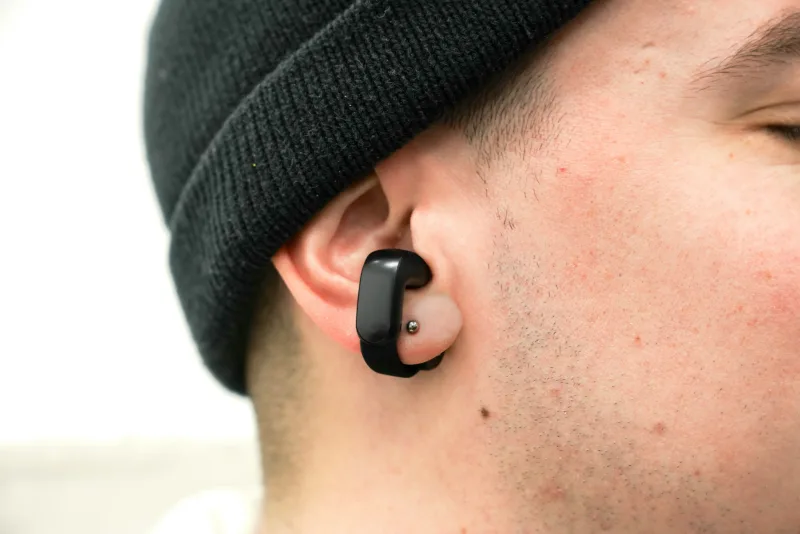
Samsung Galaxy Buds 3 Pro can feel secure for commuting and workouts because the in-ear seal helps lock them in place and supports Active Noise Cancellation: Yes. The trade-off is that comfort depends on tolerating in-ear insertion for hours at a time.
Bose Ultra Open Earbuds switch the equation: they’re explicitly open-ear with a cuff-shaped design that does not cover the ear canal, and Bose calls out airflow via OpenAudio to help keep ears dry. That typically reduces in-ear pressure and «plugged ear» fatigue, but it also means Active Noise Cancellation: No, so they won’t feel «comfortable» in the sense of quieting a loud commute.
Conclusion: For long-wear comfort and avoiding in-ear pressure, Bose Ultra Open Earbuds have the clearer ergonomic advantage; for stability plus isolation, the in-ear Samsung/Soundcore approach fits more use cases.
Winner: Bose Ultra Open Earbuds
Battery & fast charge

Battery life (earbuds)
Samsung Galaxy Buds 3 Pro are rated for up to 7 hours (ANC off) / 6 hours (ANC on) on the earbuds alone. That ANC-on figure is the more realistic baseline for commuting and office use, since you’ll typically keep noise cancelling enabled for consistent isolation.
Soundcore Liberty 4 Pro claims up to 10 hours on the earbuds, which is a sizable gap over Samsung even before factoring in ANC use. In practical terms, that extra headroom is the difference between finishing a full workday without a mid-day top-up versus planning charging breaks.
Conclusion: Soundcore Liberty 4 Pro wins on earbuds-only longevity (10h vs 7h/6h), and the margin is large enough to matter day-to-day.
Total playback (with charging case)
Samsung Galaxy Buds 3 Pro reach up to 30 hours (ANC off) / 26 hours (ANC on) with the case. The 26-hour ANC-on total is the key number if you’re buying these primarily for travel, transit, or noisy environments.
Soundcore Liberty 4 Pro is rated for up to 40 hours with the case. That’s +10 hours vs Samsung’s 30 hours (ANC off) and +14 hours vs 26 hours (ANC on), which translates into fewer full-case recharges over a week.
Conclusion: Soundcore Liberty 4 Pro wins on total endurance (40h vs 30h/26h), especially if you want a «charge it and forget it» routine.
Fast charging
Samsung Galaxy Buds 3 Pro have no fast-charge spec listed in the provided data, so it’s hard to quantify emergency top-ups. Also, multiple reviewers report charging issues with Buds 3 Pro—earbuds not charging and occasional disconnects/cut-outs—which can directly undermine real-world battery reliability even if the rated hours look fine.
Soundcore Liberty 4 Pro has an explicit fast-charge claim: 5 minutes = 4 hours of playtime. That’s an unusually strong quick-top-up ratio, and it’s particularly valuable for people who forget to charge overnight.
Conclusion: Soundcore Liberty 4 Pro wins on fast charging because it provides a clear, high-value quick-charge spec (5 min → 4h) while Samsung doesn’t list one here and has reported charging friction.
Where Bose fits (open-ear trade-off)
Samsung Galaxy Buds 3 Pro are in-ear with ANC and are rated up to 7h/6h earbuds-only and 30h/26h with case, positioning them as a more «sealed» all-day option where isolation and consistent audio matter. However, battery value depends on trouble-free charging—an area where multiple reviewers report issues that can offset the spec advantage versus other brands.
Bose Ultra Open Earbuds are open-ear (no ANC) and are rated up to 7.5 hours on the earbuds and up to 27 hours with the case, plus fast charging at 10 minutes = up to 2 hours. That’s respectable for open-ear, and fits the «hear your surroundings» use case, but it still trails the raw endurance and fast top-ups of Soundcore.
Conclusion: Bose is competitive for open-ear stamina, but Soundcore still leads overall on both total hours (40h vs 27h) and fast charging efficiency (5 min → 4h vs 10 min → 2h).
Winner: Soundcore Liberty 4 Pro
Durability
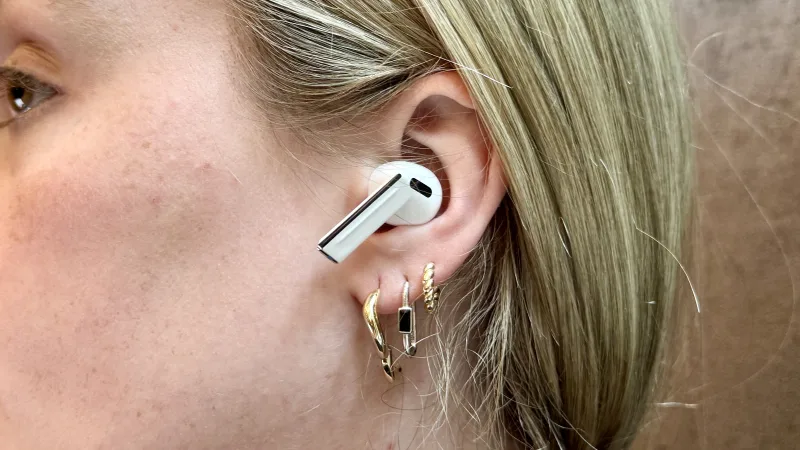
Samsung Galaxy Buds 3 Pro are rated IP57, which typically means protection against dust plus water immersion (not just splashes). That’s the most forgiving spec here for sweaty workouts and getting caught in real rain, because it’s designed for more than surface moisture.
Soundcore Liberty 4 Pro come in at IPX5, a solid sweat-and-splash level rating, but it omits dust protection (the «X») and doesn’t imply immersion resistance. For training sessions and everyday wet-weather commuting, it’s protective—but on paper it’s a step down from IP57.
Conclusion: On pure ingress protection, Galaxy Buds 3 Pro win—IP57 vs IPX5 is a meaningful gap if you expect heavy sweat, downpours, or rougher day-to-day handling.
Samsung Galaxy Buds 3 Pro also have a notable durability-adjacent risk: multiple reviewers report charging issues (earbuds not charging), along with random disconnects and audio cut-outs in the broader reporting. That doesn’t negate the IP rating, but it can impact long-term ownership if the case/charging reliability becomes a recurring failure point.
Bose Ultra Open Earbuds are rated IPX4, which is more «light sweat / drizzle» than «workout beater,» and their open-ear cuff design is inherently less about sealing out the elements. Bose’s own guidance emphasizes correct positioning for best performance, and the open design prioritizes airflow and awareness over isolation—useful outdoors, but it doesn’t compensate for the lower IPX4 spec in heavy-sweat or rainy training.
Conclusion: Bose Ultra Open Earbuds are last for weather resilience on spec (IPX4), and the open-ear form factor doesn’t change that; they fit «fair weather» activity better than intense, wet workouts.
Winner: Samsung Galaxy Buds 3 Pro
App & ecosystem
Samsung Galaxy Buds 3 Pro are positioned as the most «transparent» day-to-day experience when you’re inside Samsung’s ecosystem: fast pairing, smooth device switching, and the most complete feature set on Galaxy/One UI. On the tech side, they also lean into ecosystem audio features via Samsung Seamless Codec (up to 24‑bit/96kHz) plus support for SSC HiFi and UHQ (24‑bit/96kHz) per retailer documentation. However, multiple reviewers report charging and stability issues including earbuds not charging, random disconnects, and audio cut-outs—problems that can undermine the otherwise «it just works» promise.
Soundcore Liberty 4 Pro take the opposite approach: their value is more app-driven, with the Soundcore app acting as the center of EQ/profile customization (per the section thesis and the video chaptering above). Codec support is also broadly «platform-friendly» for Android users, with SBC/AAC/LDAC in the spec table, and a separate source noting additional codec support including aptX—reinforcing the idea that Soundcore aims for compatibility rather than a single-brand pipeline. The trade-off is that the experience can feel less cohesive than Samsung’s ecosystem flow, and some users note disconnecting/sound interruptions, with Soundcore itself publishing troubleshooting guidance (including toggling «Dual Connections») and reset steps.
Conclusion (Samsung vs Soundcore): For the most seamless ecosystem UX, Samsung Galaxy Buds 3 Pro have the edge—provided you use Galaxy devices—while Soundcore Liberty 4 Pro win on depth of app-based tuning and «tinker-friendly» control. This point is primarily a trade-off: ecosystem smoothness (Samsung) vs customization density (Soundcore), with both having documented connectivity/charging friction in the field.
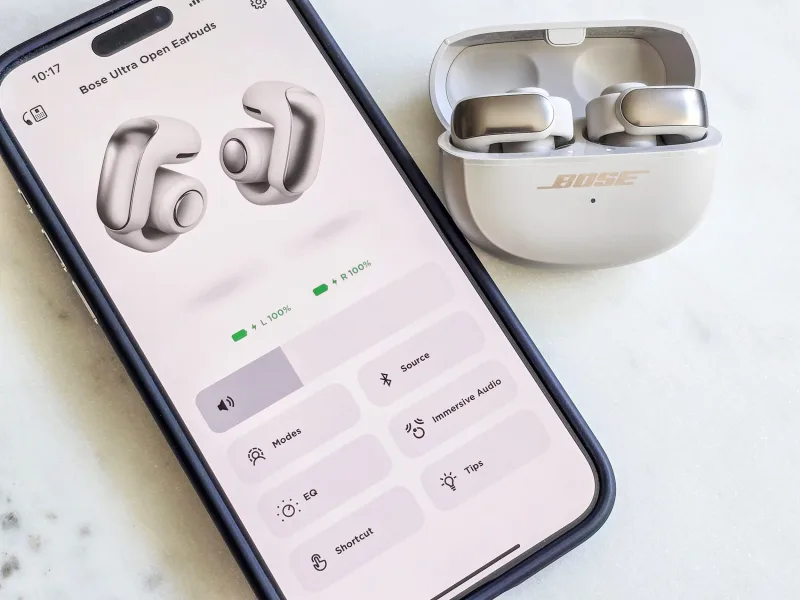
Bose Ultra Open Earbuds are the most minimalist in ecosystem ambition: the product pitch is «use it and forget it,» supported by a simpler companion experience and a hardware-led approach (their cuff-shaped open-ear design is a core differentiator). They do include modern connectivity building blocks like Bluetooth 5.3 and aptX Adaptive (spec table), but the software side is intentionally less about deep EQ/profile experimentation and more about stable, low-friction operation. Practically, Bose also leans on straightforward, physical workflows—e.g., turning on by opening the case and resyncing by placing both earbuds back in the case—consistent with a simplicity-first UX.
Conclusion (Samsung vs Bose): If you want a feature-rich, integrated «smart» earbud experience, Samsung Galaxy Buds 3 Pro are clearly stronger than Bose on ecosystem depth; Bose’s advantage is the lowest-complexity approach, not the most advanced one.
Conclusion (Soundcore vs Bose): If app features and tuning control matter, Soundcore Liberty 4 Pro are the clear pick over Bose; Bose’s «win» is that you’re less dependent on app configuration to get started and keep going.
Winner: Tie — Samsung Galaxy Buds 3 Pro lead on seamless ecosystem UX (especially on Galaxy) and high-res ecosystem codecs, Soundcore Liberty 4 Pro lead on app customization and broad Android-friendly tuning workflows, and Bose Ultra Open Earbuds lead on simplicity with fewer software knobs. The best choice depends on whether you prioritize ecosystem integration, customization, or low-friction simplicity.
Reliability & quirks
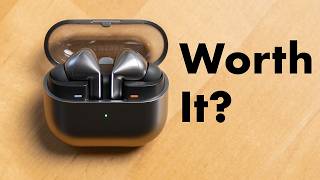
Samsung Galaxy Buds 3 Pro have the most concrete reliability red flags in the provided sources: multiple reviewers report charging issues (earbuds not charging), plus random disconnects and audio cut-outs across several mentions (occurrence_count 6). On top of that, Samsung’s manual notes ear tips must be attached before wearing, which can add a small «gotcha» during tip swaps or maintenance.
Soundcore Liberty 4 Pro also has known connectivity friction, but the difference is that Soundcore treats it as a documented, solvable class of problems: the manufacturer explicitly acknowledges disconnecting/sound interruptions and publishes step-by-step fixes, including changing settings like turning off «Dual Connections» and a repeatable reset flow (earbuds in the case, hold the voice bar). That combination of official troubleshooting plus a clear reset path generally reduces downtime when issues appear.
Conclusion: On pure «how often do issues get surfaced,» Samsung looks riskier here, while Soundcore handles real-world quirks more defensibly thanks to clearer manufacturer-level mitigation steps—so Soundcore has the edge on reliability/quirk management.
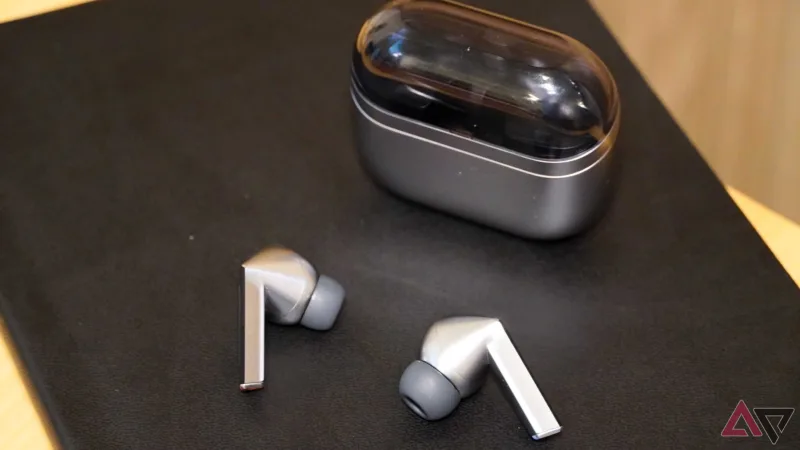
Samsung Galaxy Buds 3 Pro lean into a more mode-rich «system» experience (manual lists Ambient, Adaptive, and Active noise cancelling modes), but that sophistication doesn’t offset the more serious reports around charging and stability. Bluetooth is 5.4, yet the user-reported issues in the SoT set suggest the newest version number alone isn’t a guarantee of fewer interruptions.
Bose Ultra Open Earbuds avoid ANC complexity entirely (spec shows no ANC) and focus on straightforward day-to-day operation, including a simple resync method (put both earbuds in the case) and a status light for charge state. The trade-off is that Bose reliability «quirks» skew toward fit/position sensitivity—Bose explicitly warns that correct positioning affects audio and mic performance—so consistency can depend more on user placement than on software toggles.
Conclusion: Bose is less about bugs and more about biomechanics (getting the cuff-style placement right), while Samsung’s issues are more «traditional TWS failure modes» (charging/disconnects). That makes Bose the calmer pick if you accept open-ear constraints, but it doesn’t beat Soundcore’s combination of in-ear stability focus and documented fixes.
Winner: Soundcore Liberty 4 Pro
The Bottom Line
After breaking down noise control, sound, comfort, battery, durability, apps, and real-world quirks, the choice comes down to whether you want maximum isolation, maximum value, or maximum awareness.
Best everyday earbuds for most people: The Samsung Galaxy Buds 3 Pro are the most balanced pick thanks to their three-mode noise control, strong IP57 rating, and the smoothest experience for Galaxy users.
Best value + longest battery: The Soundcore Liberty 4 Pro win on sheer endurance (up to 40 hours with the case), standout fast charging, and the deepest app-driven EQ and tuning.
Best for outdoor awareness and no in-ear pressure: The Bose Ultra Open Earbuds are the right call if open-ear situational awareness is the whole point, and you want long-wear comfort without sealing the ear canal.
Best for workouts in rain/sweat-heavy use: The Samsung Galaxy Buds 3 Pro are the safest bet on paper with IP57 protection for harsher conditions.
Best for Android codec flexibility: Tie — pick Soundcore Liberty 4 Pro for LDAC on a wide range of Android phones, or Bose Ultra Open Earbuds if aptX Adaptive and open-ear listening fit your use case.
Overall,
for being the most universally capable mix of ANC performance, durability, and (especially on Galaxy) ecosystem polish—while acknowledging the trade-off that Soundcore Liberty 4 Pro clearly lead on battery and customization, and Bose Ultra Open Earbuds do open-ear comfort and awareness better than either in-ear option.If you’re buying with your «most days» routine in mind, go Samsung; if you want the most features per dollar and the least charging anxiety, go Soundcore; and if you want to hear the world by design, Bose is the only one here built for that.
FAQ
Which has the best noise cancelling: Galaxy Buds 3 Pro, Liberty 4 Pro, or Bose Ultra Open?
Which earbuds have the longest battery life?
Are Bose Ultra Open Earbuds good for the gym?
Which is best if I have a Samsung Galaxy phone?
Which is better for sound customization and EQ?
What’s the biggest reason to choose Bose Ultra Open Earbuds?
Which earbuds are the most durable for workouts and rain?
Do Galaxy Buds 3 Pro have reliability issues?
New Draft 2026-03-25 01:21
- Track daily health with a smart ring → Oura Ring 4 vs Samsung Galaxy Ring: Best Smart Ring?
- Fitness monitoring and smartphone integration → Apple Watch Series 10 vs Samsung Galaxy Watch 6
- Optimize training and recovery → WHOOP 5.0 vs Oura Ring 4: Best for Recovery & Training?
- Decide between smart glasses for multimedia or display → Ray-Ban Meta vs RayNeo 4 Pro: Capture or Personal Screen?
"Images are used for editorial and informational purposes only. All trademarks and images belong to their respective owners."