GoPro MISSION 1 PRO vs Insta360 Ace Pro 2: Which Films Better?
TL;DR
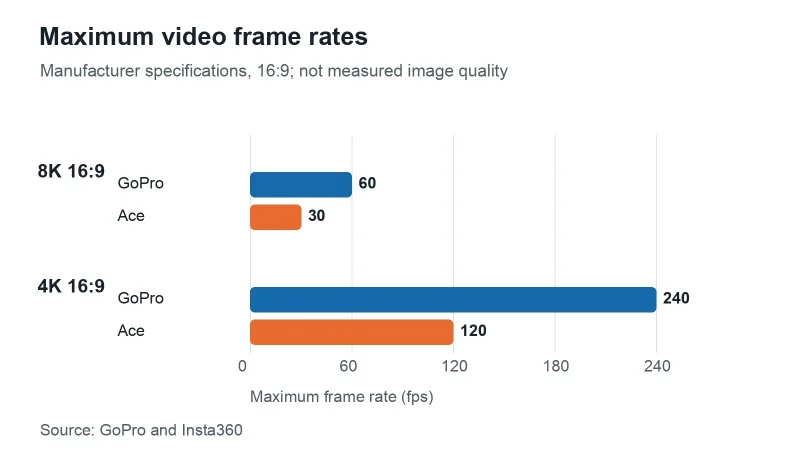
The fixed-lens GoPro MISSION 1 PRO is the pick for natural daylight color and high-resolution slow motion. It records up to 60 frames per second at 8K and 240 at 4K, giving you room to slow down fast action and keep the resolution.
The Insta360 Ace Pro 2 makes more sense for filming yourself. Its touchscreen flips forward and it focuses closer. The Jaunting Ape also preferred its rendering of colored neon. At US storefront prices on November 20, 2026, the setups with the same memory card cost $739.98 for the GoPro and $349.98 for the Ace, a $390 gap. Existing GoPro subscribers pay $100 less, which narrows it to $290. The GoPro kit has one battery and the Ace bundle two.
| Specification | GoPro MISSION 1 PRO | Insta360 Ace Pro 2 |
|---|---|---|
| Sensor | 1 in | 1/1.3 in |
| 8K video (16:9) | Up to 60 fps | Up to 30 fps |
| 4K video (16:9) | Up to 240 fps | Up to 120 fps |
| Night video mode | Low Light | PureVideo |
| Log profile | GP-Log2 | I-Log up to 4K60 |
| Waterproof depth without a housing | 20 m (66 ft) | 12 m (39 ft) |
| Battery capacity | 2,150 mAh | 1,800 mAh |
| Rear touchscreen | Fixed 2.59 in OLED | Flip-up 2.5 in |
| Memory card | microSD V30 or U3 | microSD UHS-I V30 or faster, up to 1 TB |
| Mount | Folding fingers, 1/4-20 thread, compatible magnetic latch | Quick Release |
| Setup price with memory card | $739.98; $639.98 for existing GoPro subscribers | $349.98 |
The video figures are mode maximums. Setup prices include the same $39.99 card, one battery with the GoPro and two with the Ace, before tax and shipping in the US on November 20, 2026.
📑 Table of Contents
- GoPro keeps daylight footage looking natural
- Ace handles colored neon well, and other night scenes go both ways
- GoPro shoots faster, with heat limits on long takes
- GoPro looked steadier in VIDEOAKTIV's cycling test
- GoPro goes deeper, and voice quality depends on where you stand
- Ace lets you frame a selfie from in front
- The Ace bundle starts with two batteries
- Final Verdict
- FAQ
GoPro keeps daylight footage looking natural
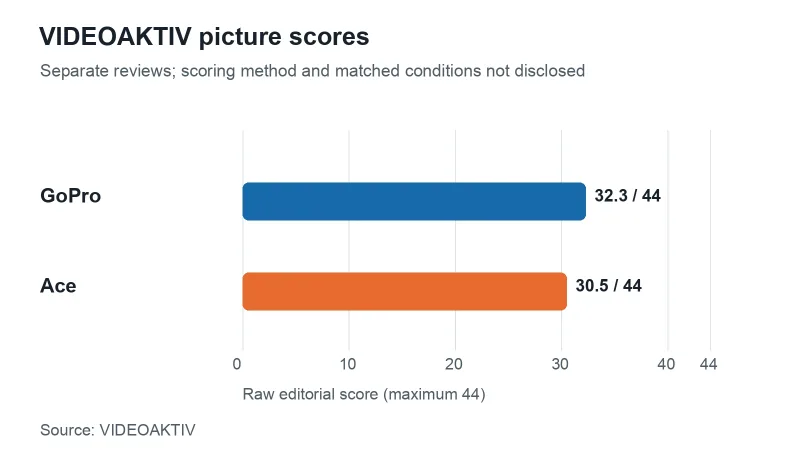
Sunlit rides bring out the GoPro's strengths. In VIDEOAKTIV's cycling comparison, Jonas Schupp and Joachim Sauer preferred its color, dynamic range and control of glare. The Ace's Flat profile looked less natural to them and needed more work in editing. They liked its I-Log footage, with the catch that I-Log tops out at 4K60. In its separate reviews, the magazine gave the GoPro 32.3 out of 44 for picture quality and the Ace 30.5. The overall scores were 81.7 and 79.2 out of 100, respectively.
The GoPro can still leave a face too dark. Shervin preferred its skin tones in a blind comparison (03:26), but the GoPro exposed for the sky in a backlit selfie. He also preferred the GoPro's greenery, while the two cameras looked close at the waterfall.
Ray Maker preferred the GoPro's 8K footage. In his upgrade advice for Ace Pro 2 owners (26:12), he said to expect little day-to-day change unless you need a new feature. If you already have the Ace, the GoPro's faster modes give you a reason to switch if you'll use them.
Ace handles colored neon well, and other night scenes go both ways
In The Jaunting Ape's neon test (01:36), the reviewer preferred the Ace's colors and saw the GoPro duplicate an LED strip. He liked the GoPro's white and yellow results more, though, and preferred it at 8K up to about ISO 800. At 4K30 and a 1/60-second shutter, he said the GoPro's image started to deteriorate at ISO 1600 and showed visible noise at ISO 3200.
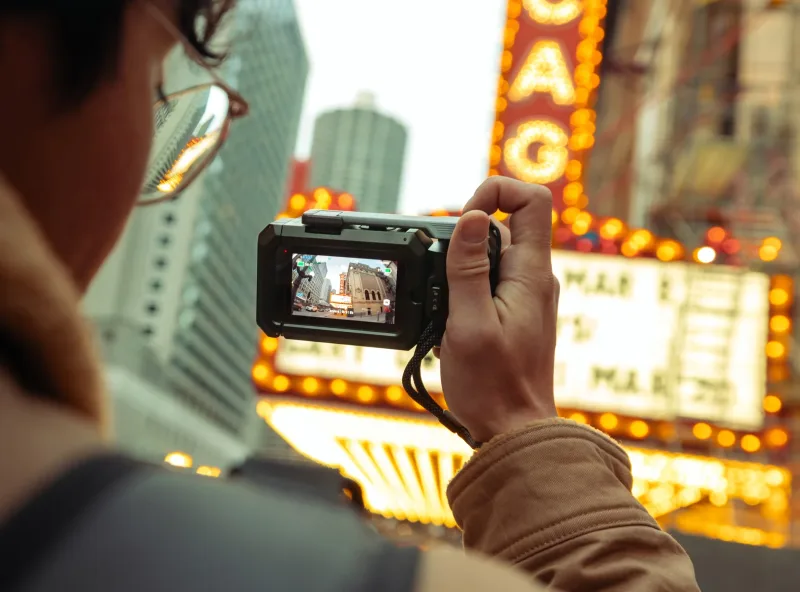
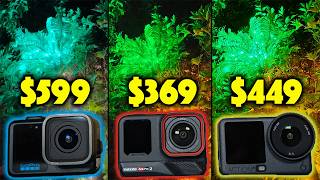
Turn on Low Light or PureVideo and a nearly dark trail can look brighter than it does to your eyes. The Jaunting Ape saw that effect with both cameras. VIDEOAKTIV saw both modes trade away detail for brightness, with the GoPro sometimes yellow and the Ace sometimes magenta. In his GoPro review, Sauer saw a blue tint instead and preferred the Ace's night mode. In standard footage, the magazine saw the Ace lose more fine detail at ISO 800 and put its working limit at ISO 1600, versus ISO 3200 for the GoPro.
Ray Maker found the cameras roughly even at night. The lead changed by scene, and the GoPro still gave him usable footage after sunset.
GoPro shoots faster, with heat limits on long takes
On a 30 fps timeline, a one-second jump plays back over eight seconds at GoPro's 4K240 and four at the Ace's 4K120. At 1080p, PetaPixel's Jordan Drake found that the GoPro's 960 fps mode ran in 10-second bursts with a drop in quality.
The GoPro offers GP-Log2 for grading and HLG HDR as a separate option. Drake liked the 4K GP-Log2 footage for avoiding the oversharpened look he expects from action cameras, but saw a loss of dynamic range at 8K. WIRED's Scott Gilbertson preferred the GoPro's manually graded footage and found its 8K files large. In his action camera roundup, he saw digital artifacts in fast-moving 8K footage from the Ace.
GoPro rates the series for up to 90 minutes at 8K30. With the battery door shut at room temperature, Drake's MISSION 1 PRO stopped after 51 minutes 3 seconds in that mode. It stopped at 47 minutes 13 seconds at 4K120 and 12 minutes 6 seconds at 4K240. For a long continuous take, 4K24 ran over two hours without a warning in Drake's test and about three hours for Gilbertson.
The GoPro heated up faster without airflow in Ray Maker's test at roughly 80°F. At maximum resolution and bitrate with the screens and assists on, Sauer's GoPro shut down after 23 minutes with 68% charge left. After 15 minutes to cool, it ran another 14½ minutes and stopped at 43%. With cooling breaks, he got close to an hour of footage and about five hours of intermittent use. His new GoPro batteries also lost more than 30% of their charge in a week. FlytPath used the GoPro for a week without it overheating.
The Ace is rated for about three hours at 1080p24 and 77°F with Endurance Mode on and Active HDR off. That mode disables voice and gesture control. GoPro rates the series for up to five hours at 1080p30 in Endurance mode, with reduced stabilization and noise reduction.
GoPro looked steadier in VIDEOAKTIV's cycling test
Both cameras steadied the bike footage at their standard stabilization settings. The reviewers saw slightly more bounce from the Ace. In very low light, WIRED saw points of light jitter when the GoPro's stabilization was on.
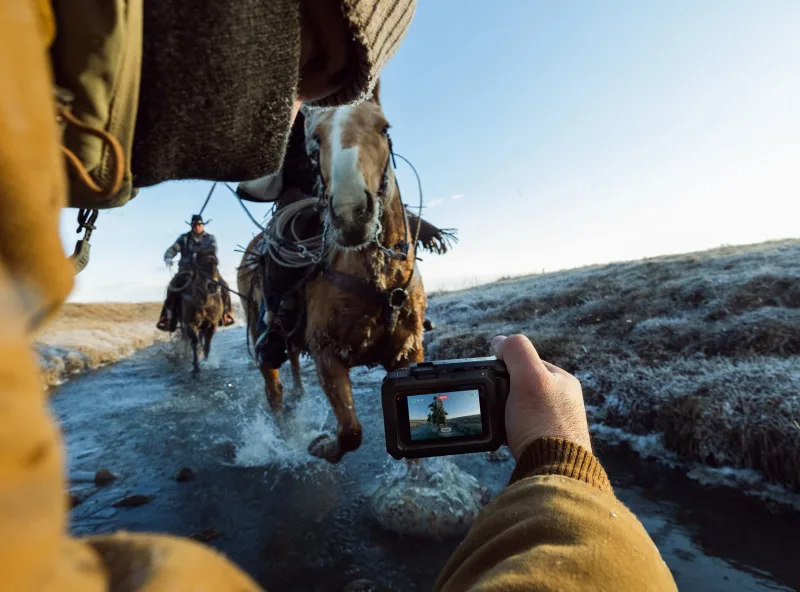
GoPro's HyperSmooth handles shake. Its separate 360° Horizon Lock keeps the frame level in Linear mode at supported rates and is unavailable at 8K60 and 4K240. The Ace applies FlowState stabilization in Video mode and supports automatic 360° Horizon Lock in-camera at supported settings. With FreeFrame, you can apply FlowState and Horizon Lock in the app or Studio after recording. On the GoPro, choose a lower, supported frame rate when keeping the horizon level matters more than slowing down the action.
GoPro goes deeper, and voice quality depends on where you stand
With the doors closed, the GoPro can go to 66 feet (20 m) without a housing, compared with 39 feet (12 m) for the Ace. Both are rated to 60 m with their dedicated dive housings, and Insta360 recommends its case for prolonged underwater use. Shervin preferred GoPro's rendition of skin and sand underwater, but the GoPro made green water look whitish and showed bubbles less distinctly. On the Ace, bubbles showed up and skin took on a green tint.
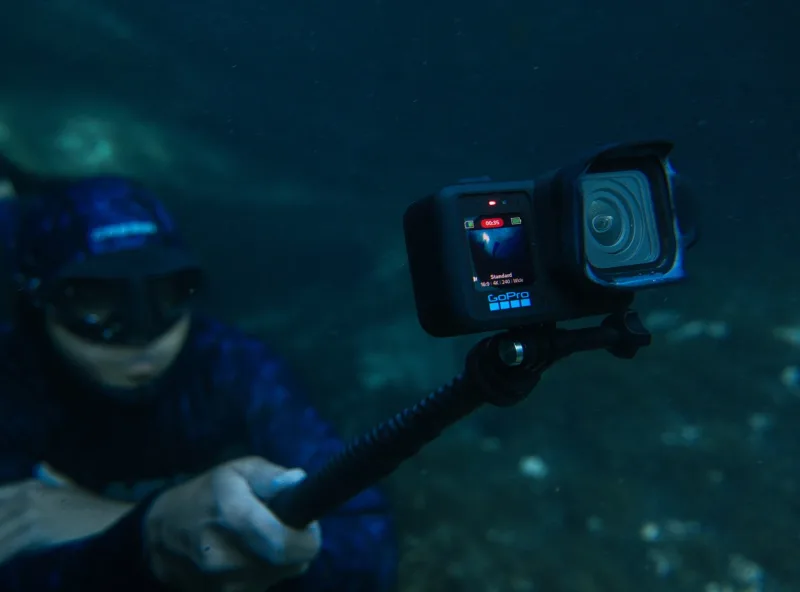
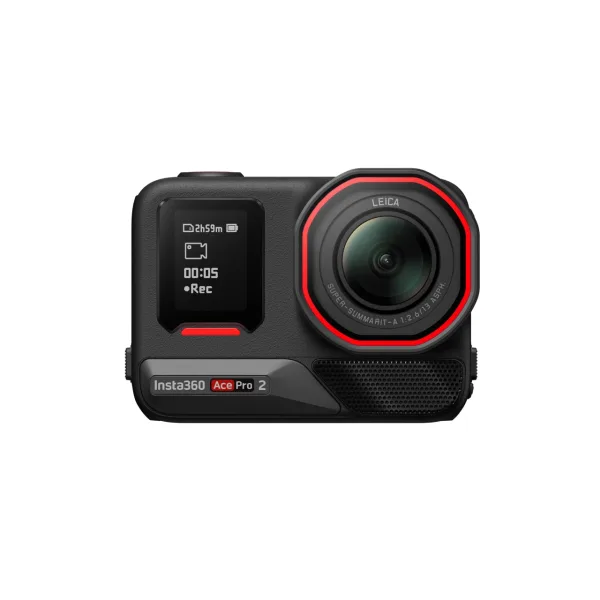
For narration, think about which way the lens points. VIDEOAKTIV heard the GoPro pick up voices behind the camera better and preferred the Ace for speech from in front, giving both 5.5 out of 7 for audio in its reviews. Shervin was unimpressed by either camera on a windy shore. TechRadar's Hamish Hector liked the GoPro's voice pickup and handling of wind, while PetaPixel found its built-in audio fell short for speech. The GoPro can save a separate 32-bit float audio file in RAW Audio mode. Both cameras accept external mics. A wired mic requires opening a door on the GoPro or removing the USB cover on the Ace. Keep those ports shut for a swim.
Ace lets you frame a selfie from in front
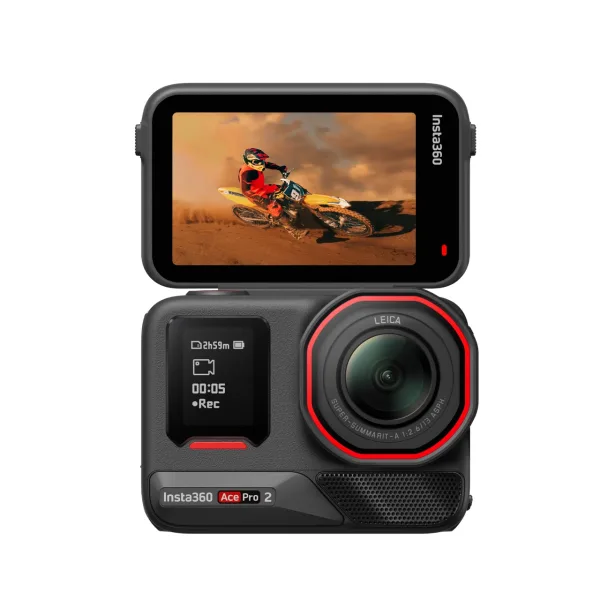
The Ace's 2.5-inch touchscreen flips up to face you. The GoPro has a separate, non-touch front display, and Digital Camera World found its lens can hide part of that display at certain angles. Insta360 gives the Ace a minimum focus distance of about 15 inches. GoPro recommends keeping subjects about 24 inches away or farther. Shervin saw blur up close on both cameras, especially the GoPro. PetaPixel found some GoPro helmet selfies too soft to use, and WIRED noticed the GoPro's bulk on a helmet. GoPro gives its weight as 207 grams, and Insta360 puts the Ace at about 182 to 184 grams depending on the version.
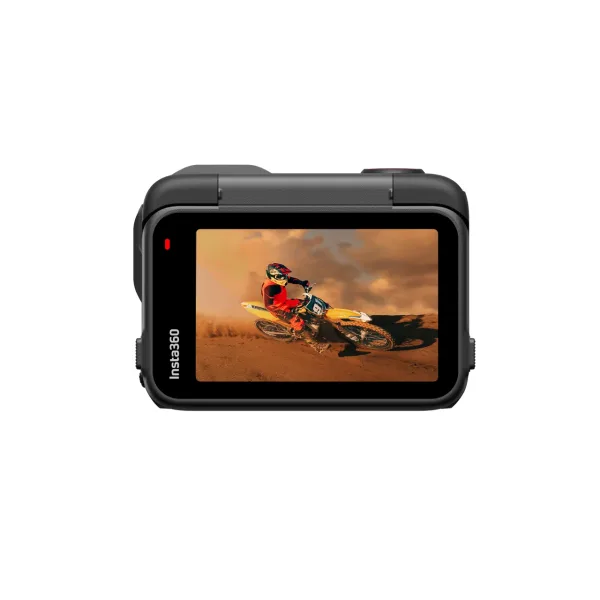
FlytPath (03:30) explains how GoPro's 4:3 Open Gate and the Ace's FreeFrame leave room to cut horizontal and vertical versions of the same shot. Open Gate uses the GoPro's full sensor at up to 8K30 and is off by default. The GoPro also records 4:3 video at up to 120 fps in 4K.
VIDEOAKTIV preferred the GoPro's buttons and menus and found the Insta360 app more capable than Quik. In the magazine's ratings, the Ace scored 22.5 out of 26 for handling, against 20.5 for the GoPro. The equipment scores were close, at 20.4 out of 23 for GoPro and 20.7 for the Ace.
The Ace requires app activation. The GoPro needs a firmware update before first use, which you can do through Quik or manually. Ray Maker's GoPro display went blank once and came back after a restart.
The Ace bundle starts with two batteries
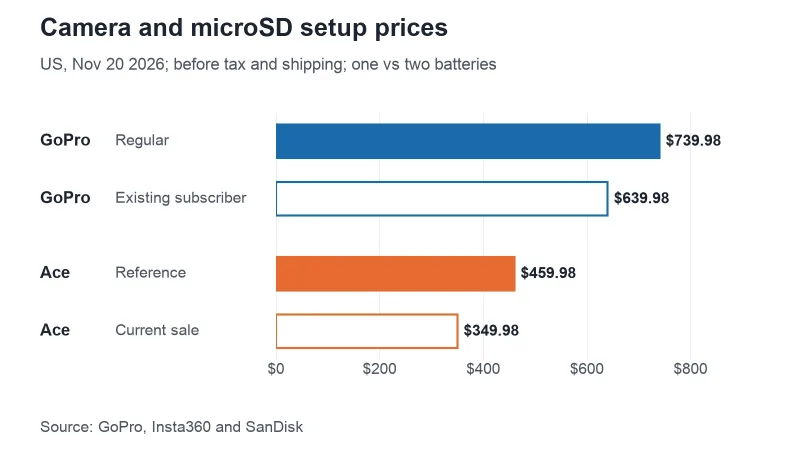
On November 20, 2026, GoPro's US storefront sold the camera kit with one battery for $699.99. Yearly GoPro subscribers get $100 off when their subscription renews, so they pay $599.99. Insta360's US storefront showed $309.99 for the Ace Dual Battery Standard Bundle, down from $419.99, and Amazon had the same bundle at $309.99. With the same compatible $39.99 SanDisk Extreme 64 GB microSD card, the setups come to $739.98 for the GoPro, $639.98 for an existing GoPro subscriber and $349.98 for the Ace, before tax and shipping.
Cloud storage is optional for both. GoPro Premium costs $59.99 a year and includes unlimited backup of GoPro footage plus 100 GB for other content; Premium+ costs $99.99. Insta360+ starts at $22.99 a year for 200 GB, with 1 TB at $70.99 and 2 TB at $94.99.
Final Verdict
The GoPro MISSION 1 PRO is the choice for natural-looking daylight footage and high-resolution slow motion, while the Insta360 Ace Pro 2 fits solo vlogging at a substantially lower setup cost.
- Fast action and color grading. GoPro MISSION 1 PRO, for 4K240 and the GP-Log2 footage reviewers liked working with.
- Solo vlogging and colored neon. Insta360 Ace Pro 2, for the screen that faces you and the colors The Jaunting Ape preferred under neon signs.
- Diving without a housing. GoPro MISSION 1 PRO, when you need to go deeper than 39 feet (12 m) within its 66-foot (20 m) limit, with the doors closed.
Skip the GoPro if you mainly film at arm's length and want to see and tap the screen from in front.
Skip the Ace Pro 2 if you need 4K240 for slow motion or 8K60 for moving subjects.