Roborock RockNeo Q110H vs Segway Navimow i215 LiDAR: Which Fits Your Yard?
TL;DR
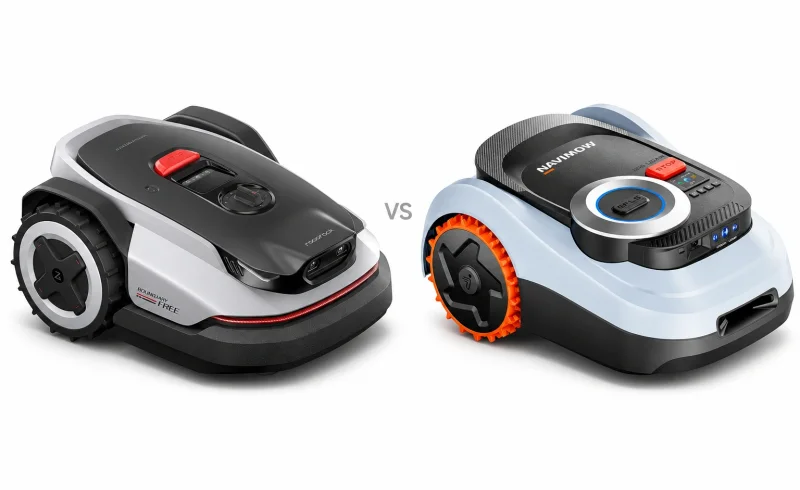
The Segway Navimow i215 LiDAR maps the yard with a laser sensor and a camera, so it needs no antenna and no view of the sky. The Roborock RockNeo Q110H steers by satellite RTK and is rated for a quarter acre, against 0.37 acre for the i215. The i215 lists at $1,599, $300 more than the Q110H at $1,299, and November sales have widened that gap.
- Trees, a covered deck or houses close around the lawn: the i215, which held its position under heavy shade through a 10-month test.
- A flat, open lawn up to a quarter acre with a working antenna or network RTK signal: the Q110H, which handled The Verge's flat front yard with trees.
- Heavy roots and steep slopes: Navimow's all-wheel-drive i210 AWD, rated for the same 45% slopes and a quarter acre, and guided by satellite.
| Feature | Roborock RockNeo Q110H | Segway Navimow i215 LiDAR |
|---|---|---|
| List price | $1,299 | $1,599 |
| Navigation | Full-band RTK + VSLAM | LiDAR + vision |
| RTK antenna | Optional, network RTK where covered | Not used |
| Obstacle detection | 2 cameras | LiDAR + camera |
| Drive | Rear-wheel, front casters | Rear-wheel, front casters |
| Max slope | 45% (24°) | 45% (24°) in a zone, 25% at the boundary |
| Recommended lawn size | 1/4 acre | 0.37 acre |
| Rated runtime per charge | 130 min | About 160 min |
| Recharge time | 75 min | About 130 min |
| 4G | $129.99 module | Built in, first year of Connect+ included, then $32.90 a year |
| Anti-theft | PIN, alarm, GPS tracking with 4G module | PIN, lift alarm, geofence, Apple Find My |
| Weight | 27.1 lb | 32.41 lb |
| Weather rating | IPX6 | IP66 |
| Warranty | 2 years | 3 years, battery 2 years |
The i215's runtime rating assumes standard speed, 77°F and freshly cut grass; its 45% slope rating assumes dry, 2-inch grass with no obstacles.
📑 Table of Contents
- The i215 navigates without a sky view, while the Q110H needs satellite coverage
- Both are two-wheel-drive mowers that slip on steep, rough ground
- Both dodge large objects, but only the i215 can switch its camera off inside a zone
- The i215 lets you redraw boundaries on a phone, while the Q110H has to drive them
- Navimow rates the i215 for 0.37 acre, Roborock the Q110H for a quarter
- The i215 comes with 4G theft tracking built in
- The Q110H is the cheaper buy, and sales have widened the gap
- Final Verdict
- FAQ
The i215 navigates without a sky view, while the Q110H needs satellite coverage
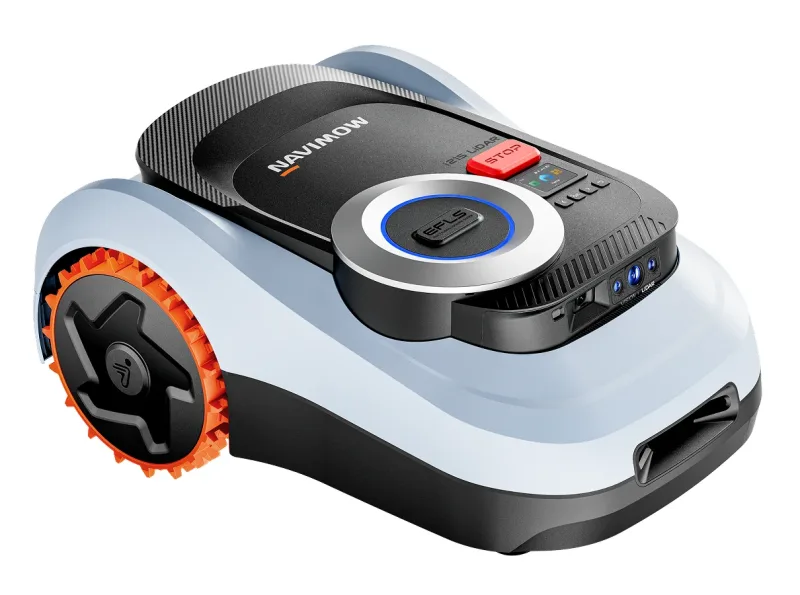
The Q110H finds its place by satellite: full-band RTK backed by VSLAM camera mapping, through either its RTK antenna or Roborock's antenna-free network RTK where the service covers your area. The i215 LiDAR maps the yard with a front LiDAR sensor and a camera, so it needs neither an antenna nor a clear view of the sky.
Gizmodo's Wes Davis, who briefly used Navimow's $1,600 LiDAR mower alongside the Q110H, ran the Q110H for a week on front and back yards totaling about 1/20 acre, with the antenna squeezed between two two-story houses. Twice the antenna couldn't get a signal, the map drifted, the mower flattened a tall plant inside a no-go zone, and he had to rerun mows after it skipped whole sections. Near the end, an update added network RTK, and after a map recalibration the Q110H mowed normally. For yards with heavy tree cover or tall buildings nearby, he points buyers elsewhere, because "the Q110H needs good satellite exposure." The Verge's Jennifer Pattison Tuohy, who named it her budget pick, found it impressive on her flat front yard with trees.
The i215's longest test ran under heavy shade. Wirecutter's Grant Clauser found that it works like a robot vacuum and doesn't need a view of the sky to see GPS satellites. In Pest and Lawn Ginja's 10-month review, the i215 kept its position under trees and a covered deck (04:31) where satellite mowers tested on the same property lost theirs; it needed rescuing three times, all at one patch of sunken ground. LiDAR has its own failure mode: on The Hook Up's side yard, the i215 wandered into the neighbor's lawn, which the reviewer blames on a reflection off a PVC fence. Deleting that zone and remapping fixed it.
Both are two-wheel-drive mowers that slip on steep, rough ground
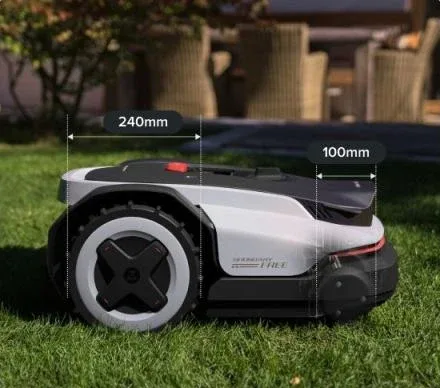
Both are rated for 45% (24-degree) slopes and drive only their rear wheels, with casters up front. Navimow limits the i215 to 25% (14 degrees) along a zone boundary, and Navimow confirmed to PCWorld's Michael Ansaldo that the i215 has no dedicated cliff sensor, so a boundary near a drop-off needs a margin.
The i215's results on rough ground run both ways. Wirecutter's i215 crossed large exposed roots that stopped bigger, pricier mowers, though it tumbled off a curb once. Tom's Guide's Mike Prospero saw the i215 spin its wheels and tear grass on the steeper parts of his hillside lawn, and it drove off a retaining wall. Pest and Lawn Ginja's i215 climbed and descended slopes of about 24 degrees and worked a 15-degree patch for 10 months without slipping or rutting.
The Q110H has less time on rough ground. A large tree root occasionally halted it on The Verge's lawn. In Gizmodo's yard, its small front wheels dug ruts on uneven pavers, and it needed rescuing several times from a sandy pit near the dock; the Navimow LiDAR mower crossed the same pavers and pit. On a front slope well beyond its 24-degree rating, the Q110H slid on the way down and churned up dirt climbing back.
For steep, wet slopes, Nater Tater's i210 AWD, which drives its front wheel too, climbed through mud where his two-wheel-drive mowers couldn't.
Both dodge large objects, but only the i215 can switch its camera off inside a zone
The Q110H watches its path with two cameras; the i215 LiDAR pairs its LiDAR with a camera. Navimow claims recognition of more than 200 object types; Pest and Lawn Ginja's i215 avoided things about 2 inches tall or 3 inches wide, a threshold that improved with firmware updates over the months.
Gizmodo's Q110H regularly went around plants, pets and stray items. With a foot placed in its path, it mostly stopped and detoured, but it bumped the leg once and drove over the foot another time, and the reviewer wouldn't run it with small pets or children nearby. The Verge rated its camera detection better than that of Navimow's i100N from the year before.
The i215 avoided every obstacle Wirecutter put in its way and everything on The Hook Up's course of a branch, a palm frond and a sprinkler hose, though it also treated mulch beds as obstacles and skirted them. Tom's Guide saw it go around a small soccer ball and a toy but run over a baseball-size ball, and the app doesn't mark where it met an obstruction.
Pavers and hanging plants can confuse a mower's camera. The Q110H lets you turn camera detection off in the passages between zones but not inside a mowing zone, which Gizmodo missed. The i215's app adds VisionFence-off zones for those spots.
The i215 lets you redraw boundaries on a phone, while the Q110H has to drive them
Setup took Gizmodo about 45 minutes, and the setup flow sent him straight to installing the RTK antenna. The Q110H runs auto-mapping only on simple yards; on his sectioned yard it didn't offer it, so he drove the boundary by hand with on-screen controls. The Q110H moves a boundary only when you drive the mower to the new line. He still found parts of Roborock's app layout slightly more intuitive than Navimow's.
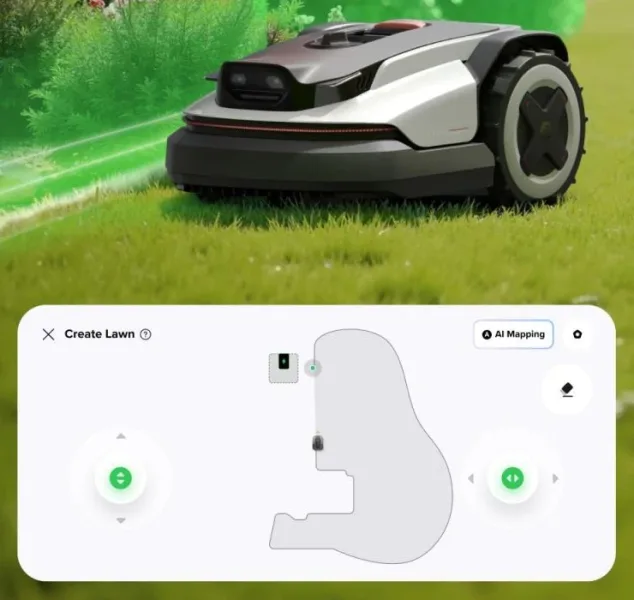
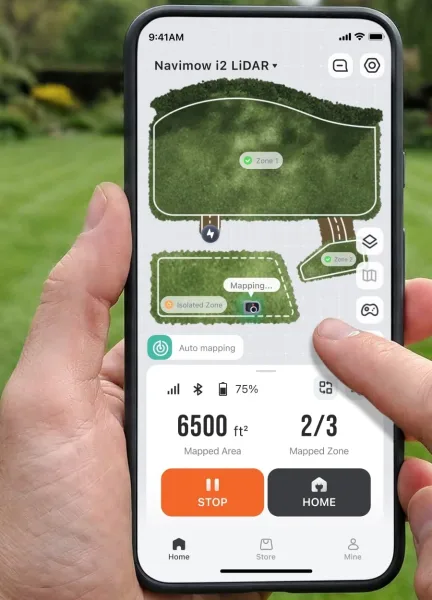
PCWorld waited through two firmware updates, about 20 minutes, and even auto-mapping needed a little joystick driving to get the mower onto the grass; afterward, the app edits boundaries, no-go zones and channels between zones on the phone. Tom's Guide had to trim the auto-drawn map after the mower kept nosing off one corner. In his setup chapter, Greg Phillips calls the i215 one of the easiest robot mowers he has set up (04:17).
Navimow rates the i215 for 0.37 acre, Roborock the Q110H for a quarter
Roborock rates the Q110H for a quarter acre and 130 minutes per charge, with a 75-minute recharge. Navimow rates the i215 LiDAR for 0.37 acre and about 160 minutes per charge, with a recharge of about 130 minutes; on The Hook Up's 0.1-acre lawn of Bermuda and St. Augustine grass, it mowed for 3 hours 25 minutes and finished 92% before docking, and took 5 hours 51 minutes overall with a 2-hour recharge. The reviewer scored its cut 8 out of 10. Gizmodo's Q110H used 60 to 70% of its battery on about 1/20 acre and missed small patches on most runs.
Gizmodo says the Q110H leaves edges to a trimmer, and Roborock offers an optional edge module. Pest and Lawn Ginja's i215 left 2 inches or less along the fence, about 10 minutes with a string trimmer every two weeks.
The i215 comes with 4G theft tracking built in
The i215 LiDAR has 4G, a PIN lock, a lift alarm, a geofence alarm you can set from 33 to 164 feet, and Apple Find My. Its Connect+ plan carries the cellular link: remote monitoring away from Wi-Fi, plus the lift and geofence alarms with live location. Mowing and schedules run over Wi-Fi and Bluetooth without it, the PIN lock works without it, and Find My pairs through Apple's Find My app. The Q110H comes with a PIN and an alarm, and Roborock's optional 4G module adds GPS theft tracking.
The Q110H has an onboard rain sensor and can wait out wet grass. It is rated IPX6; the i215's IP66, for mower and dock, adds dust protection, and PCWorld notes it handles rain and hose spray. The i215 takes its weather from the internet, and Wirecutter found that data not always accurate.
The Q110H is the cheaper buy, and sales have widened the gap
At list, the Q110H is $1,299 and the i215 LiDAR $1,599. On November 23, 2026, Amazon sold the Q110H for $649.99 and Navimow sold the i215 for $1,329, which widened the gap from $300 to $679.
For 4G theft tracking, the Q110H needs Roborock's $129.99 module. The i215 has 4G built in, and PCWorld reports that Connect+ is included for the first year and costs $32.90 a year after that. Navimow covers the i215 for three years and its battery for two; the Q110H carries a two-year warranty.
On a small, open lawn with good satellite coverage, the Q110H covers the job. Gizmodo would pull it out of the dirt now and again to save $300, and PCWorld says a flat, open rectangle of grass may not need the i215. The Q110H reached the US in June 2026, so it has no long-term track record yet; Pest and Lawn Ginja rates the i215 one of the most dependable mowers the channel has tested.
Final Verdict
The i215 LiDAR is the pick when trees or nearby houses block the sky or the lawn tops a quarter acre; its extra cost buys navigation without satellites, boundary edits on the phone, room for 0.37 acre and a three-year warranty against two years for the Q110H.
- Heavy shade or houses close around the lawn: i215 LiDAR, which needs no sky view.
- A flat, open lawn up to a quarter acre with RTK coverage: Q110H, for $300 less at list.
- Heavy roots or steep, wet slopes: Navimow's i210 AWD, which drives its front wheel too.
- Skip the Q110H if your lawn sits under trees or between tall buildings.
- Skip the i215 LiDAR if your lawn is a flat, open patch under a quarter acre.