
PETLIBRO Granary with Camera vs. PETKIT Fresh Element Solo: A Monitoring-First Feeder or a Simpler Dispenser?
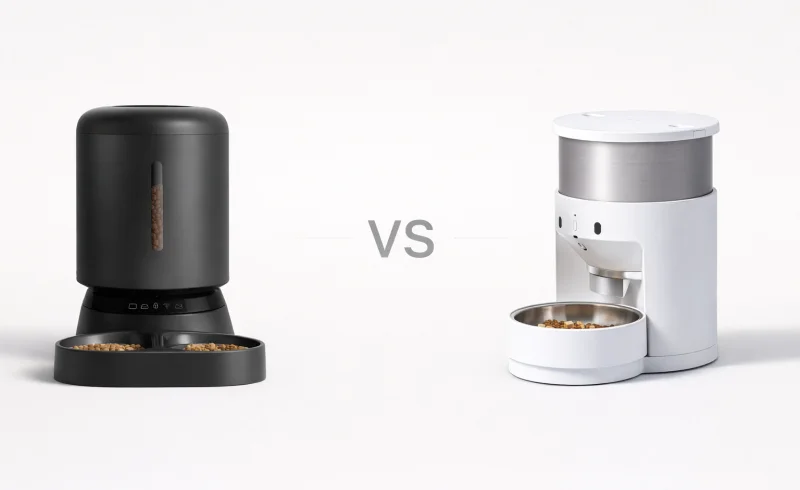
Compare PETLIBRO Granary Automatic Cat Feeder with Camera vs PETKIT Fresh Element Solo Smart Pet Feeder on monitoring, portioning, freshness, anti-jam reliability, capacity, connectivity, and value (pricing current as of January 31, 2026).
TL;DR
Quick Decision
- If you want remote visual check-ins, night monitoring, and two-way audio for peace of mind → choose the PETLIBRO Granary with Camera.
- If you care most about hopper freshness, preventing jams, and a straightforward «set-and-forget» routine without video complexity → choose the PETKIT Fresh Element Solo.
- If you simply need reliable, multi-meal scheduling for one cat → either feeder handles the basics well.
Key Differentiators This is a choice between a connected monitor and a dedicated food dispenser. The PETLIBRO’s 1080p camera, night vision, and two-way audio create a unique remote check-in experience, but that capability brings video storage considerations. The PETKIT excels at its core job, with a documented focus on sealing and an anti-jam impeller for a simpler, more appliance-like reliability. Both require you to calibrate portion sizes for your specific kibble.
Who Should NOT Buy Either If you primarily need to feed wet food or require true, scale-accurate gram measurements for a strict medical diet, you should look at specialized feeders instead.
| Feature | PETKIT Fresh Element Solo Smart Pet Feeder | PETLIBRO Granary Automatic Cat Feeder with Camera |
|---|---|---|
| Power | ||
| Backup battery support | Supported (AAA batteries) | Supported (D batteries) |
| Capacity | ||
| Food hopper capacity | 3L | 5L |
| Connectivity | ||
| Wi-Fi connectivity | 2.4GHz Wi-Fi | 2.4GHz and 5GHz Wi-Fi |
| Food Compatibility | ||
| Supported kibble size | ≤12 mm | 2–15 mm |
| Camera & Monitoring | ||
| Built-in camera | No camera | 1080p camera |
| Feeding & Scheduling | ||
| Scheduled meals per day | 1–10 meals | Up to 10 meals |
📑 Table of Contents
Camera & Remote Check-Ins
Built-in camera (and what you can actually see)
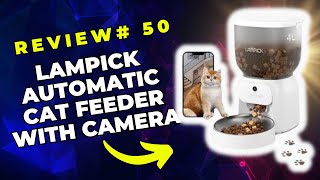
PETLIBRO Granary Automatic Cat Feeder with Camera has a built-in 1080p HD camera with a 145° wide-angle lens plus infrared night vision, so you can visually confirm whether your cat approached the bowl—even in the dark. This is a fundamentally different capability than «feeding logs,» because it provides direct verification rather than inference.
PETKIT Fresh Element Solo Smart Pet Feeder is a non-camera feeder (no camera spec listed), so «remote check-ins» rely on app status and scheduling rather than live video. If your main goal is simply to dispense on a schedule, the absence of video can also mean fewer monitoring features to manage.
Conclusion: For true remote visibility—especially night check-ins—PETLIBRO clearly wins because it’s the only one with a 1080p/145° camera + IR night vision.
Two-way interaction and monitoring-style alerts
PETLIBRO Granary Automatic Cat Feeder with Camera adds two-way audio, extending check-ins from «watching» to «interacting» (you can speak and listen). It also mentions app-side notifications around operation status (e.g., food level and errors), reinforcing a monitoring-first approach beyond basic dispensing.
PETKIT Fresh Element Solo Smart Pet Feeder focuses on app control for feeding rather than interaction—there’s no two-way audio spec, and without a camera there’s no video-based monitoring layer. It still supports programmable schedules and portion control via the PETKIT app, but that’s different from being able to actively check behavior at the bowl.
Conclusion: If you want remote interaction and a more surveillance-style check-in loop, PETLIBRO has the edge thanks to two-way audio and camera-centric monitoring.
The «hidden variable»: video storage and long-term UX
PETLIBRO Granary Automatic Cat Feeder with Camera is the more capable monitoring device, but camera features can come with practical overhead: PETLIBRO’s product ecosystem includes cloud video plan positioning as well as SD-card-only usage. That means the long-term experience can depend on whether you’re willing to manage local storage or pay for cloud features (which can materially change the value of «remote check-ins»).
PETKIT Fresh Element Solo Smart Pet Feeder avoids this entire complexity because there’s no video to store, upload, or manage. In practice, that can be a benefit for owners who want the feeder to stay «set-and-forget» and don’t want ongoing decisions about video retention.
Conclusion: PETLIBRO offers more, but PETKIT can be simpler specifically because it eliminates camera storage/subscription considerations; the better choice depends on whether monitoring is a must-have or a distraction.
Winner: PETLIBRO Granary Automatic Cat Feeder with Camera
Freshness & Anti-Jam Reliability
Freshness: hopper sealing and keeping kibble from going stale
PETLIBRO Granary Automatic Cat Feeder with Camera advertises a «quadruple sealed» system and pairs it with app-side operational notifications (including low food and food jam alerts) so you can react if something compromises feeding. Its larger 5L hopper can reduce refill frequency, but more stored food also means freshness depends heavily on how well that sealing performs over time.
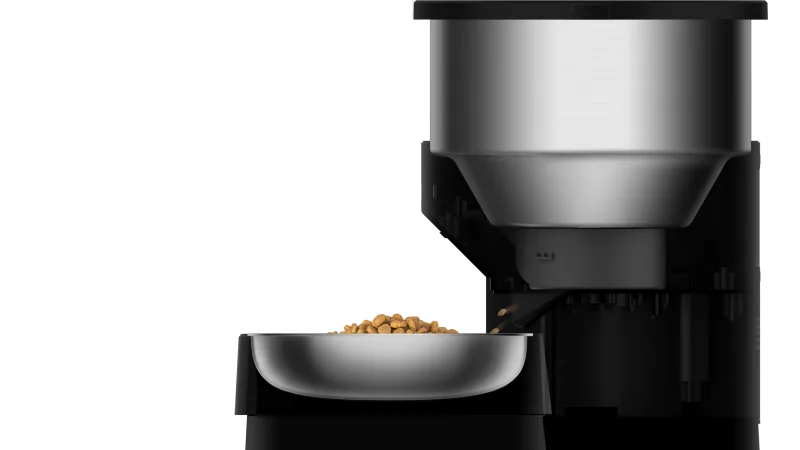
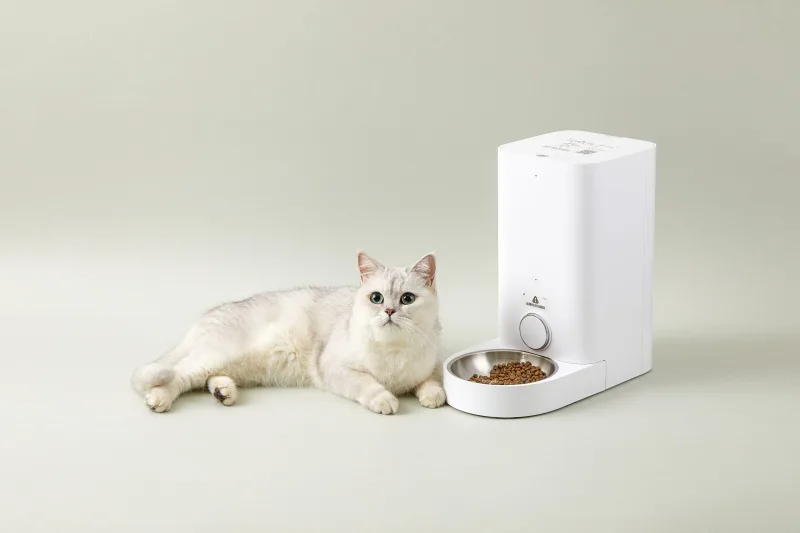
PETKIT Fresh Element Solo Smart Pet Feeder, by contrast, is explicitly positioned around freshness hardware: a Duo-Lock sealing approach and desiccant included to reduce moisture exposure in the hopper. Its capacity is 3L (12 cups), so you’ll typically cycle through food faster than a 5L hopper, which can also help keep kibble «newer» in real use.
Conclusion: PETKIT has the clearer freshness advantage because it documents freshness-focused components (Duo-Lock + desiccant), while PETLIBRO’s freshness story is more general («quadruple sealed») and leans on alerts rather than explicit moisture-control accessories.
Anti-jam: preventing clogs vs detecting problems when they happen
PETLIBRO Granary Automatic Cat Feeder with Camera supports kibble sizes of 2–15 mm, which is a relatively wide stated range and can help avoid jams with larger pieces. It also leans into a «notify and respond» model: the app can surface food jam alerts, and reviewers note stable dispensing and a hard-to-break-into build—useful for reliability, but not the same as a documented anti-jam mechanism.
PETKIT Fresh Element Solo Smart Pet Feeder lists kibble support below 12 mm and markets an improved impeller plus a wider outlet specifically to reduce blockages. That’s a direct «prevent jams at the mechanism» posture, although portioning is still volumetric rather than gravimetric—some users note it doesn’t dispense by grams and instead uses fixed volume per motor turn (complain about translating portions to real-world amounts).
Conclusion: PETKIT has the stronger anti-jam case on paper because it emphasizes impeller/outlet design to prevent clogs, while PETLIBRO is better described as detecting jams (alerts) and accommodating slightly larger kibble (15 mm vs <12 mm).
Winner: PETKIT Fresh Element Solo Smart Pet Feeder
Portion Control & Scheduling

Scheduling flexibility (meals per day)
PETLIBRO Granary Automatic Cat Feeder with Camera supports app control and scheduling up to 10 meals per day. That ceiling is straightforward and matches what most households need for split meals, snacks, or timed routines. In practice, it’s a «set it and forget it» schedule framework, with the camera acting as an optional verification layer (seeing that the feeding happened).
PETKIT Fresh Element Solo Smart Pet Feeder also supports app control and scheduling up to 10 meals per day. Retailer/manufacturer documentation consistently positions it as a programmable daily dispenser, so you’re not giving up baseline smart-feeder scheduling. The included how-to ecosystem also emphasizes schedule adjustment in-app (see @06:11 in the video).
Conclusion: On scheduling range, this is a true parity point (10/day vs 10/day)—neither feeder has a defensible advantage on maximum daily feedings.
Portion definition and practical accuracy
PETLIBRO Granary Automatic Cat Feeder with Camera uses a volume-based system: 1–50 portions per meal, with each portion sized at ~20 ml. That makes it flexible for scaling meals up/down, but it also means owners often have to translate «ml portions» into diet targets (grams/calories) for their specific kibble. Editorially, the main risk is not under/over-dispensing—it’s the extra calibration effort required to make «portion counts» map to a vet-recommended gram target.
PETKIT Fresh Element Solo Smart Pet Feeder is commonly described in listings as dispensing up to 50 g per dispense, which sounds more diet-friendly on paper. However, some users note it does not truly weigh what it dispenses and instead measures by a fixed-volume mechanism per motor action—so «grams» should be treated as guidance rather than a guarantee. The practical implication is similar to PETLIBRO: you’ll want to validate how many «units» equals your pet’s real-world serving size with your specific food.
Conclusion: Neither is truly «gram-accurate» based on the provided evidence, but they communicate portions differently: PETLIBRO is explicitly ml/portion (20 ml), while PETKIT is often marketed in grams (up to 50 g) yet may still behave like volumetric dispensing. Advantage PETKIT for more intuitive gram-oriented framing (when it matches your workflow), advantage PETLIBRO for being clearer about what its «portion» actually represents.
A practical calibration tip (applies to both)
PETLIBRO Granary Automatic Cat Feeder with Camera: Because 1 portion ≈ 20 ml, a quick setup step is to dispense, say, 5–10 portions into a measuring cup (ml) and/or onto a kitchen scale (grams), then record the result as your baseline for that kibble. This helps convert your target grams/day into a repeatable «portions per meal» schedule.
PETKIT Fresh Element Solo Smart Pet Feeder: Since portions may be mechanism-based rather than weighed, do a similar test: trigger a manual dispense and weigh the output, then adjust the in-app portion setting until it matches your desired serving size. Re-check if you switch to a different kibble shape/density, because volume-to-grams conversion changes with food type.
Conclusion: Calibration is equally important on both, and it’s the best way to avoid false expectations—especially if you’re aiming for strict diet control.
Winner: Tie — Both feeders match on scheduling (up to 10 meals/day), and both benefit from real-world calibration for portion accuracy; the better pick depends on whether you prefer PETLIBRO’s explicit 20 ml «portion» model or PETKIT’s more gram-oriented (but not necessarily weighed) guidance.
Capacity & Kibble Compatibility
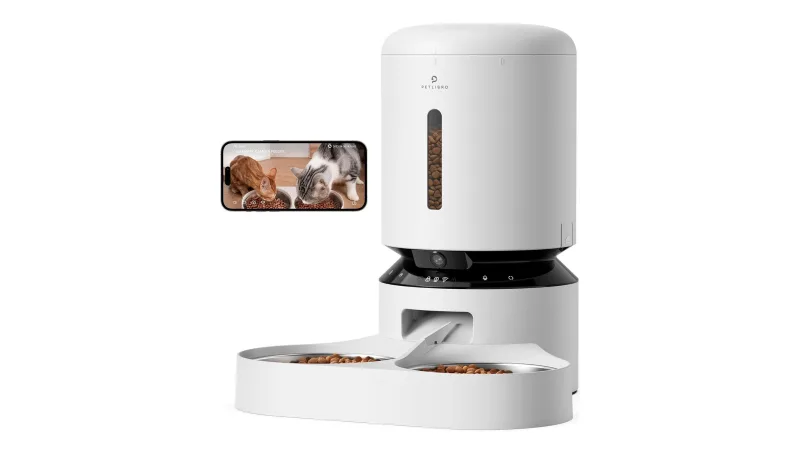
PETLIBRO Granary Automatic Cat Feeder with Camera ships with a 5 L hopper, which is meaningfully larger than most compact single-pet feeders. PETLIBRO also states it can handle kibble sizes from 2–15 mm, giving it more headroom for chunkier dry-food shapes. In practice, that wider size window can matter because larger or irregular kibble is more likely to stress the chute/impeller in any auto-feeder.
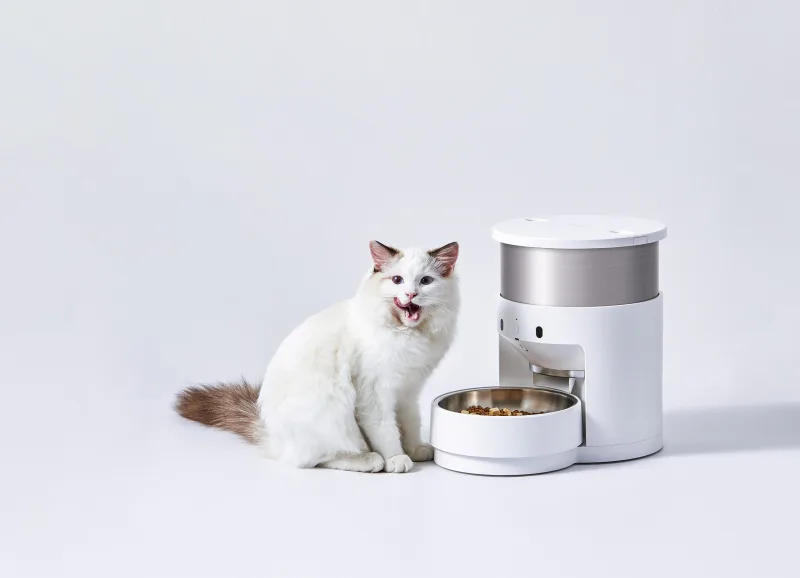
PETKIT Fresh Element Solo Smart Pet Feeder is a smaller-capacity design at 3 L / 12 cups (manufacturer-listed), which generally means more frequent refills if you’re feeding a larger cat, multiple pets, or larger daily rations. PETKIT’s manual limits kibble to < 12 mm, a narrower ceiling than PETLIBRO’s 15 mm max. PETKIT is also positioned to work with dry and some freeze-dried formats (within size constraints), which can be useful if you rotate in freeze-dried pieces rather than feeding only standard kibble.
Conclusion: On pure «how long can it run before a refill» and «how tolerant is it to larger kibble,» PETLIBRO’s 5 L capacity and 2–15 mm kibble spec beat PETKIT’s 3 L / <12 mm limits. The main trade-off is format flexibility: PETKIT has the edge if you specifically want limited freeze-dried compatibility, while PETLIBRO is clearly optimized for dry kibble.
Winner: PETLIBRO Granary Automatic Cat Feeder with Camera
Connectivity & App Experience

Network compatibility (Wi‑Fi bands) and pairing flexibility
PETLIBRO Granary Automatic Cat Feeder with Camera is explicitly positioned for modern home networks with Wi‑Fi support on both 2.4 GHz and 5 GHz. It also documents multiple onboarding/recovery paths—Bluetooth, QR code, and hotspot connection methods are referenced in PETLIBRO support materials—useful when the camera live view or standard pairing flow is finicky.
PETKIT Fresh Element Solo Smart Pet Feeder primarily targets the simpler end of the spectrum: it runs over Wi‑Fi on 2.4 GHz networks (as documented in its materials). Listings also commonly note Wi‑Fi + Bluetooth, which can help with initial setup and short-range provisioning, but it won’t solve the core constraint if your router is 5 GHz-only or segregates SSIDs.
Conclusion: PETLIBRO has the connectivity edge because 2.4/5 GHz dual-band support plus alternative onboarding options reduce network-related setup friction in more households than PETKIT’s 2.4 GHz-only approach.
App experience: «remote monitoring» vs «simple control»
PETLIBRO Granary Automatic Cat Feeder with Camera builds its app experience around monitoring: a 1080p HD camera with 145° wide-angle and night vision, plus two-way audio, turns the app into a check-in tool, not just a scheduler. It also supports operational alerts (e.g., food level and error notifications are referenced by retailers), but the camera introduces an extra UX variable: video access may depend on cloud plans vs SD-card-only modes, which can affect long-term satisfaction.
PETKIT Fresh Element Solo Smart Pet Feeder keeps the app scope narrower—schedule programming and portion control are the focus, and documentation confirms scheduling/management via the PETKIT App. A key practical nuance is that, per user discussion, PETKIT portions are not true gram-based weighing; it dispenses by fixed volume per mechanism movement rather than measuring grams, which can surprise owners expecting weight-accurate feeding.
Conclusion: Neither is a universal winner on app experience—PETLIBRO is stronger if you want video-based remote check-ins, while PETKIT is better if you want a simpler, non-camera control app and you’re comfortable calibrating portions without true weighing.
Scheduling parity, different «portion» mental models
PETLIBRO Granary Automatic Cat Feeder with Camera supports scheduling up to 10 meals per day, and its portioning is explicitly 1–50 portions per meal with a 20 ml portion size (volume-based). That’s consistent and repeatable, but it can require a conversion step to match a vet-recommended gram target.
PETKIT Fresh Element Solo Smart Pet Feeder also schedules up to 10 meals per day, so timing flexibility is essentially matched. But its portioning can be framed more «diet-plan friendly» in some listings (e.g., described in grams), even though real-world reports indicate it still dispenses by volume rather than weighing—meaning you still need to validate output with your specific kibble.
Conclusion: Tie on scheduling (10/day vs 10/day), with a trade-off in portion UX: both can require calibration, but PETLIBRO is more transparently volume-defined (20 ml portions) while PETKIT can be misinterpreted as weight-precise.
Winner: PETLIBRO Granary Automatic Cat Feeder with Camera — it has a clear, defensible advantage in connectivity thanks to explicit 2.4/5 GHz Wi‑Fi support and documented alternative onboarding paths, which typically matter more day-to-day than PETKIT’s otherwise solid but 2.4 GHz-only approach.
Power Backup & Out-of-Box Readiness
PETLIBRO Granary Automatic Cat Feeder with Camera is designed around continuous operation: it runs on a 5V power supply and supports an outage fallback via 3× D batteries (backup batteries typically not included). That larger D-cell format generally signals a longer-runtimes approach than smaller cells, aligning with PETLIBRO positioning as «continuity-focused» for outages.
PETKIT Fresh Element Solo Smart Pet Feeder also supports backup power, but its requirements are more «bring-your-own-accessories»: power is DC 5V via a power adapter (not included) plus 5× AAA alkaline batteries (not included) for battery backup. In practical terms, that means you may need an extra shopping step before it’s truly «set and forget,» especially if you don’t already have a compatible 5V adapter on hand.
Conclusion: Both feeders can keep schedules running during short power interruptions, but PETLIBRO has the edge on backup-power readiness because its backup strategy is built around 3× D batteries alongside standard mains power, whereas PETKIT’s setup more commonly hinges on sourcing the correct 5V adapter (not included) plus 5× AAA backups.
What «ready on day one» looks like
PETLIBRO Granary Automatic Cat Feeder with Camera minimizes «gotchas» around power by offering a straightforward primary-power + backup-battery model—plug it in, then add 3× D cells for outage coverage. If you plan to rely on it during travel or storms, keeping fresh D batteries on hand is the main readiness task.
PETKIT Fresh Element Solo Smart Pet Feeder can be just as reliable day-to-day, but out-of-box readiness depends on having both (1) a compatible DC 5V power adapter (explicitly not included) and (2) 5× AAA batteries installed for backup. That’s not a deal-breaker—just a higher chance of «it arrived, but I can’t power it yet» if you don’t pre-check accessories.
Conclusion: For households prioritizing resilience with minimal prep, PETLIBRO is the cleaner plug-in + backup path, while PETKIT is best if you’re comfortable validating the 5V adapter requirement and stocking AAA batteries upfront.
Winner: PETLIBRO Granary Automatic Cat Feeder with Camera
The Bottom Line
After breaking down camera features, freshness hardware, scheduling, and day-to-day reliability, the decision comes down to what role you want the feeder to play in your routine.
You want to see your cat eat (day/night) and talk through the feeder: Choose the PETLIBRO Granary Automatic Cat Feeder with Camera because its 1080p wide-angle camera with IR night vision and two-way audio enables true remote check-ins, not just app status.
You just need reliable scheduled dry-food meals at the lowest cost: Pick the PETKIT Fresh Element Solo Smart Pet Feeder since it delivers the core scheduling experience without the monitoring layer, while leaning harder into freshness sealing and anti-jam design.
You need longer time between refills: The PETLIBRO Granary Automatic Cat Feeder with Camera is the better fit thanks to its larger 5L hopper, which typically reduces refill frequency versus PETKIT’s smaller capacity.
Your priority is freshness protections and easy-to-clean, hygienic contact surfaces: Go with the PETKIT Fresh Element Solo Smart Pet Feeder because its Duo-Lock + desiccant freshness approach (and the stainless bowl emphasis) aligns with a freshness/hygiene-first setup.
Overall, this matchup is a genuine split decision: PETLIBRO wins when you value monitoring (camera/night vision/two-way audio plus alerts, and stronger connectivity and backup-readiness), while PETKIT wins when you want a simpler dispenser-first experience with clearer freshness and anti-jam engineering—and no video/storage overhead.
Match your pick to your household’s reality: if «I want to verify and interact remotely» is the goal, go PETLIBRO; if «I want straightforward scheduled meals with less to manage» is the goal, go PETKIT—then choose the scenario above that best fits your routine and Wi‑Fi setup.
FAQ
Does PETLIBRO Granary with Camera support 5GHz Wi‑Fi?
Does PETKIT Fresh Element Solo work on 2.4GHz Wi‑Fi?
Can either feeder dispense wet food?
How many meals per day can they schedule?
Which one holds more food?
Are portions measured by weight (grams) or volume?
Which feeder is better for remote check-ins?
Which feeder has better anti-jam reliability?
📄 Used Manuals & Documentation
PETLIBRO Granary Automatic Cat Feeder with Camera
PETKIT Fresh Element Solo Smart Pet Feeder
"Images are used for editorial and informational purposes only. All trademarks and images belong to their respective owners."
Navigating the Smart Pet Device Landscape
- to improve pet hydration with a smart fountain → PETKIT Eversweet 3 Pro vs PETLIBRO Dockstream: Which Wins?
- a pet camera for interactive monitoring → Furbo 360 Dog Camera vs Petcube Bites 2 Lite
- self-cleaning litter boxes for odor control → FEELNEEDY vs OROLEY Self-Cleaning Litter Box Comparison
- a GPS tracker for extensive pet roaming → Tractive Smart vs Tractive XL: Best GPS Tracker for Your Dog?
- comparing pet GPS trackers for security and range → Petivity Smart GPS vs Fi Series 3: Best Dog GPS Tracker?
- a Bluetooth tracker for short-range monitoring → Tractive Smart vs Apple AirTag: Pet GPS vs Bluetooth Tracker
- evaluating pet camera vs baby monitor → Furbo 360 vs Nanit Pro: Pet Camera or Baby Monitor?
- UPFAS Little Box 500C vs Lohhuby CAST LB500B: Best Pick?