
FEELNEEDY vs OROLEY Self-Cleaning Litter Box: Enclosed Privacy or Open Throughput?
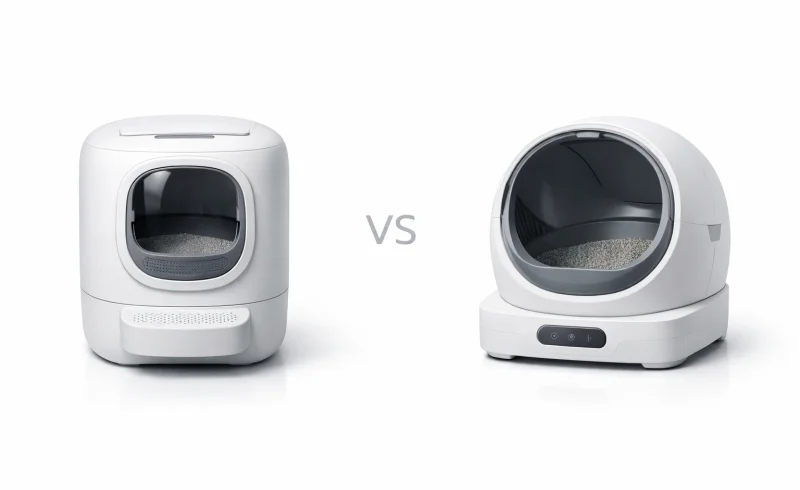
Compare FEELNEEDY vs OROLEY self-cleaning litter boxes on odor control, safety sensors, capacity, setup, daily use, and price to pick the right fit for your cat household.
TL;DR
Quick Decision
- If you have a single cat in a living area and want the unit to look less like a litter box → choose FEELNEEDY.
- If you have multiple or large cats and need maximum throughput and fast cat acceptance → choose OROLEY.
- If your primary concern is odor control and you don't mind a longer acclimation period, either can work, but the approach is fundamentally different.
Key Differentiators The core trade-off is between FEELNEEDY’s enclosed, «set-and-forget» design that hides mess and OROLEY’s open, sensor-heavy design built for busy homes. This dictates everything: FEELNEEDY is easier to blend into a room but harder to check on, while OROLEY gives instant cleanliness visibility but requires more floor-space management. OROLEY’s larger litter chamber and faster clean cycle cater to higher traffic, but its reliance on multiple sensors makes the app experience more central.
Who Should NOT Buy Either If you require deep smart-home integration (like Alexa routines or health tracking) or are shopping on a very tight budget, consider a more basic automated box or a traditional high-quality litter system instead.
| Feature | OROLEY Self-Cleaning Litter Box | FEELNEEDY Self-Cleaning Litter Box |
|---|---|---|
| Build | ||
| Material | Polypropylene (PP) | Acrylonitrile Butadiene Styrene (ABS) |
| Design | ||
| With Lid | No | Yes |
| Safety | ||
| Safety Sensors | 3 infrared sensors + 4 gravity sensors + 3 Hall effect sensors (pauses when cat enters) | Infrared sensor (trash bin port) + weight sensing (pauses when cat enters) |
| Capacity | ||
| Waste Bin Capacity | 9L | 11L |
| Litter Chamber Capacity | 96L | 65L |
| Physical | ||
| Item Weight | 17.7 Pounds | 12 Kilograms |
| Product Dimensions | 21.25"L x 19.68"W x 21.65"H | 53L x 50W x 66H centimetres |
| Smart Features | ||
| App Monitoring & Control | Supported | Supported |
📑 Table of Contents
Design & Cat Acceptance
Covered vs. open form factor (behavioral friction)
FEELNEEDY Self-Cleaning Litter Box uses a covered design (With Lid: Yes), which typically gives cats more privacy and reduces the «litter box on display» feeling in a main room. The trade-off is that enclosed boxes can be more sensitive to cat preferences—per the editor notes, some cats need a transition period, and door orientation/clearance can matter more during placement.
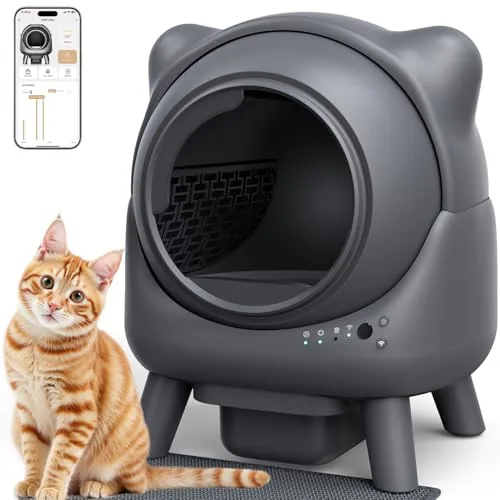
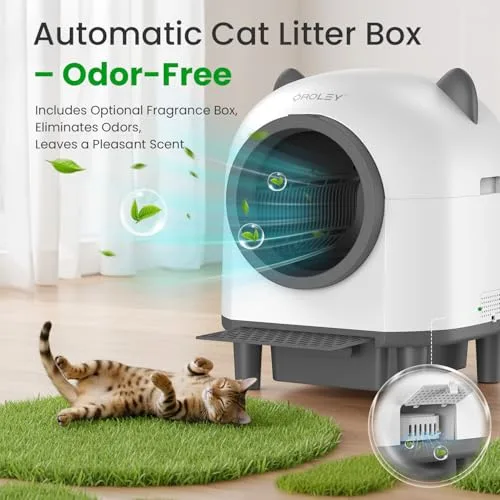
OROLEY Self-Cleaning Litter Box is open (With Lid: No), which makes it closer to a traditional tray and usually lowers the chance a cat refuses it at first. The same openness can increase surrounding mess management needs (e.g., litter scatter), and it tends to feel more visually present if placed in a living space.
Conclusion: For cat acceptance speed and lower behavioral friction, OROLEY has the edge because the open form factor is generally easier to introduce; FEELNEEDY wins on visual privacy, but that can come with a higher acclimation burden.
Size cues that affect who’s comfortable using it
FEELNEEDY Self-Cleaning Litter Box lists a 65L litter chamber capacity and measures 53L × 50W × 66H cm. That footprint can work well in smaller apartments where you want a contained unit, but the enclosed entry and interior «turning room» can be less forgiving for cats that dislike covered spaces (per editor notes) or for households that want instant, no-drama adoption.
OROLEY Self-Cleaning Litter Box has a larger 96L chamber and is rated suitable for cats up to 20 lb, with a footprint called out at 27.4 × 23.6 in in review sourcing. In practice, that bigger/open presentation can be more welcoming for larger cats and multi-cat throughput, though it asks for more surrounding floor planning (mat, scatter zone) because there’s no lid.
Conclusion: If you have larger cats or multi-cat traffic, OROLEY’s larger 96L/open design is the safer bet; FEELNEEDY’s 65L enclosed approach is more about keeping the box visually contained than maximizing «any cat, any size» comfort.
Placement sensitivity in real homes
FEELNEEDY Self-Cleaning Litter Box is typically better when you want the unit to blend into a living area and reduce the constant visual reminder of litter, aligning with the editor’s «small-apartment/odor containment + privacy» positioning. However, because it’s enclosed, placement tends to be more constrained—clearance and entry approach matter more, and owners lose quick at-a-glance confirmation of litter condition (editor notes).
OROLEY Self-Cleaning Litter Box is generally easier to place and introduce because the open top reduces «tunnel/doorway» friction and makes litter status obvious at a glance. The downside is that in a prominent room it can feel more intrusive visually, so it often fits better in utility-style locations where aesthetics are secondary.
Conclusion: FEELNEEDY fits living spaces better, while OROLEY fits high-traffic, utility placement better—but for most households prioritizing smoother first-week adoption, OROLEY remains the more forgiving design.
Winner: OROLEY Self-Cleaning Litter Box — the open, tray-like design plus larger 96L chamber is more consistently aligned with fast cat acceptance and multi-cat/large-cat comfort, even though FEELNEEDY can look cleaner and more private in a main room.
Safety Sensors & Fail-Safes
Sensor coverage and redundancy
FEELNEEDY Self-Cleaning Litter Box lists «Infrared sensor (trash bin port) + weight sensing (pauses when cat enters)» as its safety stack. In practice, that’s a simpler approach: weight sensing is the primary «don’t cycle while occupied» safeguard, and the IR sensor appears targeted to the waste/bin area rather than broad, multi-angle occupancy detection. The benefit is fewer layers to manage, but it also means fewer independent checks if a sensor drifts or a cat triggers edge-case behavior at the threshold.
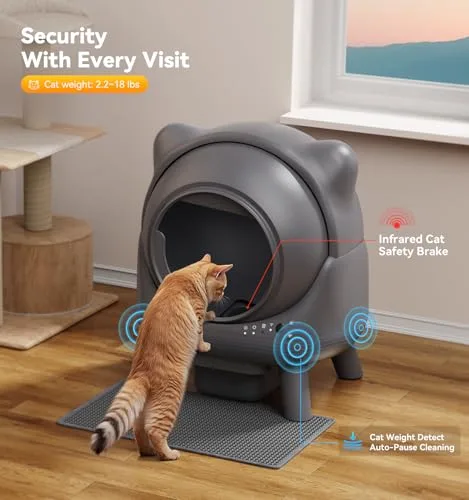
OROLEY Self-Cleaning Litter Box specifies a much more redundant system: 3 infrared sensors + 4 gravity sensors + 3 Hall effect sensors (pauses when cat enters). That combination suggests multiple ways to detect presence/position and confirm mechanism state, which is especially relevant in high-traffic homes where cats may re-enter quickly or linger near the entry. On paper, this is a «belt-and-suspenders» design intended to reduce false starts and improve confidence during automated cycles.
Conclusion: For raw safety engineering headroom, OROLEY has the clear advantage—its 10-sensor stack (3 IR + 4 gravity + 3 Hall) is materially more redundant than FEELNEEDY’s IR + weight sensing.
Real-world fail-safe confidence (what can still go wrong)
FEELNEEDY Self-Cleaning Litter Box emphasizes pausing via weight detection, which can be effective for preventing mid-use cycling when a cat is fully inside. The trade-off is that enclosed setups can be more placement- and behavior-sensitive (door orientation, acclimation), and owners may rely on the device to «just work» rather than actively monitoring settings—consistent with FEELNEEDY’s more conservative, set-and-forget positioning in the provided context.
OROLEY Self-Cleaning Litter Box’s multi-sensor approach should, in theory, improve handling of weird scenarios (partial entry, quick re-entry, higher usage frequency). However, isolated reports suggest a deformed bin door can cause OROLEY to error out during its cleaning cycle (Isolated reports suggest…). That doesn’t negate the stronger sensor spec, but it’s a reminder that mechanical tolerances can still undermine an otherwise safety-forward design.
Conclusion: OROLEY still edges this point because its redundancy is more robust for multi-cat throughput, but FEELNEEDY’s simpler «pause on weight» approach may appeal if you prioritize fewer complexity-driven variables over maximum sensing coverage.
Winner: OROLEY Self-Cleaning Litter Box
Capacity & Multi-Cat Throughput
Litter chamber capacity (how much «working volume» you get)
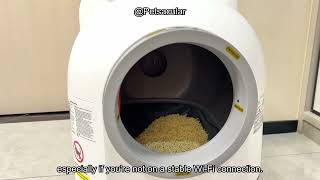
FEELNEEDY Self-Cleaning Litter Box is rated for a 65L litter chamber. In practice, that’s enough for typical single-cat routines, but the smaller chamber gives you less buffer for frequent back-to-back visits (a common pattern in multi-cat homes). This aligns with the editor guidance that FEELNEEDY fits single-cat/small-apartment setups where privacy and enclosure matter more than raw throughput.
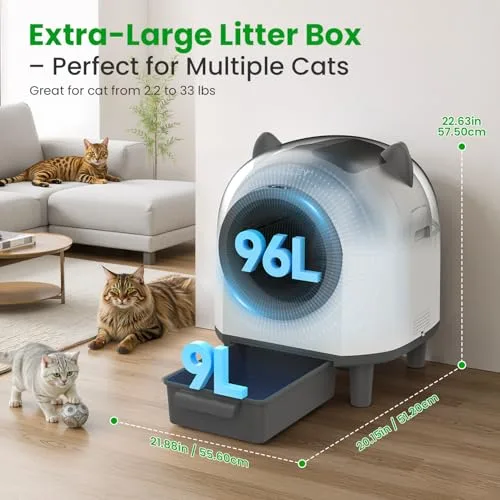
OROLEY Self-Cleaning Litter Box lists a 96L litter chamber, a substantial jump over 65L. It’s also explicitly positioned for heavier usage (and is noted as suitable for cats up to 20 lb in third-party coverage), which typically correlates with fewer «capacity pinch points» when multiple cats share one box. The editor guidance also flags OROLEY as the better match for multi-cat homes and larger cats where throughput matters.
Conclusion: For litter chamber capacity and multi-cat throughput, OROLEY has a clear advantage (96L vs 65L).
Waste bin capacity (how often you empty the drawer)
FEELNEEDY Self-Cleaning Litter Box counters with an 11L waste bin. All else equal, a larger drawer usually means less frequent emptying, which supports FEELNEEDY’s «set-and-forget» ownership style—especially helpful if you prefer minimal daily interaction once the unit is configured.
OROLEY Self-Cleaning Litter Box comes with a 9L waste bin. That smaller drawer can mean more frequent bag changes, particularly in high-traffic multi-cat households where clumps accumulate quickly, even if the main chamber is large.
Conclusion: On waste-drawer capacity alone, FEELNEEDY has the edge (11L vs 9L)—it may reduce emptying cadence compared with OROLEY.
Winner: OROLEY Self-Cleaning Litter Box — its much larger 96L chamber is the more meaningful differentiator for multi-cat throughput, even though FEELNEEDY’s 11L waste bin can be more convenient for emptying frequency.
Odor Control & Cleanliness
Odor containment approach (design vs «odor system»)
FEELNEEDY Self-Cleaning Litter Box leans on physical containment: it ships with a lid, which can reduce how much odor visually and physically «escapes» into a living space. That said, enclosed boxes have a known trade-off: if cleaning cycles or liner/waste management slip, the enclosure can trap humidity, which can make odor feel worse over time (because you’re effectively holding smells in). FEELNEEDY’s 65L chamber also suggests a more compact internal volume than OROLEY, which can make timely waste removal more important for odor control.
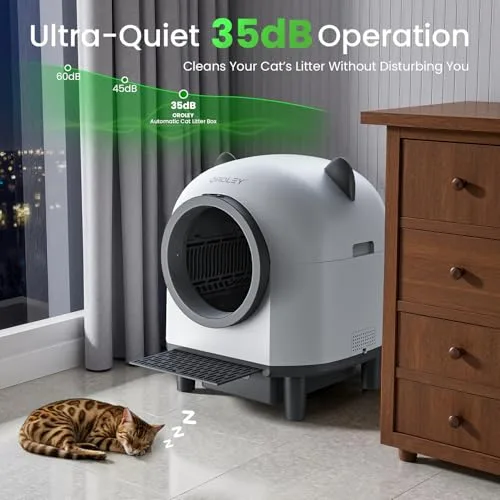
OROLEY Self-Cleaning Litter Box is lidless but explicitly markets a triple-layer odor defense system, and it’s positioned around keeping homes «cleaner and more odor-free.» Its larger 96L chamber can help reduce crowding and messy contact points in higher-traffic homes, but an open design generally means odor control depends more on litter quality and how consistently waste is isolated/emptied. In practice, you’re trading physical containment for more reliance on system design and cleaning cadence.
Conclusion: Neither has a universal odor-control advantage on specs alone—FEELNEEDY’s lid can be better for living-room placement and visual/odor containment, while OROLEY’s triple-layer odor defense is purpose-built for smell management despite being open.
Cleanliness in the surrounding area (scatter + «at-a-glance» checks)
FEELNEEDY Self-Cleaning Litter Box’s enclosed build generally reduces the «visual reminder» of litter and waste, which can make a space feel cleaner even when the unit is in a shared room. The downside is everyday cleanliness is harder to verify instantly—owners get less quick visual feedback on litter condition because the box is covered, and delayed upkeep in an enclosed space can compound odor/humidity issues. FEELNEEDY also runs its cleaning cycle within 2 minutes after the cat exits, which can leave waste exposed slightly longer between visits.
OROLEY Self-Cleaning Litter Box makes litter condition more visible at a glance because it’s open, which some owners prefer for confirming the box is actually staying clean between emptying the bin. The trade-off is surrounding-floor management: an open design tends to mean more visible litter scatter, making a mat or floor protection more important. OROLEY also claims a faster post-exit cycle—within 1 minute—which can help reduce the time waste sits before sifting (assuming the unit runs reliably).
Conclusion: FEELNEEDY has the edge for perceived tidiness in living spaces (enclosed/less visual clutter), while OROLEY has the edge for quick cleanliness checks and potentially faster waste isolation (1 minute vs 2 minutes).
Winner: Tie — FEELNEEDY’s lid can better contain mess and visual clutter, but OROLEY counters with an explicit triple-layer odor system, more «at-a-glance» cleanliness, and a faster (1 minute) cleaning trigger that can reduce how long waste sits exposed.
Cleaning Cycle Speed & Automation Style
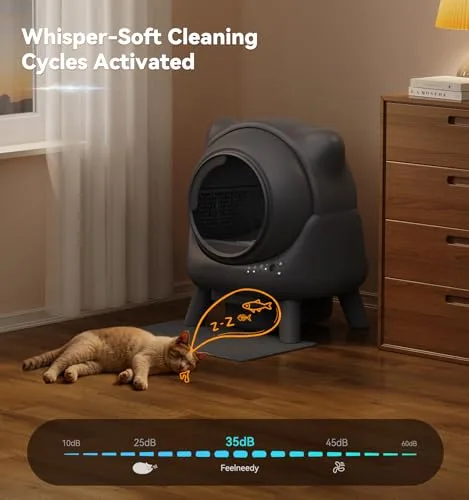
FEELNEEDY Self-Cleaning Litter Box starts its self-cleaning cycle within 2 minutes after a cat exits (manufacturer-stated). In practice, that timing pairs with its more conservative, «set-and-forget» rhythm: once placement and acclimation are handled, owners typically interact mainly for waste removal and occasional checks, rather than constantly tweaking settings.
OROLEY Self-Cleaning Litter Box is listed to trigger within 1 minute after exit (retailer-stated). That faster trigger matters most when traffic is high—e.g., in multi-cat homes—because it reduces the window where the next cat can walk into a just-used box, and it can keep the surface condition fresher between visits.
Conclusion: On pure cycle speed, OROLEY has the edge (1 minute vs 2 minutes), and that advantage is more meaningful when you’re managing frequent back-to-back usage.
FEELNEEDY Self-Cleaning Litter Box also leans toward a lower-touch ownership style: its enclosed, privacy-forward design can reduce the «need to look» during the day, but it also limits at-a-glance confirmation of litter condition. The trade-off is that if cleaning cadence or liner upkeep slips, enclosed designs can trap humidity and odor longer than you’d expect, which makes the «hands-off» approach work best when maintenance is kept consistent.
OROLEY Self-Cleaning Litter Box, with its open form factor, makes the litter state easier to monitor visually—owners can quickly see whether a cycle ran and whether litter needs topping up. The flip side of that transparency is that open designs tend to feel more «hands-on» day to day (more visible scatter and surrounding floor management), even if the raking/cleaning itself is automated.
Conclusion: FEELNEEDY wins for a low-interaction, blended-into-the-room routine, while OROLEY wins for faster turnaround and more visible, throughput-friendly operation—especially in busier households.
Winner: OROLEY Self-Cleaning Litter Box
App, Monitoring & Long-Term Support
FEELNEEDY Self-Cleaning Litter Box supports app monitoring & control (listed as «Supported»), but the product’s overall experience is typically «automation-first» rather than «app-first.» In practice, it’s positioned as more of a status/check-in companion to a fairly set routine, aligning with a stability-first mindset (fewer settings to manage day to day). FEELNEEDY also leans on simpler sensing—infrared sensor (trash bin port) + weight sensing—which can reduce software complexity but also limits how much telemetry the app can meaningfully surface.
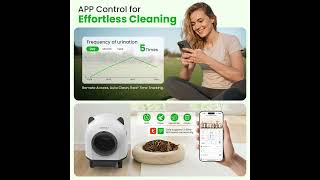
OROLEY Self-Cleaning Litter Box also supports app monitoring & control (also «Supported»), but its hardware stack implies a more monitoring-centric experience. The unit’s 3 infrared sensors + 4 gravity sensors + 3 Hall effect sensors put more emphasis on continuous state detection and safety interlocks, which generally makes app feedback feel more central—especially if you want reassurance that the box is paused appropriately when a cat re-enters. The trade-off is that long-term satisfaction depends more heavily on app/firmware stability because more of the product’s value comes from sensor-driven reporting and control.
Conclusion: Both offer the basics (app monitoring/control) and neither plugs into a broader smart-home ecosystem, but OROLEY has the clearer advantage for app-centered monitoring and transparency thanks to its much more sensor-forward design.
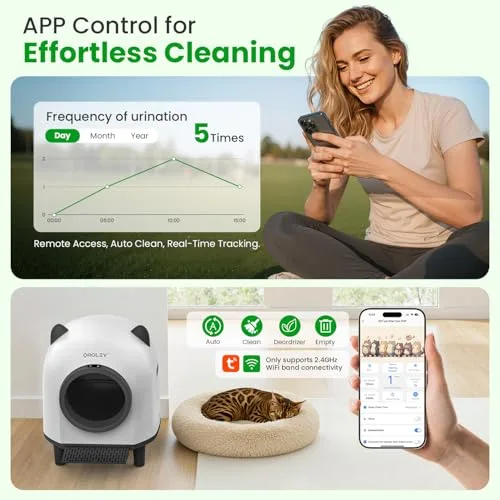
FEELNEEDY Self-Cleaning Litter Box is the better fit if you want the app to stay in the background and prefer fewer adjustable parameters over time. That pairs naturally with its «set-and-forget» operation (manufacturer states cleaning triggers within 2 minutes after a cat exits) where the app is largely there for basic control and peace-of-mind checks. Long-term, this «more static» software approach can mean fewer points of failure, but it also tends to offer less diagnostic depth if something seems off.
OROLEY Self-Cleaning Litter Box is more aligned with owners who expect to use the app actively—particularly in multi-cat homes—because the product’s safety/monitoring proposition is closely tied to its sensor redundancy. It also advertises a faster post-exit trigger (within 1 minute, per retailer listing), which can increase the perceived need to monitor cycles and interruptions in busy households. However, isolated reports suggest a deformed bin door can cause errors during the cleaning cycle (isolated reports suggest), which is exactly the kind of issue that can make app/firmware feedback feel «required» rather than optional.
Winner: OROLEY Self-Cleaning Litter Box
Footprint, Materials & Placement
FEELNEEDY Self-Cleaning Litter Box uses ABS (Acrylonitrile Butadiene Styrene) and is listed at 53L × 50W × 66H cm with an item weight of 12 kg. Because it’s a lidded/enclosed design («With Lid: Yes»), real-world placement tends to be more sensitive to clearance, airflow, and door orientation, and some cats may need an acclimation period to a covered box.
OROLEY Self-Cleaning Litter Box uses PP (Polypropylene) and is listed at 21.25"L × 19.68"W × 21.65"H with an item weight of 17.7 lb. It also provides clearer footprint guidance—27.4 × 23.6 inches—and is explicitly rated for cats up to 20 lb, which helps set expectations for larger breeds and multi-cat throughput.
Conclusion: On «how easy it is to size the space and predict fit,» OROLEY has the edge thanks to clearer footprint guidance and a stated large-cat limit.
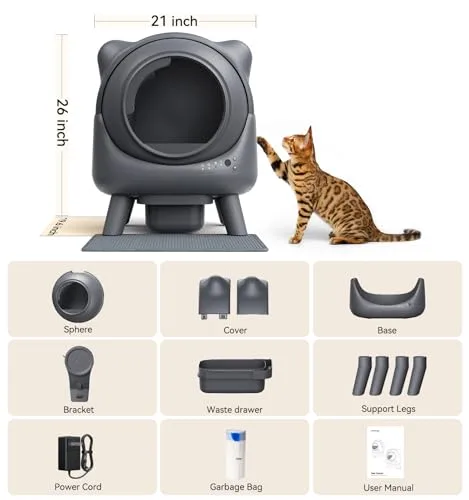
FEELNEEDY’s enclosure can be a practical placement advantage in living areas: it reduces the «open litter tray» visual and typically supports a more set-and-forget routine once it’s dialed in, but you trade off quick visual checks of litter condition. Editor notes also flag a common enclosed-box constraint: delayed maintenance can trap humidity/odor, and high-aiming or aggressive turners can create internal residue that’s harder to notice.
OROLEY, as an open design («With Lid: No»), is typically easier to introduce because it’s closer to a traditional tray and you can visually confirm cleanliness at a glance. The trade-off is that open designs often require more «surroundings management» (mat/floor protection) to mitigate scatter, and odor control depends more heavily on litter choice and cleaning cadence.
Conclusion: FEELNEEDY fits better in bedrooms/living-room corners where aesthetics and visual privacy matter, while OROLEY fits better in bathrooms/laundry rooms/balcony enclosures where visibility, access, and throughput outweigh concealment.
Winner: OROLEY Self-Cleaning Litter Box — it offers more actionable footprint guidance (27.4 × 23.6 in) and clearer suitability signals for larger cats (up to 20 lb), making placement and fit easier to predict even though FEELNEEDY’s enclosure can be the better aesthetic choice in living spaces.
The Bottom Line
After breaking down design, safety, capacity, odor strategy, and day-to-day automation, the decision comes down to where you’ll place the box and how much traffic it needs to handle.
For small apartment, single cat, litter box in a living space: The FEELNEEDY Self-Cleaning Litter Box is the better fit thanks to its covered, living-room-friendly privacy and «set-and-forget» feel once placement is dialed in.
For multi-cat household with heavy daily usage: The OROLEY Self-Cleaning Litter Box is the clear choice with its larger 96L chamber and more redundant sensor stack built for throughput and confidence.
For large cat (up to ~20 lb) or shared box for bigger breeds: The OROLEY Self-Cleaning Litter Box wins on clearer size suitability guidance and a capacity-first, open design that’s typically more welcoming.
For you want fewer settings and minimal app dependence: The FEELNEEDY Self-Cleaning Litter Box fits best, leaning into a simpler, more «automation-first» routine with less reliance on active monitoring.
For you want quicker post-exit cleaning and more active monitoring: The OROLEY Self-Cleaning Litter Box takes it with its faster 1-minute trigger and monitoring-centric approach.
Overall, OROLEY earns the nod for most households because its sensor redundancy and multi-cat-friendly 96L capacity consistently showed up as the biggest practical advantages. The main trade-offs: FEELNEEDY does better at blending into living spaces with a covered design and gives you a larger 11L waste bin.
Both automate scooping and support app control—so measure your placement area, then choose based on traffic level and whether your cat will happily use an enclosed box.
FAQ
Which is better for multiple cats: FEELNEEDY or OROLEY?
Do FEELNEEDY and OROLEY work with clumping litter?
Which one is better for odor control?
How quickly do they start cleaning after my cat exits?
Is an open or covered self-cleaning litter box easier for cats to accept?
What are the main safety differences between FEELNEEDY and OROLEY?
Which litter box is better for larger cats?
How do their waste bin capacities compare?
"Images are used for editorial and informational purposes only. All trademarks and images belong to their respective owners."
Navigating the Smart Pet Device Landscape
- a reliable automatic pet feeder with camera features → PETLIBRO Granary Automatic Cat Feeder with Camera vs PETKIT Fresh Element Solo Smart Pet Feeder: Camera Control or Simple Reliability?
- to improve pet hydration with a smart fountain → PETKIT Eversweet 3 Pro vs PETLIBRO Dockstream: Which Wins?
- a pet camera for interactive monitoring → Furbo 360 Dog Camera vs Petcube Bites 2 Lite
- a GPS tracker for extensive pet roaming → Tractive Smart vs Tractive XL: Best GPS Tracker for Your Dog?
- comparing pet GPS trackers for security and range → Petivity Smart GPS vs Fi Series 3: Best Dog GPS Tracker?
- a Bluetooth tracker for short-range monitoring → Tractive Smart vs Apple AirTag: Pet GPS vs Bluetooth Tracker
- evaluating pet camera vs baby monitor → Furbo 360 vs Nanit Pro: Pet Camera or Baby Monitor?
- UPFAS Little Box 500C vs Lohhuby CAST LB500B: Best Pick?