
Govee H5075 vs Xiaomi Smart Temperature and Humidity Monitor 3: Bluetooth Logging or Xiaomi Home Automation?
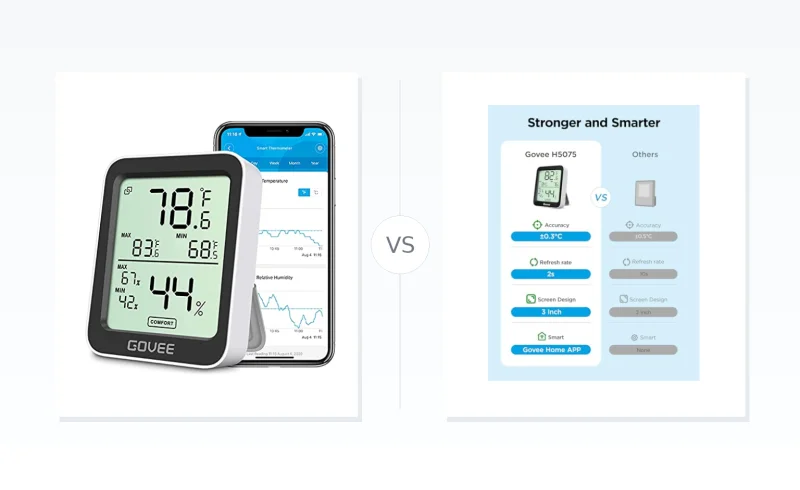
We compare the Govee H5075 and Xiaomi Smart Temperature and Humidity Monitor 3, two popular Bluetooth temperature and humidity sensors. Discover which model offers the best display, smart features, and value for your monitoring needs.
TL;DR
The Govee H5075 and Xiaomi Smart Temperature and Humidity Monitor 3 are both Bluetooth room monitors, but they solve different problems.
- Govee H5075 is better suited to straightforward temperature and humidity tracking. Its 3-inch LCD keeps the environmental readings prominent, Govee Home supports calibration and CSV export, and the sensor updates quickly. The important limitation is that the H5075 is Bluetooth-only: it has no Wi-Fi connection and no official Wi-Fi gateway path for away-from-home monitoring.
- Xiaomi Smart Temperature and Humidity Monitor 3 is the more capable standalone display and the stronger automation sensor. Its 62.6 × 53.2 mm LCD can show temperature, humidity, time, date, day, and comfort status, while a compatible Xiaomi Bluetooth gateway enables temperature- and humidity-based Xiaomi Home automations.
- For historical data, Govee has the clearer advantage if portable records matter because it explicitly supports CSV export. Xiaomi stores up to three months of readings locally and provides history inside Xiaomi Home, but its official documentation centers on in-app graphs rather than file export.
- For battery endurance, Xiaomi has the stronger manufacturer rating: up to about 1.5 years from a CR2450 cell under its stated standby conditions, versus about six months from two AAA batteries for the Govee.
The central distinction is not "large display versus small display." Both have substantial LCDs. It is simple Bluetooth monitoring and export on Govee versus deeper Xiaomi Home integration and gateway-based automation on Xiaomi.
Market price overview

 Gshopper
| Feature | Govee H5075 | Xiaomi Smart Temperature and Humidity Monitor 3 |
|---|---|---|
| Power | ||
| Battery Life | Up to 1 year | Approximately 1.5 years |
| Power Source | 2x AAA batteries | 1x CR2450 |
| Sensor | ||
| Humidity Range | 0% to 99.9% RH | 0% to 99.9% RH |
| Humidity Accuracy | ±3% RH | ±3% RH |
| Temperature Range | -20°C to 60°C | -20°C to 60°C |
| Temperature Accuracy | ±0.3°C | ±0.3°C |
| Display | ||
| Display Type | Segment LCD | Segment LCD |
| Features | ||
| Data History | Yes (in app) | Yes (in app) |
| Companion App | Govee Home | Mi Home |
| Connectivity | ||
| Wireless Connectivity | Bluetooth | Bluetooth |
📑 Table of Contents
Display & Everyday Readability
The original premise that the Govee H5075 has a large display while the Xiaomi Monitor 3 has a tiny one does not hold up against the manufacturers' specifications.
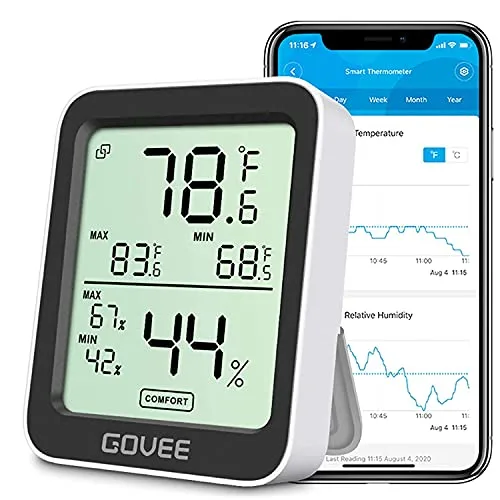
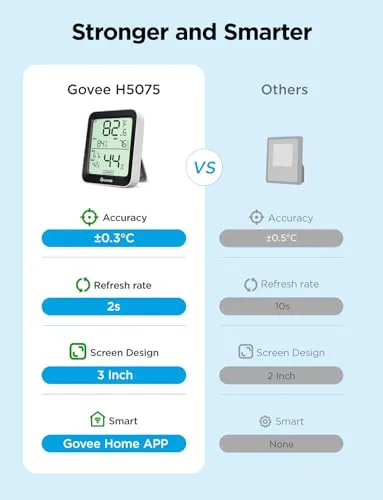
Govee uses a 3-inch LCD with large numerals and a layout focused primarily on temperature and humidity. That simplicity matters in a room sensor: there is little visual competition for the two values most people check repeatedly.
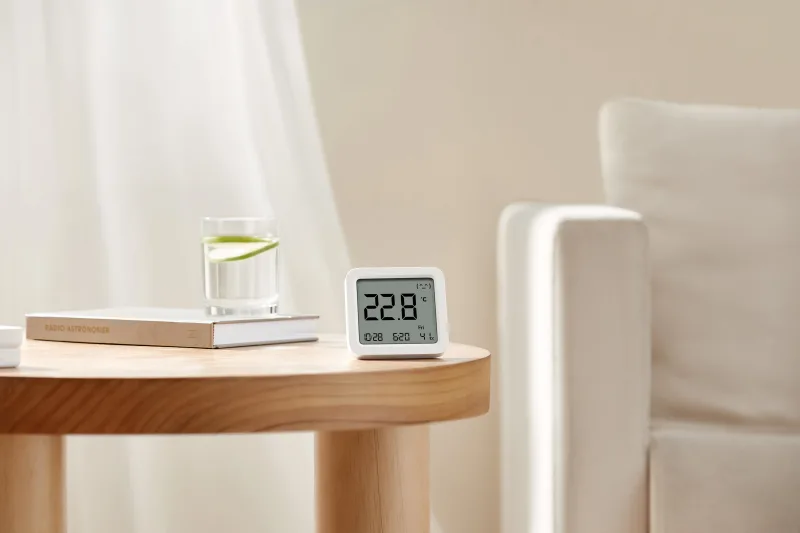
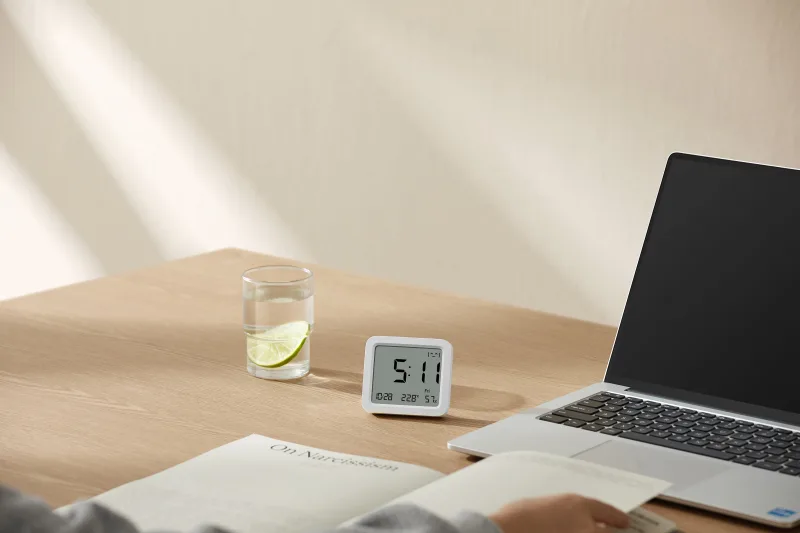
Xiaomi's screen is not small. The 62.6 × 53.2 mm segment LCD occupies much of the front of a body measuring 79.6 × 70.2 × 14.5 mm. Xiaomi says the display can present temperature, humidity, time, date, day of the week, and a comfort indicator. Temperature and humidity form a dual display, while the larger main field can be switched among temperature, humidity, and time using the button on the side.
That makes the two displays different rather than clearly better or worse. The Govee H5075 devotes more visual attention to environmental readings, so it makes sense where temperature and humidity are the only information that matters. The Xiaomi Monitor 3 functions more like a compact room information display, with clock and calendar information alongside its sensor readings.
There is therefore no factual basis for describing Xiaomi's screen as a cramped panel that forces the user to view only one environmental measurement at a time. Its layout is denser, but its physical display is substantial and both temperature and humidity remain part of the on-screen information.
Measurement & Update Behavior
Both devices use digital temperature and humidity sensors, but their published specifications need to be interpreted carefully.
Govee claims the H5075 is accurate to approximately ±0.32°C for temperature and ±3% RH for humidity, with readings responding every 2 seconds. Those figures come from Govee's product documentation rather than an independent side-by-side laboratory comparison.
Xiaomi uses a Sensirion digital sensor and specifies a 0.1°C temperature resolution and 1% RH humidity resolution. The Monitor 3 refreshes its displayed temperature and humidity every 6 seconds.
Resolution is not the same thing as accuracy. A sensor displaying changes in 0.1°C increments is not automatically accurate to ±0.1°C. Xiaomi's global specifications do not provide an equivalent absolute ± accuracy figure that can be compared directly with Govee's published tolerance.
For practical room monitoring, the more meaningful difference is update speed. Govee refreshes more frequently, while Xiaomi's six-second cycle is still short enough for ordinary indoor climate tracking. Neither specification alone supports declaring one device categorically more accurate than the other.
Connectivity, Remote Access & Automation
This is where the products separate most clearly.
The Govee H5075 is a Bluetooth-only sensor. Govee's support documentation explicitly states that it does not support Wi-Fi and gives a maximum Bluetooth range of about 50 m / 164 ft in an open, unobstructed environment.
That distinction matters because the phrase "remote monitoring" can be misleading here. The H5075 can be checked from another part of a home while the phone remains within Bluetooth reach, but the sensor has no independent Internet connection. If the phone leaves Bluetooth range, the H5075 does not become an Internet-connected monitor through an optional Govee gateway.
Govee Home can generate temperature and humidity alerts when the phone is communicating with the sensor. The H5075 can also participate in selected first-party GoveeLife integrations. Govee lists it as compatible with certain smart tower fans and humidifiers that can use an external thermo-hygrometer reading for automatic climate control. That is useful, but it is narrower than treating the H5075 as a general smart-home automation sensor.
The Xiaomi Smart Temperature and Humidity Monitor 3 also communicates directly over Bluetooth, specifically Bluetooth 5.0 Low Energy. When a phone is directly connected, Xiaomi says current values are transferred every six seconds and historical records can synchronize through Xiaomi Home.
Adding a compatible Xiaomi Bluetooth or Bluetooth Mesh gateway changes the role of the Monitor 3. It allows the sensor to participate in Xiaomi Home smart scenes, with supported trigger conditions including:
- temperature above or below a defined threshold;
- humidity above or below a defined threshold;
- battery level below a defined threshold.
Those conditions can then control compatible devices such as humidifiers, fans, heaters, or air conditioners within Xiaomi Home.
The gateway path is not instantaneous. Xiaomi says the monitor can report to a Bluetooth gateway as often as once per minute or as slowly as once every five minutes, depending on the gateway and conditions. Cloud updates typically take additional time, with Xiaomi citing roughly 5 to 10 minutes in many cases. That latency is acceptable for room-climate automation, but it should not be confused with the six-second refresh shown directly on the sensor.
Xiaomi's own humidifier setup documentation also calls for the monitor and Bluetooth gateway to remain within about 5 m of each other for that configuration, so gateway placement is part of the setup.
App & Data Management
The Govee H5075 has the more explicit data-export workflow.
Govee Home provides historical temperature and humidity graphs, configurable alert thresholds, and temperature and humidity calibration adjustments. Govee advertises 20-day curve views and says historical data reaching back as far as two years can be exported in CSV format.
That makes the H5075 particularly useful when the data needs to leave the manufacturer's app—for example, when comparing seasonal changes, keeping environmental records, or analyzing readings in a spreadsheet.
The Xiaomi Monitor 3 takes a different approach. Xiaomi says the device can retain three months of temperature and humidity data locally. When connected directly to a phone, historical readings can synchronize to Xiaomi Home and the cloud. A compatible Bluetooth gateway provides another path for cloud synchronization without requiring the phone to remain directly connected.
Xiaomi Home provides historical views by day, month, and half-year. The app also handles device sharing, firmware updates, clock settings, and the automation rules that form the main reason to add a gateway.
The difference is therefore less about whether either product records history—both do—and more about what happens afterward. Govee explicitly supports portable CSV records. Xiaomi is built around viewing and using the readings inside Xiaomi Home.
For someone mainly investigating how humidity changed over several weeks, Govee's export capability is the more useful distinction. For someone who wants the reading itself to become an automation condition, Xiaomi's app and gateway architecture is considerably more capable.
Design & Placement
Physically, both are small indoor instruments designed to remain visible rather than disappear completely into the background.
The Govee H5075 includes a rear stand for tabletop or shelf placement and a hanging hole for suspended mounting. Its design is straightforward: the front is dominated by the LCD, while the stand gives it a conventional desktop thermometer form.
The Xiaomi Monitor 3 is thinner at 14.5 mm and weighs 72 g. Xiaomi includes both a stand and a wall adhesive, so the same sensor can sit on furniture or attach to a smooth vertical surface. It does not include a magnetic mount.
The durability claims sometimes attached to this comparison need more restraint. There is no solid basis for stating that the Govee stand routinely tips, that its enclosure yellows, or that Xiaomi's adhesive commonly fails in humid rooms.
There is one environmental limitation worth noting. Xiaomi explicitly states that the Monitor 3 is not waterproof. Govee describes the H5075 as an indoor sensor and does not list an ingress-protection rating for it. Neither should therefore be treated as a water-resistant instrument simply because humidity is one of the values it measures.
Battery Life & Maintenance
The battery comparison also changes substantially once the manufacturers' current documentation is used.
The Govee H5075 uses two AAA batteries, and Govee currently estimates approximately six months of operation.
The Xiaomi Monitor 3 uses one CR2450 coin cell. Xiaomi rates it for approximately 1.5 years of standby operation, though its own footnote makes clear that the figure refers to conditions in which the monitor is not continuously connected to the app and that actual endurance varies with usage and environment.
Xiaomi therefore carries the longer official battery-life claim, but the two numbers are not controlled results obtained under identical workloads.
Battery maintenance is also simpler than the original description suggested. The Xiaomi does not require a screwdriver. Xiaomi's instructions say to remove the battery cover from the opening at the bottom, replace the CR2450 with the positive side facing upward, and reinstall the cover. The display also includes a low-battery icon.
Govee's use of standard AAA cells may be more convenient where those batteries are already kept on hand, while Xiaomi trades the less common coin cell format for a substantially longer stated interval between replacements.
The Bottom Line
These sensors overlap in basic function but have different strengths.
The Govee H5075 is better suited to someone who wants a straightforward Bluetooth temperature and humidity monitor with a simple environmental display, fast refreshes, calibration controls, threshold alerts while the phone is within Bluetooth reach, and especially CSV export for historical records.
The Xiaomi Smart Temperature and Humidity Monitor 3 is better suited to someone who wants the sensor itself to show more information or plans to use temperature and humidity as Xiaomi Home automation conditions. Its configurable multifunction display, three months of local data storage, gateway support, and much longer rated battery life give it capabilities the H5075 does not match.
For away-from-home monitoring, the distinction is decisive: Xiaomi has an official gateway path to cloud-connected operation. The Govee H5075 does not. Despite Govee's use of "remote monitoring" language for Bluetooth access, the H5075 itself remains a Bluetooth-only device.
For data portability, the advantage runs the other direction. Govee explicitly supports CSV export and long historical records, while Xiaomi's documented workflow is centered on Xiaomi Home.
There is no meaningful overall winner independent of the intended setup. Govee makes more sense as a local monitor and data logger; Xiaomi makes more sense as a sensor inside a Xiaomi Home automation system.
FAQ
Do these sensors work with Apple HomeKit?
Can I use the Xiaomi Monitor 3 without a hub?
Which sensor has better accuracy?
How do I export historical data?
What is the maximum Bluetooth range of the Govee H5075?
How long does the Xiaomi Monitor 3 battery last?
Do these sensors have a backlight?
📄 Used Manuals & Documentation
Govee H5075
"Images are used for editorial and informational purposes only. All trademarks and images belong to their respective owners."