
A&D Medical UA-651 vs Braun ExactFit 1: Averaging or Wider Cuff?
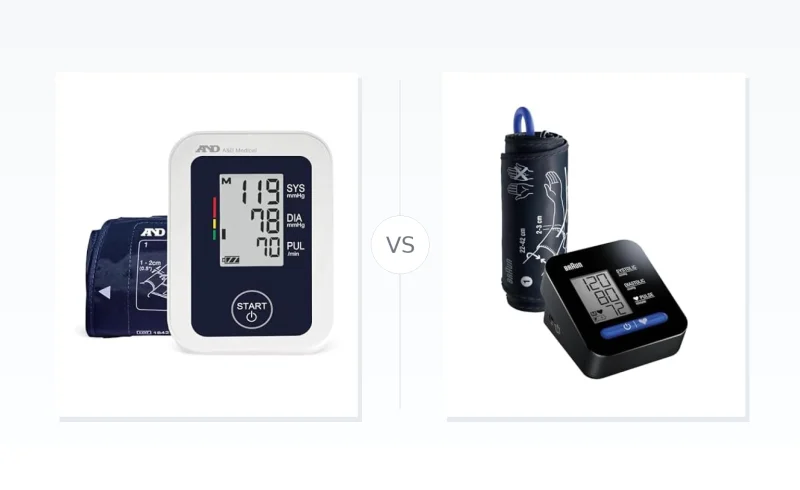
Compare the A&D Medical UA-651 and Braun ExactFit 1 blood pressure monitors. Discover which offers superior clinical validation, cuff comfort, memory features, and long-term durability for your home monitoring needs.
TL;DR
The A&D Medical UA-651 makes the stronger case for routine home blood-pressure tracking: it has published, model-specific clinical validation, stores 30 readings, calculates an average of stored measurements, flags irregular heartbeats, and supports an optional larger cuff and AC adapter.
The Braun ExactFit 1 has one major practical advantage: its included 22–42 cm (8.6–16.5 in) cuff covers substantially more arm sizes than the UA-651's standard 22–32 cm (8.7–12.6 in) cuff. Its large display and one-button operation also keep individual measurements straightforward.
The tradeoff is that the ExactFit 1 stores only the most recent reading, not 40 readings, and it does not calculate averages. More importantly, Braun states that the model has clinically proven accuracy, but independent validation documentation for the BUA5000/BUA5000US is less clear than it is for the UA-651.
Scope note: This comparison covers the standard A&D UA-651 and Braun ExactFit 1 BUA5000/BUA5000US. The UA-651SL, UA-651Plus, Braun ExactFit 1E BUA4000, and other regional variants have different specifications.
| Feature | Braun ExactFit 1 | A&D Medical UA-651 |
|---|---|---|
| Cuff | ||
| Cuff circumference range | 22-42 cm (8.6-16.5 inches) | 22-32 cm (8.7-12.6 inches) |
| Power | ||
| Power source | 4 x AA batteries | 4 x AA batteries |
| Memory | ||
| Average function | No | Yes, average of all stored readings |
| Number of readings stored | 40 | 30 |
| Features | ||
| Clinical validation | Clinically validated | ESH 2010, Medaval 5-star |
| Irregular heartbeat detection | Yes | Yes |
| Warranty | ||
| Warranty period | 2 years | 2 years |
| Measurement | ||
| Measurement method | Oscillometric | Oscillometric |
📑 Table of Contents
Accuracy & Clinical Validation
For a home blood-pressure monitor, validation matters more than extra display features. On that point, the A&D Medical UA-651 has unusually clear documentation.
The UA-651 was evaluated in a peer-reviewed study under the European Society of Hypertension International Protocol revision 2010, with the results published in Blood Pressure Monitoring in 2014. A second published validation evaluated the device with a wide-range cuff. Medaval lists both studies and regards the UA-651's blood-pressure measurement technology as having proven validation evidence.
Braun's documentation is more complicated. The ExactFit 1 BUA5000 manual states that its measuring accuracy was demonstrated through clinical research conducted according to ESH IP-2002 and ANSI/AAMI SP-10-2002, and Braun currently describes the ExactFit 1 as clinically validated. However, Medaval's entry for the BUA5000US says it has not found peer-reviewed clinical-validation evidence for that specific device and therefore does not recommend it on its independent-validation criteria.
That does not establish that the Braun produces inaccurate readings. It means the public evidence trail is easier to verify for the A&D.
There is another point that matters just as much as the monitor itself: cuff fit and measurement technique. A validated device used with the wrong cuff size, over clothing, with the arm unsupported, or without several minutes of rest can still produce misleading numbers. The more defensible choice is therefore the monitor that combines appropriate cuff sizing with the strongest available validation evidence for the individual using it.
Advantage: A&D Medical UA-651 for the transparency of its model-specific published validation.
Cuff Size & Fit
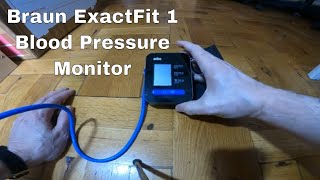
This is where the Braun ExactFit 1 has its clearest advantage.
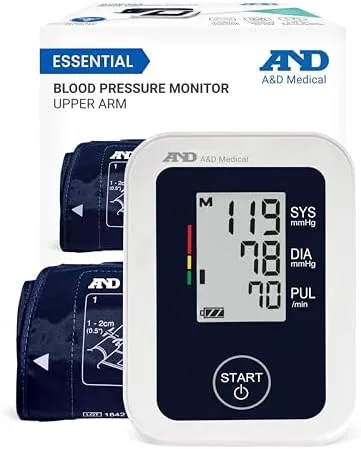
Its included universal cuff is specified for upper-arm circumferences of 22–42 cm (8.6–16.5 in). The standard A&D UA-651 package instead includes a 22–32 cm (8.7–12.6 in) SlimFit cuff.
That difference is not cosmetic. A cuff that is too small can distort a blood-pressure measurement, so someone whose arm circumference is above the UA-651 cuff's specified range should not simply tighten the standard cuff and continue.
A&D does provide an official 31–45 cm large SlimFit cuff option, which means the monitor itself is not limited to 32 cm arms. The drawback is logistical: the correct larger cuff has to be available with the device rather than already being included. A&D also explicitly describes its SlimFit cuff as latex-free and metal-free.
For an arm circumference between roughly 33 and 42 cm, the Braun package is simpler because the supplied cuff already covers that range. For someone within the UA-651's standard 22–32 cm range, cuff width by itself is much less of a reason to favor the Braun.
Advantage: Braun ExactFit 1 for the wider cuff included with the standard package.
Memory & Averaging
The original specifications often attributed to these two monitors can make this comparison look much closer than it actually is. It is not.
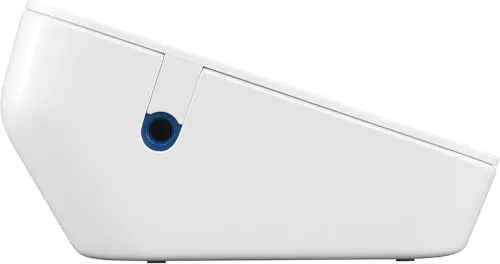
The A&D UA-651 stores 30 measurements and can display an average of the systolic and diastolic values in memory. That is useful when measurements are being taken repeatedly rather than as occasional isolated checks.
The Braun ExactFit 1 BUA5000 stores only the latest measurement. Its manual explicitly describes memory as a last-reading recall function. When the next completed result is stored, the device is effectively maintaining a reference to the most recent measurement rather than building a multi-reading history.
Braun does provide access to the Braun Healthy Heart app in supported markets, but the ExactFit 1 is not a connected monitor. Measurements have to be entered manually.
The UA-651's averaging function should also be kept in perspective. It calculates an average from the values stored in the device; it is not a substitute for a structured log when a clinician wants readings separated by morning, evening, date, or measurement session. Still, having 30 results available on the monitor is substantially more useful for repeated monitoring than retaining a single previous result.
Advantage: A&D Medical UA-651. The difference is not 30 readings versus 40; it is 30 readings plus averaging versus one recalled reading.
Display, Indicators & Everyday Operation

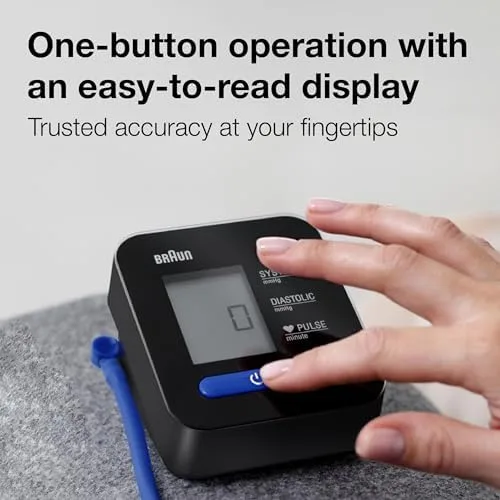
Both monitors are intentionally simple. Each uses automatic upper-arm measurement and can start a reading with a single main button.
The A&D UA-651 uses a three-line LCD showing systolic pressure, diastolic pressure, and pulse. It also includes a WHO blood-pressure classification indicator and an irregular-heartbeat (IHB) indicator.
That last feature is worth clarifying because it is frequently misreported in comparisons of the two devices. Irregular-heartbeat detection is an explicitly documented UA-651 feature. The current Braun ExactFit 1 BUA5000US manual does not list an irregular-heartbeat detector, so it should not be treated as a shared feature of these two specific models.
The Braun ExactFit 1 emphasizes a larger, easy-to-read display. Braun's current U.S. instructions also describe an AHA indicator arrow shown with the completed measurement, providing a quick reference for the blood-pressure category.
Neither monitor depends on a phone, account, wireless connection, or companion service to perform a measurement. That makes both suitable for someone who wants a conventional standalone monitor, but the A&D provides more information and history directly on the device.
For pure screen size, the Braun has an appealingly straightforward presentation. For information available without keeping a separate record, the UA-651 does more.
Power, Warranty & Service Life
Both monitors use four AA batteries, but the UA-651 also supports an optional A&D TB-233 AC adapter. That can be useful when the monitor normally stays beside the same chair or table.
Warranty terms vary by market, but A&D's UK documentation specifies a five-year warranty for the UA-651, excluding the cuff and batteries. Braun's BUA5000 documentation specifies a two-year warranty.
That difference should not be turned into a claim that one sensor necessarily remains accurate for three years longer than the other. Warranty length describes manufacturer coverage, not measured long-term calibration performance.
A&D does have a practical serviceability advantage in its official cuff ecosystem. The standard 22–32 cm cuff can be exchanged for the manufacturer's larger 31–45 cm option when arm size requires it. The monitor therefore does not have to be replaced simply because the supplied cuff is the wrong size.
Advantage: A&D Medical UA-651 for the optional mains power, longer documented warranty in applicable markets, and official alternative cuff size.
The Bottom Line
These monitors solve slightly different problems.
For someone with an upper-arm circumference within 22–32 cm who expects to measure blood pressure regularly, the A&D Medical UA-651 has the stronger overall technical case. Its validation history is easier to verify independently, it retains 30 readings, calculates an average, includes an irregular-heartbeat indicator, and offers both a larger cuff option and AC power.
For someone with an arm circumference above the UA-651's standard cuff range, the Braun ExactFit 1 has an important practical advantage: its supplied 22–42 cm cuff already covers that range. Using the correctly sized cuff is more important than forcing a preferred monitor to work with an unsuitable one.
The Braun's limitation is not its simplicity; simplicity can be useful. The issue is that the BUA5000's single-reading memory provides almost no on-device trend history, while independent documentation of model-specific clinical validation is less complete than it is for the UA-651.
If both cuffs fit properly, the UA-651 is the more capable monitor for repeated home tracking. If only the Braun's supplied cuff fits, cuff suitability changes the equation—and the more appropriate comparison may be between the Braun and another independently validated monitor supplied with a wide-range cuff rather than between the Braun and an incorrectly fitted UA-651.
FAQ
Which monitor is more accurate?
Can I use these monitors with a smartphone app?
What's the cuff size difference?
Do they detect irregular heartbeats?
Which one is better for tracking weekly averages?
How do the displays compare between the A&D UA-651 and Braun ExactFit 1?
Which blood pressure monitor offers a longer warranty?
Can I replace the cuff on the A&D UA-651 if it wears out?
📄 Used Manuals & Documentation
A&D Medical UA-651
"Images are used for editorial and informational purposes only. All trademarks and images belong to their respective owners."