
Inkbird IBS-TH2 Plus vs Tuya TH08: Data Logger or Wi-Fi Room Monitor?
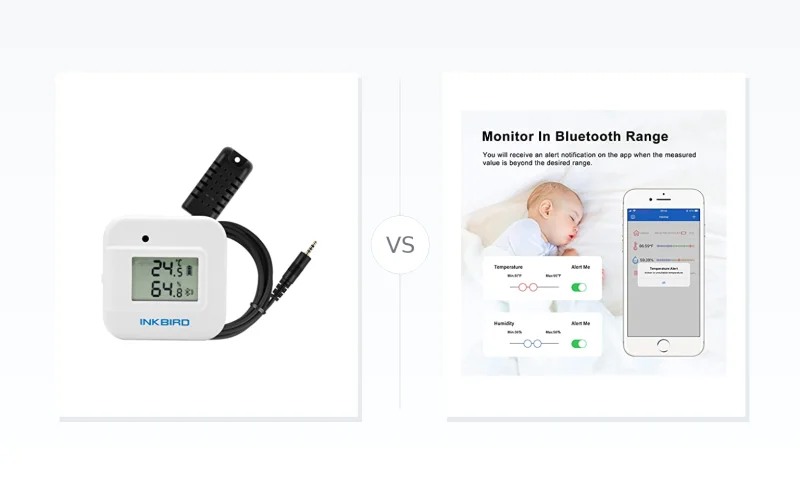
Compare the Inkbird IBS-TH2 Plus and Tuya TH08 temperature/humidity sensors. The Inkbird excels in accuracy, logging depth, and long-term reliability, while the Tuya offers remote access and smart home integration. Discover which fits your needs.
TL;DR
- Inkbird IBS-TH2 Plus is better suited to measurement and logging: its manufacturer specifications are tighter, it stores up to 30,000 readings on the device, offers configurable sampling and data export, and supports an external probe.
- Tuya TH08 is better suited to connected-room monitoring: the common Wi-Fi version provides remote app access, threshold alerts, Tuya/Smart Life scenes, and temperature/humidity queries through Alexa and Google Assistant without a separate gateway.
- The Inkbird is not permanently limited to nearby Bluetooth use. An optional Inkbird IBS-M2 Wi-Fi gateway supports the IBS-TH2 Plus, adding remote monitoring and push alerts, although that changes the simplicity and cost of the system.
- Neither is an ideal fit for someone who wants local-first smart-home automation with no vendor cloud. A Zigbee, Z-Wave, or locally supported Bluetooth sensor and coordinator is a more natural fit for that architecture.
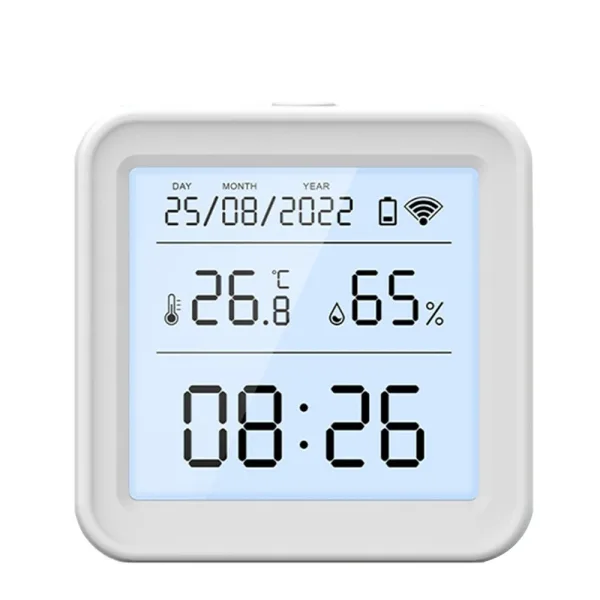
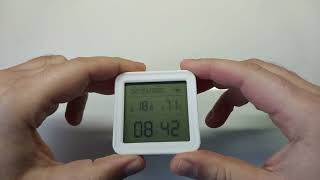
One model-name caveat matters before comparing specifications: TH08 is used by multiple sellers for Tuya/Smart Life-compatible hardware rather than representing one tightly controlled retail product. The comparison here refers to the common Wi-Fi TH08 with a 56 mm-class LCD, three AAA batteries, 2.4 GHz Wi-Fi, a -9.9°C to 60°C temperature range, ±1°C stated temperature accuracy, and ±5% RH stated humidity accuracy. Firmware, app options, reporting intervals, and even some hardware details can vary between TH08 versions. The similarly named ZTH08 is a Zigbee model and is not the device discussed here.
| Feature | Tuya TH08 | Inkbird IBS-TH2 Plus |
|---|---|---|
| Connectivity | ||
| Wireless Protocol | Wi-Fi (2.4 GHz, IEEE 802.11b/g/n) | Bluetooth |
📑 Table of Contents
Accuracy and Probe Options
On manufacturer specifications alone, the Inkbird IBS-TH2 Plus has the stronger measurement credentials.
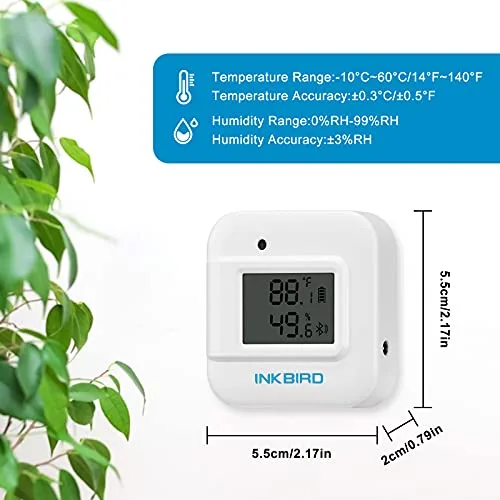
Its built-in sensor is rated for -10°C to 60°C, with typical temperature accuracy of ±0.3°C and a stated maximum error of ±0.5°C. Humidity covers 0–99% RH. At 25°C and between 20% and 80% RH, Inkbird specifies typical humidity accuracy of ±3% RH and a maximum of ±4.5% RH. Across the wider humidity range, the stated tolerance becomes looser.
The common Wi-Fi TH08 is specified for -9.9°C to 60°C, with ±1°C temperature accuracy and ±5% RH humidity accuracy across its stated 0–99% RH range.
Those numbers do not prove that every Inkbird unit will outperform every TH08 in real conditions; they are manufacturer specifications rather than results from a common independent calibration test. They do, however, give the Inkbird substantially narrower stated tolerances, particularly for temperature.
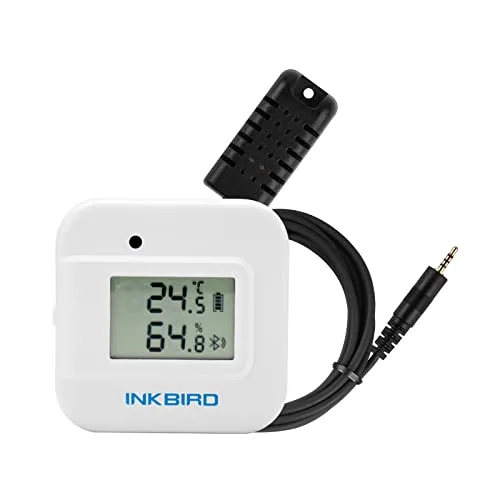
The larger practical difference is the Inkbird's external-probe socket. IBS-TH2 Plus versions are offered with either a temperature probe or a temperature-and-humidity probe.
With the temperature-only probe, the documented measurement range extends to -40°C to 125°C, with ±0.5°C stated accuracy. The logger records the probe temperature while continuing to use its internal sensor for humidity. A separate temperature-and-humidity probe variant covers -40°C to 60°C for temperature and 0–99% RH for humidity.
That separation is useful in situations where the sensor body should remain outside the environment being measured. A refrigerator or freezer is an obvious example: the probe can be placed inside while the logger and its radio remain outside. The probe's extended range does not mean that the IBS-TH2 Plus body itself is rated to operate from -40°C to 125°C.
The TH08 has no comparable external-probe input. It is fundamentally an ambient room sensor.
Both devices can also provide calibration controls in their documented apps. Inkbird explicitly supports accuracy calibration, while manuals for the common LCD TH08 describe temperature and humidity offsets in Smart Life/Tuya Smart. Calibration therefore is not an Inkbird-exclusive feature.
For measurement-oriented use, the Inkbird has the clearer advantage because of its tighter stated tolerances and external-probe options.
Data Logging and History
This is where the two products differ most fundamentally.
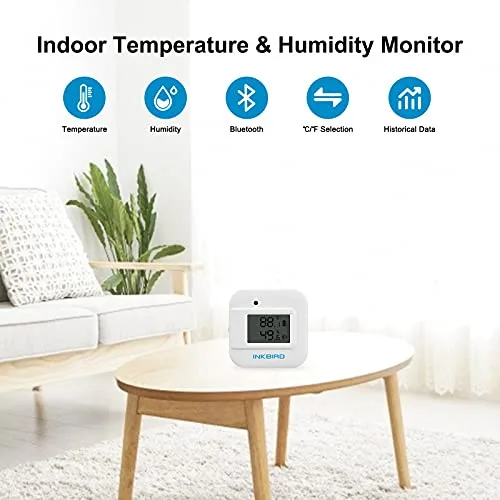
The IBS-TH2 Plus is a data logger first. Inkbird says the device itself can retain up to 30,000 data points. Its app provides historical graphs, adjustable sampling intervals, calibration controls, and data export.
That combination matters when the shape of the data is important rather than just the latest reading. A configurable sampling interval can capture gradual temperature changes, cycling equipment, overnight humidity behavior, or short excursions without relying on a cloud service to decide when a new point is worth reporting.
The TH08 does retain historical data, and common manuals describe up to one year of temperature and humidity history with email export. That corrects an important misconception: the TH08 is not limited to a current-value dashboard.
Its weakness as a logger is how readings are reported.
Documentation for the common Wi-Fi TH08 describes an event-driven scheme. A change of roughly 0.5°C or 5% RH can cause reporting every two minutes, while stable conditions are reported much less often. TH08 documentation is not completely consistent about that slower interval: some versions describe approximately 30-minute cloud reporting, while others describe one-hour updates.
That inconsistency is another consequence of the model's white-label nature. It is safer to think of TH08 history as cloud monitoring with adaptive reporting, not as a guaranteed fixed-rate scientific log.
The distinction has practical consequences. If a room sits near the same temperature for several hours, either product can show that it remained broadly stable. If the goal is to reconstruct exactly how conditions moved through that period using a known sampling cadence, the Inkbird provides the more appropriate data model.
Export also exists on both sides, so the relevant difference is not simply "export versus no export." It is local, configurable sampling versus cloud-controlled reporting.
For detailed historical records, the IBS-TH2 Plus is substantially better suited. For remotely accessible trend history without managing a local logger, the TH08 is more convenient.
Connectivity, Remote Access, and Alerts
Used on its own, the IBS-TH2 Plus communicates over Bluetooth. Inkbird rates the connection at up to 98 feet (30 meters) without obstacles, although walls, appliances, metal enclosures, and other radio conditions can reduce usable range.
That means the basic workflow is local. The sensor continues collecting data without an internet connection, but a phone must return within Bluetooth range to synchronize and inspect it.
There is also an important alert limitation. Inkbird support documentation has stated that, with a direct Bluetooth connection, Engbird/INKBIRD notifications depend on the app being active and connected; a locked phone outside Bluetooth range cannot turn the standalone sensor into an away-from-home alarm system.
The TH08 uses 2.4 GHz Wi-Fi and the Tuya cloud. Once connected to Smart Life or Tuya Smart, current readings, history, and threshold notifications can be accessed from outside the home as long as the sensor, router, internet connection, and Tuya service are available.
That makes the TH08 much more natural for situations such as checking a second home, a room in another building, or an environment that needs remote threshold warnings.
There is an important qualification to the usual "Bluetooth versus Wi-Fi" comparison, however: the IBS-TH2 Plus is compatible with Inkbird's IBS-M2 Wi-Fi gateway. Inkbird lists the IBS-TH2 Plus among the gateway's supported subdevices.
With the gateway in place, Inkbird provides remote readings, push alarms, and longer-term history through its connected platform. The IBS-M2 can handle multiple compatible Inkbird sensors.
So the actual distinction is:
- Inkbird standalone: local Bluetooth logging.
- Inkbird plus IBS-M2: local logger combined with gateway-based remote monitoring.
- TH08: Wi-Fi/cloud remote monitoring built into the sensor workflow, with no separate gateway required.
The architecture also changes the failure modes. Inkbird's standalone logging does not need internet service. TH08 remote readings, cloud history, notifications, and scenes depend on the Wi-Fi and Tuya path remaining available. Conversely, a standalone IBS-TH2 Plus cannot alert someone who is away from its Bluetooth range.
For remote monitoring with the fewest components, the TH08 has the simpler architecture. The Inkbird can provide remote access too, but only after adding a compatible gateway.
Smart Home and Automation
The TH08 is much more deeply integrated into a conventional consumer smart-home platform.
Within Smart Life/Tuya Smart, the sensor can act as an input for scenes. A temperature or humidity threshold can therefore trigger another compatible Tuya device—for example, an air conditioner controlled through a Tuya-compatible IR controller or a humidifier connected through compatible automation hardware.
Its documentation also supports temperature and humidity queries through Amazon Alexa and Google Assistant.
There is a subtle automation behavior worth knowing. TH08 documentation describes its conditions as edge-triggered. In other words, an automation is generally triggered when the reading crosses the configured threshold rather than continuously firing simply because the value remains beyond it.
For example, if a rule is created while the room is already above its high-temperature threshold, the documented behavior may require the temperature to drop below that boundary and cross it again before the action fires. This matters more in climate-control routines than it does in simple monitoring.
The IBS-TH2 Plus is not designed around that kind of native smart-home scene system. Its standalone role is sensing and logging. The IBS-M2 gateway expands remote monitoring and notifications, but it does not turn the sensor into the equivalent of a Tuya automation endpoint with the same native Alexa/Google and scene workflow.
Users building an explicitly local smart home should also recognize that neither architecture is ideal in its default form. The TH08's main connected features rely on Tuya's cloud, while Inkbird's official path centers on its own Bluetooth/app/gateway ecosystem.
For native Smart Life scenes and mainstream voice-assistant queries, the TH08 is the stronger fit.
Setup and Everyday Use
The Inkbird is simpler when used as a standalone logger.
It runs on two AAA batteries, displays temperature and humidity directly on its LCD, and can be paired over Bluetooth without entering Wi-Fi credentials or provisioning a cloud-connected device.
Older Inkbird documentation points users to the Engbird app. Inkbird later added support for these sensors in the newer INKBIRD app, where the IBS-TH2 Plus can be added through the IBS-THS device option. That app history is worth noting because instructions bundled with older stock may not match the current software path.
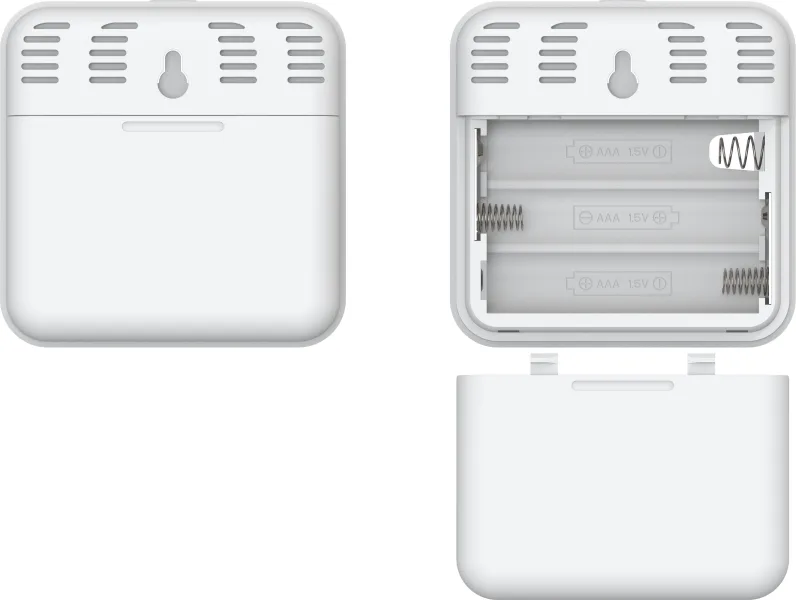
The TH08 uses three AAA batteries and requires 2.4 GHz Wi-Fi provisioning through Smart Life or Tuya Smart. That adds the usual Wi-Fi setup variables: network credentials, signal strength, router configuration, and access to the cloud service.
After setup, however, the TH08 asks less of the phone. Its LCD provides local readings, while the app remains reachable remotely. The user does not need to return to Bluetooth range just to see the latest cloud-reported value.
The Inkbird's daily rhythm is different. The display handles immediate local checks, the logger keeps recording on its own, and the phone becomes important when detailed history needs to be synchronized, reviewed, configured, or exported.
The TH08's event-driven reporting should also be kept in mind when looking at the app. "Connected" does not mean that a fresh cloud data point is being transmitted every few seconds. The product deliberately reduces reporting when conditions are stable.
Neither workflow is inherently superior. Inkbird minimizes network setup; TH08 minimizes proximity requirements after setup.
Power, Maintenance, and Platform Dependence
It is tempting to infer battery life or hardware longevity simply from Bluetooth versus Wi-Fi, but the available documentation does not provide a reliable common runtime test for these two products. A more useful comparison is what each system requires to keep functioning as intended.
The IBS-TH2 Plus uses two replaceable AAA batteries. Its sensing and local data storage do not depend on a router or internet service. If the phone is absent, it can continue logging until its local storage or power becomes the limiting factor.
The TH08 uses three AAA batteries and depends on Wi-Fi for its connected functions. Its documentation specifically warns that network problems can increase battery consumption because the sensor may repeatedly attempt to reconnect.
The support situation also differs.
The IBS-TH2 Plus is a defined Inkbird model with manufacturer documentation, a documented app path, optional gateway compatibility, and a stated warranty.
"TH08," by contrast, appears under multiple seller and brand names while sharing Tuya/Smart Life software and similar enclosure designs. Manuals for these variants agree on many core functions, but not on every reporting interval, battery configuration, operating range, or firmware behavior.
That does not make the TH08 inherently unreliable. It does mean that the exact TH08 unit and its accompanying documentation matter more than the model name alone.
The Bottom Line
These devices overlap in what they measure but are designed around different priorities.
For detailed temperature and humidity logging: the Inkbird IBS-TH2 Plus is the stronger fit. Its on-device 30,000-point storage, configurable sampling, narrower stated accuracy tolerances, export tools, and probe support are all directly relevant to recording environmental conditions over time.
For remote room monitoring: the Tuya TH08 is the more straightforward fit. Wi-Fi, cloud access, threshold notifications, Smart Life scenes, and Alexa/Google queries are part of the normal setup rather than features that require a separate gateway.
For refrigerator or freezer monitoring: the Inkbird's external temperature probe is especially useful because the logger body can remain outside the enclosure. Remote warnings are possible when the sensor is paired through a compatible Inkbird gateway.
For grow rooms, humidors, storage areas, or other environments where small changes matter: the Inkbird's tighter stated measurement tolerances and controllable logging cadence are more relevant than the TH08's smart-home integrations. Any application requiring traceable or compliance-grade measurements should still use appropriately calibrated instrumentation rather than treating either consumer sensor as a laboratory reference.
For smart-home climate scenes: the TH08 has the clearer native path through Tuya/Smart Life, with the caveat that its reporting is event-driven and its core connected functions depend on the Tuya cloud.
There is therefore no useful "best overall" designation between them. The IBS-TH2 Plus is primarily a logger that can be extended into remote monitoring; the TH08 is primarily a connected room monitor that also keeps cloud history. That architectural difference matters more than most individual specifications.
FAQ
Does the Inkbird IBS-TH2 Plus work without a smartphone?
Can the Tuya TH08 monitor temperature remotely?
Which sensor is more accurate?
Can I export historical data from the Tuya TH08?
Do these sensors work with Alexa?
Does the Inkbird IBS-TH2 Plus include an external probe?
Does the Tuya TH08 work on 5 GHz Wi-Fi?
Can the Tuya TH08 trigger smart home automations?
"Images are used for editorial and informational purposes only. All trademarks and images belong to their respective owners."