
Govee Smart Thermometer Hygrometer (WiFi) vs SensorPush HTP.xw: Instant Remote Alerts or Measurement-First Tracking?
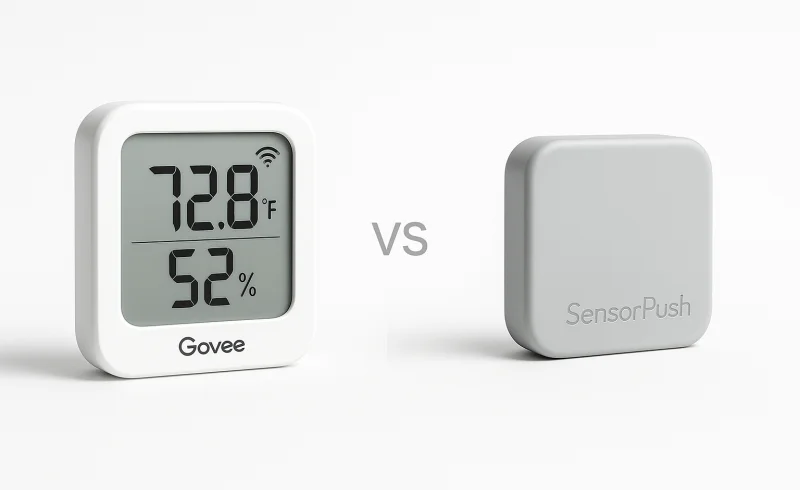
Compare Govee Smart Thermometer and SensorPush HTP.xw for temperature and humidity monitoring. Govee offers WiFi remote access, while SensorPush excels in precision and data logging. Choose based on your need for connectivity, accuracy, or long-term data reten...
TL;DR
Quick decision:
- If you want to open an app from anywhere and see current temp/humidity without buying extra bridges → grab the Govee Smart Thermometer Hygrometer (WiFi).
- If precision ( ±0.2°C / ±2% RH typical ), multi-year battery life, and history that survives internet outages matter more than out-of-the-box remote access → choose the SensorPush HTP.xw.
- If you already live in Govee’s smart-home world, adding this sensor is a no-brainer convenience; if you’re building a monitoring station for a humidor, instrument case, or archive and plan to compare readings like a logbook, SensorPush’s instrument approach pays off.
Key differentiators: Govee delivers true built-in Wi‑Fi remote monitoring right out of the box, but it ties you to cloud uptime and demands more frequent battery changes (~7 months). SensorPush is a more accurate, water-resistant instrument that logs locally without internet and runs for 2+ years on a coin cell—but remote access is not included; you’ll need to buy and position a separate gateway. This isn’t about «better»—it’s about whether you prefer a hands-off smart-home alert tile or a deliberate, data-obsessed monitoring tool.
Who should skip both: If you need a sensor that also tracks CO₂, VOCs, or particulate matter, or one that can live outdoors in direct rain, neither device fits—look at dedicated air quality monitors or weather stations instead.
| Feature | SensorPush HTP.xw | Govee Smart Thermometer Hygrometer (WiFi) |
|---|---|---|
| Power | ||
| Battery Life | Typical over 2 years | About 7 months |
| Battery Type | CR2477 (user replaceable) | 3 x AA batteries |
| Monitoring | ||
| Humidity Range | 0 - 100% | 0%RH - 99%RH |
| Humidity Accuracy | ±2% typical, ±3% max | ±3%RH |
| Temperature Range | -40°C to 60°C (-40°F to 140°F) | -20°C to 60°C (-4°F to 140°F) |
| Measurement Interval | Every minute | 10, 30, or 60 seconds |
| Temperature Accuracy | ±0.2°C / ±0.36°F typical, ±0.3°C / ±0.54°F max | ±0.3°C / ±0.54°F |
| Measurements Supported | Temperature, humidity, barometric pressure | Temperature, humidity |
| Connectivity | ||
| Native Connectivity | Bluetooth LE | Wi-Fi (2.4GHz), Bluetooth |
| Native Wi-Fi Support | Not supported | Yes (2.4GHz only) |
| Built-in Remote Internet Access | No (requires SensorPush G1 WiFi Gateway) | Yes |
| Compatibility | ||
| Mobile App Support | iOS 11+; Android 9+ | iOS 9.3+; Android 4.3+ |
| Data & Alerts | ||
| Data Export | CSV export supported | CSV export supported |
| Alert Notifications | Yes | Yes |
| Historical Data Storage | 30 days on-board; unlimited in-app | 20 days online view; export up to 2 years |
📑 Table of Contents
Connectivity & Remote Access
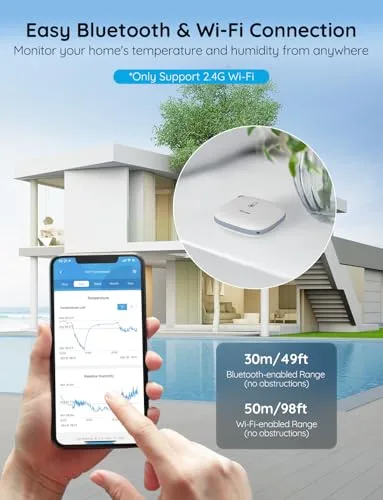
Govee Smart Thermometer Hygrometer (WiFi) ships with native Wi‑Fi (2.4GHz) plus Bluetooth, and it explicitly supports built-in remote internet access: Yes. In practice, that means remote monitoring and alerts can work immediately through the Govee Home app once it’s joined to your 2.4 GHz network—without adding any extra bridge device. For in-home coverage, the H5179 is rated for a Wi‑Fi range of up to 50 m (98 ft) without obstructions.
SensorPush HTP.xw, by contrast, is Bluetooth LE for its native connectivity and lists native Wi‑Fi support: Not supported. It also specifies built-in remote internet access: No, because off-site access requires the separate SensorPush G1 WiFi Gateway, turning «remote monitoring» into a two-part setup (sensor + gateway). That gateway requirement can be a deliberate choice if you want to start local-first and keep monitoring usable even when you’re not depending on a Wi‑Fi join process.
Conclusion: For straightforward, out-of-the-box remote viewing, Govee’s built-in 2.4 GHz Wi‑Fi is a clear advantage; SensorPush can match remote access only by adding a gateway.
Govee Smart Thermometer Hygrometer (WiFi) also supports older phones on paper—iOS 9.3+ and Android 4.3+—which can matter if you’re repurposing an old device as a «monitoring phone.» The trade-off is that Wi‑Fi onboarding brings typical network constraints (2.4 GHz requirement, router quirks) that can become the real point of failure rather than the sensor itself.
SensorPush HTP.xw requires iOS 11+ and Android 9+, a narrower compatibility window that may force an OS upgrade or newer device. But its Bluetooth-first model can be simpler for immediate local checks and reduces dependence on cloud connectivity unless you choose to add the G1 gateway for remote access later.
Winner: Govee Smart Thermometer Hygrometer (WiFi) — it delivers true remote monitoring without additional hardware, while SensorPush’s remote access is an optional (and extra) system.
Accuracy & Measurement Capabilities
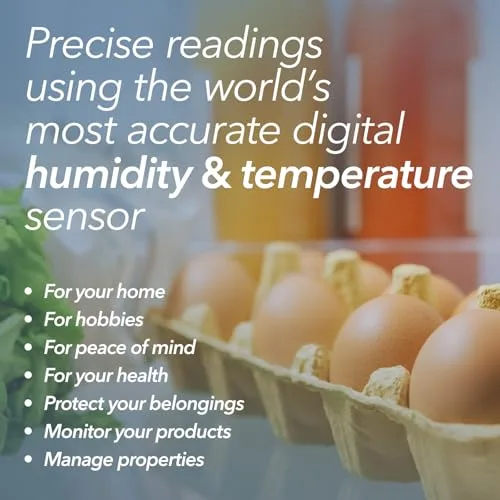
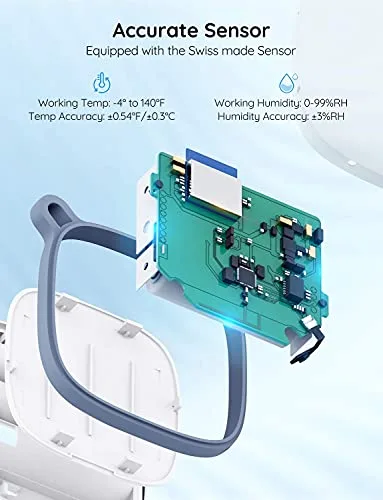
Govee Smart Thermometer Hygrometer (WiFi) specifies ±0.3°C (±0.54°F) temperature accuracy and ±3%RH humidity accuracy, covering -20°C to 60°C and 0–99%RH. It also lets you choose a faster sampling cadence—10, 30, or 60 seconds—which can make short-lived swings show up sooner in charts and alerts (the H5179 is documented as updating at those intervals).
SensorPush HTP.xw, by comparison, is rated tighter at ±0.2°C typical (±0.3°C max) and ±2%RH typical (±3% max), with a wider low-end temperature range of -40°C to 60°C and full 0–100%RH coverage. Its logging interval is fixed at every minute, which is usually sufficient for storage monitoring but slightly less responsive than Govee’s fastest 10-second mode.
Conclusion: For precision, SensorPush HTP.xw has the edge on both headline accuracy (±0.2°C typical vs ±0.3°C; ±2%RH typical vs ±3%RH) and operating range, while Govee’s advantage is faster configurable sampling (10–60s vs 1 min) if you’re chasing rapid changes.
Govee Smart Thermometer Hygrometer (WiFi) measures temperature and humidity only, which covers most «keep it in range» use cases (nursery, small greenhouse corner, wine cabinet spot-checking) but leaves out other environmental context. If you’re validating conditions beyond basic comfort/storage thresholds, you’re limited to interpreting temp/RH alone.
SensorPush HTP.xw adds barometric pressure alongside temperature and humidity. That extra metric can matter in «measurement problem» setups—where you correlate pressure shifts with humidity stability, weather fronts, or enclosure behavior—especially when you want longer-term consistency in readings and trend interpretation.
Conclusion: On measurement breadth, SensorPush HTP.xw clearly wins by including barometric pressure, which Govee doesn’t offer.
Winner: SensorPush HTP.xw
Battery Life & Power
Govee Smart Thermometer Hygrometer (WiFi) is rated for about 7 months of battery life and runs on 3× AA batteries. That shorter cycle is consistent with its always-available remote access approach, since it has native Wi‑Fi (2.4 GHz) alongside Bluetooth—Wi‑Fi radios typically impose a steady power cost compared with Bluetooth-only sensors.
SensorPush HTP.xw is rated for typical over 2 years on a single CR2477 coin cell (user replaceable). Its low-power profile aligns with its Bluetooth LE-first design (remote access isn’t built in and instead requires a separate gateway), which generally allows the sensor to spend more time in deep sleep between transmissions.
Conclusion: On pure maintenance burden, SensorPush is meaningfully better—2+ years vs ~7 months means far fewer battery swaps in «set-and-forget» placements (cabinets, storage boxes, instrument cases), even though both devices use user-replaceable batteries.
Winner: SensorPush HTP.xw
Data Logging & Alerts
History depth & data retention
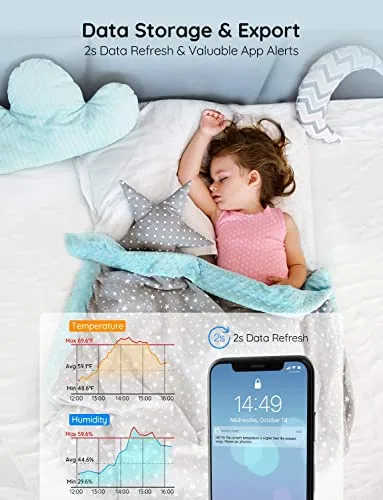
Govee Smart Thermometer Hygrometer (WiFi) shows 20 days of online history in the app, and it supports CSV export up to 2 years (a notably generous horizon for long-term trend checks). Its readings can refresh every 10/30/60 seconds, so the dataset can be quite granular when everything is connected. The trade-off is that the «online view» implies a cloud path for day-to-day history access.
SensorPush HTP.xw records continuously and keeps 30 days of on-board memory on the sensor itself, then syncs to the app whenever you reconnect—so history exists even without internet. In addition, it offers unlimited in-app storage plus CSV export, which fits the «measurement logbook» use-case (e.g., comparing weeks or months across multiple sensors). Its typical recording interval is once per minute, which is less granular than Govee but still dense for most environmental monitoring.
Conclusion: SensorPush has the stronger reliability-first logging model thanks to 30-day local storage + unlimited in-app history, while Govee is compelling if your priority is easy long-horizon exports (up to 2 years) and faster sampling.
Alerts & reliability when connectivity is imperfect
Govee Smart Thermometer Hygrometer (WiFi) supports threshold notifications and has built-in remote internet access, so alerts can reach you off-site without extra hardware. However, as noted in the editorial context, this convenience comes with cloud and home-network dependency—if Wi‑Fi or the cloud path is down, remote visibility (and the practicality of timely alerts) can degrade.
SensorPush HTP.xw also supports alert notifications, and its on-sensor 30-day memory helps prevent «mystery gaps» in the timeline when connectivity drops, because the device keeps logging and backfills later. The key limitation is remote alerting isn’t «out of the box»: native Wi‑Fi isn’t supported, and true remote monitoring requires the SensorPush G1 WiFi Gateway.
Conclusion: For out-of-the-box remote alerts, Govee is simpler; for data continuity and post-incident traceability when connections are flaky, SensorPush is more robust.
Winner: SensorPush HTP.xw — its 30-day on-board logging plus unlimited in-app history is a defensible advantage for consistent monitoring, even though Govee’s 2-year export and built-in remote access are strong conveniences.
App & Software Experience
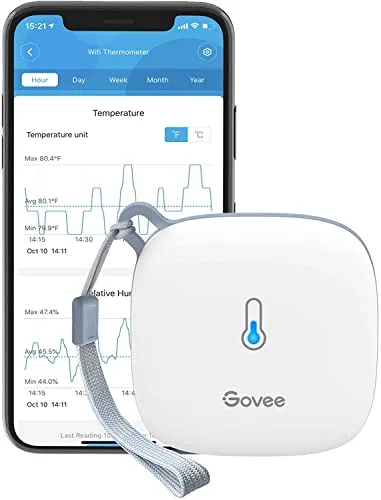
Govee Smart Thermometer Hygrometer (WiFi) is built around the Govee Home smart-home ecosystem, which is convenient if you already run other Govee devices (lights, sensors, etc.). Because it has built-in remote internet access (Yes) over 2.4 GHz Wi‑Fi + Bluetooth, the «check it from anywhere» workflow is native, and it’s optimized for quick glances and notifications. Data-wise, Govee offers 20 days online view and CSV export up to 2 years, which fits «is it in range?» monitoring more than deep analysis.
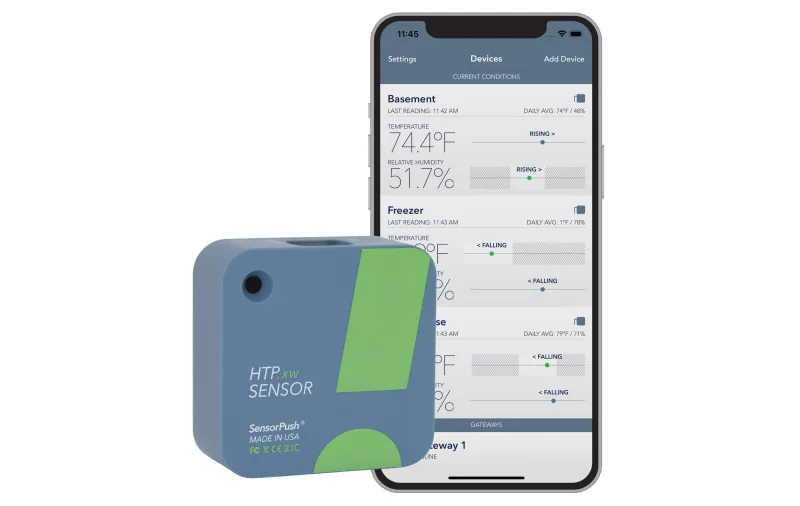
SensorPush HTP.xw uses a more monitoring-centric app experience that’s meant for reviewing graphs and treating readings like a logbook. By default it’s Bluetooth LE with no built-in remote internet access (remote requires the SensorPush G1 WiFi Gateway), which keeps basic operation local-first but adds a decision point if you truly need off-site viewing. For history handling, it stores 30 days on-board and provides unlimited in-app storage plus CSV export, which supports longer-term trend review across time windows.
Conclusion: Tie — Govee is the smoother pick for out-of-the-box remote checking inside a broader smart-home app, while SensorPush is stronger if your priority is a focused monitoring workflow and long-term, instrument-like data review (and you’re OK adding a gateway for remote access).
Build & Long‑Term Reliability
Govee Smart Thermometer Hygrometer (WiFi) is positioned as an indoor temperature/humidity monitor (model H5179), which implicitly limits how much abuse it’s meant to take in damp or harsh placements like basements or greenhouses. Its broader convenience story leans on built-in Wi‑Fi (2.4 GHz) remote access, which can be great day-to-day but also adds more long-term dependency on home network stability and cloud reachability.
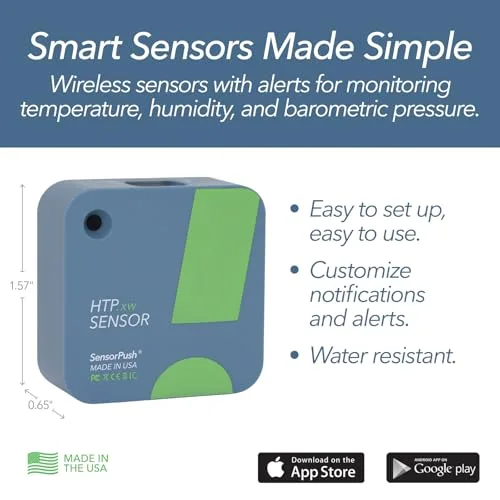
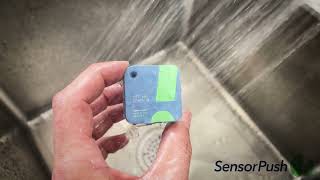
SensorPush HTP.xw, by contrast, is explicitly described as having a water-resistant design, a practical durability advantage when condensation or humidity spikes are part of the environment. It also behaves more like an «instrument» over time: it has 30 days of on-board memory plus unlimited in-app history, so it can keep logging locally even when your phone isn’t nearby.
Conclusion: For physical resilience and «set it in a tough spot and trust it» deployments, SensorPush’s water-resistant build is a clear advantage over an indoor-oriented Govee.
Govee Smart Thermometer Hygrometer (WiFi) is rated for about 7 months of battery life on 3×AA batteries, which means more frequent battery changes and more opportunities for a device to go offline unnoticed if maintenance slips. While it can refresh readings as fast as every 10 seconds, that pace doesn’t necessarily translate into longer service intervals.
SensorPush HTP.xw is rated at typical over 2 years on a user-replaceable CR2477, which better supports multi-year placements where you don’t want regular check-ins. Its once-per-minute logging cadence is slower than Govee’s fastest setting, but it’s aligned with long-term stability and lower maintenance.
Conclusion: On maintenance burden alone, SensorPush wins with 2+ years vs ~7 months estimated battery life.
Winner: SensorPush HTP.xw
The Bottom Line
After breaking down connectivity, accuracy, logging, apps, and long-term reliability, the choice comes down to whether you value instant remote convenience or instrument-style monitoring.
Best for casual home or nursery monitoring: The Govee Smart Thermometer Hygrometer (WiFi) is the clear pick because its built-in 2.4GHz Wi‑Fi delivers immediate remote viewing and alerts without adding a separate gateway.
Best for wine cellars, humidors, or lab spaces: Choose the SensorPush HTP.xw for its tighter accuracy, added barometric pressure, and reliability-first logging with 30 days of on-board memory for uninterrupted long-term records.
Best for multi‑sensor deployment with centralized history: The SensorPush HTP.xw is the stronger option since its monitoring-centric app and unlimited in-app history (plus local backfill) are built for comparing multiple placements over time.
In the end, this is an «it depends» matchup: Govee wins on out-of-the-box remote access and simpler off-site alerts, while SensorPush is the better long-haul tool for accuracy, durability, battery life, and data continuity.
The Govee and SensorPush serve two different philosophies. If remote convenience and affordability matter most, Govee is your champion. If you insist on measurement precision and data sovereignty, invest in SensorPush. Match your choice to your monitoring mission.
FAQ
Can the Govee WiFi thermometer be used without an internet connection?
Does the SensorPush HTP.xw require a gateway for remote access?
Which sensor is more accurate?
How long do the batteries last on each device?
Can I export data from either sensor?
How often can the Govee H5179 check temperature and humidity?
Is the SensorPush HTP.xw water-resistant?
How long does the SensorPush HTP.xw store data without syncing?
"Images are used for editorial and informational purposes only. All trademarks and images belong to their respective owners."