CyberPower PR1500RT2UC vs PRL1500RT2UC: Lead-Acid or Lithium for Your Rack?
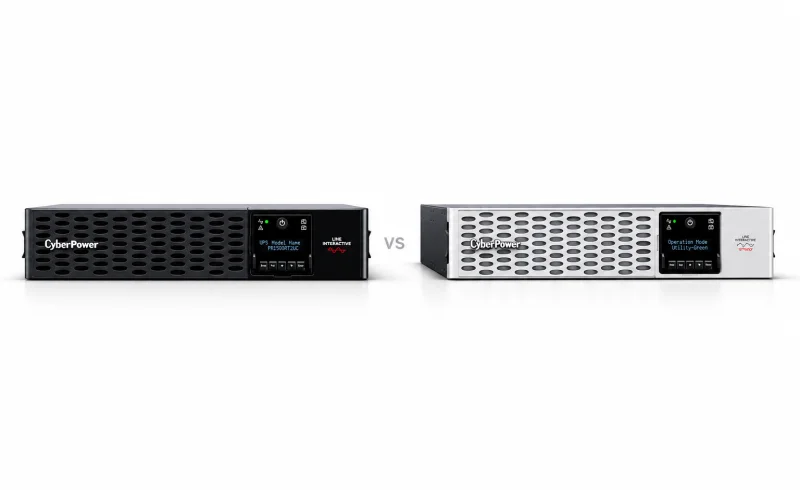
CyberPower rates the PRL1500RT2UC for longer runtime at 1500 W, while the PR1500RT2UC fits shallower racks; at 750 W, the claimed runtime gap is just 30 seconds.
TL;DR
The CyberPower PR1500RT2UC and PRL1500RT2UC deliver the same 1500 VA / 1500 W of backup power, but their batteries make them better suited to different setups.
The PRL1500RT2UC is the longer-term option. Its lithium-ion battery is designed for a longer service life, it carries a five-year warranty rather than three years, and CyberPower rates it for 8.7 minutes at full load versus 6.5 minutes for the lead-acid PR1500RT2UC.
The PR1500RT2UC has the physical advantage. Its chassis is 16.2 inches deep rather than 19.7 inches, a substantial difference in a shallow network rack. At 750 W, the two are almost tied on runtime: 18.2 versus 18.7 minutes.
The important question isn't simply which UPS lasts longer during an outage. It's whether your setup benefits more from a compact chassis or from a battery that should need replacing less often over years of service.
| Feature | CyberPower PR1500RT2UC | CyberPower PRL1500RT2UC |
|---|---|---|
| Capacity and backup | ||
| Rated capacity and runtime | 1500 VA / 1500 W; 18.2 min at 750 W, 6.5 min at 1500 W [1] [2]Manufacturer runtime ratings. | 1500 VA / 1500 W; 18.7 min at 750 W, 8.7 min at 1500 W [3]Manufacturer runtime ratings. |
| Battery and installation | ||
| Battery type and service | Sealed lead-acid; hot-swappable, user-replaceable RB1290X4J cartridge [1] | Lithium-ion; hot-swappable, user-replaceable RB1260X4 cartridge [3] |
| Rack/tower size and weight | 2U rack/tower; 17.1 × 3.4 × 16.2 in (W × H × D); 55.8 lb [1] | 2U rack/tower; 17.1 × 3.4 × 19.7 in (W × H × D); 54.2 lb [3] |
📑 Table of Contents
- How Much Backup Time Do You Actually Need?
- The Biggest Difference Is What Happens After Several Years
- Rack Depth May Settle the Question Before Anything Else
- Power Conditioning: More Similar Than Different
- Monitoring Matters More Than the LCD Screen
- Which One Makes More Sense Near a Desk?
- Final Verdict: Battery Longevity or a Shallower Chassis?
- FAQ
How Much Backup Time Do You Actually Need?
Imagine a power failure while a home server is writing data to storage. The UPS doesn't necessarily need to carry everything through a prolonged outage. It needs to keep essential equipment running long enough for a controlled shutdown.
That's where the load matters more than the headline capacity.
According to CyberPower's published specifications, the PR1500RT2UC and PRL1500RT2UC have these estimated runtimes:
- At 750 W: 18.2 minutes for the PR1500, compared with 18.7 minutes for the PRL1500.
- At 1500 W: 6.5 minutes for the PR1500, compared with 8.7 minutes for the PRL1500.
That extra 2.2 minutes at full load could matter if several servers need to finish shutdown sequences. But it is much less significant for a rack operating around 750 W, where the difference is only 30 seconds.
A lightly loaded networking rack is a different situation again. A router, switch, and NAS may draw considerably less than 750 W, depending on their specifications and activity. Neither of the two published runtime figures tells you exactly how long that particular setup will last.
Measure the complete system's power draw rather than adding up equipment power-supply ratings. Include devices that must remain operational during an outage, and account for changes in load when servers or storage become busy.
CyberPower's estimates assume fully charged, new batteries under normal conditions. Actual runtime changes with battery age, temperature, charge level, and connected equipment.
For a NAS or server, the more important precaution is configuring an automatic shutdown before the battery reaches its limit. Neither UPS should be treated as a substitute for a generator or another extended-duration power source.
The Biggest Difference Is What Happens After Several Years
The two models use fundamentally different battery technologies.
The PR1500RT2UC contains four sealed lead-acid batteries and uses the RB1290X4J replacement cartridge. The PRL1500RT2UC uses lithium-ion batteries and the RB1260X4 cartridge.
Both cartridges are user-replaceable and hot-swappable, but their expected service lives are different.
In its explanation of lithium and lead-acid UPS batteries, CyberPower describes typical design lives of approximately three to five years for conventional sealed lead-acid batteries and eight to ten years for lithium-iron batteries.
Those are technology-level expectations, not guaranteed replacement dates for either UPS. Temperature, usage, charging conditions, and the number of discharge cycles all affect actual battery longevity.
Still, the practical implication is clear.
A PR1500 installed in an always-on rack may require a replacement battery cartridge during a period when the PRL1500 is still operating with its original battery. That means another maintenance task, another battery to recycle, and another occasion to verify that the UPS is functioning correctly.
Lithium's advantage becomes more relevant when the rack is difficult to access or when outages happen frequently enough to cycle the battery regularly.
The warranty difference is substantial
CyberPower provides:
- PR1500RT2UC: Three-year limited warranty, including batteries.
- PRL1500RT2UC: Five-year limited warranty, including batteries.
The PRL1500 warranty covers a longer initial period, but that doesn't make the battery immune to aging after five years.
Both models still require battery-health checks. Hot-swappable also doesn't mean that protection is uninterrupted under every circumstance: if utility power fails while the battery is disconnected, there may be no backup available.
What about recovery after an outage?
The lithium model also has a documented charging advantage.
CyberPower specifies approximately two hours to recover to 90% charge after a full-load discharge for the PRL1500, compared with three hours to reach 90% for the PR1500.
These are comparable recovery targets, not full-charge times.
For a location experiencing several outages in one day, recovering most of the battery capacity sooner can matter. For a rack that experiences only occasional brief interruptions, the difference is less consequential.
Lithium doesn't automatically mean a dramatically lighter UPS, either. The PRL1500 weighs 54.2 pounds, compared with 55.8 pounds for the PR1500. The assembled units are close in weight despite their different batteries.
Rack Depth May Settle the Question Before Anything Else
Both UPS units occupy 2U of rack height. Their depth is another matter.
The PR1500RT2UC measures 16.2 inches deep. The PRL1500RT2UC measures 19.7 inches.
That 3.5-inch difference is easy to underestimate until the rack is assembled.
A shallow wall-mounted cabinet may accommodate the PR1500 while leaving room for rear connections, cable bends, and ventilation. The PRL1500 may extend too far into that same space.
But chassis depth alone isn't enough. Check the usable internal depth, front-to-rear mounting-post distance, rail requirements, and the clearance available behind the outlets. A UPS that technically fits between the doors may still leave too little room for power cords.
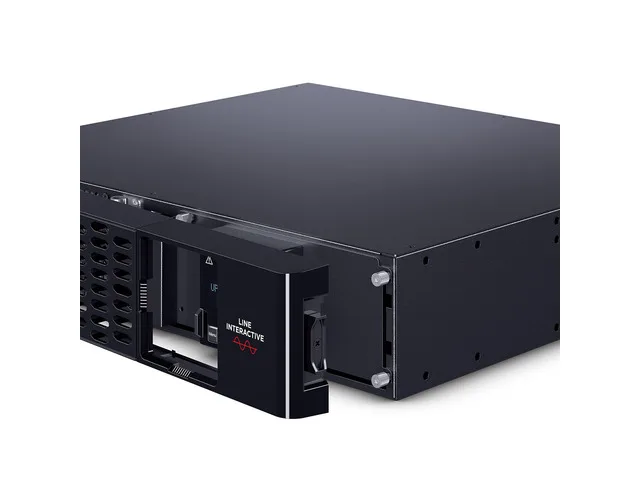
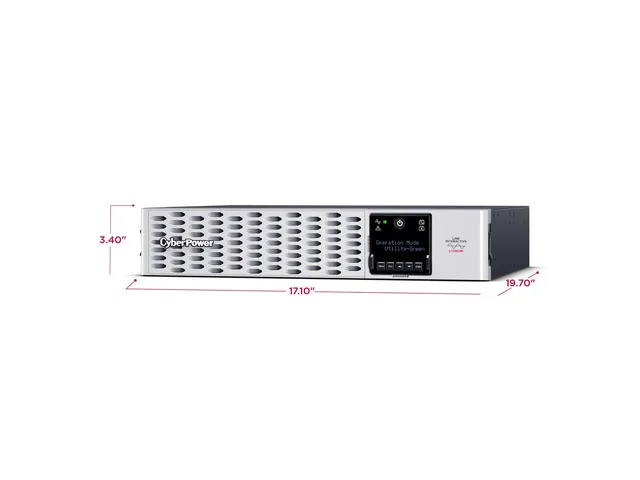
Both support rack and tower configurations. Their manuals describe two-post and four-post rack installation as well as vertical tower placement, although the mounting hardware and required clearances should be checked for the particular installation.
The PR1500's physical design can also be seen in the video below.
The connections are effectively the same
Each model provides eight NEMA 5-15R outlets with battery backup and surge protection, including four designated critical-load outlets.
This is useful when a rack contains equipment with different shutdown priorities. A server or NAS needs enough time to close files and stop services, while less essential equipment may be able to disconnect earlier.
Both UPS units also have a 10-foot input cord with a right-angle, 45-degree-offset NEMA 5-15P plug. The plug orientation can matter when the input receptacle sits close to another connection or inside a crowded cabinet.
These are North American 100–125 V UPS models. They are not interchangeable with CyberPower's similarly named 230 V versions intended for other electrical systems.
Power Conditioning: More Similar Than Different
The PR1500 and PRL1500 are both line-interactive UPS units.
When incoming voltage dips or rises moderately, their automatic voltage regulation can correct it without immediately drawing from the battery. Both use CyberPower's double-boost/single-buck AVR arrangement.
That matters in a building where the lights occasionally dim or voltage fluctuates under changing electrical loads. The UPS can compensate for supported fluctuations while preserving battery capacity for actual power interruptions.
Both also provide sine-wave output on battery, which is relevant to servers and desktop systems using active power-factor-correction power supplies.
Neither is an online double-conversion UPS with a continuously operating inverter and zero transfer time.
Is one faster when switching to battery?
CyberPower's current online specifications list 6 milliseconds typical transfer time and 11 milliseconds maximum at normal sensitivity for both models.
There is a documentation inconsistency worth knowing about: an older CyberPower PR1500RT2UC datasheet lists 4 milliseconds instead.
Because those published figures conflict, the supposed 2-millisecond advantage of the PR1500 is not a reliable reason on its own to favor that model.
Most conventional server and networking power supplies are designed to tolerate brief interruptions, but compatibility depends on the connected equipment. If a device has unusually strict power-continuity requirements, confirm its hold-up-time tolerance and obtain clarification about the UPS transfer specification.
Monitoring Matters More Than the LCD Screen
Both UPS units provide a multifunction LCD that can rotate for rack or tower installation. CyberPower also describes an adjustable viewing angle, useful when the UPS is installed near the bottom of a rack.
The screen is convenient for checking load, battery status, and operating conditions, but it shouldn't be the only way to discover that something has gone wrong.
For an unattended rack, automatic notifications and shutdown coordination are far more useful.
USB monitoring and automatic shutdown
Both models provide USB and serial communication and support CyberPower's PowerPanel Business software.
A directly connected computer can use compatible management software to monitor UPS status and initiate a controlled shutdown when battery conditions require it.
For a NAS, virtualization host, or multi-server setup, confirm that the chosen software and operating system support the intended shutdown arrangement. Having USB connectivity does not automatically guarantee that every connected device will shut down in the correct sequence.
Cloud monitoring versus local network management
Both UPS units include an Ethernet connection for built-in cloud monitoring.
That doesn't mean the port provides every local network-management function. CyberPower specifies the optional RMCARD205 for direct management through a web browser or network management system using SNMP/HTTP capabilities.
The distinction matters:
- PowerPanel Cloud provides remote status visibility and notifications through CyberPower's online service.
- The RMCARD205 enables network-based management through a dedicated management card.
- USB communication supports a directly connected computer running compatible shutdown software.
PowerPanel Cloud has service plans and licensing conditions, so built-in connectivity shouldn't be confused with unlimited free cloud service.
There's also a practical dependency: cloud alerts need a working network connection. If the modem or router loses power before the UPS can report an outage, remote monitoring may become unavailable at precisely the wrong time.
Keeping essential networking equipment on battery-backed outlets helps avoid that problem.
Which One Makes More Sense Near a Desk?
Battery chemistry alone doesn't establish which UPS will be quieter.
CyberPower lists the PR1500RT2UC at 52.5 dBA measured one meter from the unit. That specification doesn't establish how often its fan operates at that noise level during ordinary use.
The US PRL1500RT2UC product specifications don't provide a directly comparable acoustic figure.
It would therefore be misleading to call the lithium model quieter without comparable measurements.
This is especially relevant in a home office where the UPS sits under a desk rather than inside a separate network closet. Fan noise can become more noticeable during high loads, charging, or battery operation, and a rackmount UPS should not be assumed to behave like a silent consumer appliance.
Ventilation requirements are similar. CyberPower specifies approximately 93.3 BTU/hr of heat dissipation for the PR1500 in normal operation and 96.7 BTU/hr for the PRL1500 in AC mode. That small published difference doesn't establish a meaningful thermal advantage for either model.
Both need adequate airflow, especially in an enclosed cabinet.
If near-silent operation is essential, neither model has enough comparable published acoustic information to establish a clear winner.
Final Verdict: Battery Longevity or a Shallower Chassis?
The CyberPower PR1500RT2UC makes more sense in a shallow rack or an installation where replacing a lead-acid battery cartridge periodically is acceptable. Its 16.2-inch chassis is materially easier to accommodate, and at a 750 W load its rated runtime is almost identical to the lithium model's.
The CyberPower PRL1500RT2UC is better aligned with a long-term installation where reducing battery replacements matters. Its lithium-ion battery, five-year warranty, faster recharge to 90%, and additional runtime near the maximum load all support that use case. The trade-off is a deeper 19.7-inch chassis.
Neither model has a meaningful advantage in rated output capacity, outlet count, sine-wave delivery, AVR arrangement, or basic monitoring connectivity.
For a modestly loaded home network rack, battery longevity and physical fit are more decisive than the 30-second runtime difference at half load. For a heavily loaded server rack, the PRL1500's additional full-load runtime becomes more relevant.
The final check is straightforward: measure the rack, establish the equipment's actual wattage, and verify that its shutdown process can complete comfortably within the expected battery runtime. Those three details determine far more about reliable backup power than the battery label alone.
FAQ
How long will either UPS run a 1000 W setup?
Can I connect either UPS to my NAS for automatic shutdown?
Will the critical-load outlets automatically keep essential equipment running longer?
📄 Sources & Documentation
CyberPower PR1500RT2UC
CyberPower PRL1500RT2UC
Images are used for editorial and informational purposes only. All trademarks and images belong to their respective owners.