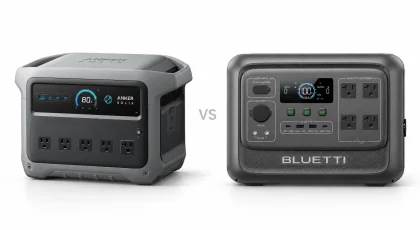
Anker SOLIX F3800 vs F3800 Plus: What Actually Changes for Home Backup?
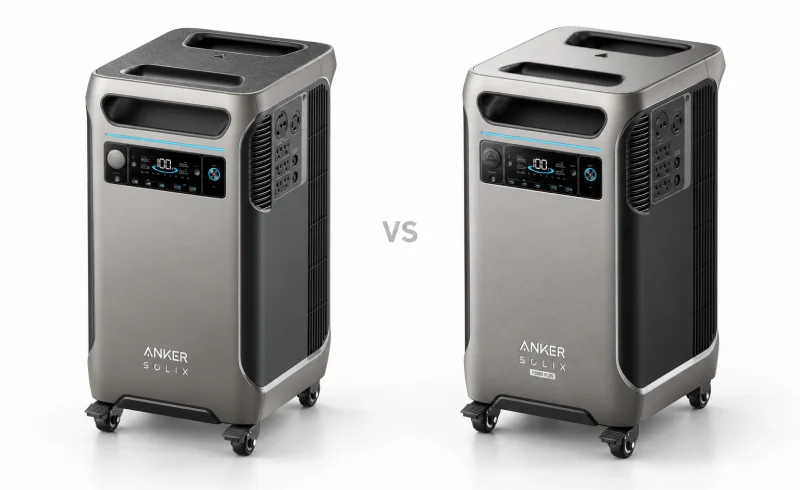
The Anker SOLIX F3800 Plus offers a wider direct-solar voltage range, not more base capacity; choosing between them depends on your array’s voltage and current limits.
TL;DR
The Anker SOLIX F3800 Plus is mainly an upgrade to how the battery recharges—not how much energy it stores or how much power it delivers. Both stations have a 3,840Wh battery, a 6,000W inverter with 120V/240V output, and the same expansion capacity.
The Plus has three meaningful differences:
- More flexible solar charging: Up to 3,200W across two 165V inputs, versus 2,400W across two 60V inputs on the original F3800. The higher voltage limit makes the Plus easier to pair with larger solar panel strings.
- Better generator integration: With Anker's separate Generator Input Adapter, the Plus can recharge from a compatible 240V generator while passing generator power through to connected loads. The original lacks this dedicated generator-bypass capability.
- A different high-power outlet: The Plus replaces the original's 240V NEMA 14-50 receptacle with a 120V TT-30R outlet for RV-style connections. Both retain a 240V L14-30R outlet.
For a household relying primarily on wall charging and a battery reserve during occasional blackouts, the original F3800 delivers essentially the same core backup capability. The Plus becomes more useful when replenishing energy from solar panels or a generator is central to the setup.
One limitation applies to both: an ordinary grid-tied rooftop solar system cannot recharge either station through Anker's Home Power Panel during a grid outage. Solar replenishment during a blackout requires compatible panels connected directly to the station.
The outlet and AC-charging details below concern North American 120V/240V models. Anker also sells regional configurations with different electrical connections.
| Feature | Anker SOLIX F3800 | Anker SOLIX F3800 Plus |
|---|---|---|
| Charging and expansion | ||
| Wall AC charging | 2,990 W maximum [1]UK guide: 220–240 V, 13 A maximum, 50 Hz. | 1,800 W maximum [2] [3]Documented wall input: 120 V, 15 A. |
| Direct solar input | 2,400 W total; 11–60 V inputs [1]UK guide: 1,200 W per input; 10 A at 11–32 V or 25 A at 32–60 V. | 3,200 W total; 11–165 V inputs [3]Each input: up to 1,600 W and 17 A; connect a separate solar array to each port. |
| Single-station battery expansion | Up to six BP3800 batteries; 26,880 Wh total [4] [5] [1] | Up to six BP3800 batteries; 26.9 kWh total [3] |
| Power and connected loads | ||
| AC voltage options | Review: 120/240 V split-phase; UK guide: 230 V [1] [6]TechRadar's January 2024 review limits the split-phase configuration to one 240 V device at a time. | 120/240 V output [3] |
| Wall-connected AC output | Review: UPS outlets only while externally powered [6]TechRadar, January 2024: other AC outlets required battery operation with external power disconnected. | 120 V bypass up to 1,440 W (12 A), through three UPS sockets [3]When connected to a wall outlet. |
| Base capacity and rated AC output | 3,840 Wh; 6,000 W continuous AC output [4] [1] | 3,840 Wh; 6,000 W AC output [7] [3] |
📑 Table of Contents
- Same battery, same power: What does that mean during an outage?
- Solar charging: The Plus has a real advantage, but not for every array
- Generator charging: The Plus's other major improvement
- Outlets: A difference that matters for RVs and EVs
- Home Power Panel: What happens when the grid fails?
- Will rooftop solar keep the batteries charged during a blackout?
- Living with either station between outages
- Final Verdict: F3800 or F3800 Plus?
- FAQ
Same battery, same power: What does that mean during an outage?
Imagine a blackout that takes out the refrigerator, internet connection, lighting, and heating system. Either F3800 can run suitable appliances, but there are two separate questions: Can the station supply enough power when those appliances are operating, and does it store enough energy to keep them running for the required time?
Both stations offer 6,000W of total AC output. That is the amount of electrical power they can deliver at once under their rated operating conditions. It does not mean they can supply 6,000W for an entire hour.
Each starts with 3,840Wh, or 3.84kWh, of nominal battery capacity. Theoretical runtime calculations illustrate how quickly that reserve can disappear:
- At a constant 500W load, 3,840Wh provides 7.68 hours before conversion losses and operating overhead.
- At a constant 1,000W load, that falls to 3.84 hours.
- A household averaging 500W continuously over a 24-hour outage needs 12kWh of energy before losses—more than three times either station's starting capacity.
Actual runtime will be lower than these ideal calculations. Refrigerators and heating systems also cycle on and off, so their energy use over an entire day matters more than a single running-wattage reading. Motor startup demands must be considered separately from continuous consumption.
The Plus does not have an inherent runtime advantage. With the same connected loads and comparable battery conditions, there is no basis for expecting it to last longer simply because it is the newer model.
Expansion changes the equation
Both stations support up to six compatible BP3800 expansion batteries, each adding another 3,840Wh. A fully expanded single-station system reaches 26.88kWh. Two appropriately connected stations, each with six expansion batteries, can reach 53.76kWh of combined capacity and up to 12,000W of rated output.
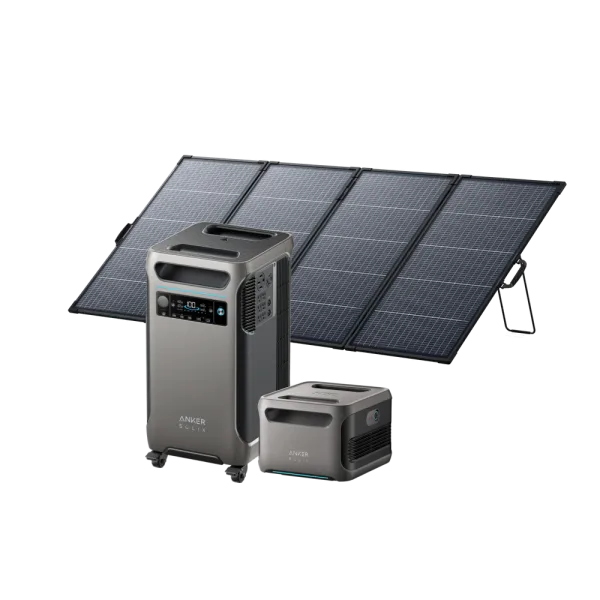
For a prolonged outage, additional battery capacity can matter substantially more than the distinction between F3800 and F3800 Plus. Expansion adds stored energy, not extra inverter output to an individual station.
Even a large battery system has practical limits. Heating, cooling, water pumps, and electric cooking can consume stored energy much faster than lighting and communications equipment. Prioritizing essential circuits is often more effective than trying to operate an entire household without restrictions.
Solar charging: The Plus has a real advantage, but not for every array
Solar charging is where the specifications diverge most clearly.
The original F3800 has two XT60 solar inputs rated for 11–60V and up to 1,200W each, allowing 2,400W combined. The F3800 Plus raises those limits to 11–165V, 17A, and 1,600W per input, for a combined maximum of 3,200W.
Those numbers describe two different improvements: higher maximum charging power and a much wider voltage range.
The higher wattage ceiling can replenish the Plus more quickly when sufficient sunlight and appropriately configured panels are available. The wider voltage range makes it easier to connect multiple panels in series, where their voltages add together.
That is particularly relevant with rigid residential-style panels. A string that exceeds the F3800's 60V input limit may fit within the Plus's 165V limit without requiring a different panel arrangement.
But higher maximum solar wattage does not mean the Plus accepts every panel configuration more efficiently.
Check voltage and current together
The original F3800 can accept more current than the Plus over part of its operating range.
According to Anker's published F3800 specifications, firmware version 2.1.1 and later supports up to 27A per input from 15–60V, subject to the 1,200W-per-port ceiling. Earlier firmware has different current thresholds and limits.
The Plus is limited to 17A per solar input across its 11–165V range. As a result, a compatible lower-voltage, higher-current array may work better with the original F3800 than the Plus, even though the Plus has the higher overall solar rating.
Before connecting panels, check:
- Open-circuit voltage (Voc): The total voltage of panels wired in series must remain below the station's maximum, including the increase in Voc that can occur in cold weather.
- Current: The panel configuration must respect the input's electrical limits, not just its advertised wattage.
- Power per input: The Plus supports up to 1,600W on each input, while the original supports 1,200W. The combined maximum is not available through one port.
- Connections: The original and Plus use different solar-input connections. Confirm that the appropriate charging cables and connectors are available.
Anker's F3800 Plus technical guide also specifies that each solar input has its own MPPT controller and should receive a separate array. Connecting the same array across both inputs can interfere with power tracking.
For a relatively small array delivering only a few hundred watts in typical sunlight, neither station gains anything simply from having a much higher input ceiling. For larger, correctly configured arrays, the Plus can accommodate solar arrangements that would exceed the original's voltage limit.
Generator charging: The Plus's other major improvement
A gas generator changes the calculation for a multiday blackout. Instead of depending entirely on whatever charge was stored before the outage, the station can be replenished whenever the generator is operating.
Both North American models support ordinary 120V AC charging at up to 1,800W through their wall-charging input. The original F3800 can also charge from a suitable 120V generator through that input. Anker specifies a pure sine-wave generator with total harmonic distortion below 5%.
The Plus adds a more capable generator connection through the separately supplied Anker SOLIX Generator Input Adapter.
With a compatible 240V generator, Anker specifies maximum charging rates of:
- 3,300W for the F3800 Plus alone.
- 4,300W with one BP3800 expansion battery.
- 6,000W with two expansion batteries.
These are charging ceilings, not guaranteed rates under every operating condition. The generator's available output, connected loads, battery configuration, and charging settings determine how much power remains for recharging.
Why generator bypass matters
The important difference is not merely faster charging.
Through the dedicated adapter, the Plus can let the generator power supported loads while the system uses available generator capacity to replenish its batteries.
This is different from charging the original F3800 through an ordinary 120V input, where the 240V output is unavailable while AC charging is active.
For a home relying on a 240V connection through an appropriate transfer-switch arrangement, that distinction can determine whether essential circuits remain supplied while the batteries are being replenished.
There are limits. Generator bypass requires the correct adapter and supported configuration; it is not a capability that can be added to the original F3800 through a generic cable. Anker's documentation also restricts generator-bypass configurations involving multiple stations.
Generator bypass should not be mistaken for zero-interruption power. Anker specifies switching intervals of approximately 30ms when transferring to generator power and 50ms when returning to battery power. Equipment that cannot tolerate even a brief interruption may need its own dedicated UPS.
For a home without a generator, or one that only needs occasional recharging from a conventional 120V outlet, much of the Plus's generator advantage goes unused.
Outlets: A difference that matters for RVs and EVs
The two models both supply 120V and 240V power, but their high-power receptacles are not identical.
The original F3800 has a NEMA 14-50 outlet and a NEMA L14-30R outlet, both offering 240V capability. The F3800 Plus retains the 240V L14-30R and replaces the 14-50 with a NEMA TT-30R, a 120V connection commonly associated with RV electrical systems.
For an RV with a compatible TT-30 connection, the Plus may eliminate a plug-format mismatch. For equipment that already uses a NEMA 14-50 connection, the original may be simpler.
The connector's name does not establish how much current the station can supply. In particular, the Plus's TT-30R output is limited to 3,000W at 120V, or 25A, rather than the full 30A associated with the receptacle type. Similarly, the original's 14-50 outlet does not provide 50A from the station.
Both models retain a 240V L14-30R connection with up to 6,000W output at 25A, subject to the overall station limit.
Both also support emergency EV charging through their appropriate 240V connection. Anker requires the vehicle or charging equipment to be limited to 25A or less and describes this capability as intended for emergencies rather than routine EV charging.
What happens to the outlets while AC charging?
This is an easy limitation to miss.
Both stations have three 120V UPS-enabled outlets. When connected to a conventional 120V wall supply, those outlets receive bypass power, with a 1,440W combined limit. If the external supply fails, Anker specifies a transfer to battery power within 20ms.
But the stations' full 6,000W output rating does not apply to that wall-powered bypass arrangement. In particular, the 240V output is unavailable while charging through the ordinary 120V AC input.
The Plus's dedicated generator-bypass path changes the available connections under generator operation, but it does not remove these limitations from ordinary wall charging.
For computers, networking equipment, medical devices, or other interruption-sensitive electronics, check their power-continuity requirements separately. A specified 20ms transfer time is not equivalent to a zero-transfer-time online UPS.
Home Power Panel: What happens when the grid fails?
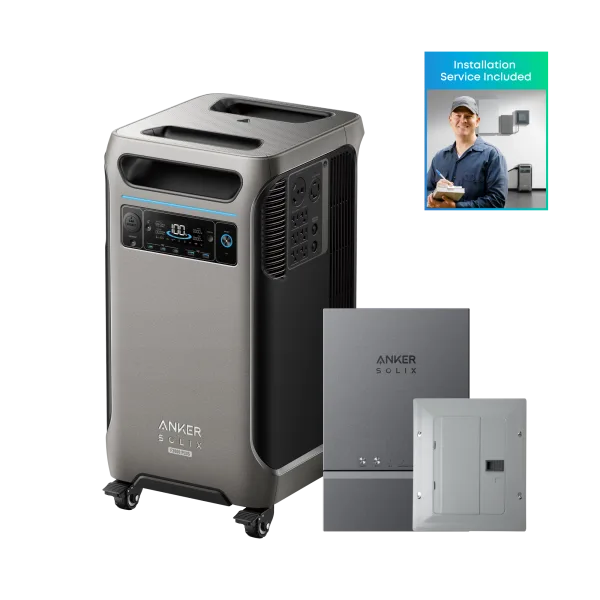
Both stations can work with Anker's Home Power Panel for an installed backup system. This should not be confused with plugging a few appliances directly into the power station.
With a compatible Home Power Panel installation, selected household circuits are connected through a backup load center. When utility power fails, the panel switches those circuits to battery power automatically. Anker specifies a transfer time of 20ms or less.
A manual transfer-switch installation is a different arrangement: it requires manual intervention rather than automatically taking over when the grid fails.
The F3800 system guide and the F3800 Plus design guide establish the same principal backup limits: one station can deliver up to 6,000W at 240V/25A, while an appropriately configured two-station system can supply up to 12,000W at 240V/50A.
That does not mean every home can operate normally from a single station. A central air conditioner, electric water heater, well pump, or several large appliances running together may exceed the system's limits. Starting currents can also be much higher than the normal operating draw.
A qualified installer should evaluate which circuits need backup and whether the inverter can handle their combined running and startup demands.
The outlets on the station are not available as usual
When a station is connected to Home Power Panel, the panel controls its AC input and output. Anker specifies that the station's own AC input and output ports are disabled in this configuration.
That matters if the plan includes both a permanently connected household backup system and equipment plugged directly into the station. The installed system cannot be treated as though every standalone outlet remains independently available.
The on-grid power limit is different
Both models also have a distinction between their outage rating and their output when connected to the grid through Home Power Panel.
In common configurations, Anker limits on-grid battery output to approximately 1.92kW for one station and 3.8kW for two. Additional expansion batteries can change the applicable limit. During a blackout, the higher 6kW-per-station backup rating applies.
This matters when using the battery for everyday time-of-use energy management. The power available for daily battery discharge should not be assumed to equal the emergency inverter rating.
Will rooftop solar keep the batteries charged during a blackout?
Not necessarily—and this limitation applies to both the F3800 and F3800 Plus.
An ordinary grid-tied rooftop solar inverter is required to stop exporting power when the utility grid fails. This anti-islanding protection prevents the solar installation from energizing a grid that utility workers may be repairing.
Consequently, even with bright sunlight on the roof, a conventional grid-tied system will not recharge either F3800 through Anker's Home Power Panel while the grid is down.
During normal grid operation, the Home Power Panel can integrate energy from a compatible rooftop solar installation. That does not make it an off-grid solar charger during an outage.
The alternative is to connect appropriately configured solar panels directly to the station's DC solar inputs:
- The F3800 accepts panel configurations within its 11–60V input range.
- The F3800 Plus accepts compatible configurations within 11–165V per input.
An existing rooftop installation cannot necessarily be moved from its solar inverter to either station. The string voltage may be too high, the wiring may not be suitable, and safe disconnection and reconnection require appropriate equipment and professional planning.
For a household expecting several days without utility power, the practical distinction is whether there is a usable source of energy during the outage, not simply whether solar panels are installed on the property.
The Plus's higher-voltage inputs make some direct-solar arrangements easier, but they do not eliminate the grid-tied inverter limitation.
Living with either station between outages
Both F3800 models are substantial pieces of equipment rather than portable batteries in the usual sense.
The original weighs approximately 132lb, while the Plus weighs approximately 137lb. Their wheels and handles make repositioning easier on suitable floors, but neither is convenient to carry up stairs or frequently move between locations.
Placement deserves attention before an emergency. Both can discharge between −4°F and 104°F (−20°C to 40°C), but battery charging requires 32°F to 104°F (0°C to 40°C).
A unit left in a freezing garage may still supply power, yet be unable to recharge until its battery returns to the permitted temperature range. Anker also recommends a dry, ventilated location and moderate storage temperatures.
For units kept disconnected in storage, Anker advises checking the remaining battery level weekly and performing periodic maintenance charging. Its technical guides also provide additional battery-cycling instructions for extended storage. Neither model should be assumed to remain indefinitely ready after being left unused for months.
Watch for automatic AC shutoff
Both models also have a behavior worth understanding when powering equipment intermittently.
Anker warns that an appliance connected only to a high-power outlet may not always be detected by the station's Smart AC Output system. If the detected load remains below 20W for 15 minutes, AC output can shut down automatically.
This can matter for equipment such as pumps or refrigerators that spend part of their operating cycle idle. The Anker app provides an option to disable Smart AC Output Mode so that AC output remains enabled.
Checking that setting before relying on an intermittently operating appliance is more useful than discovering the behavior during a prolonged blackout.
Final Verdict: F3800 or F3800 Plus?
The original Anker SOLIX F3800 remains a capable option for households that need 120V/240V backup power, expect to recharge mainly from ordinary AC power, and have solar panels compatible with its 60V inputs. Its NEMA 14-50 receptacle may also suit existing EV or RV equipment better than the Plus's revised outlet arrangement.
The F3800 Plus is better suited to setups where charging flexibility is the priority. Its 165V solar inputs accommodate a wider range of panel-string arrangements, and its dedicated generator interface supports higher-power recharging and generator bypass in approved configurations. The 120V TT-30R outlet is another practical distinction for compatible RV connections.
Neither has an advantage in starting battery capacity, rated inverter power, or maximum expansion storage. Both also share the restriction that grid-tied rooftop solar cannot replenish the battery through Home Power Panel during a utility outage.
For a short interruption, the important questions are which appliances need power and whether their electrical demands fit the station. For a multiday blackout, the determining factors become total energy consumption, expansion capacity, and the ability to recharge.
That is where the Plus can make a meaningful difference—not because it stores more energy, but because it offers more ways to restore that energy after it has been used.
FAQ
Can I keep my expansion batteries if I move from the F3800 to the F3800 Plus?
Will the Plus’s automatic switchover keep all my equipment running without restarting?
Does a two-station Plus installation also support generator bypass for both stations?
📄 Sources & Documentation
Anker SOLIX F3800
"Images are used for editorial and informational purposes only. All trademarks and images belong to their respective owners."