
Samsung HW-S60D vs TCL S45H: Dialogue, Bass, and Dolby Atmos
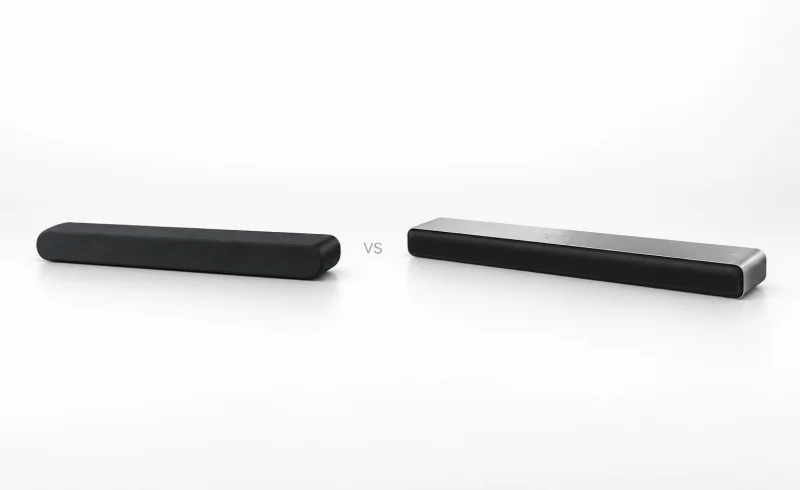
Samsung HW-S60D offers a 5.0-channel layout in a narrower bar, while TCL S45H suits USB music playback and room tuning; neither has up-firing speakers for overhead effects.
TL;DR
The Samsung HW-S60D has the stronger case for movies, dialogue-heavy TV, and everyday music. Its 5.0-channel design includes a dedicated center speaker and side-firing drivers. In RTINGS' independent testing, dialogue was clear, the overall sound was relatively balanced, and the soundstage extended beyond what its compact size might suggest.
The TCL S45H is a simpler 2.0-channel alternative. It handles ordinary TV audio and stereo music, supports Dolby Atmos through downmixing, and offers useful extras such as room calibration, Bluetooth, an analog input, and USB music playback. However, RTINGS found its soundstage relatively narrow and its bass response limited.
Neither soundbar includes a separate subwoofer or up-firing speakers. Dolby Atmos compatibility does not translate into convincing overhead sound on either model. Samsung offers more flexibility for a future speaker system, while TCL covers straightforward listening needs with fewer features centered on wireless streaming.
| Feature | TCL S45H Soundbar | Samsung HW-S60D Soundbar |
|---|---|---|
| Sound | ||
| Channels, speakers and audio formats | 2.0 stereo; Dolby Digital/DTS; Atmos and DTS:X with downmixing [1] [2]RTINGS reports Atmos and 5.1 content is downmixed to stereo. TCL also lists DTS Virtual:X. | 5.0-channel; Dolby Atmos/TrueHD/DD+, DTS 5.1 and multichannel LPCM [3] [4]Seven speakers, including center and side-firing speakers; no up-firing speakers. |
| Reviewed dialogue, bass and spatial effects | Mostly clear dialogue without competing sounds; little deep bass; bar-width soundstage [1]RTINGS’ November 2024 review, methodology v1.3; dialogue was forward but somewhat uneven, with poor height and surround effects. | Immersive DTS Virtual:X; some unclear dialogue; music bass lacking [5]Tom’s Guide’s June 2025 review; ambient effects sometimes masked dialogue, and acting or mixing may also have contributed. |
| Setup and everyday use | ||
| TV audio connections | HDMI eARC [2]EU product listing. | HDMI ARC/eARC with CEC; optical input; no HDMI input [6]eARC requires a TV that supports eARC. |
| App-based sound adjustment | TCL Home supports room calibration and personalized sweet-spot setup [2] | SmartThings adjusts EQ and listening modes [5] [4]SmartThings control requires a Samsung account and a wireless network connection. |
| Bar dimensions (W × H × D) | 31.89 × 2.36 × 3.86 inches [7] | 26.3 × 2.4 × 4.1 inches [3] |
📑 Table of Contents
- Dialogue: Why Samsung's Center Speaker Matters
- Surround Sound and Dolby Atmos: What You Actually Hear
- Bass: Two Different Designs, the Same Physical Limitation
- TV Connections: Both Rely on the Television
- Music: Samsung's Wi-Fi Streaming vs TCL's USB Playback
- Room Calibration and Everyday Controls
- Size and Placement: Samsung Is Shorter, TCL Is Shallower
- Final Verdict
- FAQ
Dialogue: Why Samsung's Center Speaker Matters
A quiet conversation can sound perfectly intelligible on almost any reasonable speaker. The harder test comes when voices compete with music, traffic, explosions, or a crowded restaurant soundtrack.
Samsung has a physical advantage here. Its HW-S60D uses a dedicated center channel, allowing dialogue in a multichannel soundtrack to be reproduced separately from much of the left- and right-channel activity. That does not eliminate masking from loud effects, but it gives the soundbar more control over how speech is presented.
RTINGS found Samsung's center-channel performance particularly strong, with well-balanced mids and clearly defined voices. That makes the S60D particularly relevant for television dramas, documentaries, sports commentary, and programs where understanding speech matters more than dramatic sound effects.
There is a qualification. In Tom's Guide's hands-on review, some dialogue sounded muffled or became difficult to follow during busier scenes. The difference between these assessments is a reminder that a dedicated center speaker does not guarantee equally clear speech across every soundtrack and listening mode.
Samsung provides Voice Enhancement and Adaptive Sound settings that can help bring dialogue forward, although their effectiveness will depend on the material.
The TCL S45H has no dedicated center channel. Dialogue is reproduced through its two stereo speakers, with processing available to emphasize voices. RTINGS described speech as generally intelligible when competing sounds were limited, but somewhat uneven and forward in the mix.
TCL's Voice mode, adjustable treble, and dedicated voice-enhancement controls give listeners ways to compensate. For news broadcasts and conversational television, the S45H can be entirely adequate. Samsung's advantage becomes more meaningful when dialogue clarity is a recurring concern across different kinds of programming.
Surround Sound and Dolby Atmos: What You Actually Hear
The channel numbers suggest a substantial difference: Samsung has 5.0 channels, while TCL has 2.0. But neither soundbar should be mistaken for a conventional surround system with speakers positioned behind the seating area.
The Samsung HW-S60D combines front-facing and side-firing drivers in one enclosure. Those side-firing speakers help spread sound laterally, so some effects can seem to extend beyond the television rather than coming directly from its center.
RTINGS found the Samsung's soundstage reasonably spacious for a compact soundbar, but its surround performance remained limited. Without rear speakers, it cannot consistently reproduce the separation and directionality of a system with speakers physically surrounding the listener.
The TCL S45H takes a different approach. Its two speakers reproduce stereo sound, and multichannel soundtracks—including Dolby Atmos and 5.1 audio—are downmixed for that arrangement. The original soundtrack remains compatible, but individual surround channels are not reproduced through separate speakers.
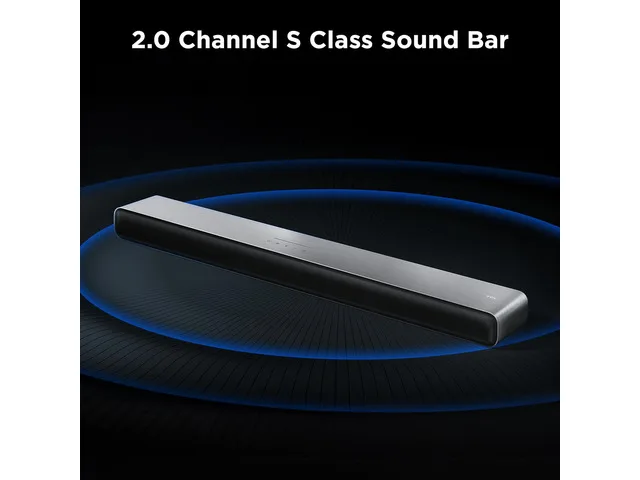
Both manufacturers also advertise DTS Virtual:X processing. This attempts to create a larger spatial impression from the available speakers. It is not equivalent to having physical rear or height channels, and its effectiveness depends on the recording, room, and listening position.
Crucially, neither bar has up-firing drivers. Their Dolby Atmos support relies on processing rather than speakers directing sound toward the ceiling. RTINGS reported poor height reproduction on the TCL and similarly limited Atmos height effects on the Samsung.
For a film dominated by conversations, music, and effects spread across the front of the room, Samsung's wider presentation has practical value. For scenes designed around helicopters overhead or sounds moving behind the viewer, neither standalone bar can reproduce the intended spatial effect particularly convincingly.
Bass: Two Different Designs, the Same Physical Limitation
TCL emphasizes its Dual Bass System, using internal acoustic chambers and processing to improve low-frequency output. The manufacturer's description suggests performance approaching a separate subwoofer, but that is a marketing claim rather than an independently established equivalence.
RTINGS' measurements tell a more restrained story. The S45H reproduces some upper-bass energy, but deep bass remains weak even with its bass adjustment increased. Low-frequency effects in action films and bass-heavy music consequently lack weight.
Samsung performs differently, though it has a similar limitation. RTINGS found a relatively balanced overall response with some emphasis in the higher bass frequencies. Kick drums and bass notes retain a degree of impact, but the soundbar cannot reproduce the lowest frequencies with the authority of a separate subwoofer.
The distinction matters most with material containing genuinely deep bass. Increasing the bass setting can change the balance of frequencies a soundbar already reproduces; it cannot fully compensate for the physical limitations of its drivers and enclosure.
Can the system be expanded later?
Samsung has a documented expansion route. Its U.S. HW-S60D specifications identify the SWA-W510 wireless subwoofer and SWA-9200S rear speaker kit as compatible accessories.
The subwoofer addresses the missing low bass, while rear speakers add actual sound sources behind the listener rather than relying exclusively on virtual effects.
There are installation considerations. The subwoofer requires mains power, and the SWA-9200S kit connects wirelessly to the soundbar but uses a power connection and a speaker cable between its two rear speakers. It is not a completely cable-free arrangement. Compatible accessory models can also vary by region, so the exact model designation matters.
TCL's S45H is designed primarily as a standalone stereo bar. Its standard specifications do not establish a comparable supported path to a complete surround system. TCL's related S55H model includes a separate subwoofer, but that is a different soundbar configuration rather than an accessory automatically compatible with the S45H.
TV Connections: Both Rely on the Television
Both soundbars support HDMI eARC and optical audio, making them compatible with a broad range of televisions. HDMI is generally the more capable connection when the television supports the appropriate audio formats.
There is an important limitation that is easy to overlook: neither model has a separate HDMI input for video passthrough.
A game console, Blu-ray player, or streaming device must connect to the television, which then sends audio back to the soundbar. TCL's advertised HDMI 2.1/eARC connection does not mean the S45H provides an extra HDMI 2.1 port for a gaming console.
For a television with several connected devices, that distinction matters more than the HDMI version printed on the packaging.
With a compatible TV, eARC can carry higher-bandwidth audio formats that ordinary ARC or optical connections cannot. Regular ARC remains useful for many common sound formats, including supported compressed Dolby audio. Optical is a fallback for basic stereo and compatible surround formats, but it does not carry Dolby Atmos.
The television's audio-output settings also matter. HDMI-CEC may need to be enabled for coordinated volume and power control, while audio passthrough or bitstream settings can affect which formats reach the soundbar.
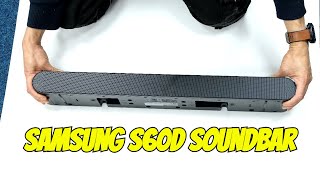
Samsung Q-Symphony vs TCL Tutti Choral
Both manufacturers offer features intended to combine compatible television speakers with the soundbar rather than silencing the TV speakers.
Samsung calls its implementation Q-Symphony. With selected Samsung televisions, the TV and HW-S60D can reproduce audio together. Samsung also offers wireless Dolby Atmos transmission with supported Samsung TVs. Neither feature should be assumed to work with every Samsung television.
TCL advertises Tutti Choral for the S45H in some markets. It similarly coordinates soundbar and TV audio, but TCL limits compatibility to specified television models and requires the appropriate connection.
These ecosystem features are secondary considerations unless the exact television model supports them. Importantly, Samsung's wireless Atmos integration is not required for ordinary HDMI eARC playback of compatible Atmos content from other TV brands.
Music: Samsung's Wi-Fi Streaming vs TCL's USB Playback
The two soundbars differ more clearly in how they receive music than in their basic ability to reproduce it.
Samsung supports Bluetooth 5.2 alongside Wi-Fi-based features including AirPlay, Chromecast, and Spotify Connect, according to its published specifications.
That matters in a household where music is played regularly from streaming services or compatible devices. Network playback can send or direct music to the soundbar without relying solely on a conventional Bluetooth audio connection. Available functions depend on the service, network, and controlling device.
The HW-S60D also benefits from its balanced midrange. RTINGS found vocals and lead instruments clear, although the lack of deep bass still limits music that depends on powerful low frequencies.
TCL offers Bluetooth 5.2 for wireless music playback, but its more distinctive advantage is physical connectivity.
The S45H includes a 3.5 mm analog input and a USB connection capable of playing music files directly. Its quick-start manual identifies support for:
- MP3
- WMA
- WAV
- FLAC
That makes the TCL useful for someone with a USB music library or an older audio source that connects through an analog cable. The soundbar can handle those files without a separate phone or computer providing the audio stream.
Samsung's USB connection, by contrast, is not intended for direct USB music playback.
The practical distinction is straightforward: Samsung offers more ways to integrate with network-based music services, while TCL provides additional options for local files and wired analog sources.
Neither soundbar is an ideal substitute for a system with substantial low-frequency output if bass-heavy music is a priority.
Room Calibration and Everyday Controls
Room calibration is not an exclusive advantage of the TCL, although it is one of the features TCL emphasizes.
Samsung's SpaceFit Sound Pro analyzes the listening environment and adjusts the soundbar's output. Samsung also provides equalizer settings, sound modes, and dialogue-related adjustments. Many controls are available through its remote or the SmartThings application.
TCL's AI Sonic-Adaptation uses the TCL Home app to tailor its output to the room and a selected listening position. TCL describes this as a way to establish a personalized listening area rather than relying on one fixed factory tuning.

Both systems attempt to compensate for the acoustic effects of placement and the surrounding room. Neither can add missing physical speaker channels or eliminate the limitations of a small enclosure.
The controls differ in emphasis. Samsung provides Adaptive Sound, DTS Virtual:X, Music, Game, and Standard modes, plus voice-enhancement and night-listening options. TCL offers modes for movies, music, voice, games, and sports, alongside bass, treble, surround-enhancement, and voice controls.
For someone frequently adjusting dialogue or reducing disruptive sound effects late at night, these options are more useful than a long list of supported audio trademarks.
One additional consideration is the application experience. Samsung's SmartThings control requires a Samsung account and network setup. TCL's calibration requires the TCL Home app. Basic remote operation remains available without using every connected feature.
Size and Placement: Samsung Is Shorter, TCL Is Shallower
These soundbars have notably different footprints despite similar heights.
The Samsung HW-S60D measures approximately 26.3 × 2.4 × 4.1 inches, while the TCL S45H measures 31.89 × 2.36 × 3.86 inches (width × height × depth).
TCL is roughly 5.6 inches wider, while Samsung requires about a quarter-inch more shelf depth. Samsung weighs approximately 6 pounds, compared with TCL's 4.51 pounds.
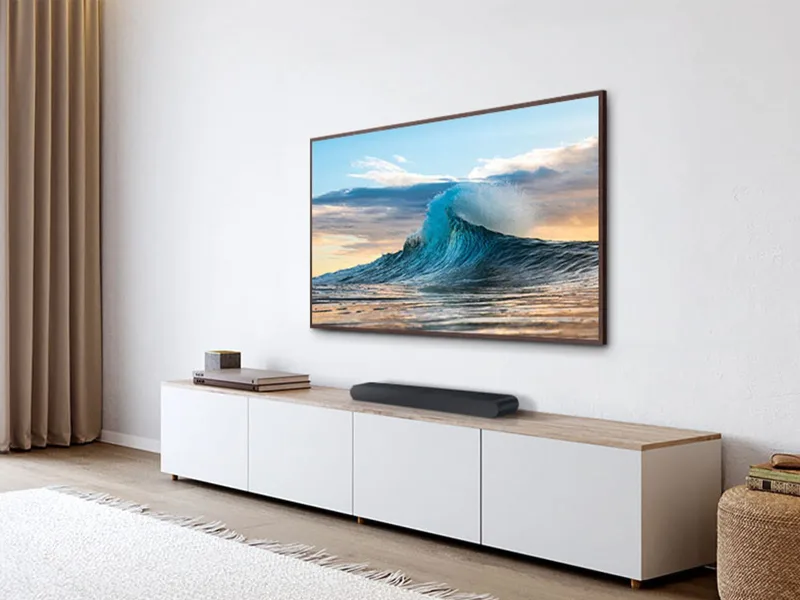
Samsung's shorter body is useful on narrow television stands, particularly where other devices compete for space. TCL's slightly shallower enclosure can be convenient on a narrow shelf, although its extra width still needs to be accommodated.
Both support wall mounting and include mounting hardware.
Before positioning either bar directly beneath a television, check the clearance between the stand and the lower edge of the screen. A soundbar that fits comfortably across the furniture can still obscure part of the picture or the television's remote-control receiver if the screen sits unusually low.
Final Verdict
The Samsung HW-S60D is the more capable all-around soundbar for listeners who prioritize dialogue clarity, a wider front soundstage, and network music playback. Its dedicated center channel and balanced midrange are meaningful advantages supported by independent testing. Its compact width and documented subwoofer and rear-speaker compatibility add flexibility.
Those strengths should not be confused with full home-theater performance. Without additional speakers, its surround reproduction remains limited, overhead effects are largely virtual, and deep bass is missing.
The TCL S45H makes sense as a straightforward stereo soundbar for ordinary TV programming, casual music listening, and setups where USB playback or an analog input matters. Its room calibration and sound controls add flexibility, but they do not overcome the narrow soundstage and limited low-frequency response identified in testing.
For dialogue-heavy television and mixed entertainment, Samsung has the clearer technical and acoustic advantages. For uncomplicated stereo listening with local media connectivity, TCL covers a different set of needs.
Neither standalone model is the right reference point for evaluating convincing overhead Atmos effects or powerful cinematic bass. Those experiences depend much more on physical height speakers, rear channels, and a dedicated subwoofer than on format compatibility alone.