
Gemini GPK-1200 vs. Supersonic IQ-5910DJWK: Karaoke Controls or a Built-In Screen?
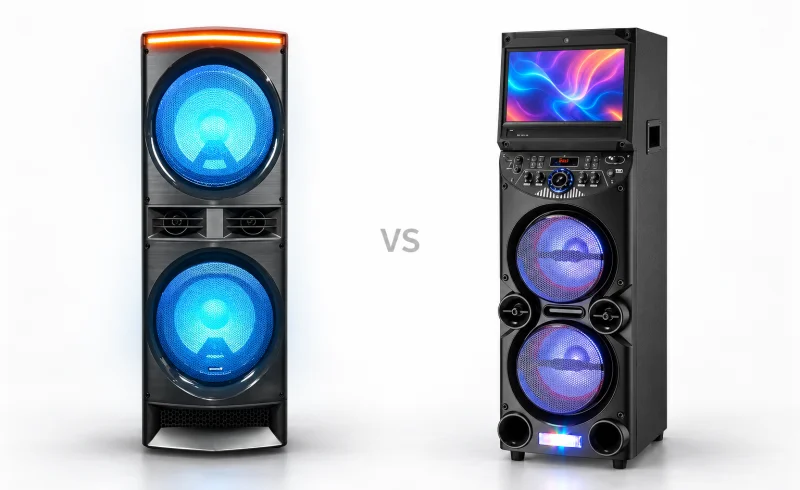
Gemini GPK-1200 suits vocal adjustments and guitar practice; Supersonic includes a 14-inch touchscreen, but check app compatibility with its Android 6.0 tablet.
TL;DR
The Gemini GPK-1200 is better suited to karaoke sessions where someone regularly adjusts microphones, balances vocals against backing tracks, or connects a guitar. It has dedicated microphone EQ and echo controls, pitch shifting, vocal reduction, USB recording, and separate music-volume adjustment.
The Supersonic IQ-5910DJWK takes a different approach, placing a 14-inch touchscreen above its speakers. It also offers SD playback, AV connections, and wheels for moving the system around. But its Android 6.0 tablet is a significant limitation: the current YouTube Android app requires a newer operating system.
Both systems include a wired microphone and remote control, support two microphone connections, and play music through Bluetooth, USB, AUX, and FM radio. Neither has a demonstrated advantage in sound quality or maximum usable volume based on the available specifications.
| Feature | Gemini GPK-1200 | Supersonic 2 x 10-inch Speaker System with 14-inch Touch Screen Tablet |
|---|---|---|
| Karaoke and speakers | ||
| Vocal and music adjustments | Pitch shifting, vocal reduction, mic priority, EQ presets, mic EQ/echo and separate music volume. [1] [2] | Not confirmed |
| Speaker driver configuration | Not confirmed | Two 10-inch full-range speakers and two 3-inch tweeters. [3] |
| Connections and controls | ||
| Control interface | Display and source-selection controls. [2] | 14-inch Android 6.0 touchscreen and included remote. [3] [4] |
| Microphone and audio connections | Two mic connections, AUX and guitar jacks; Bluetooth; USB MP3/WAV playback. [2] | Two mic jacks; Bluetooth, FM, USB, SD and AUX; AV input/output. [3]One microphone is included. |
📑 Table of Contents
- The Biggest Difference: Where Do Your Karaoke Lyrics Come From?
- Microphones: Gemini Gives You More Control Over the Performance
- Playing Music: More Shared Features Than You Might Expect
- Which System Sounds Better or Plays Louder?
- Living With a Large Karaoke Speaker
- Final Verdict: The Screen Is the Deciding Trade-Off
- FAQ
The Biggest Difference: Where Do Your Karaoke Lyrics Come From?
Picture a karaoke night with several people taking turns. Someone needs to find the next song, singers need to see the lyrics, and the music needs to reach the speakers. The two systems handle those jobs differently.
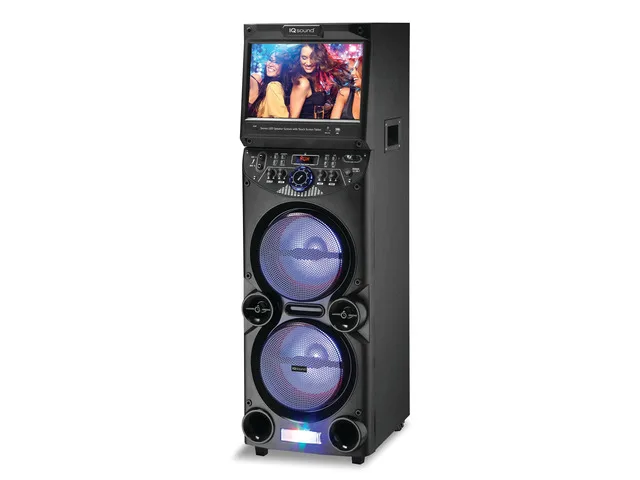
Supersonic's defining feature is its built-in 14-inch capacitive touchscreen. With a 1280 × 800 display and Wi-Fi connectivity, it offers a place to view content directly on the speaker rather than positioning a separate tablet nearby.
That arrangement makes sense when the singer stands close to the system. For a room full of people following the lyrics, however, a 14-inch screen may still be difficult to read from across the room.
The problem with Supersonic's Android tablet
The screen is useful only if it can run the content you actually want.
Supersonic specifies Android 6.0, a quad-core Cortex-A7 processor, 1GB of RAM, and 8GB of internal storage. That is an old, limited hardware and software configuration by current standards.
More importantly, Google's current YouTube mobile app requirements specify Android 9.0 or later. The Android 6.0 version advertised for the Supersonic tablet does not meet that requirement.
An older installed app or browser-based playback may behave differently, but neither should be assumed to work reliably without checking the actual device. Modern karaoke and streaming apps may have similar compatibility restrictions. Limited RAM and storage also constrain how comfortably the tablet can handle demanding applications.
Supersonic describes its tablet as HDMI-compatible and lists AV input and output for the speaker system. Those specifications do not establish exactly how external displays connect or whether the tablet can mirror its screen to a television. That matters if the intended arrangement involves lyrics on a larger screen.
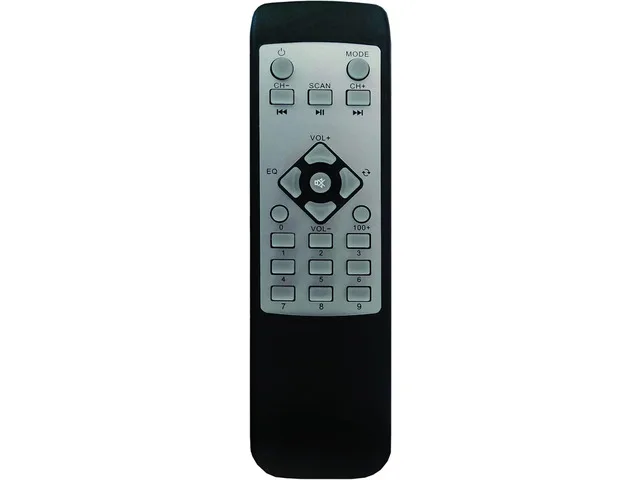
Gemini takes the simpler route. Its small display shows playback information rather than videos or lyrics. Music comes from a connected device or storage drive, leaving a phone, laptop, tablet, or television to handle the visual side of karaoke.
That means arranging a separate lyrics display when one is needed, but it also avoids depending on an aging Android installation built into the speaker.
Microphones: Gemini Gives You More Control Over the Performance
Both systems have two microphone inputs, and both include one wired microphone. A duet using separate microphones therefore requires an additional compatible mic with either system.
The difference emerges when singers have different voices, volumes, and preferences.
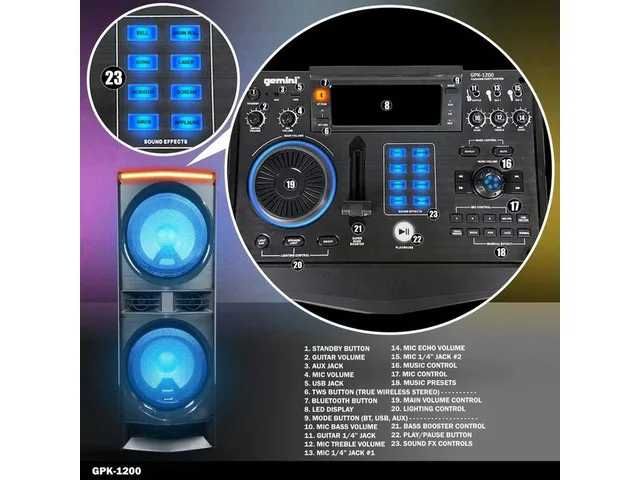
Gemini's control layout includes microphone bass, treble, echo, and volume adjustments, alongside separate controls for music volume and overall output.
Suppose one person sings softly while the next projects loudly. The microphone level can be changed without necessarily altering the backing track. If a voice sounds muddy or too sharp, the bass and treble controls offer basic tonal adjustment. Echo can add a sense of space, although excessive echo may make lyrics harder to understand.
Gemini also includes a microphone-priority function that lowers music playback volume when the microphone is being used. That's useful when someone wants to announce the next song or speak over the music without repeatedly reaching for the main volume control.
Pitch shifting and vocal reduction have limits
The Gemini manual documents pitch-shift buttons, a tone-reset function, and a vocal-reduction effect.
Pitch adjustment offers additional flexibility during karaoke, although the documentation is not sufficiently clear about exactly how the adjustment affects the microphone signal versus the accompaniment. Anyone who specifically needs to transpose backing tracks should verify that behavior rather than assume the controls provide full song-key adjustment.
Vocal reduction is another feature with an important qualification. Gemini provides a function intended to weaken the original singer's voice in a music track. Its effectiveness depends on the recording and how the vocals were mixed.
It should not be treated as a guaranteed way to turn every commercial song into a clean instrumental. Some original vocals may remain, and parts of the instrumentation may also be affected.
Supersonic's published specifications confirm two microphone connections but do not document the same range of pitch, vocal-reduction, microphone-EQ, or priority controls. Its touchscreen should not be mistaken for evidence that these audio-processing functions are available.
For households where singers frequently need different microphone settings, Gemini's documented physical controls are the more substantial distinction.
Playing Music: More Shared Features Than You Might Expect
The two systems have considerable overlap in ordinary music playback.
Both support Bluetooth audio, USB media, an AUX connection, and FM radio. Each also includes a remote control and built-in lighting effects that can be switched off.
That makes either system usable for a straightforward evening of music from a phone followed by karaoke with a wired microphone.
The differences become more relevant when the music comes from somewhere other than a phone.
Gemini: USB files, a guitar input, and recording
Gemini supports MP3 and WAV playback from USB storage, along with a 3.5mm AUX input. A collection of locally stored backing tracks can therefore be played without relying on an internet connection.
Its separate 1/4-inch guitar input and dedicated guitar-volume control are useful when alternating between singing and playing an instrument. The instrument level can be adjusted independently of the music.
There is also a built-in recording function. According to the GPK-1200 operating instructions, the speaker can record microphone, FM, or AUX audio to USB storage.
One restriction is easy to overlook: the manual states that music already playing from USB cannot be recorded back to USB. The recorder is a convenient way to capture supported audio inputs, not a general-purpose recorder for every playback source.
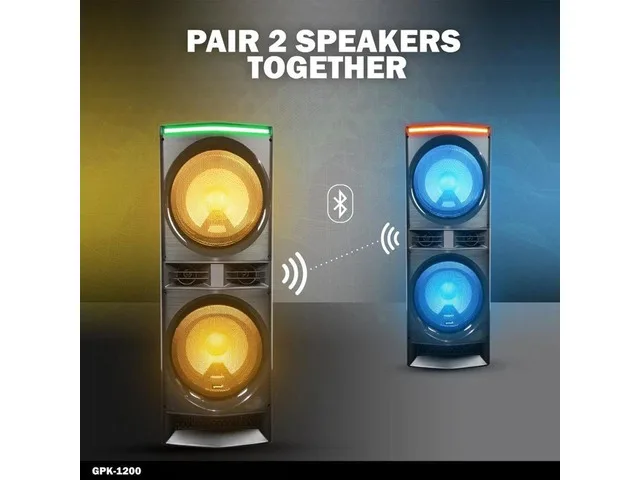
Gemini additionally provides True Wireless Stereo pairing with another compatible GPK speaker. That offers a route to a two-speaker setup, although it requires a second unit.
Supersonic: SD cards and additional AV connections
Supersonic adds an SD input to its speaker connections. The tablet also has microSD and USB support, although these should not automatically be treated as interchangeable with the speaker's own media inputs.
Its specified AV input and output may matter in a setup involving other audio or video equipment. The appropriate connection depends on the actual ports and signal routing.
For someone who primarily streams music from a phone, these extras may make little difference. For someone with an SD-based music collection or a particular wired AV arrangement, they could be more relevant than Gemini's guitar and recording functions.
Which System Sounds Better or Plays Louder?
The published specifications don't provide a reliable answer.
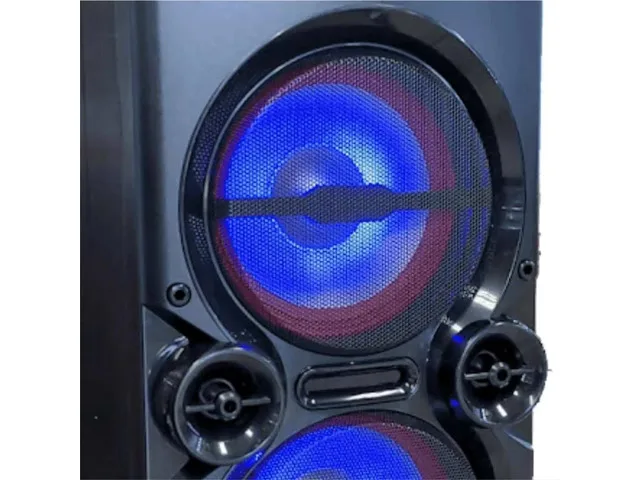
Gemini specifies two 12-inch woofers and two 3-inch tweeters. Supersonic uses two 10-inch woofers and two 3-inch tweeters.
The larger drivers in the Gemini may suggest greater potential for moving air at low frequencies, but driver diameter alone cannot establish deeper bass, cleaner vocals, or greater usable output. Cabinet design, tuning, amplifier behavior, and distortion at higher volumes all matter.
Power ratings are an especially poor shortcut here.
Gemini's product information advertises 6,000 watts of peak power while separately listing 1,200 watts as audio power. Those figures are not presented with sufficiently clear, comparable measurement conditions.
Supersonic specifies 800 watts peak and 80 watts RMS.
Peak marketing figures and RMS output ratings do not describe the same thing. Comparing the numbers directly would create a misleading impression of how much louder one speaker might play.
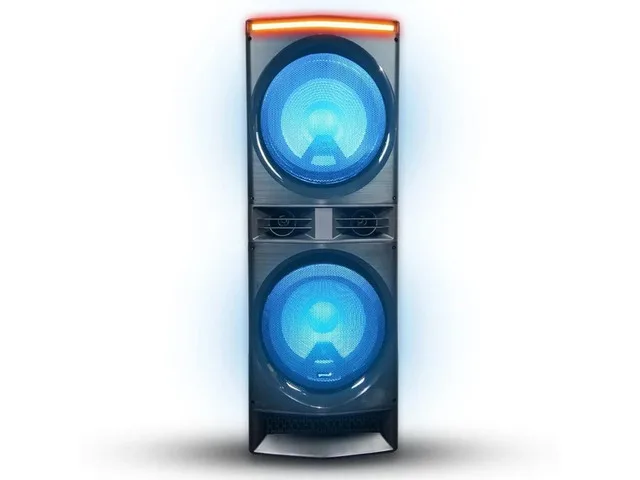
Gemini does offer a bass-boost function and Rock, Pop, Jazz, and Normal EQ presets. Those provide ways to change its tonal balance, but EQ settings cannot establish that the underlying speaker sounds better.
Supersonic publishes a frequency-response range of 45Hz–20kHz, while Gemini gives 20Hz–20kHz. Without consistent measurement tolerances and conditions, these numbers also cannot establish which system produces more convincing bass.

What matters in practice is whether vocals stay intelligible over the music, bass remains controlled, and the sound avoids obvious distortion at the volume the room requires.
Neither system has sufficiently comparable independent acoustic measurements to establish a winner on those points. A listening comparison using similar material, positioning, and volume would be more informative than the advertised wattage.
Living With a Large Karaoke Speaker
Neither system is a small tabletop device. Both are tall, floor-standing speakers that need space for the cabinet, cables, microphones, and people gathering around them.
According to the manufacturers' published dimensions:
- Gemini GPK-1200: approximately 15.75 × 11.81 × 45.31 inches, weighing about 46 pounds.
- Supersonic IQ-5910DJWK: approximately 13.77 × 13.38 × 43.50 inches, weighing about 36.4 pounds.
The Supersonic is somewhat shorter and lighter. It also has a built-in handle and wheels, which are particularly useful when moving it between a storage area and a living room without lifting the entire cabinet.
Gemini has carrying handles, but its greater weight makes frequent lifting less convenient.
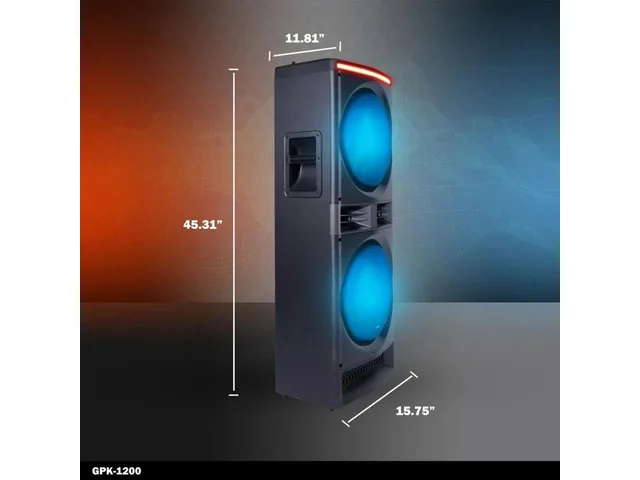
Power requirements deserve attention too. Supersonic explicitly lists a 110V/60Hz AC supply, while Gemini is supplied with a power cord. Neither should be assumed to operate as a cordless, battery-powered party speaker.
Supersonic's stated power specification is particularly important for use in regions with different mains voltage. The rating label and any required power conversion need to be checked rather than relying on the word "portable."
For either system, a stable location with ventilation clearance and a safely routed power cable matters more than the lighting effects. Gemini's manual specifically recommends keeping the unit away from heat and water and lowering volume controls before powering it on.
Final Verdict: The Screen Is the Deciding Trade-Off
Gemini GPK-1200 makes more sense when the karaoke session revolves around sound control. It offers clearly documented adjustments for microphone tone, echo, music level, pitch, and vocal reduction. Its guitar connection and USB recording capability add practical uses beyond ordinary music playback.
It does require an external device for lyrics, but that can be preferable to depending on an old operating system inside the speaker.
Supersonic IQ-5910DJWK makes more sense when an integrated display, SD playback, AV connectivity, and easier movement are the priorities. Its 14-inch screen is a genuine hardware distinction, especially for someone singing directly in front of the system.
The qualification is substantial: Android 6.0, 1GB of RAM, and 8GB of storage make the tablet's current application compatibility a central consideration, not a minor technical detail. Its usefulness for modern online karaoke services cannot be assumed from the presence of a touchscreen and Wi-Fi alone.
For simple Bluetooth playback and occasional karaoke, the systems share most of the essential functions, including a microphone, remote, FM radio, and two microphone inputs. Neither has a verified advantage in sound quality or usable loudness.
The meaningful difference is therefore not the size of the advertised power number. It's whether more control over the singing and audio matters more than having a screen attached to the speaker.