
Emporia Vue 3 vs. Siemens Inhab: Circuit Monitoring, Solar, and Home Compatibility
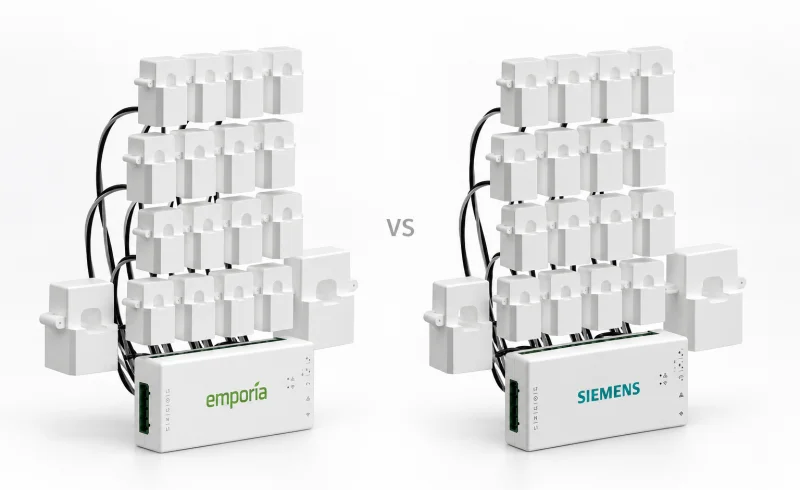
Compare Emporia Vue 3 and Siemens Inhab for panel fit and sensor needs, with Inhab the choice for branches above 50A but below 75A on compatible electrical systems.
TL;DR
Emporia Vue 3 and Siemens Inhab are more alike than their branding suggests. Both measure whole-home electricity use, support up to 16 individual branch-circuit sensors, work with Ethernet or 2.4 GHz Wi-Fi, and provide historical energy data through cloud-connected apps.
Emporia Vue 3 offers more flexibility in how a system starts and expands. It comes in configurations with zero, eight, or sixteen branch sensors, supports optional flexible main-current sensors for difficult panels, and works within Emporia's broader energy-management platform.
Siemens Inhab is a comparable option when sixteen branch sensors are needed immediately. Its documented INHEM1216 package includes all sixteen, and its Siemens-branded app provides circuit history, alerts, and CSV exports. The app is powered by Emporia, so those software capabilities are not exclusive to Siemens.
Neither has a decisive advantage for higher-current branch circuits. Both use 50A-rated branch sensors, even though their measurement electronics can report currents above that rating. Panel compatibility, the number of sensors required, and the connected devices you intend to use are more useful distinctions.
| Feature | Siemens Inhab Energy Monitor | Emporia Vue 3 Home Energy Monitor |
|---|---|---|
| Monitoring coverage | ||
| Sensor capacity per monitor | Up to 16 branch CTs and 3 mains CTs. [1] [2]Mains monitoring is optional; count depends on phase. Multi-pole circuits use one CT per leg or a multiplier; Siemens generally discourages multipliers on subpanels. | Up to 16 branch CTs and 3 mains CTs. [3] [4] [5]Included sensors vary by bundle. Multi-pole circuits use one CT per pole for greatest accuracy; a single-CT multiplier is inaccurate for unbalanced loads. |
| Solar production monitoring | Solar monitoring uses a reversed 50A CT on AC lines. [2]Included CTs cannot monitor the inverter’s DC side. | Branch CTs on inverter leads, configured as Solar/Generation. [5]Separate production monitoring requires branch CTs; mains CTs provide net metering. |
| Everyday access and connectivity | ||
| Network connectivity | 2.4 GHz Wi-Fi or Ethernet; wired LAN prioritized. [2] [6]Internet required; setup requires 2.4 GHz Wi-Fi and uses Bluetooth assistance. | 2.4 GHz Wi-Fi or Ethernet; wired LAN preferred with Wi-Fi fallback. [5] |
| Data access and export | Mobile/web access; circuit-history comparisons and emailed CSV exports. [7] | Mobile/desktop circuit graphs; export one monitor or Smart Plug at a time. [8]A reviewer reported limited graph navigation and roughly one month per download. |
📑 Table of Contents
- What Can These Monitors Actually Tell You?
- How Many Circuits Can You Monitor?
- Does Siemens Have an Advantage Above 50 Amps?
- Solar Monitoring: Grid Flow Is Not the Same as Production
- App Experience, Historical Data, and Alerts
- Energy Monitoring Is Not the Same as Appliance Control
- Panel Compatibility May Matter More Than the App
- Ethernet, Wi-Fi, and What Happens During an Outage
- How Accurate Are the Readings?
- Final Verdict: Which Home Is Each Better Suited To?
- FAQ
What Can These Monitors Actually Tell You?
Imagine your electricity bill has climbed, but you cannot tell whether the heat pump, water heater, or EV charger is responsible. Either monitor can help separate those loads, provided each has a sensor on its circuit.
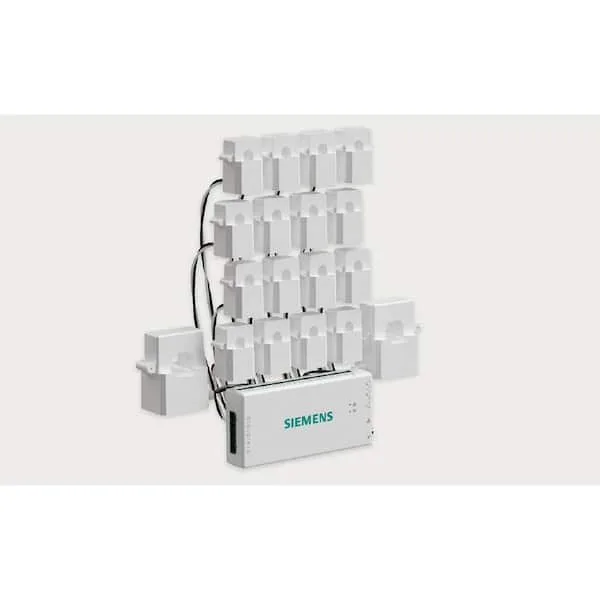
Both systems use current transformers, or CTs: clamps installed around electrical conductors. Larger sensors monitor the main service lines, while smaller ones measure selected branch circuits. The app combines those readings with voltage measurements to calculate power and energy consumption.
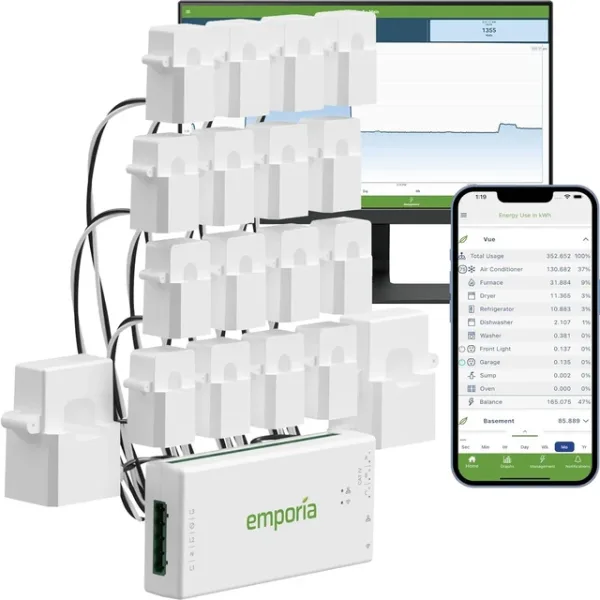
There is an important limitation shared by both products: a circuit reading is not necessarily an appliance reading.
If an EV charger has its own circuit, its energy consumption is relatively straightforward to identify. A kitchen circuit powering a refrigerator, microwave, and several outlets is different. A sensor reports their combined electricity use, not a separate figure for each appliance.
That distinction matters when investigating small, persistent loads. Either monitor can show that a circuit consumes energy overnight, but additional measurements may be necessary to identify the particular device responsible.
The main sensors also provide a broader view of electricity use. Comparing their measurements with the individually monitored circuits helps reveal consumption elsewhere in the home. That difference is useful, but it does not identify the unmonitored appliances.
How Many Circuits Can You Monitor?
Both monitors have sixteen branch-sensor inputs. The number of sensors supplied, however, depends on the configuration.
Emporia's Vue 3 documentation describes configurations with no branch sensors, eight sensors, or sixteen sensors. Starting with eight can make sense when the main concern is a handful of high-consumption circuits, such as HVAC equipment, an electric water heater, a dryer, and an EV charger. Additional sensors can be installed later.
Siemens lists the INHEM1216 with sixteen 50A branch CTs and two 200A main CTs. That provides the full branch-sensor complement for a typical North American split-phase installation.
A sensor input does not always equal one complete appliance circuit, though.
A 240-volt appliance can complicate the count
Many large North American appliances use two-pole breakers. A purely 240V load with balanced current on both legs can sometimes be monitored using one CT and a multiplier in the app.
But not every two-pole circuit is balanced. Some 120/240V appliances also power components from individual legs. A single sensor with a multiplier can miss those differences.
Both manufacturers support monitoring multiple conductors separately, and that is the more dependable arrangement when the load is unbalanced. Two sensors then occupy two of the sixteen available inputs, even if their readings are combined under one appliance name.
This becomes significant when several large appliances, a solar inverter, and a subpanel all need individual measurements. Sixteen inputs can disappear faster than a count of breaker labels suggests.
For more than sixteen branch inputs, both manufacturers support installations with multiple monitors. Emporia also documents combined and nested Vue configurations, which can help organize measurements across larger electrical systems.
Does Siemens Have an Advantage Above 50 Amps?
The current ratings require more care than the labels initially suggest.
Both systems use branch CTs designated 50A, and both manufacturers describe measurement ranges extending beyond that nominal rating.
Siemens' Inhab FAQ states that its branch measurement ports can report currents up to 75A. Beyond that point, the displayed measurement reaches its limit. Installing a larger CT on the same branch input does not remove the port's measurement ceiling.
Emporia's CT accuracy guidance also describes operation beyond the nominal 50A rating. According to Emporia, its branch CTs remain accurate up to approximately 63A under the tested conditions, begin to saturate above that level, and underreport increasingly as current approaches 75A.
The distinction is between a sensor's rated operating range and the maximum current its electronics can display. A 75A measurement ceiling does not automatically make a 50A-rated sensor suitable for every circuit operating near 75A.
For a high-current EV charging circuit, feeder, or other substantial load, the circuit's actual continuous current and the manufacturer's installation guidance matter more than the breaker label alone. A breaker rated at 60A, for example, does not establish that the connected equipment continuously draws 60A.
Neither system should be treated as the clear winner for currents between 50A and 75A solely because of its documented measurement ceiling.
Emporia also documents using a dedicated Vue with main-sensor inputs to monitor certain higher-current feeders. That is a different installation arrangement, not a way to turn an ordinary branch input into a higher-rated channel.
Solar Monitoring: Grid Flow Is Not the Same as Production
Both products support solar installations, but what appears in the app depends on where the sensors are installed.
The main CTs can measure net electricity flowing between the home and the utility grid. A negative net reading can indicate that solar generation exceeds household consumption.
That does not necessarily tell you how much electricity the solar panels produced.
For example, if a solar system produces 5 kW while the home consumes 3 kW, the grid may see approximately 2 kW of export. The net reading alone cannot distinguish those two underlying figures.
To measure solar generation separately, additional CTs generally need to monitor the inverter's AC output conductors. Both manufacturers document this arrangement.
Emporia's solar monitoring guidance explains how sensor placement changes between breaker-fed and line-side-tap installations. Siemens addresses the same distinction in its Inhab installation documentation.
Neither system's standard CTs measure the DC wiring between solar panels and the inverter.
When solar wiring changes the result
A solar connection located upstream of the main sensors can alter what those sensors observe. Without the correct placement and app configuration, the monitor may report household consumption without properly accounting for exported electricity.
The installer therefore needs to identify how the inverter connects to the electrical system before assigning the CTs.
A solar installation may also consume several branch-sensor inputs. The number depends on the inverter wiring and whether each conductor is measured separately.
For a household mainly interested in total electricity imported from or exported to the grid, main-sensor monitoring may be sufficient. Separately tracking solar production and household consumption requires a more deliberate sensor arrangement.
App Experience, Historical Data, and Alerts
This is another area where the products have more in common than might be expected.
Both manufacturers advertise real-time energy readings, historical consumption, circuit-level comparisons, and notifications.
The Siemens Inhab Energy app listing describes energy goals, alerts, utility-rate comparisons, and historical CSV exports. It also explicitly identifies the app as powered by Emporia.
Emporia offers corresponding capabilities through its own mobile and web applications.
What the data looks like over time
A real-time power reading answers a different question from an energy-history graph.
Watts show how much power a circuit is drawing at a particular moment. Kilowatt-hours show how much energy it used over a period. The second figure is generally more useful when comparing daily or monthly consumption.
Both systems internally sample voltage and current at approximately 24,000 samples per second and calculate RMS averages twice per second. Those engineering figures do not mean that either app provides a downloadable 24,000-sample-per-second waveform.
For Emporia, the current CSV export documentation specifies several levels of historical detail:
- One-second readings for up to three hours.
- One-minute readings for up to seven days.
- Fifteen-minute readings covering the selected export period.
- Hourly and daily energy totals for longer comparisons.
Exports are requested through the app and delivered by email as downloadable CSV files. A device and date range can be selected.
Siemens also documents emailed historical CSV data. Its public app description does not establish an identical set of export resolutions and retention limits, so the two systems should not be assumed to produce exactly the same files.
For someone investigating when a heat pump cycles or how household demand changes throughout the day, the available time resolution matters more than the monitor's internal sampling rate.
Alerts are available on both
Siemens supports energy goals and notifications about unusual usage. Emporia likewise provides energy alerts, usage history, and configurable energy-management features.
Neither system should be selected on the assumption that Siemens alone offers notifications or that Emporia cannot export circuit data.
The more meaningful distinction is what else the monitoring system needs to work with.
Energy Monitoring Is Not the Same as Appliance Control
A monitor can show that an EV charger is drawing substantial power. That does not mean the monitor itself can reduce charging current or switch the circuit off.
Those actions require compatible controllable equipment.
Emporia's ecosystem includes smart plugs, EV chargers, and other supported connected devices. Its energy-management software can coordinate compatible equipment around utility-rate schedules, excess solar generation, and power-demand limits.
Siemens describes similar energy-management possibilities through Inhab and compatible devices.
However, Siemens also markets separate products, including the Inhab Load Manager and Inhab Controllable Breaker. Their capabilities should not be attributed automatically to the standalone Inhab Energy Monitor.
The same caution applies to the Emporia Vue 3: its measurements do not independently provide switching or electrical load-shedding hardware.
For a home with an existing smart charger or automation system, the practical question is whether that specific equipment is supported by the intended energy-management configuration.
And despite the presence of Ethernet ports, neither monitor is designed as a standalone local-data server. Their standard monitoring platforms depend on cloud services.
Panel Compatibility May Matter More Than the App
An energy monitor that works well on paper is of little use if its sensors cannot safely fit around the conductors or its controller has nowhere suitable to mount.
Both manufacturers describe support for single-phase, split-phase, and compatible three-phase electrical systems.
For three-phase installations, the important distinction is the wiring configuration. The documented supported arrangements include grounded-neutral Wye systems; Delta configurations are not supported under the standard specifications.
Both use 200A-rated main CTs and have a maximum line-to-neutral voltage specification of approximately 264V.
A three-phase installation generally needs three main CTs, one for each live phase. The Siemens INHEM1216 package includes two, so a third is required. Emporia offers configurations with three main CTs.
High-leg systems, unusual voltage relationships, and inaccessible service conductors also require additional compatibility checks.
Tight panels and unusual conductors
The Vue 3's standard branch CTs have a 10 mm internal opening. Its conventional main CTs have larger openings, but some panels use bus bars or conductor arrangements that do not accommodate rigid clamps.
Emporia offers optional flexible current sensors for certain constrained installations. These can wrap around conductors where a conventional clamp will not fit, although they require their own supporting electronics and an additional power connection.
Siemens supplies conventional CTs with its standard Inhab configuration. Its installation documentation warns against substituting unsupported third-party sensors. Accessories from the two product families should not be treated as interchangeable simply because their monitoring platforms are related.
Cable length can matter as well.
Emporia documents extensions up to 30 feet for Vue 3 CT wiring under its specified conditions. Siemens' Inhab FAQ describes CT extensions shorter than 20 feet using appropriately rated wiring.
Those differences become relevant when sensors must reach a separate enclosure or a distant part of the electrical installation.
Both devices also require clearance from exposed energized components. Their installation guides specify at least two inches between the monitor and live parts, excluding insulated cables.
These are not installations where turning off the main breaker makes every conductor safe. Service conductors may remain energized. A qualified electrician should assess the enclosure, current ratings, wiring arrangement, and applicable electrical code before installation.
Ethernet, Wi-Fi, and What Happens During an Outage
Both Vue 3 and Inhab support wired Ethernet and 2.4 GHz Wi-Fi.
Their installation guides describe the same basic connection priority: Ethernet takes precedence when available, with Wi-Fi used as a fallback if the wired connection becomes unavailable.
That is useful in basements, garages, or utility rooms where wireless coverage is unreliable. A metal electrical panel can also interfere with Wi-Fi reception, making correct antenna placement important.
A 5 GHz-only wireless network is not suitable for either monitor. Ethernet can avoid that wireless-band limitation, but an internet connection is still necessary for normal cloud access.
Neither is a fully offline monitoring system
Both devices continue measuring while powered during a temporary internet interruption, but the detailed readings cannot be viewed normally through their cloud applications until connectivity returns.
According to Emporia's offline-behavior documentation, interruptions shorter than approximately fifteen minutes can be buffered locally and uploaded afterward.
During longer interruptions, the Vue retains cumulative usage information but loses some of the detailed time series. The missing interval is represented through averaged consumption rather than its original second-by-second activity.
Siemens describes a similar approximately fifteen-minute buffering window and comparable averaging behavior during longer outages.
For monthly electricity totals, this may have little practical effect. For investigating a brief power spike or intermittent appliance behavior, losing the original time resolution can matter considerably.
Neither is an obvious solution for a household that requires continuous, independently accessible local measurements without relying on a vendor's cloud.
How Accurate Are the Readings?
Both manufacturers describe approximately ±2% accuracy under their specified measurement conditions. Neither system is a revenue-grade utility meter.
That level of accuracy can be useful for identifying major loads and comparing consumption patterns. It is not a guarantee that every branch reading will remain within 2% under every electrical condition.
Emporia's engineering documentation, for example, explains that branch-level power accuracy can deteriorate with low power-factor loads, including some motor-driven equipment. The CTs measuring the mains can behave differently from the smaller branch CTs.
Improper sensor orientation, incorrect circuit multipliers, and mismatched voltage relationships can also produce misleading results.
If a circuit appears to consume much more or much less energy than expected, those installation and configuration factors deserve attention before drawing conclusions about the appliance itself.
The electricity provider's meter remains the appropriate reference for official utility billing. Neither Vue 3 nor Inhab should be used as a substitute for certified metering where legally accurate billing is required.
Final Verdict: Which Home Is Each Better Suited To?
Emporia Vue 3 is the more flexible documented fit for a household that wants to begin with a smaller set of monitored circuits, add more over time, use optional flexible main-current sensors, or coordinate measurements with compatible Emporia energy-management devices.
Siemens Inhab is a reasonable alternative for a conventional compatible panel requiring sixteen branch sensors from the outset. Its INHEM1216 configuration supplies that full set, and its software provides the core historical monitoring, alerts, and export capabilities expected from this category.
Neither clearly outperforms the other in standard circuit count, basic measurement technology, wired connectivity, or short-outage data retention.
For solar homes, large 240V appliances, and subpanels, the sensor arrangement matters more than the logo. In those installations, the electrician's assessment of conductor access, load balance, measurement range, and wiring topology can determine whether either system provides the desired results.
The clearest reasons to favor one are therefore specific: the sensor package, available installation accessories, supported connected devices, and compatibility with the electrical system already in place.