
Wyze Smart Scale X vs RENPHO Smart Scale ES-CS20M: Which Smart Scale Fits Your Family and Your Phone?
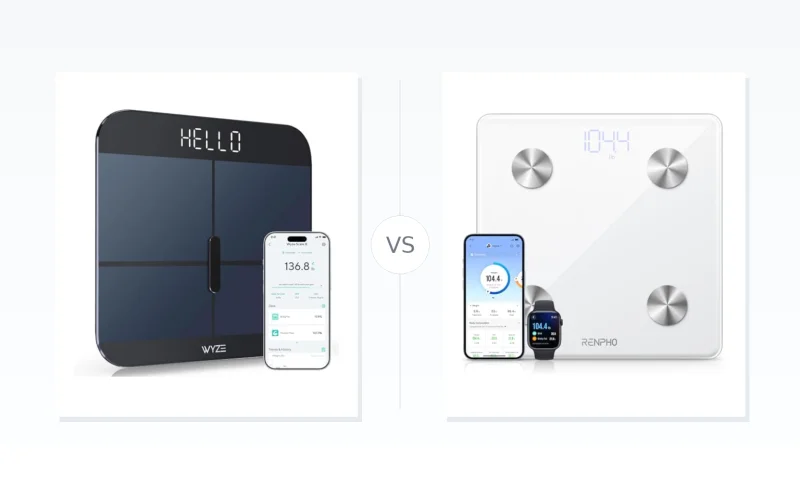
Compare Wyze Smart Scale X and RENPHO ES-CS20M on body composition metrics, multi-user support, app integration, safety features, and battery life. Find out which smart scale best fits your family's needs and smartphone compatibility.
TL;DR
Quick Decision
- Wyze Smart Scale X is the stronger fit if you want an explicit software Weight-Only mode that disables bioelectrical impedance, a larger 11.8-inch platform, Health Connect support, or a manufacturer-rated battery life of up to 22 months in Power Saver Mode.
- RENPHO Smart Scale ES-CS20M makes more sense for very large households, people who want skeletal-muscle and subcutaneous-fat estimates in the app, Samsung Health or MyFitnessPal integration, or an older Android phone.
- Neither scale has Wi-Fi. Both rely on Bluetooth for transferring measurements to a phone, so a Wi-Fi scale is a better fit if automatic cloud synchronization without a nearby phone is essential.
- Treat the body-composition numbers from either model as estimates for tracking trends, not clinical measurements. Hydration, recent exercise, meals, temperature, and other conditions can shift BIA results.
| Feature | Wyze Smart Scale X | RENPHO Smart Scale ES-CS20M |
|---|---|---|
| Power | ||
| Battery Life | 18 months | 6-12 months |
| Battery Type | AAA | AAA |
| Number of Batteries | 4 | 3 |
| General | ||
| Product Type | Smart Scale | Smart Scale |
| Features | ||
| Baby Mode | Yes | Yes |
| Auto On/Off | Yes | Yes |
| User Profiles | Up to 8 | Unlimited |
| Measurement | ||
| Resolution | 0.1 lb / 0.05 kg | 0.1 lb / 0.05 kg |
| Units Supported | lb, kg, st | lb, kg, st |
| Weight Capacity | 400 lbs / 180 kg | 396 lbs / 180 kg |
| Connectivity | ||
| Wi-Fi | No | No |
| Bluetooth Version | 5.0 | 4.0 |
| Compatibility | ||
| Required Operating Systems | iOS 14+ / Android 7.0+ | iOS 8.0+ / Android 4.3+ |
| Third-Party App Integrations | Apple Health, Google Fit | Apple Health, Google Fit, Samsung Health, Fitbit |
| Body Composition | ||
| BMI | Yes | Yes |
| BMR | Yes | Yes |
| Protein | Yes | Yes |
| Body Type | Yes | No |
| Bone Mass | Yes | Yes |
| Body Weight | Yes | Yes |
| Muscle Mass | Yes | Yes |
| Visceral Fat | Yes | Yes |
| Skeletal Muscle | No | Yes |
| Subcutaneous Fat | No | Yes |
| Water Percentage | Yes | Yes |
| Body Fat Percentage | Yes | Yes |
| Total Metrics Count | 12 | 13 |
| Metabolic Age / Body Age | Yes | Yes |
| Requires Barefoot for Composition | Yes | Yes |
| Lean Body Mass / Fat-Free Body Weight | Yes | Yes |
| Physical Specifications | ||
| Weight | 4.4 lbs | 3.3 lbs |
| Material | Tempered glass | Tempered glass |
| Dimensions | 12.2 x 12.2 x 1.0 inches | 10.2 x 10.2 x 0.9 inches |
| Display Type | LED | LED |
📑 Table of Contents
- First, What These Scales Actually Measure
- Body Composition: Different Dashboards, Not Different Levels of Accuracy
- Multi-User Support
- Apps, Health Platforms & Phone Compatibility
- Weight-Only Modes, Pregnancy, Medical Implants & Special Uses
- Platform Size & Everyday Use
- Battery Life & Maintenance
- The Bottom Line
- FAQ
First, What These Scales Actually Measure
The most important distinction in this comparison is not whether one scale reports 12, 13, or some other number of metrics. It is how those numbers are produced.
Both the Wyze Smart Scale X and RENPHO Smart Scale ES-CS20M measure weight and use bioelectrical impedance analysis (BIA) to estimate body composition. When you stand barefoot on the electrodes, the scale sends a very small electrical current through the body and combines the resulting impedance with information such as weight, height, age, and sex to calculate estimates for body fat, muscle, water, visceral fat, and related values.
That makes readings such as skeletal muscle, subcutaneous fat, visceral fat, bone mass, and protein fundamentally different from weight. They are not separately measured tissues. They are model-derived estimates.
This matters because BIA is sensitive to conditions that have little to do with an actual change in body composition. Hydration, food and fluid intake, recent exercise, skin temperature, and time of day can all affect the result. A sudden change in a body-fat or muscle estimate does not necessarily mean your body changed overnight.
For useful trend data, consistency matters more than squeezing the largest number of metrics out of an app. Weighing under similar conditions—such as at roughly the same time of day and before eating or exercising—makes comparisons more meaningful.
Neither scale should be treated as a diagnostic device.
Body Composition: Different Dashboards, Not Different Levels of Accuracy
Both companies now describe their systems as providing 13 health or body-composition metrics, but the headline number is misleading because they do not count exactly the same things.
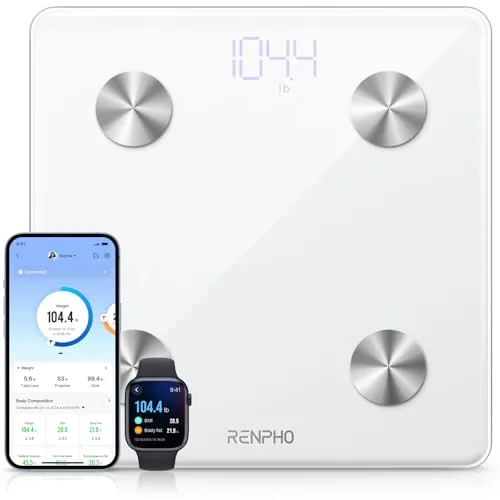
The RENPHO ES-CS20M reports weight, BMI, body fat, fat-free body weight, subcutaneous fat, visceral fat, body water, skeletal muscle, muscle mass, bone mass, protein, basal metabolic rate, and metabolic age.
The Wyze Smart Scale X covers a broadly similar set of estimates, including weight, BMI, body fat, lean body mass, muscle measurements, visceral fat, body water, bone mass, protein, basal metabolic rate, and metabolic age. Wyze also includes heart rate in its current set of 13 readings, but there is an important qualification: Scale X itself does not measure heart rate through the scale hardware. The Wyze app measures it separately using the phone's camera and your fingertip.
So a simple 13-versus-13 comparison does not tell you which device provides more useful information.
RENPHO does expose two categories that are particularly useful for people who like detailed fitness dashboards: skeletal muscle and subcutaneous fat. Wyze presents muscle and fat information differently and does not provide those same categories as separate headline readings.
That gives RENPHO a more granular presentation, but it should not be confused with greater measurement precision. A skeletal-muscle estimate from a consumer BIA scale is still an estimate derived from impedance and user data; the same applies to subcutaneous fat. These figures can be useful for watching long-term patterns under consistent measurement conditions, but they cannot independently confirm that a person has gained a specific amount of muscle or lost a specific type of fat.
The more practical distinction is therefore about how much detail you want in the trend dashboard. RENPHO exposes more distinct body-composition categories. Wyze presents a somewhat simpler set of composition data while integrating it into the broader Wyze app.
Edge: RENPHO ES-CS20M for body-composition granularity. Neither model has an inherent advantage simply because its app displays more calculated values.
Multi-User Support
This is one of the clearer differences, although Wyze's own documentation makes its side of the comparison less straightforward than it should be.
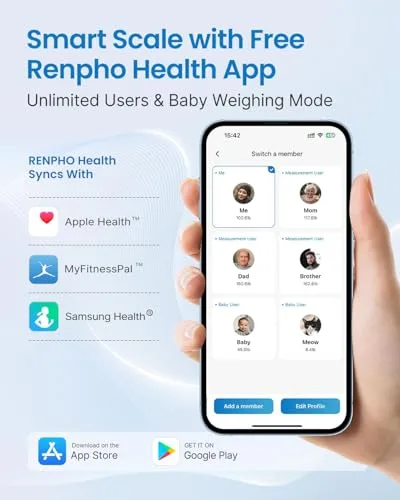
RENPHO Health explicitly supports an unlimited number of users. A household can either maintain separate accounts on separate phones or create additional measurement users within an account. That structure is useful for large families and other situations in which many people regularly share one scale.
Wyze's current documentation is less consistent. The Scale X storefront and FAQ describe sharing and automatic recognition for up to eight users, while a separate Wyze support summary uses the phrase “Unlimited Sharing and User Recognition.” Because Wyze still documents eight-user recognition elsewhere, it is safer to treat eight automatically recognized users as the clearly documented practical limit rather than assume unrestricted recognition.
For a typical household, this distinction may never matter. For a house with more than eight regular users, RENPHO's documentation is considerably clearer.
Automatic recognition also has limits on any scale that identifies people primarily by weight. When household members have similar body weights, the app may need additional help identifying whose measurement belongs to whom. That is a reason to pay attention to profile assignment rather than assume every reading will always land in the correct history.
Edge: RENPHO ES-CS20M for large households. Its unlimited-user model is explicit, while Wyze's current documentation around its user limit is contradictory.
Apps, Health Platforms & Phone Compatibility
A smart scale can work perfectly well as a basic weight scale without constant phone interaction, but the companion app is where historical trends and the full body-composition dashboard become useful.
The two products take different approaches.
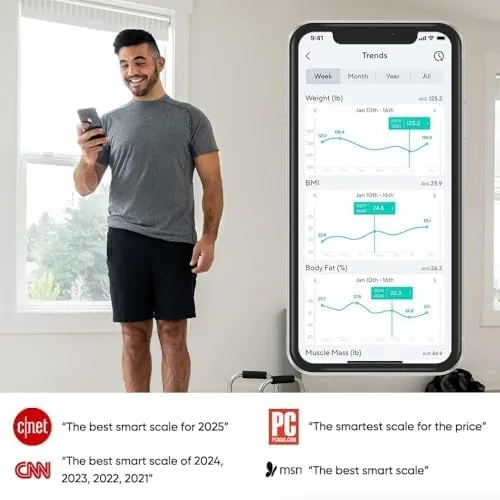
Wyze Smart Scale X lives inside the broader Wyze app. That can be convenient if the same household already uses Wyze cameras or other Wyze devices, but health tracking is only one part of a much larger smart-home application.
RENPHO ES-CS20M uses the dedicated RENPHO Health app, so its interface is centered on measurements, profiles, trends, and health data rather than a broader device ecosystem.
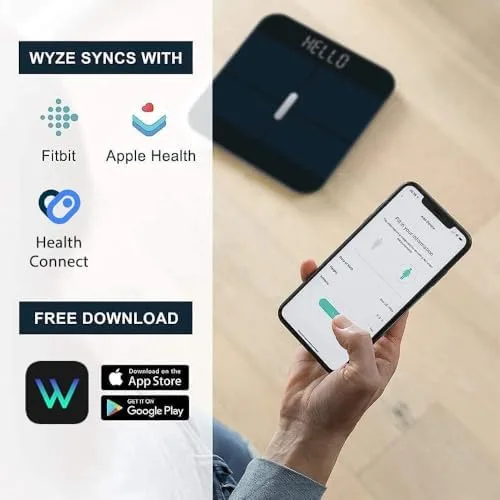
Third-party compatibility has also changed since Scale X originally launched. Current Wyze documentation lists support for:
- Apple Health
- Fitbit
- Health Connect
RENPHO's current documentation lists integrations including:
- Apple Health
- Fitbit
- Samsung Health
- MyFitnessPal
RENPHO documentation has not always been consistent about Google Fit support, so Google Fit is not a sensible deciding factor without checking the current app version on the phone that will actually be used.
The more significant compatibility difference is the operating system requirement.
As of 2026, the current Wyze app 3.x requires iOS 16 or later or Android 10 or later. Older Wyze documentation that lists iOS 14 or Android 7 refers to earlier app versions and no longer describes the current installation requirements.
The current RENPHO Health listing requires iOS 15.1 or later on iPhone, while RENPHO's ES-CS20M documentation lists Android 7 or later.
That makes the iPhone difference relatively small, but the Android difference can be substantial. An Android 7, 8, or 9 device may still meet RENPHO's stated requirement while falling below the current Wyze app requirement.
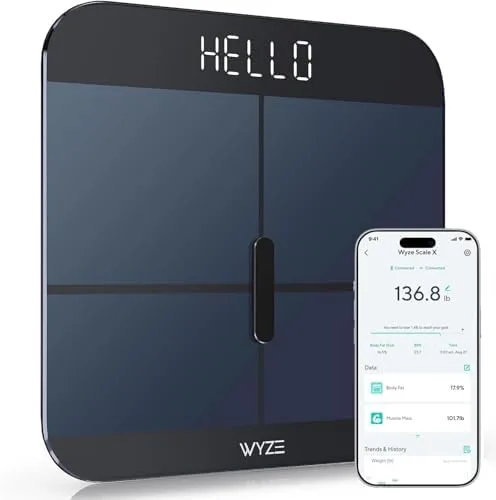
Neither model requires the app to remain open for every weigh-in.
Scale X can record measurements and synchronize them with the Wyze app later over Bluetooth. The RENPHO ES-CS20M can also operate without the app open after initial setup and user recognition; its display can show weight, BMI, and body-fat percentage directly on the scale.
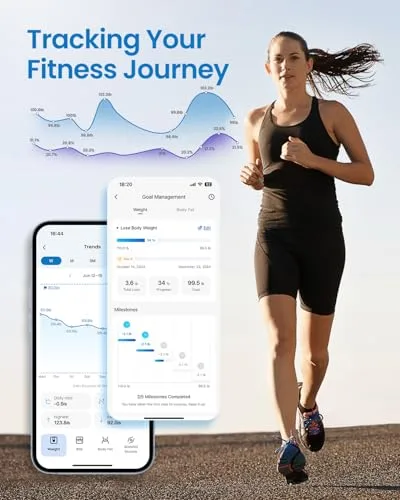
The phone is still necessary for historical charts, the complete set of calculated metrics, profile management, and third-party synchronization.
Neither model includes Wi-Fi, so data transfer ultimately depends on a Bluetooth connection to a compatible phone.
Edge: RENPHO ES-CS20M for older Android devices and Samsung Health/MyFitnessPal users. Wyze is better aligned with Health Connect and the broader Wyze ecosystem.
Weight-Only Modes, Pregnancy, Medical Implants & Special Uses
This is the section where the distinction between the two products needs the most careful wording.
BIA scales use an electrical current during body-composition measurements. People who are pregnant or use pacemakers or other implanted medical devices should follow the guidance for their specific medical situation and device rather than assuming that every BIA scale or operating mode is appropriate.
The Wyze Smart Scale X has a dedicated Pregnancy/Weight-Only mode in the app. When enabled, Wyze says the scale turns off BIA and provides weight measurements without sending the body-composition current through the user.
That is a meaningful usability advantage because disabling BIA is an explicit software setting rather than something the user has to remember to accomplish indirectly.
The RENPHO ES-CS20M manual does not provide an equivalent software BIA-off toggle. It advises people who are pregnant or have pacemakers, artificial joints, or other relevant implants to use weight measurement only and to wear shoes so the electrode current does not pass through the body.
That is an important correction to the idea that RENPHO has no weight-only workaround at all. It does. The difference is that Wyze provides a dedicated setting for it, while RENPHO documents a physical method for bypassing BIA.
Neither implementation should be described as universally “safe” for every medical situation. Manufacturer instructions and relevant medical-device guidance take precedence.
Wyze also documents several household-oriented modes beyond normal weighing:
- Baby/Pet Mode
- Luggage Mode
- Pregnancy/Weight-Only Mode
RENPHO's ES-CS20M documentation includes a Baby Holding mode for determining an infant's weight by comparing measurements.
For households that expect to disable BIA regularly or use the scale for objects and pets as well as adults, Wyze offers the more extensive set of explicitly documented special modes.
Edge: Wyze Smart Scale X for special-use flexibility and its dedicated BIA-off control.
Platform Size & Everyday Use
The scales are close in overall size, but they are not identical.
The Wyze Smart Scale X measures about 11.8 × 11.8 inches, while the RENPHO ES-CS20M is about 11 × 11 inches. Both are slim glass-platform scales rated for weights up to roughly 400 pounds.
An extra 0.8 inch in each direction does not transform the experience, but the Wyze provides a little more standing room. That can matter for people with larger feet or anyone who simply prefers more space for consistent foot placement on the electrodes.
The RENPHO is slightly more compact, which may be useful in a small bathroom.
Both scales should be placed on a hard, level floor. Carpet and uneven surfaces can interfere with weight measurement, and moving a scale can require it to re-zero before the next reading.
There is no decisive technical winner here. The Wyze favors platform space; the RENPHO occupies slightly less floor area.
Battery Life & Maintenance
Wyze has the stronger documented battery-life claim, but the original comparison overstated how directly the two scales can be compared.
The Wyze Smart Scale X uses four AAA batteries. Wyze currently advertises up to 22 months of battery life with Power Saver Mode. As with any battery-life estimate, actual runtime depends on usage and settings.
The RENPHO ES-CS20M uses three AAA batteries. Its current model-specific manual identifies the battery type but does not provide a directly comparable 6- or 12-month runtime estimate.
That means it is reasonable to say Wyze publishes a notably long battery-life target, but not to claim that it definitively lasts twice as long as RENPHO or cuts battery changes by a particular percentage.
The difference also should not be attributed simply to Bluetooth versions. Battery life depends on the complete hardware and firmware design, usage frequency, display behavior, sleep states, battery quality, and other factors—not just the radio specification.
Both models have straightforward reset procedures if measurements become abnormal after moving the scale or changing batteries. Wyze provides a factory-reset function through the unit button, while RENPHO documents a battery-removal reset procedure.
For either model, consistent placement on a hard, flat surface matters more to everyday measurement reliability than the reset procedure itself.
Edge: Wyze Smart Scale X for its documented long-runtime specification, with no reliable basis for assigning a specific battery-life advantage over RENPHO.
The Bottom Line
There is no meaningful universal winner because these scales emphasize different parts of the same basic task.
Wyze Smart Scale X is the stronger fit when:
- An explicit software switch for disabling BIA is important.
- Baby, pet, and luggage weighing modes would be useful.
- A slightly larger platform is preferable.
- Health Connect is part of the existing health-data setup.
- The household already uses the Wyze ecosystem.
- A manufacturer-rated battery life of up to 22 months in Power Saver Mode is appealing.
RENPHO Smart Scale ES-CS20M is the stronger fit when:
- More than eight people may regularly share the scale.
- Skeletal-muscle and subcutaneous-fat estimates are useful additions to the trend dashboard.
- Samsung Health or MyFitnessPal integration matters.
- The phone runs an Android version older than Android 10 but still meets RENPHO's stated Android 7+ requirement.
- A dedicated health-tracking app is preferable to a broader smart-home app.
For many households, the overlapping capabilities are more important than the differences. Both track weight, both provide BIA-derived body-composition estimates, both support Apple Health and Fitbit, both can function without keeping the app open during every weigh-in, and neither has Wi-Fi.
The most consequential differences are therefore phone compatibility, multi-user requirements, health-platform integration, and how you want BIA disabled when only weight is needed.
Whichever model fits those requirements better, the same interpretation rule applies: use body-composition readings to watch consistent long-term trends, not as precise measurements of individual tissues or as medical conclusions.
FAQ
Which smart scale is better for bodybuilders?
Can I sync these scales with a Fitbit?
How many users can each scale track?
Do these scales work if I have a pacemaker?
Which scale has the longest battery life?
Do these scales require a Wi‑Fi connection?
Do I need to be barefoot to measure body fat?
Can I weigh my luggage on the Wyze Scale X?
📄 Used Manuals & Documentation
Images are used for editorial and informational purposes only.
All trademarks and images belong to their respective owners.