
Etekcity ESN00 vs RENPHO R-T001: App Tracking, Capacity, and Measurement Compared
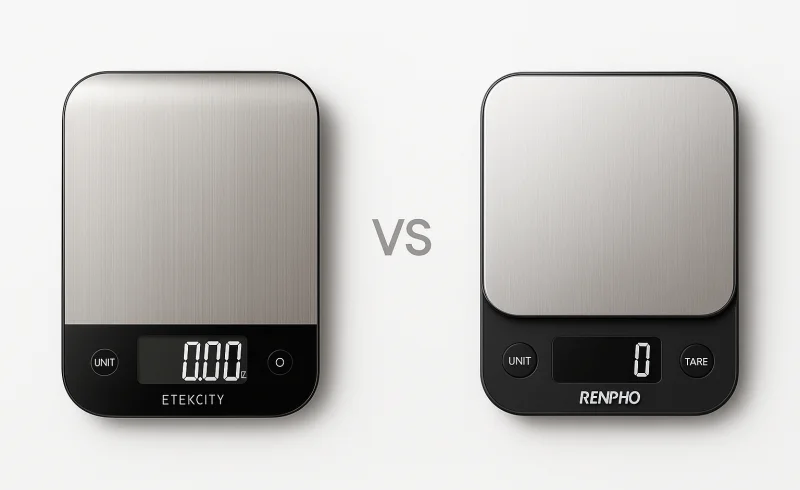
Explore the differences between Etekcity Smart Food Kitchen Scale ESN00 and RENPHO Digital Kitchen Scale R-T001. Learn which scale fits better for recipe logging, health dashboard integration, and large-batch cooking needs.
TL;DR
At a glance
- Etekcity ESN00 has the stronger case for everyday kitchen use if a stainless-steel platform, clearly documented Apple Health and Fitbit connections, and a 120-second scale auto-off matter more than maximum capacity.
- RENPHO R-T001, also listed by RENPHO as the Calibra 1L, has substantially more stated load headroom at 22 lb / 10 kg, a finer 0.05 oz display increment, and a Renpho Health workflow that includes food logging, a diary, nutrition analysis, and a coffee-brewing mode.
- Both display weight in 1 g increments, so RENPHO's 0.05 oz readout does not make it inherently more accurate in gram-based cooking. RENPHO publishes accuracy tolerances at several loads; Etekcity does not provide a directly comparable tolerance table.
- Etekcity explicitly specifies a 3 g minimum weighing range. RENPHO specifies 1 g increments, but its documentation does not establish a comparably clear 1 g minimum load. Those two specifications should not be treated as the same thing.
- Both can function as ordinary kitchen scales without a phone. Bluetooth and the companion apps are needed for the nutrition-logging layer, not for basic weighing and tare.
The biggest distinction is less about "recipe logging versus health dashboards" than the original framing suggests. Both products combine a conventional kitchen scale with an app-based food diary. The more meaningful differences are capacity, materials, app integrations, and the way each manufacturer documents measurement performance.
| Feature | RENPHO Digital Kitchen Scale R-T001 | Etekcity Smart Food Kitchen Scale ESN00 |
|---|---|---|
| Power | ||
| Battery | 3 * AAA(1.5V) Batteries | 3 x 1.5V AAA Batteries |
| Scale Auto-Off | 30 seconds | 120 seconds |
| Product | ||
| Product Type | Smart nutrition kitchen scale | Smart nutrition kitchen scale |
| Capacity | ||
| Maximum Volume Capacity | 10000ml / 352fl'oz | 5000 mL |
| Maximum Weight Capacity | 22lbs / 10kg | 176.4 oz / 11 lb / 5000 g |
| Minimum Measurable Weight | 1 g | 3 g |
| Physical | ||
| Material | Tempered Glass + HIPS | Food-grade 304 stainless steel weighing platform |
| Dimensions | 8.3 × 6.3 × 0.7 inch | 9.2 x 6.3 x 0.6 in / 235 x 160 x 16.5 mm |
| Measurement | ||
| Units | oz / fl.oz / lb:oz / ml / g | oz / lb:oz / g / mL |
| Increment | 0.05oz / 1g / 1ml / 0.1fl'oz | 0.1 oz / 1 g / 1 mL |
| Tare Function | Supported | Supported |
| Connectivity | ||
| Companion App | Renpho Health | VeSync |
| Wireless Connectivity | Bluetooth 5.0 or above | Bluetooth |
| Health App Integrations | Apple Health | Apple Health, Fitbit |
📑 Table of Contents
Smart Features: More Similar Than They First Appear
Neither scale identifies food by itself
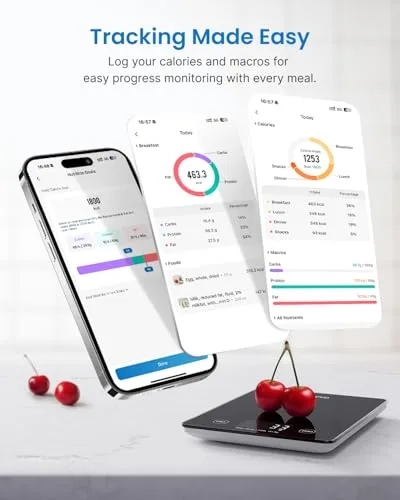
The Bluetooth connection can make these scales feel more sophisticated than they actually are. What the hardware measures is weight. Calories, protein, carbohydrates, fat, sodium, and other nutrition values come from the food entry selected in the companion app.
That distinction matters. If the wrong food record, serving basis, or custom nutrition profile is selected, an accurate weight reading can still produce an inaccurate nutrition log.
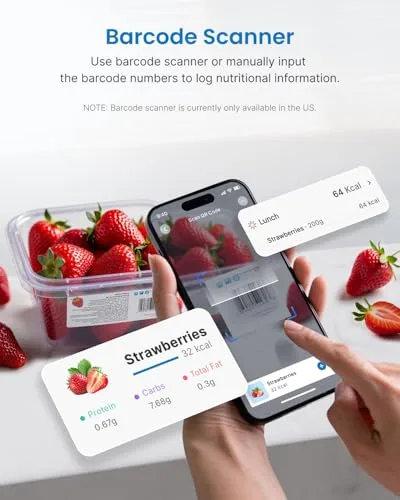
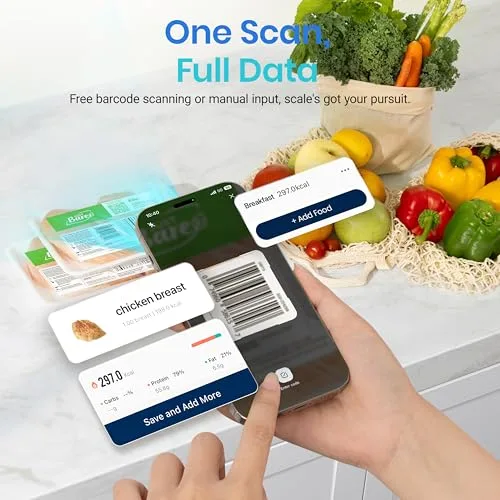
With the Etekcity ESN00, VeSync links the measured weight to food data. Etekcity says the app tracks up to 19 nutrients, uses Nutritionix data covering roughly one million food records, and allows custom food entries. Etekcity also advertises barcode scanning, although it states that this feature is currently available only in the United States.
The RENPHO R-T001 uses Renpho Health in current documentation. Its setup guide describes searching for a food, creating custom foods, viewing nutrition information for the measured quantity, adding the item to a Plate, and saving records in a Diary. The app also provides nutrition analysis and historical reports.
So the core interaction is comparable: identify the food in the app, weigh it, then save the nutritional entry.
Health-app integration favors Etekcity on documented breadth
Etekcity explicitly documents connections from VeSync to both Apple Health and Fitbit. That gives the ESN00 a concrete advantage for anyone already using Fitbit alongside nutrition tracking.
RENPHO documentation for the R-T001 includes Apple Health support. The manufacturer's material does not document Fitbit support for this model in the same way Etekcity does, so Fitbit compatibility should not be assumed.
That makes Etekcity's integration story broader on the evidence available, but Apple Health alone is not a decisive distinction between the two because both ecosystems can interact with it.
RENPHO has one unusual kitchen feature: coffee mode
RENPHO's app documentation includes a Coffee Maker mode that tracks brewing time and the ratio of coffee to water. That is a genuinely different use case from ordinary calorie logging.
It does not turn the R-T001 into a dedicated specialty coffee scale, and its 1 g display increment is coarser than the 0.1 g resolution commonly associated with more specialized coffee equipment. Still, for someone who wants basic ratio guidance and a timer in the same app, it is a useful extra.
Section edge: Etekcity for explicitly documented health-platform breadth; RENPHO for the additional coffee workflow.
Measurement: Resolution Is Not the Same as Accuracy
This is where the specification sheets need the most careful interpretation.
Gram measurements are effectively tied on display resolution
The Etekcity ESN00 displays measurements in 1 g increments.
The RENPHO R-T001 also displays measurements in 1 g increments.
For recipes written in grams, therefore, neither has a finer display step.
RENPHO does show ounces in 0.05 oz increments compared with 0.1 oz on the Etekcity. That is a legitimate difference for ounce-based use, but it describes the size of the displayed step—not how close the measurement is to the true mass.
RENPHO publishes accuracy tolerances; Etekcity does not publish an equivalent table
RENPHO's R-T001 technical specifications state the following precision tolerances:
- 1,000 g: ±3 g
- 3,000 g: ±10 g
- 5,000 g: ±15 g
- 7,000 g: ±17 g
- 10,000 g: ±20 g
Those figures provide more useful context than the 1 g display increment alone. A display can change one gram at a time while the actual measurement uncertainty is several grams at a given load.
Etekcity specifies a 1 g increment and a weighing range of 3 g to 5,000 g, but its current product specifications do not provide a directly comparable accuracy-tolerance table.
Without independent head-to-head calibration data, that leaves no defensible basis for declaring either scale more accurate overall.
The "1 g minimum" claim for RENPHO should not be inferred from its increments
Etekcity explicitly states that the ESN00 weighs from 3 g to 5,000 g.
RENPHO lists 1 g measuring increments, but an increment is not automatically a minimum load specification. The R-T001 documentation also describes activation using pressure or an object over 200 g, while the technical table does not provide a straightforward low-end minimum equivalent to Etekcity's 3 g figure.
For very small quantities—fractions of a gram of yeast, supplements, spices, or other ingredients where one or two grams materially changes the result—neither specification set makes these scales a substitute for a dedicated finer-resolution scale.
Tare matters more often than exotic precision
Both support tare, which is the feature that makes either scale practical for normal kitchen work: place a bowl on the platform, zero its weight, add an ingredient, and repeat as needed.
For repeatable measurements, both manufacturers also instruct users to work on a hard, flat, stable surface. That is more consequential than the small difference between their ounce display steps when normal recipe quantities are involved.
Section result: no overall accuracy winner. RENPHO provides the more informative published tolerance data, while both use 1 g steps in gram mode.
Capacity: RENPHO Has More Headroom, With a Documentation Caveat
Capacity is the clearest hardware difference.
The Etekcity ESN00 is rated for 11 lb / 5,000 g. That is enough for most ordinary ingredient portions, but the container counts toward the limit. A heavy mixing bowl can therefore consume a meaningful part of the available range before any food is added.
The RENPHO R-T001 technical specification table lists 22 lb / 10 kg, twice Etekcity's stated maximum. RENPHO's support documentation and overload information also identify 10 kg as the upper limit.
There is, however, an inconsistency worth noting: one RENPHO Calibra 1L manual contains a safety line warning not to exceed 11 lb / 5 kg, even though the same manual's technical table and overload indicator specify 22 lb / 10 kg. RENPHO's dedicated R-T001 support material likewise lists 22 lb / 10 kg.
For normal loads this discrepancy is unlikely to matter. Anyone intending to work routinely near the upper end of the scale's range should be aware that RENPHO's own documentation is not perfectly consistent.
What the mL and fl oz specifications actually tell you
Etekcity lists a maximum of 5,000 mL, while RENPHO lists 10,000 mL / 352 fl oz.
Those numbers should not be interpreted as separate physical volume capacities. These are still weight-based scales, not devices that independently sense the volume of a liquid. The volume units are convenience readouts derived from weight.
Etekcity is particularly explicit that its gram/milliliter modes include settings for water and milk. For liquids with substantially different densities, weight in grams remains the clearer measurement.
The practical capacity distinction is therefore the simpler one: 5 kg for Etekcity versus a stated 10 kg for RENPHO.
Section edge: RENPHO R-T001.
Build and Countertop Practicality
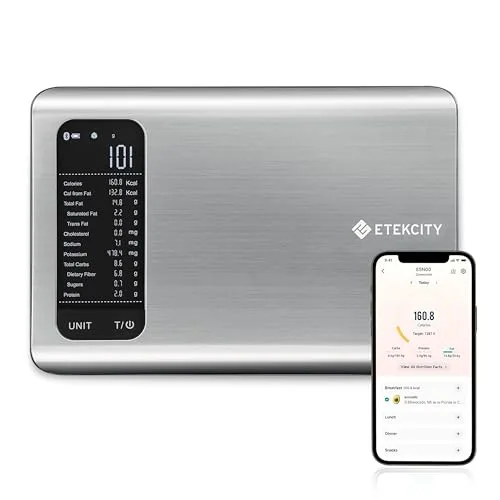
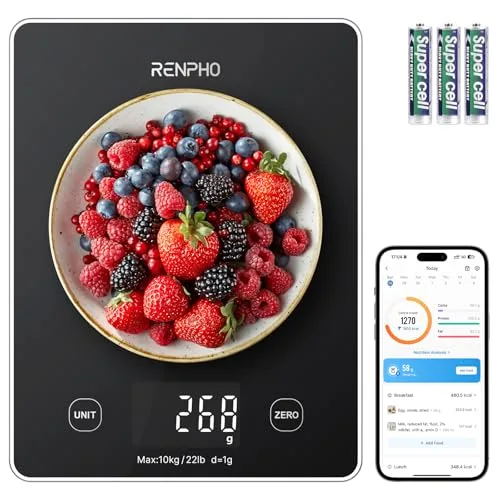
The material difference is straightforward.
The Etekcity ESN00 uses a food-grade 304 stainless-steel weighing platform. Its dimensions are approximately 9.2 × 6.3 × 0.6 inches.
The RENPHO R-T001 uses T3 tempered glass and HIPS plastic and measures about 8.3 × 6.3 × 0.7 inches.
Etekcity therefore provides a slightly longer weighing surface while remaining marginally thinner. The shared 6.3-inch dimension means the difference is not dramatic, but the additional platform length can help when a larger bowl partly obscures the display area.
Material preference is more consequential. Stainless steel avoids the breakage concern that comes with any glass weighing surface and is well suited to repeated wiping after food preparation. Tempered glass provides a smooth surface and keeps the RENPHO relatively light, but the manual specifically instructs users not to strike, shake, or drop the scale.
Neither model is waterproof. Both manufacturers instruct users to wipe spills rather than immerse the scale.
Section edge: Etekcity ESN00 for the stainless-steel platform and slightly larger footprint.
Power and Auto-Off Behavior
Both scales run on three AAA batteries, so there is no meaningful distinction in battery format.
Etekcity's documentation is unusually clear about its timers:
- Backlight auto-off: 30 to 120 seconds, adjustable in VeSync
- Scale auto-off: 120 seconds
That gives the ESN00 two minutes before the scale itself shuts down.
RENPHO's documentation is less consistent across revisions. One R-T001 manual specifies automatic shutoff after 30 seconds, while RENPHO's current setup material also exposes a Display-Off/shutdown-time setting in the app.
Because those documents describe slightly different behavior, 30 seconds is better treated as a documented default in some versions rather than as a universally fixed limit across every R-T001 app or firmware configuration.
The practical point is that Etekcity's two-minute scale timeout is explicitly documented, while RENPHO's behavior depends more on the documentation and software revision being referenced.
Section edge: Etekcity ESN00 for clearer and longer documented scale-on time.
Using Either Scale Without the App
The "smart" label can make both devices sound more phone-dependent than they are.
The Etekcity ESN00 has physical controls for units and tare. The RENPHO R-T001 likewise provides unit and zero controls. Basic kitchen weighing therefore does not require Bluetooth, Apple Health, Fitbit, or an active nutrition log.
What disappears without the companion app is the reason these models are marketed as smart scales: matching weights to food records, calculating nutritional values, maintaining a diary, and synchronizing supported data with other services.
That leads to a simple distinction. For someone who regularly tracks calories, macros, or nutrient intake, the app layer can remove some manual arithmetic. For someone who only needs grams and tare, much of the additional software is unnecessary.
The Bottom Line
These scales are closer competitors than the original "recipe logger versus health dashboard" framing implies. Both are conventional 1 g kitchen scales with Bluetooth-assisted food logging. The meaningful split is in the hardware limits and surrounding software ecosystem.
Etekcity ESN00 fits everyday nutrition logging particularly well when:
- Apple Health and Fitbit connectivity matter.
- A 304 stainless-steel platform is preferable to glass.
- The explicitly documented 3 g minimum weighing range is adequate.
- An 11 lb / 5 kg ceiling covers the normal containers and ingredients involved.
- A clearly documented 120-second scale auto-off is useful during multi-step preparation.
RENPHO R-T001 fits better when:
- A stated 22 lb / 10 kg capacity provides useful extra headroom.
- 0.05 oz display steps matter more than Etekcity's 0.1 oz steps.
- Renpho Health's Plate, Diary, nutrition-analysis, and coffee-timer functions align with the intended workflow.
- A tempered-glass surface is acceptable.
For measurement quality, neither deserves an unsupported accuracy victory. RENPHO publishes useful tolerance figures, but both display grams in 1 g steps, and there is no independent head-to-head testing here that establishes one as consistently closer to a reference weight.
For general home-kitchen use,
because its stainless-steel platform, explicitly documented health integrations, clear 3 g lower range, and well-defined two-minute scale timeout are practical advantages without depending on unusually heavy loads.RENPHO remains the more relevant alternative when capacity is the deciding constraint or when its coffee and Renpho Health features are specifically useful.
FAQ
Which scale has better app integration?
Can I use these scales without a smartphone?
Which scale is more accurate for small amounts?
What are the differences in build material?
Is the RENPHO 22lb version worth the extra cost?
How long do the batteries last?
📄 Used Manuals & Documentation
Etekcity Smart Food Kitchen Scale ESN00
RENPHO Digital Kitchen Scale R-T001
"Images are used for editorial and informational purposes only. All trademarks and images belong to their respective owners."