Garmin Index S2 vs Withings Body Smart: Which Smart Scale Fits Your Routine?
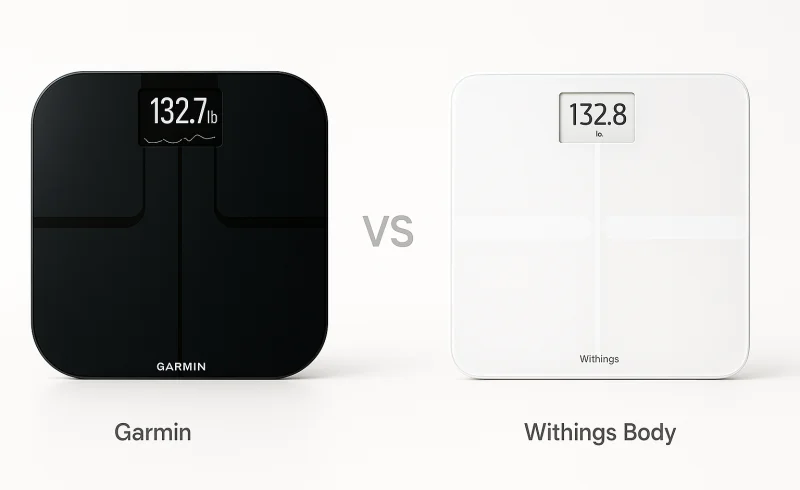
Explore a detailed comparison between Garmin Index S2 and Withings Body Smart scales. Learn how each fits into different routines and ecosystems, from fitness tracking to health-first apps, and discover which scale might be better suited for your needs.
TL;DR
- Garmin Index S2 fits most naturally when Garmin Connect is already your main fitness dashboard. Weight and body-composition trends sit beside workouts and other Garmin health data, and the scale supports up to 16 users.
- Withings Body Smart makes more sense when the scale itself is meant to be a broader health hub. It adds visceral fat index, basal metabolic rate, metabolic age, standing heart rate, lean mass, and several household modes, while supporting up to 8 users.
- Withings measures more, but that does not prove that its body-fat estimates are more accurate. Both scales use bioelectrical impedance analysis (BIA), and consumer BIA is far more useful for following consistent trends than for treating a single body-fat or muscle reading as a clinical result.
- Both need a phone app and account for setup, then can sync without the phone nearby over Wi-Fi. Withings also supports Bluetooth synchronization.
- For a large Garmin-heavy household, the Index S2 has the practical edge. For a mixed-device household that wants more scale-derived health metrics and broader data exchange with Apple Health or Health Connect, Body Smart is the more flexible fit.
Market price overview
Garmin Index S2

 Joom
Joom Joom
Joom Joom
JoomWithings Body Smart
| Feature | Garmin Index S2 | Withings Body Smart |
|---|---|---|
| Power | ||
| Battery Life | Up to 9 months | 15 months typical use |
| Battery Type | 4 AAA alkaline batteries | 4 AAA alkaline batteries |
| Users | ||
| Supported User Profiles | Up to 16 users | Up to 8 users |
| Automatic User Recognition | Yes | Yes |
| Display | ||
| Display Type | LCD screen; high-resolution color display | Color 2.86 inch LCD screen |
| General | ||
| Product Type | Smart scale | Connected smart scale |
| Capacity | ||
| Maximum Load | 181.4 kg (400 lb) | 200 kg (440 lb) |
| Weight Units | kg, lb, st | kg, lb, st lb |
| Environment | ||
| Storage Temperature | -20°C to 50°C | -10°C to 50°C |
| Operating Temperature | 10°C to 40°C | 5°C to 35°C |
| Measurement | ||
| BMI | Yes | Yes |
| Weight Measurement | Yes | Yes |
| Body Composition Method | Bioelectrical impedance | Bioelectrical Impedance Analysis (BIA) multifrequency |
| Body Composition Metrics | Body fat percentage, body water percentage, skeletal muscle mass, bone mass | Body fat, water percentage, muscle mass, bone mass, lean mass |
| Connectivity | ||
| Wireless Connectivity | Wi‑Fi, Bluetooth | Wi‑Fi, Bluetooth |
| Companion App for Setup | Garmin Connect app | Withings app |
| Phone-Free Sync After Setup | Yes, over Wi‑Fi | Yes, over Wi‑Fi |
📑 Table of Contents
- The Real Difference Is Where the Data Is Supposed to Live
- Software, Syncing & Ecosystem Fit
- Body Composition: Withings Gives You More Numbers, Not Clinical Certainty
- Household Use: 16 Garmin Profiles vs 8 Withings Profiles
- Display & the Morning Weigh-In
- Battery Life, Size & Weight Capacity
- Safety & Weight-Only Use
- The Bottom Line
- FAQ
The Real Difference Is Where the Data Is Supposed to Live
These scales overlap on the basics: both measure weight, estimate body composition through BIA, recognize multiple users, show results on a color screen, and send measurements to a companion app. The meaningful difference is what happens after the weigh-in.
The Garmin Index S2 is designed as an extension of Garmin Connect. If a Garmin watch already records your training, sleep, heart rate, and daily activity, the scale adds weight and body-composition trends to the same record. That makes the S2 feel less like a separate health product and more like another sensor in the Garmin system.
The Withings Body Smart puts more emphasis on the scale and the Withings app as a general health-tracking pair. It exposes more scale-related metrics, supports several specialized modes, and connects with Apple Health and Android Health Connect in both directions for supported data categories. The distinction is not simply “fitness” versus “health,” but how much you want the scale to contribute beyond weight.
If your morning routine is supposed to be step on, see a number, and move on, Garmin's tighter focus can be an advantage. If you actually intend to inspect composition trends, standing heart rate, metabolic estimates, and other health data in one app, Withings gives you more material to work with.
Software, Syncing & Ecosystem Fit
Garmin Index S2: strongest inside Garmin Connect
Setup runs through the Garmin Connect app, and the scale must be connected to a compatible Wi-Fi network to use its full connected feature set. After setup, measurements can upload automatically over Wi-Fi without the phone being beside the scale.
Garmin Connect is not completely isolated from other health platforms. On iPhone, it can send supported data including weight, BMI, and body-fat percentage to Apple Health. On compatible Android devices, Garmin Connect can also send weight and body fat to Health Connect. Those connections are primarily outbound: Garmin documents them as one-way transfers from Garmin Connect rather than a general-purpose import system.
That matters if Garmin Connect is already the place where you review training and recovery. The Index S2 does not need to become a second dashboard; it simply adds another stream of data to the one you already use.
Withings Body Smart: broader health-data exchange
Body Smart also requires the Withings app and a Withings account for setup. Once configured on Wi-Fi, it can sync measurements without the phone nearby. It also supports Bluetooth, which gives it another synchronization path when Wi-Fi is not the preferred setup.
The Withings app can exchange supported data with Apple Health and Health Connect, and Withings also maintains integrations with services such as MyFitnessPal and Strava. That makes Body Smart easier to place in a household where the scale is not tied to one wearable brand.
Withings also offers an optional Withings+ service, but the scale's baseline measurements and ordinary trend history do not require that subscription. The extra service is about additional guidance and analysis rather than unlocking the core weight and composition readings.
What happens when the network is unavailable
Neither scale becomes useless if the internet drops, but the connected experience depends on eventually restoring sync. Withings specifies that Body Smart can hold up to 16 weigh-ins when it cannot synchronize wirelessly. Garmin's normal workflow is similarly built around uploading measurements to Garmin Connect once Wi-Fi is available.
Both manufacturers publish troubleshooting guidance for failed synchronization, so neither should be treated as a fully offline device. If you specifically want a scale with no cloud account or companion app in the loop, these are the wrong category of product.
Body Composition: Withings Gives You More Numbers, Not Clinical Certainty
The Garmin Index S2 reports weight, BMI, body-fat percentage, body-water percentage, skeletal muscle mass, and bone mass. It also shows a 30-day weight trend on the scale and keeps longer-term history in Garmin Connect.
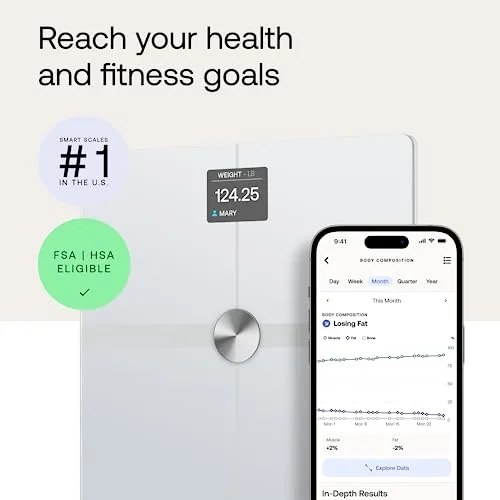
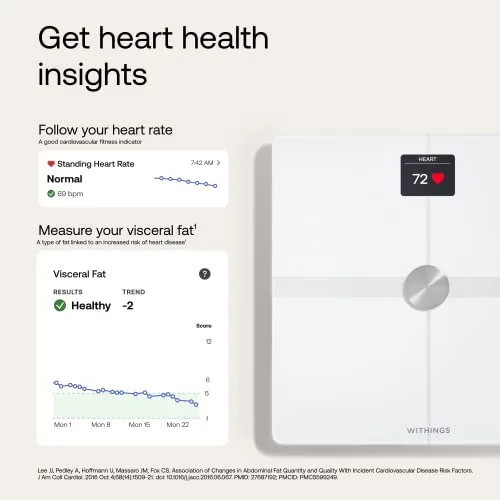
The Withings Body Smart covers the same general composition categories while adding lean mass, visceral fat index, basal metabolic rate, metabolic age, and standing heart rate. Withings explicitly describes Body Smart as using multifrequency BIA; its current comparison material identifies the model as using two frequencies.
That is a real technical difference, but it should not be turned into an accuracy claim that the evidence does not support. There is no robust independent head-to-head clinical validation showing that Body Smart produces more accurate body-fat or muscle estimates than Index S2 across a general population. Multifrequency BIA can provide more inputs to an estimation model, yet BIA results still depend on algorithms, body geometry, hydration, recent food intake, exercise, and other conditions.
Research on smart scales and more sophisticated BIA systems makes the same broader point: weight tends to be the more dependable measurement, while body-composition estimates can show meaningful offsets from DXA even when repeated measurements are internally consistent. That makes day-to-day consistency more useful than chasing an apparently exact body-fat percentage.
Garmin itself acknowledges this limitation in a practical way: Garmin Connect lets Index S2 users enter recent body-fat and skeletal-muscle values from a trusted external assessment, such as DXA, and then uses those values as reference points for later estimates.
Withings gives similar practical guidance for Body Smart. Its support documentation recommends weighing under repeatable conditions and notes that hydration, posture, food or drink, and other factors can shift composition readings. For either model, a useful routine is boring but effective: same scale, similar time of day, similar hydration state, hard level floor, and attention to changes over weeks rather than one morning's estimate.
The practical verdict on composition: Body Smart provides a broader set of outputs. Index S2 provides a smaller set that integrates neatly with Garmin training data. Neither has a defensible claim to clinical body-composition precision simply because one screen shows more metrics.
Household Use: 16 Garmin Profiles vs 8 Withings Profiles
This is one of the few differences that is both simple and consequential.
The Garmin Index S2 supports 16 total users: the owner can invite up to 15 additional people, and each registered user needs a Garmin Connect account. The scale identifies people primarily by weight and displays initials before the rest of the measurements. If it selects the wrong person, the user can cycle to the correct profile on the scale. Guest measurements are possible, but Garmin does not store or sync guest data to a Garmin Connect account.
The Withings Body Smart recognizes up to 8 users. Measurements are assigned to individual profiles, and the app provides a way to handle measurements that were not correctly attributed. As with any scale that identifies people partly from weight, households with similarly weighted users may occasionally need to correct attribution rather than assume every weigh-in landed in the right profile.
Garmin therefore has the straightforward capacity advantage for unusually large households, shared living arrangements, or teams. Withings' eight-user limit is sufficient for many homes, but its more interesting household advantage is not the number of profiles; it is the range of modes attached to them.
Withings has the more varied modes
Body Smart includes Athlete Mode, Baby Mode, Pregnancy Mode, and Eyes Closed Mode. These are not decorative extras:
- Athlete Mode adjusts the body-composition algorithm for people Withings considers to have an athletic body type.
- Baby Mode lets an adult track a baby's weight while holding the child.
- Pregnancy Mode tracks pregnancy-related weight change and disables impedance-based measurements while the mode is active.
- Eyes Closed Mode hides numerical results during the weigh-in and substitutes other on-screen messages, which can be useful when the act of seeing weight immediately is not desirable.
Garmin offers a weight-only mode that disables its advanced body metrics, but it does not match Withings' range of household-specific modes.
Display & the Morning Weigh-In
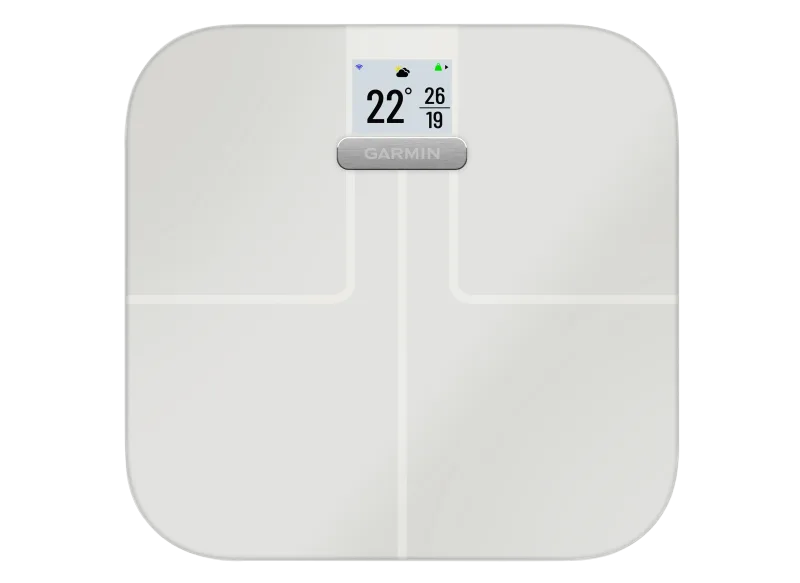
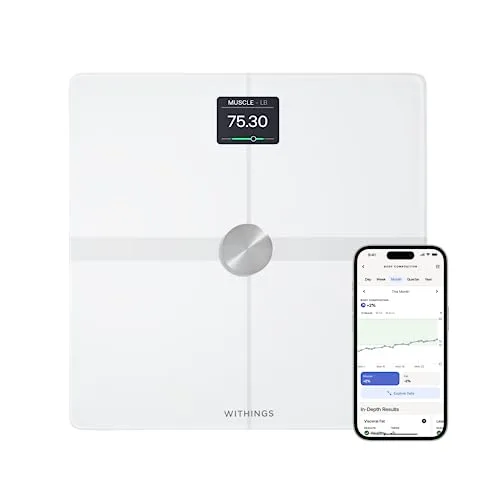
The Index S2 has a high-resolution color display and can cycle through the metrics you enable in Garmin Connect. Its most useful on-scale extra is arguably the 30-day weight trend, because it immediately puts today's number in context. It can also show a weather forecast over Wi-Fi.
The Body Smart uses a 2.8-inch, 320 × 240 color LCD and can show measurements, personalized screens, weather information, and an air-quality rating. Withings' interface is designed to surface more health context directly on the scale, while Eyes Closed Mode can intentionally do the opposite and suppress the numbers.
Neither display changes the core measurement quality. The difference is behavioral. Garmin is better suited to a short glance before the data disappears into Garmin Connect; Withings offers more ways to make the weigh-in itself part of the health-tracking experience.
Battery Life, Size & Weight Capacity
Both models use four AAA alkaline batteries, so there is no charging routine to manage.
Garmin rates the Index S2 for up to 9 months of battery life. Withings rates Body Smart at an average of 15 months. Those are manufacturer estimates, and real battery life will vary with wireless conditions, usage frequency, and battery quality, but the published gap is substantial enough to matter for maintenance.
Body Smart also supports a higher stated weight range: 5 to 200 kg (9 to 440 lb). The Index S2 is rated to 181.4 kg (400 lb).
Physically, they are close. Garmin lists the Index S2 at 320 × 310 × 28 mm, while Withings lists Body Smart at 325 × 325 × 25.6 mm. Both use glass platforms and are intended to sit on a hard, level surface; both include carpet feet for suitable carpeted setups.
For most bathrooms, the dimensional difference is trivial. The higher weight limit and longer published battery life are the more practical hardware advantages for Body Smart.
Safety & Weight-Only Use
Both scales use a small electrical current for impedance measurements, so the safety guidance deserves more attention than it usually gets in spec comparisons.
Garmin states that the Index S2 should not be used by people with pacemakers or other internal electronic medical devices, and it advises people who are pregnant or may be pregnant to consult a physician before use.
Withings also warns against impedance measurements for people with pacemakers or other implanted electronic devices. Its support guidance provides a Weight-Only/Pacemaker Safety Mode that disables impedance-based functions, and Pregnancy Mode likewise disables impedance measurements during pregnancy.
These are manufacturer safety instructions, not merely software preferences. Anyone using an implanted electronic device should follow the relevant product guidance rather than treating body-composition mode as an ordinary optional setting.
The Bottom Line
There is no useful universal winner here because the two scales solve slightly different problems.
Garmin Index S2 fits better when Garmin Connect is already central to your routine. Its strongest advantages are the clean integration with Garmin's fitness ecosystem, the 30-day trend display, straightforward phone-free Wi-Fi syncing after setup, and support for up to 16 registered users. It is especially coherent in a home where several people already have Garmin accounts.
Withings Body Smart fits better when the scale is expected to do more on its own. It provides more body-composition and derived wellness metrics, standing heart rate, specialized household modes, a higher maximum weight, longer published battery life, and broader two-way health-data exchange through Apple Health and Health Connect.
The most important correction to the usual spec-sheet comparison is that more BIA metrics do not automatically mean more accurate body composition. Body Smart's multifrequency system is technically more elaborate, but neither model should be treated as a substitute for clinical assessment. For routine home use, repeatability and ecosystem fit matter more than whether one morning says 21.8% body fat and another says 22.6%.
If Garmin Connect already organizes the rest of your fitness data, the Index S2 is the more coherent extension of that system. If no single wearable ecosystem dominates and you want the scale to contribute a wider set of health signals, Body Smart is the more versatile device.
FAQ
Which scale is better for Garmin watch users?
Can I use these scales without a smartphone?
How accurate are the body composition readings?
Which scale supports more users?
How long do the batteries last on each scale?
Can the Withings Body Smart be used without the app?
What body composition metrics does the Withings Body Smart measure?
📄 Used Manuals & Documentation
Garmin Index S2
"Images are used for editorial and informational purposes only. All trademarks and images belong to their respective owners."