THIRDREALITY Smart Soil Moisture Sensor vs GARDENA smart Sensor
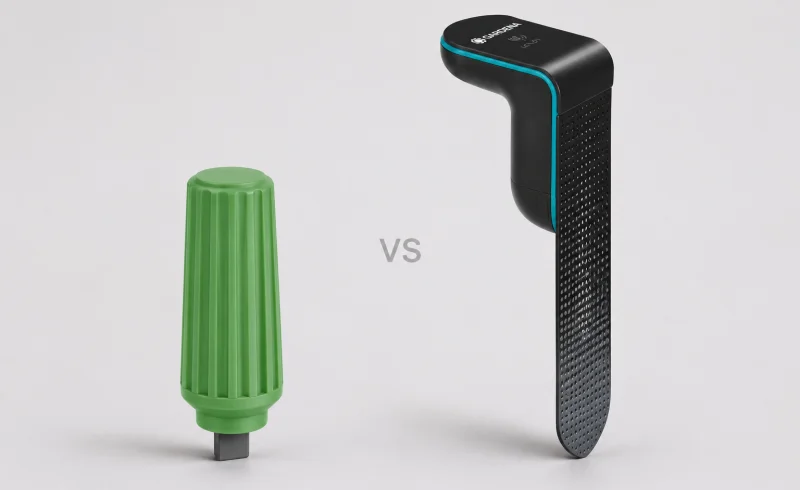
GARDENA suits moisture-aware watering with its Gateway and compatible controls, while THIRDREALITY suits Zigbee2MQTT users seeking a manual moisture-reading offset.
TL;DR
The practical split is ecosystem, not sensor specs. GARDENA is the more integrated option if you already use — or plan to use — its smart watering hardware: the smart Sensor works through the required smart Gateway, and with compatible GARDENA controls it can skip scheduled watering when the soil is still moist.
THIRDREALITY is the more flexible fit for a Zigbee-centered smart home. Model 3RSM0147Z reports soil moisture and temperature through Zigbee2MQTT, and THIRDREALITY’s current manual documents pairing with Home Assistant, SmartThings, Hubitat, compatible Amazon Echo devices, Homey and the company’s own hubs. It is better suited to people who are comfortable building their own automation around a moisture threshold.
The installation burden is also very different. THIRDREALITY calls for a small hole and correct insertion depth. GARDENA requires careful soil contact, a hole at least 20 cm deep, several hours for the reading to settle and up to 24 hours for automatic soil-type calibration. Moving the GARDENA sensor starts that calibration process again.
| Feature | GARDENA smart Sensor | THIRDREALITY Smart Soil Moisture Sensor |
|---|---|---|
| Setup and upkeep | ||
| Placement and installation | Measuring area needs full contact with damp soil; keep at least 5 cm from pot edges. [1]After installation and watering, actual soil-moisture measurement may take several hours. | Not confirmed |
| Battery power and winter upkeep | 2 AA alkaline batteries, not included; no rechargeables. Store frost-free without batteries in winter. [1] [2] [3] [4]Manual estimates about six months, varying with temperature and transmission frequency; GARDENA describes a complete garden season. | Not confirmed |
| Readings and connection | ||
| Software ecosystem | Requires GARDENA smart Gateway and smart App, plus a GARDENA/Husqvarna account. [1] [2] [3]Setup requires an internet-connected Gateway; registration requires a username and email address. | Moisture calibration and precision controls are available in Zigbee2MQTT. [5]Absolute-offset calibration applies on the next report; precision can only be reduced. |
| Soil-moisture reading | Measures root-level soil moisture; specified range 0–100%. Readings appear in the smart App. [1] | Reports soil moisture as a percentage; read-only. [5] |
| Temperature reporting | Temperature readings appear in the smart App. [1] | Reports temperature in °C; read-only. [5] |
📑 Table of Contents
- The biggest difference is how each sensor fits into a smart home
- What moisture and temperature readings do you get?
- Manual correction on THIRDREALITY vs automatic soil recognition on GARDENA
- Automatic watering: native integration vs build-your-own automation
- Installation and placement differ more than the spec sheets suggest
- Battery requirements and seasonal care
- Final Verdict
- FAQ
The biggest difference is how each sensor fits into a smart home
GARDENA is designed as part of a complete irrigation system. The sensor works only with the GARDENA smart Gateway, and the smart App requires an internet-connected Gateway plus a GARDENA or Husqvarna Group account. That extra infrastructure matters if all you want is a moisture reading, but it becomes useful when the sensor is tied to GARDENA’s watering controls.
THIRDREALITY takes the opposite approach. Its Smart Soil Moisture Sensor is a Zigbee 3.0 device, and the manufacturer’s current manual documents several compatible Zigbee platforms, including Home Assistant with ZHA or Zigbee2MQTT. In a Home Assistant setup, you still need a Zigbee coordinator, but you are not tied to a dedicated irrigation ecosystem.
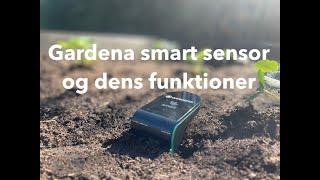
GARDENA requires its own Gateway and app-centered workflow. THIRDREALITY can work through several Zigbee platforms. The trade-off is that the THIRDREALITY sensor does not provide an irrigation valve by itself; automatic watering depends on the other devices and rules in your smart-home setup.
What moisture and temperature readings do you get?
In Zigbee2MQTT, THIRDREALITY exposes soil moisture as a percentage, temperature in °C and remaining battery level. The moisture and temperature values are measurements rather than settings, so they can be used as triggers or displayed in dashboards without being directly rewritten.
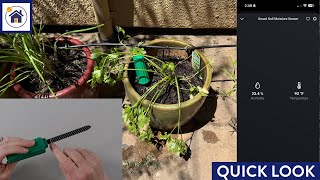
GARDENA measures soil moisture at root level on a 0–100% scale and temperature near the soil. Those readings are sent through the Gateway to the GARDENA smart App.
The documentation does not establish that the two percentage scales are directly interchangeable. GARDENA performs soil-type recognition, while THIRDREALITY exposes a user-adjustable offset in Zigbee2MQTT. In practice, establish watering thresholds from repeated readings in the soil and location you actually use rather than assuming that the same percentage represents the same condition on both sensors.
Manual correction on THIRDREALITY vs automatic soil recognition on GARDENA
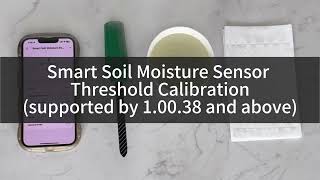
If THIRDREALITY’s moisture reading is consistently offset from the reference you want to use, Zigbee2MQTT provides an absolute soil-moisture calibration offset. The change is applied on the device’s next report rather than immediately. Zigbee2MQTT also offers a temperature offset.
GARDENA does not ask you to tune an equivalent offset in normal use. Instead, the smart Sensor 19040 automatically detects the soil type and self-calibrates. GARDENA says the process begins after installation, searches for a trigger point during the first eight hours and can take up to 24 hours depending on the soil.
That has a practical consequence: GARDENA is better treated as a sensor that stays in one location. If it is removed from the soil — including for relocation or battery work — the soil-type detection and calibration have to run again through the smart App.
Automatic watering: native integration vs build-your-own automation
GARDENA’s main advantage is not simply that it reports moisture. With the smart Gateway and compatible GARDENA watering hardware, the sensor can skip unnecessary watering programs when the soil is still moist. GARDENA’s FAQ says the smart Sensor can be connected to both smart Water Control and smart Irrigation Control.
That is useful when the goal is a watering system that reacts to soil conditions without requiring a separate automation platform. The sensor becomes one part of a predefined GARDENA workflow: measure the soil, feed the result to the app and let compatible watering controls use that information.
THIRDREALITY can also participate in automatic irrigation, but the architecture is different. Its manual explicitly describes creating an automation when soil moisture falls below a chosen value. The actual watering action still depends on a compatible valve, relay or irrigation controller exposed to the same automation platform. That makes THIRDREALITY more configurable, but also places more responsibility on the smart-home setup.
Installation and placement differ more than the spec sheets suggest
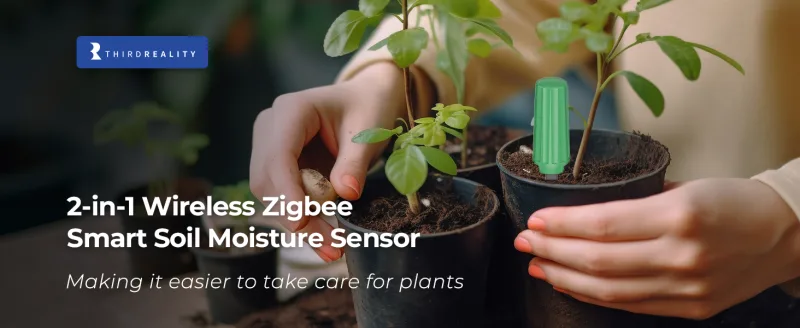
THIRDREALITY’s manual recommends making a small hole rather than forcing the probe into hard soil, then inserting the sensor until its marked line is flush with the soil surface. The warning is practical: friction or hard soil can damage the sensing section and affect accuracy.
GARDENA requires more preparation. Its installation instructions call for a funnel-shaped hole at least 20 cm deep, removal of stones and thick roots, damp soil around the measuring area and full soil contact on both sides without trapped air. After installation, GARDENA says to water the area around the sensor with about 5 litres of water and allow several hours before expecting the actual soil-moisture reading.
Placement matters just as much as insertion. GARDENA says the sensor should experience the same sun, wind and rain as the plants it represents. With drip irrigation, place it near a dripping point. In a planter, keep it at least 5 cm from the edge and avoid low spots where water can collect.
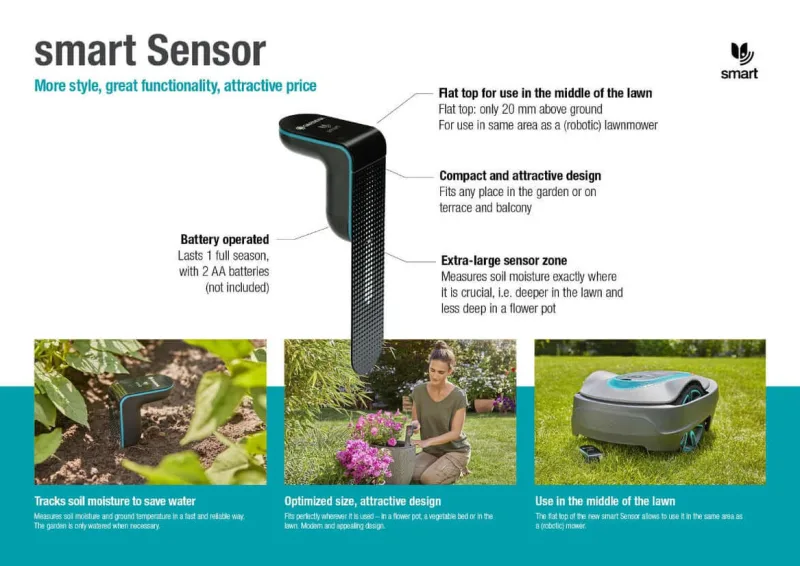
For lawns, GARDENA’s flat head is designed to remain in place while mowing, but the manual sets an important limit: the mower’s cutting height must be at least 30 mm. That makes it suitable for many ordinary lawns, but not for turf maintained below that height.
Battery requirements and seasonal care
According to the THIRDREALITY manual, the sensor uses one AA alkaline battery and includes it. In Zigbee2MQTT, remaining battery charge is exposed as a percentage, so it can be monitored alongside moisture and temperature.
GARDENA uses two LR6 (AA) alkaline batteries, not included, and the manual says rechargeable batteries should not be used. GARDENA rates operating time at about six months with alkaline batteries, with actual life depending on temperature and transmission frequency. Battery status is shown in the smart App.
For winter, GARDENA specifically recommends storing the smart Sensor without batteries in a frost-free location. If you remove and reinstall it, remember that the soil-recognition process must run again afterward.
Final Verdict
GARDENA is the stronger fit when the sensor’s main job is to influence a GARDENA watering system. The required Gateway, app and account add setup overhead, but in return the sensor can feed moisture data directly into compatible Water Control or Irrigation Control hardware and suppress scheduled watering when the soil is already moist.
THIRDREALITY is the stronger fit for a Zigbee or Home Assistant environment where you want moisture data to become one input among many. It offers direct Zigbee integration, a software offset for the moisture reading and a physically simpler installation. Automatic irrigation is possible, but it depends on the hub, automation rules and watering hardware you combine with it.
Neither has a universal advantage. The more practical question is whether you want a self-contained GARDENA irrigation workflow or a flexible Zigbee sensor that you integrate into your existing smart-home logic.
FAQ
Will GARDENA keep watering if my internet goes down?
Can I keep the same moisture threshold if I switch sensors?
Will GARDENA need to recognize the soil again after winter storage?
📄 Sources & Documentation
GARDENA smart Sensor
THIRDREALITY Smart Soil Moisture Sensor
"Images are used for editorial and informational purposes only. All trademarks and images belong to their respective owners."