ENFITNIX Cubelite III vs. Gaciron LOOP-100: Which Rear Light Works Better at Stops?
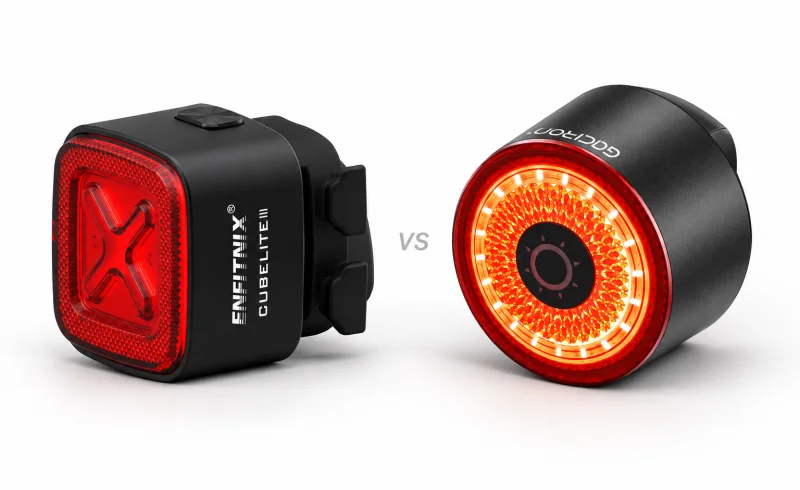
The Gaciron LOOP-100 offers three steady brightness levels, while the ENFITNIX Cubelite III suits riders who prefer four patterns and earlier switch-off in AUTO mode.
TL;DR
The biggest difference between these compact, USB-C rechargeable rear lights isn't the advertised brightness. It's what happens when the bike stops moving. In AUTO, the ENFITNIX Cubelite III goes dark after about 10 seconds, although its MANUAL setting can keep it illuminated. The Gaciron LOOP-100 waits 120 seconds before sleeping, which accommodates shorter pauses but still leaves the light off during a long stationary stop. Both wake when movement is detected.
The LOOP-100 also gives you three steady brightness settings and three flashing patterns. The Cubelite III has four lighting patterns, including one steady setting. Both can brighten in response to deceleration, but neither is directly connected to the brake levers, and neither should be relied on to recognize every slowdown.
| Feature | Gaciron LOOP-100 | ENFITNIX Cubelite III |
|---|---|---|
| Everyday use | ||
| Mounting options | Included seatpost and saddle mounts with magnetic light attachment; optional aero-seatpost mount. [1] [2] [3]For carbon-fiber saddle rails, confirm allowable maximum torque with the supplier. | Included seatpost elastic-ring mount and saddle-rail mount secured with zip ties. [4] |
| Charging and storage | USB-C, 5 V; recharge every 3 months while unused. [3]Store fully charged in a cool, dry place. | USB-C, 5 V; recharge during storage lasting longer than 3 months. [5] [6]For extended storage, disable AUTO and turn fully off in MANUAL; avoid storing with a depleted battery. |
| Automatic stop-and-wake | Sleeps after 120 seconds without motion; movement restores the previous mode. [3] | In AUTO, sleeps after about 10 seconds stationary and resumes with movement. [6]Standby still drains the battery; disable AUTO before switching fully off. |
| Road visibility | ||
| Rain-use conditions | Manual specifies IPX6. [3]Close the charging-port silicone plug fully and flat. | Retailer lists IPX6; manual specifies rain resistance when mounted vertically on the seatpost. [4] [6]The manual calls it not waterproof and says to remove it before washing the bicycle. |
| Maximum output and brake signal | 100 lm maximum; detected braking triggers 100 lm for 3 seconds. [3]Returns to the previous mode without further detected braking. | 30 lm listed maximum; braking activates a separate brake-light area at maximum intensity. [4] [6]Brake sensing requires bicycle installation; rough terrain or unusual rider movement may trigger it inadvertently. |
📑 Table of Contents
Brightness: don't mistake a 100-lumen flash for a steady beam
Gaciron's 100-lumen figure applies to its Fog mode, a variable-frequency flash, and to the temporary brake warning. Its ordinary steady modes are rated at 30, 15 and 5 lumens. That gives you a practical choice: a stronger steady light for open roads, or a lower output when riding close behind other cyclists. Its other flashing patterns are a 15-lumen quick flash (Trail) and a 5-lumen slow flash (Power Saving), according to the LOOP-100 specifications.
The Cubelite III is rated at a maximum of 30 lumens, but Enfitnix doesn't provide a comparable lumen figure for each of its four operating patterns. So it would be misleading to conclude that its constant mode exactly matches the LOOP-100's 30-lumen steady setting. Peak output alone cannot establish which light is easier to notice in traffic.
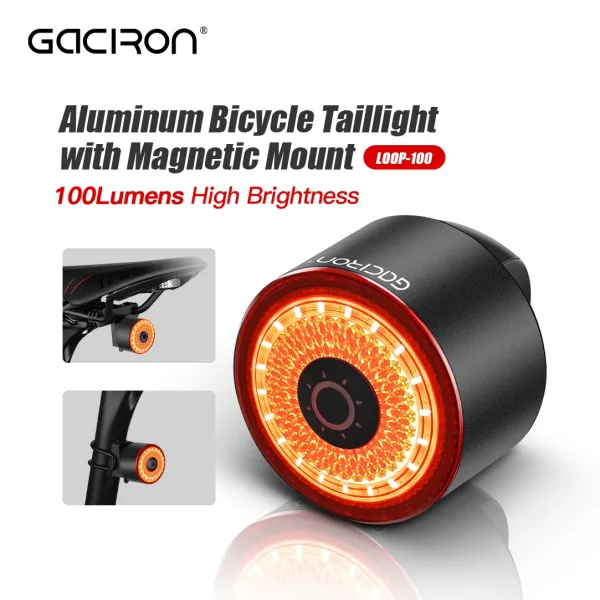
The stronger Fog flash may be useful in bright conditions, but it can be intrusive to someone riding close behind. In a Seven Day Cyclist road review, the reviewer found it conspicuous in daylight but overly intense for some slower, built-up traffic. Gaciron also advertises a viewing angle above 220 degrees and visibility beyond 1,000 meters; those are manufacturer claims, not a guarantee of detection at a particular distance. Mounting position, road conditions and ambient light still matter.
At a red light, the sleep timer matters more than the mode count
Imagine waiting at a busy intersection with traffic approaching from behind. The Cubelite III's AUTO function switches the light off after roughly 10 seconds without movement. That conserves battery during a rest stop, but it also means the rear light may be dark while you're still waiting in the road. A quick double press toggles AUTO off; in MANUAL, the light remains on until you switch it off yourself.
The LOOP-100's 120-second inactivity timer is less disruptive during ordinary traffic-light stops. It resumes the previous mode when movement is detected. But its manual describes no way to turn off automatic sleep, so a queue lasting more than two minutes can still leave you without an illuminated rear light until the bike moves again.
Neither timer distinguishes a safe place to rest from a stopped cyclist exposed to moving traffic. If uninterrupted visibility while stationary is important, the Cubelite III's MANUAL mode is the more predictable behavior; the LOOP-100 is more convenient for shorter, routine pauses.
Brake warnings: helpful, but not the same as a car's brake light
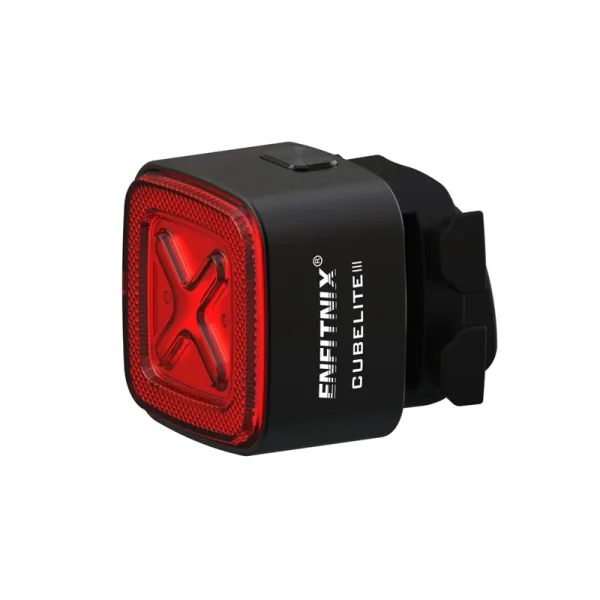
Both lights use motion sensing rather than a connection to the bicycle's brakes. On the Cubelite III, deceleration activates a separate X-shaped brake-light area at high intensity. The Cubelite III V2 manual warns that bumps and unusual bike movement may trigger the warning unexpectedly. It also specifies that the light needs to be installed on the bicycle for brake detection to work correctly.
The LOOP-100 overrides the selected mode with a 100-lumen warning for three seconds when it detects braking, then reverts to the previous mode. That doesn't mean every deceleration will be detected. In road.cc's riding test, slowing from 20 mph or 10 mph to a stop over 30 meters triggered the light, while gently stopping from 5 mph over the same distance did not; a hard stop from 5 mph did. These are observations from one test, not a universal activation threshold.
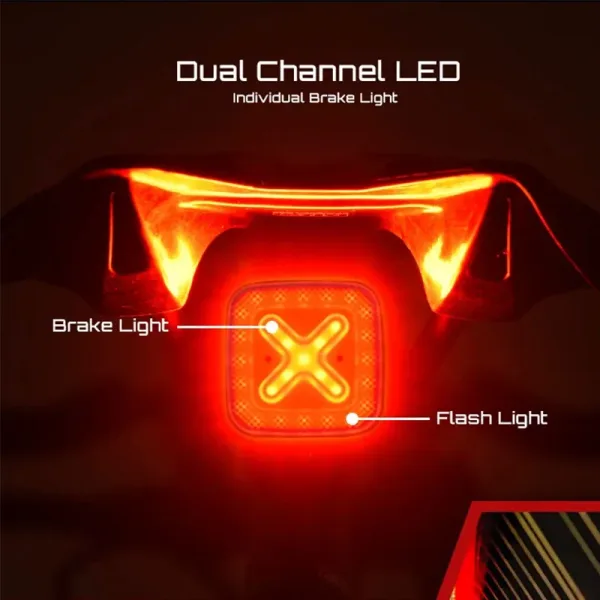
There is also a meaningful difference in how braking is switched off. On the LOOP-100, holding the button for three seconds toggles the warning without changing your regular lighting pattern. For the Cubelite III, Enfitnix documents a disable procedure for production units made after January 2023, and the Czech-market V2 manual describes the same capability. It requires a stationary setup rather than a simple on-the-road toggle, and older versions may not support it. Check the instructions for the specific unit.
On a compatible Cubelite III, disabling the brake sensor makes the main and X-shaped zones illuminate together in normal patterns; the Czech distributor warns that this reduces runtime. On the LOOP-100, disabling braking simply avoids the extra 100-lumen warning bursts. Neither setting changes the automatic sleep timer.
Modes and battery life: the numbers need context
The Cubelite III cycles through steady, single flash, breathing pulse and double flash with short button presses. AUTO versus MANUAL is a separate setting, not a fifth lighting pattern. The LOOP-100 cycles through six modes: the three steady levels, Fog, Trail and Power Saving. Its automatic brake warning is an overlay, not a seventh selectable riding pattern. After a motion-triggered wake-up, the LOOP-100 returns to its previous mode, while the Cubelite III resumes its selected lighting pattern in AUTO.
Gaciron rates the LOOP-100 at approximately 5.5 hours on high steady, 12 hours on medium, 20 hours on low and 40 hours on its slow Power Saving flash. Fog mode is rated for about 10 hours. These are specified runtimes, not a promise of identical results across temperatures and riding styles. During Seven Day Cyclist's mixed-ride testing, repeated brake activation was associated with roughly 15–20% shorter runtime than riding with braking disabled.
Cubelite III runtime figures are less consistent across published material. The manufacturer lists more than 10 hours in constant mode and over 30 hours in a flashing mode, while a Czech V2 listing gives 5.5 hours steady, 9.5 hours breathing and up to 32 hours slow flashing. The available sources don't explain the discrepancy well enough to treat either set as universal. For the Cubelite III, use the documentation for the exact version as a planning baseline and leave a margin for frequent braking.
Both recharge over USB-C. Gaciron specifies approximately 2.5 hours, with a blue, yellow or flashing-red indicator showing the remaining charge range. The Cubelite III's V2 manual quotes 2–3 hours, with a red charging indicator turning green when full. On either light, a full recharge between rides is more dependable than relying on the last few minutes of battery life.
Mounting, weather and everyday handling
Both include seatpost and under-saddle mounting options, but the attachment hardware differs. The Cubelite III uses a rubber seatpost strap or a saddle-rail bracket secured with zip ties, with the light twisting into its mount. The LOOP-100 uses a silicone seatpost strap or a screw-fastened saddle bracket, plus a magnetic attachment with a release button. road.cc's reviewer found removal easy and both mounts secure during testing, though the rubber strap raised durability concerns.
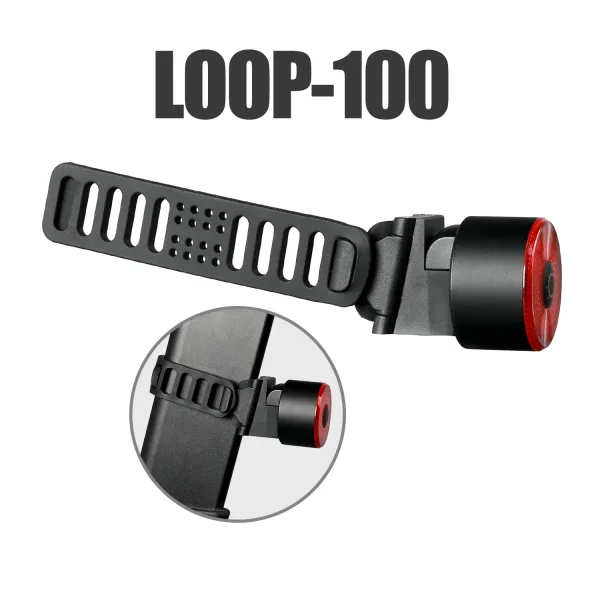
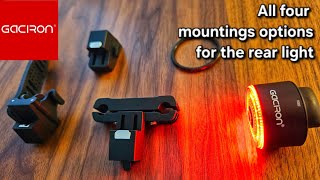
With a saddle bag, check that the light is visible from directly behind rather than hidden by fabric or the rear wheel. The LOOP-100's optional MH01 mount accommodates some aero-shaped seatposts, but it is not part of the standard package. For carbon saddle rails, Gaciron's manual explicitly cautions against exceeding the rail manufacturer's permitted clamp torque. The LOOP-100's central button may also take some locating with thick winter gloves, as noted by Seven Day Cyclist.
Both products are advertised as IPX6 water-resistant, which covers powerful water spray, not submersion. There is an important qualification for the Cubelite III: its Czech V2 instructions describe rain resistance specifically when mounted vertically on the seatpost and advise removing it before washing the bicycle. Gaciron instructs users to close the USB-C port cover completely and flush with the housing. Neither light should be treated as suitable for immersion.
For longer storage, turn the Cubelite III's AUTO setting off and power it down fully; its standby state still draws current. Both sets of instructions advise periodic charging during storage rather than leaving the battery depleted for months.
Final Verdict
The Gaciron LOOP-100 has the clearer advantage for riders who want adjustable steady brightness, a conspicuous high-output flashing option, and automatic lighting that stays on through stops shorter than two minutes. Its removable magnetic mount and simple brake-warning toggle are also practical conveniences. The trade-off is that the 120-second sleep timer has no documented manual override.
The ENFITNIX Cubelite III offers simpler lighting patterns and, crucially, a MANUAL mode that can keep the rear light illuminated through a prolonged stop. Its 10-second AUTO timeout is better suited to off-road pauses or situations where saving power matters more than continuous stationary visibility. Brake-sensor disablement and published runtimes vary by version, so those details deserve a check against the specific unit rather than an assumption based on the model name alone.