SIHOO B100 vs HBADA E3 Air 2026: Adjustment or Fold-Away Arms?
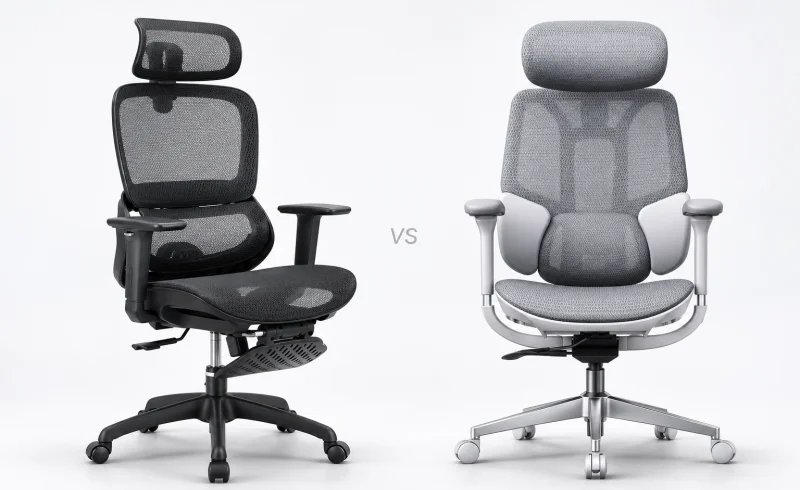
The HBADA E3 Air 2026 offers more support adjustment, while the SIHOO B100 has flip-up arms to help with desk clearance and offers a cushioned-seat option.
TL;DR
The HBADA E3 Air 2026 fits someone who wants to fine-tune support: its adjustable seat depth, backrest height and lumbar position give you more ways to position support beneath your thighs and against your back. Its narrower overall width also helps in a tight home-office corner.
The SIHOO B100 is the more practical starting point if armrests prevent parking beneath your desk: its arms fold upward 90°, though the rest of the chair still needs to clear the opening. It also offers a cushioned-seat option alongside mesh. Comfort comes down to seat firmness more than adjustment range, so try both seats if you can.
| Feature | SIHOO B100 | HBADA E3 Air 2026 |
|---|---|---|
| Size and seat construction | ||
| Seat construction | Choice of mesh or cushioned seat. [1] | Foam-free tensioned CloudMesh seat. [2] [3]Manufacturer describes a looser front-edge weave intended to flex under the legs. |
| Overall width × depth | 27.6 × 28.3 in. [1] | 24.8 × 26.4–28 in. [2] |
| Positioning and arm support | ||
| Back support and adjustment | Floating sacral support. [1] | Lumbar: 5 cm height and 3 cm depth adjustment; backrest: 8 cm height adjustment. [4] [2] [3] |
| Seat height and recline locks | Seat height 46.5–55.6 cm; 3 recline locking positions. [5] [1] | Seat height 46.5–55 cm; 5 recline locking positions. [4] [2] [3] |
| Armrest adjustment and stowing | 2D pivoting arms flip up 90° for desk clearance. [1] [6] [7]A June 2026 reviewer reported height adjustment but no fine front/back, lateral or diagonal adjustment. | 360° pad rotation; 7 cm height and 10 cm front/back adjustment; 40° synchronized recline. [4] [2] [3] |
📑 Table of Contents
Adjusting support for desk work
For setting your working height, these chairs offer almost the same range: the B100 adjusts from 46.5–55.6 cm, while the E3 Air spans 46.5–55 cm. That small difference at the top is less useful as a deciding factor than how you want to position the back and seat.
The E3 Air gives you separate ways to tune those contact points. Its adjustable seat depth and 8 cm of backrest-height travel let you change how much cushion sits beneath your thighs and where the backrest meets your torso. The lumbar support also moves 5 cm vertically and 3 cm in depth, useful when you want to change both the height and prominence of lower-back support during desk work.
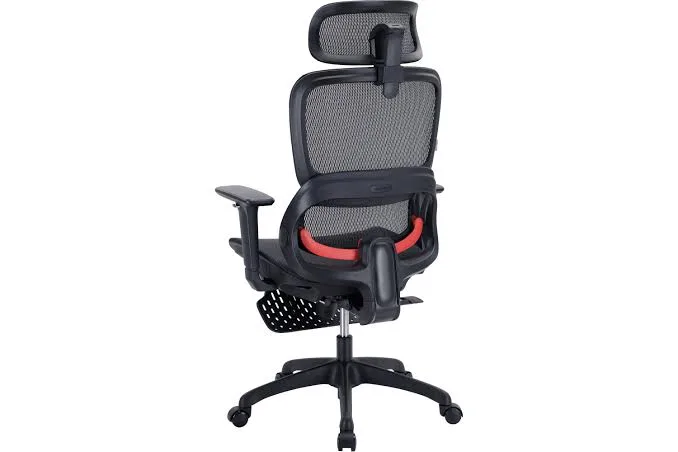
The B100 instead has floating sacral support. If you want to set lower-back support by hand, the E3 Air is the one with explicit height and depth controls.
Choosing recline positions for breaks
For more choice when leaning back, the E3 Air offers five locking positions and reclines to 140°. The B100 has three lockable positions, reaching 135°, giving you fewer settings for a reading or screen break. A YouTube review’s three-position reclining mechanism chapter (02:19) covers the B100’s recline mechanism.

Choose the E3 Air if finding a preferred locked angle matters most; the B100 suits someone content with three preset positions.
Arm support while working and parking the chair
If armrests stop you parking a chair beneath your desk, the B100 is the more practical starting point: its arms fold upward 90°, moving them out of the way. Check your desk opening against the chair’s remaining dimensions before relying on a full tuck-under fit.
For changing forearm position while working, choose the E3 Air. Its pads rotate 360°, adjust 7 cm in height and travel 10 cm forward or backward, giving you more ways to place support beneath your arms as your reach changes. The armrests also move with the recline through up to 40°, useful when switching from upright work to leaning back. If folding the arms away is essential, the B100 is the one with flip-up arms.
Checking body fit and room space
For a narrow home-office corner, the E3 Air takes less width: its overall dimensions are 24.8 inches wide and 26.4–28 inches deep, versus 27.6 inches wide and 28.3 inches deep for the B100. Mark those dimensions on the floor, leaving room to roll back from your desk.
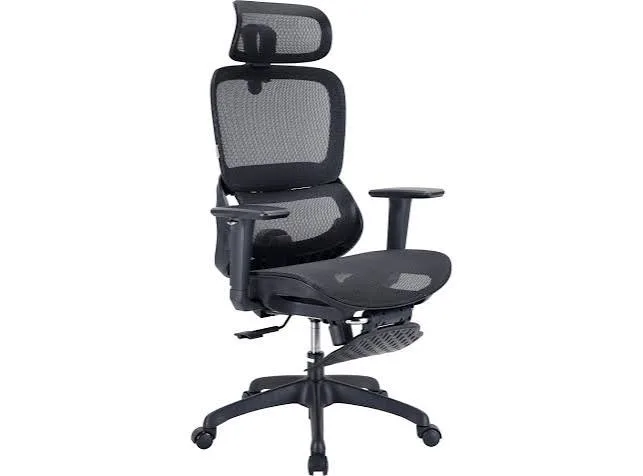
For thigh room, the E3 Air offers a 51.5 cm-wide seat with depth adjustable from 43–48 cm. The B100 manual lists a 50 cm-wide, 43.5 cm-deep seat. The E3 Air gives you more scope to match seat depth to your legs while leaving clearance behind your knees.
Shorter users should check foot support first. The B100 lowers to 46.5 cm; the E3 Air bottoms out at 18.3 inches. HBADA advises its footrest version or a separate footrest if your back-of-knee-to-floor measurement is shorter.
Near the load limit, the E3 Air is the simpler choice at 150 kg/330 lb. SIHOO’s product page lists 330 lb, but its manual specifies 136 kg, so above 136 kg the E3 Air is the safer pick.
Seat construction, firmness and warm-room comfort
If you want padding instead of a suspended mesh seat, the B100 offers both mesh and cushioned versions. Choose the version deliberately: the warm-room experience below concerns the mesh model, not the cushioned option.
In a June 2026 review, the B100 owner reported less heat and sweating than with their previous leatherette gaming chair in a 26°C room at 70–80% humidity. That makes the mesh B100 worth considering for a warm home office, provided you tolerate firmness: the same owner experienced seat discomfort during the first three days, but found the firmness more stabilizing after about a week.
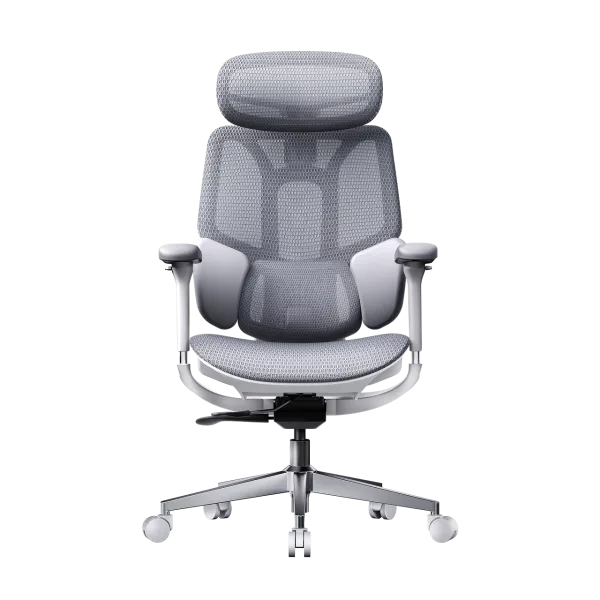
The E3 Air suits someone who specifically wants a foam-free seat. HBADA describes its CloudMesh as a breathable, four-way elastic weave, with a tension-supported seat and a more loosely woven front edge intended to flex beneath the legs. Whether that feels softer than the B100 is personal, so try the seat if firmness is your deciding factor.
Assembly and ongoing upkeep
If you want less to put together, the E3 Air arrives mostly assembled; you attach the base, seat and backrest. The B100 requires assembly, so allow time for setup before using it.
For routine B100 care, use mild soap and a damp cloth, check fasteners, and contact SIHOO support for missing, damaged or faulty components.
For longer-term ownership, HBADA lists a five-year warranty on the E3 Air’s base, gas lift and casters, and three years on other components, including the mechanism, arms and backrest. Those periods make the E3 Air worth considering if component warranty coverage matters to your choice.
Final Verdict
Choose the SIHOO B100 if you need flip-up arms to remove armrest obstruction beneath a desk, or specifically want its cushioned-seat version. Check the desk opening before assuming the chair will tuck fully underneath.
Consider the HBADA E3 Air 2026 for adjustable lumbar positioning, seat depth and backrest height, varied arm positions, or more locked recline angles. It also suits a specific preference for foam-free, tension-supported seating.
FAQ
Will the E3 Air’s adjustable seat help if the B100 feels too deep?
Does the narrower E3 Air give me less sitting room?
Does the E3 Air’s five-year warranty cover its adjustable parts for the full term?
📄 Sources & Documentation
SIHOO B100
"Images are used for editorial and informational purposes only. All trademarks and images belong to their respective owners."