MOVESPEED MSP08 vs Xiaomi Magnetic Power Bank 10000 with Built-in Stand
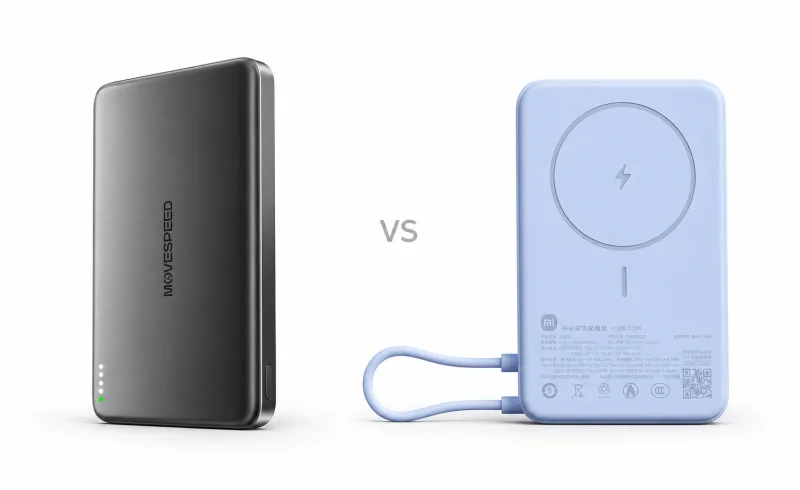
MOVESPEED MSP08 is lighter and thinner, while Xiaomi Magnetic Power Bank 10000 with Built-in Stand suits desks and offers higher wired power for compatible phones.
TL;DR
The MOVESPEED MSP08 is easier to carry, with a lighter, thinner body. The Xiaomi Magnetic Power Bank 10000 with Built-in Stand adds an adjustable stand, an attached USB-C cable and a digital battery display, making it more useful on a desk.
Wireless speed needs a closer look. Xiaomi specifies 7.5 W for compatible iPhones. MSP08's advertised 15 W maximum does not establish a 15 W iPhone charging rate. The shared 15 W headline does not tell you how fast either will charge your phone.
| Feature | MOVESPEED MSP08 Magnetic Solid-State Power Bank | Xiaomi Magnetic Power Bank 10000 with Built-in Stand |
|---|---|---|
| Charging and capacity | ||
| Documented fast-charging protocols | PD 3.0, QC 3.0, Huawei charging standards and Samsung AFC. [1]Retailer-listed protocols. | Port: PD 3.0 and QC 3.0; cable: PD 3.0. Xiaomi 33 W supported on both. [2]Reported in an August 2025 review. |
| Wired, wireless and combined output | USB-C up to 22.5 W; wireless up to 15 W; combined 10 W wired + 5 W wireless. [3] | Single USB-C output up to 33 W; wireless up to 15 W; wired + wireless up to 15 W total. [4] [2]Single wired output applies to the built-in cable or port; 33 W uses Xiaomi's proprietary protocol. Wireless maximum is listed in an August 2025 review. |
| Rated output capacity and recharge input | 37 Wh battery; rated output 6,000 mAh at 5 V/2 A. USB-C input: 5 V/3 A or 9 V/2 A. [3] [5]Capacity is a manufacturer rating at the stated load. | 37 Wh battery; rated output 5,900 mAh at 5 V/3 A. Input: 5 V/3 A, 9 V/3 A or 12 V/2.5 A. [4] [2]Capacity is a manufacturer rating at the stated load. Input is available through the built-in USB-C cable or port. |
| Wireless use and everyday setup | ||
| Cable and stand configuration | USB-C charging cable included. [5] [6] | Built-in USB-C cable and stowable, angle-adjustable metal stand. [2]Configuration described in an August 2025 review. |
| Magnetic wireless compatibility and alignment | iPhone 12 series and later attach and charge wirelessly; Qi Android phones need a magnetic-compatible case for attachment. [6]Manufacturer FAQ guidance for MSP07/08. | Portrait and landscape magnetic wireless charging demonstrated with Xiaomi 15 Pro. [2]Phone example demonstrated in an August 2025 review. |
📑 Table of Contents
Wireless charging: the phone determines the usable speed
Xiaomi's official wireless charging specifications distinguish four modes:
- 7.5 W for iPhones that support magnetic wireless charging.
- 10 W for Xiaomi 13 and later models equipped with wireless charging.
- 15 W for phones supporting the 15 W Extended Power Profile, or EPP.
- 5 W for devices using the Basic Power Profile, or BPP.
The MSP08 specification table lists up to 15 W but does not identify a 15 W iPhone mode. That leaves its iPhone charging rate less clear than Xiaomi's, despite the matching maximum ratings.
If faster magnetic iPhone charging is the priority, verify the exact accessory's charging certification and supported phone models. The Wireless Power Consortium explains Qi2 certification and provides a certified-product database. Magnetic attachment by itself does not establish Qi2 support.
Magnetic attachment and case fit are separate checks
A phone can support wireless charging without having the magnets needed to hold either pack. Apple's MagSafe compatibility guidance identifies the iPhone 16e as a Qi-compatible, non-MagSafe model, so “iPhone 12 or later” is too broad a compatibility rule. An Android phone without built-in magnetic attachment needs a suitable magnetic case; that case cannot add wireless charging to a phone that lacks it.
Case thickness also matters. Xiaomi specifies a nonmetallic case no thicker than 2 mm and recommends Apple's dedicated MagSafe cases for compatible iPhones. MOVE SPEED likewise recommends a MagSafe-compatible case when attachment is weak. Check that the pack sits flat, without a raised camera surround or case accessory holding it away from the phone.
Wired charging: Xiaomi has more headroom
Xiaomi rates both its attached USB-C cable and separate USB-C port at up to 33 W with compatible Xiaomi fast charging. Chongdiantou's protocol measurements of model WPB1007Z found fixed USB Power Delivery profiles reaching 30 W on both connections. A phone still has to support the relevant profile; neither figure promises that charging will stay at that power throughout a session.
MSP08's published USB-C outputs include approximately 20 W at 9 V and 22.5 W at 10 V. The higher number also depends on device compatibility and should not be treated as a universal USB PD charging rate.
Xiaomi's extra output matters most when the connected device can use it. A phone limited to around 20 W may gain little from the higher ceiling. A compatible tablet or phone accepting a higher-power profile has more room to benefit.
In the hand and on a desk
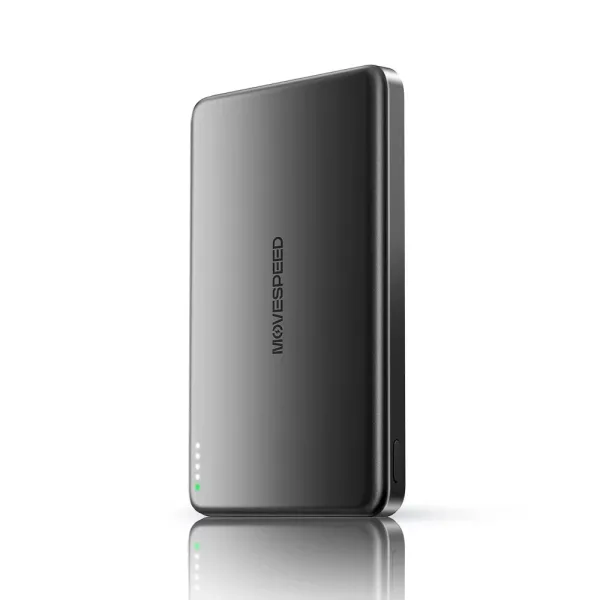
MSP08 weighs approximately 186 g and is 16.4 mm thick, compared with 229 g and 20.25 mm for Xiaomi. That makes MSP08 about 43 g lighter and 3.85 mm thinner. The difference matters when the battery stays attached while you hold the phone, as well as when carrying it in a small bag.
Xiaomi's additional bulk brings useful desk features. Its user manual describes a stand that opens to approximately 80 degrees and a display showing the remaining battery percentage. The stand can keep a compatible phone in view during a call or video, while the percentage display gives a more specific reserve reading than a few indicator lights.
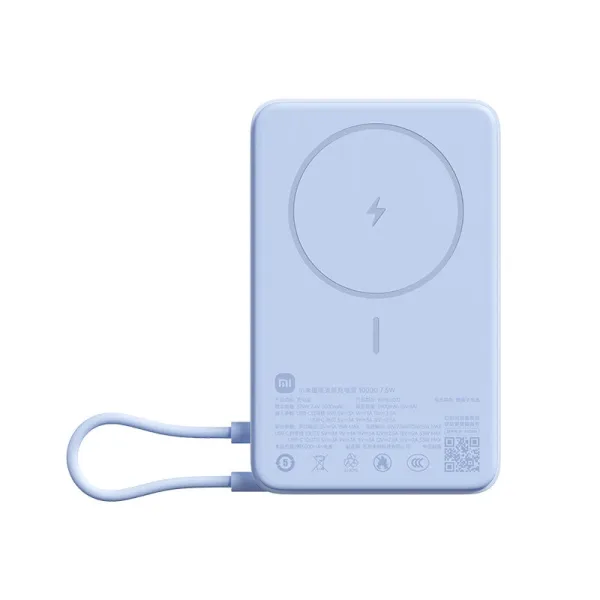
The attached cable is convenient for USB-C phones. A Lightning-equipped iPhone still needs a separate USB-C-to-Lightning cable connected to Xiaomi's USB-C port. That port also lets USB-C devices use a different cable when the attached one does not suit the setup. MSP08 uses a detachable cable; MOVE SPEED's FAQ says a USB-C cable is included.
Capacity: neither has a clear endurance advantage
Both have 37 Wh of nominal stored energy, according to the MSP08 specifications and Xiaomi specifications. Xiaomi's label also says 5,000 mAh at 7.4 V: its two-cell arrangement provides the same nominal energy as 10,000 mAh at 3.7 V.
Their rated USB output capacities are close: 6,000 mAh at 5 V/2 A for MSP08, versus 5,900 mAh at 5 V/3 A for Xiaomi. These correspond to 30 Wh and 29.5 Wh under different rated loads. The 100 mAh difference does not establish that MSP08 will deliver more phone charges. Conversion losses, charging method and the phone's own power use affect how much energy reaches its battery.
For refilling Xiaomi, both USB-C connections accept up to 30 W, requiring a charger that supports its 12 V/2.5 A input. The adapter's headline wattage alone does not confirm that profile. An input ceiling also cannot tell you the full recharge time, since charging power changes as the battery fills.
Sharing power reduces the available speed
MSP08 specifies 10 W wired plus 5 W wireless when both outputs are active. Xiaomi can power two wired devices and one wireless device, but its combined output is capped at 15 W. Adding devices trades charging speed for the convenience of serving several things at once.
Xiaomi also disables wireless output by default during wired charging. Hold the button for two seconds to enable both together. This matters if a phone stops charging wirelessly when another device is plugged in.
Both manufacturers describe charging a device while the bank itself recharges: MOVE SPEED calls this pass-through charging. Xiaomi's manual gives a useful limitation: a 5 V/3 A wall adapter restricts wireless output in this mode to 5 W. A compatible 9 V QC2.0 or PD supply enables higher modes, subject to the phone's supported rate and available power; Xiaomi recommends a supply supporting 12 V and more than 20 W for maximum output. It also instructs users to avoid unattended charging and disconnect after charging is complete, which limits its suitability as a permanent bedside dock.
What MSP08's semi-solid battery claim means
MOVE SPEED describes MSP08's electrolyte as gel-like and semi-solid, and claims approximately 2,000 charge cycles. It does not specify how much capacity would remain after those cycles.
The chemistry is a design distinction. The semi-solid label and cycle claim alone cannot tell you whether MSP08 will outlast Xiaomi or run cooler during wireless charging.
Verdict
MSP08 fits the portable role better: less weight and thickness while attached to a phone, with no reduction in nominal stored energy compared with Xiaomi.
Xiaomi fits a desk or a mixed-device kit better: the stand, battery display, attached USB-C cable and higher single-device wired ceiling make its additional bulk easier to justify when those features are useful.
For an iPhone, Xiaomi documents 7.5 W wireless charging. MSP08's advertised 15 W does not establish a faster rate on those phones, so confirmed compatibility and case fit matter more than the headline wattage.