AOTOS L2 Smart Rideable Suitcase vs Airwheel SE3MiniT
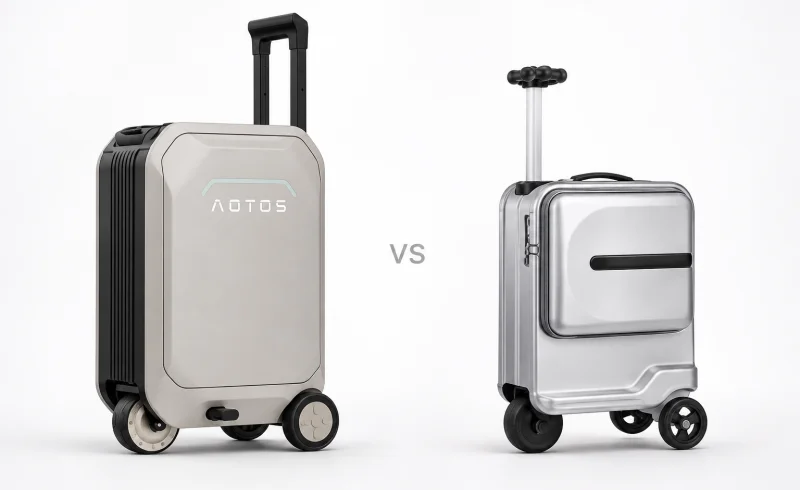
AOTOS L2 offers more packing space and longer claimed range, while Airwheel SE3MiniT doubles as a USB power bank; airline acceptance and packed weight matter for flights.
TL;DR
The AOTOS L2 has more stated packing space: 31 liters versus the Airwheel SE3MiniT's 26 liters. Its larger compartment is the clearest reason to favor it when packing room matters.
For air travel, the more consequential differences are the dimensions and the weight of the exact suitcase you will carry. Airwheel's Australian 6 kg figure excludes its battery, while AOTOS lists 17.3 lb without specifying the battery configuration. Neither is a straightforward choice for strict cabin limits, and some airlines prohibit rideable luggage altogether.
| Feature | Airwheel SE3MiniT | AOTOS L2 Smart Rideable Suitcase |
|---|---|---|
| Riding | ||
| Riding controls | Handle steering; right accelerator, left electric brake; both buttons reverse. Three app speed levels. [1] [2] [3] [4] | Electric brake; app control. [5] |
| Stated range per charge | Up to 8 km. [4] [3] [2] | Up to 6.2 mi (approximately 10 km). [5] [6] |
| Load and riding restrictions | 110 kg maximum payload. [2] [3] [4] | 110 kg maximum load. [7] [5] [6]Manual prohibits passengers, hazardous surfaces, outdoor riding in rain, and slopes over 10%. |
| Travel | ||
| Air-travel requirements | Removable 73.26 Wh battery; detach before boarding, carry in cabin, and check airline rules. [3] [4] [2] [8]Australian listing calls it typically carry-on suitable; Philippine FAQ warns it often exceeds hand-carry weight limits and that most airlines charge excess baggage fees. | Removable battery; remove before checking the suitcase and confirm airline rules. [5] |
| Dimensions and packing capacity | 38.5 × 25 × 57.5 cm folded; 26 L. [4] [3] [2] | 14.2 × 9.9 × 21.7 in; 31 L. [5] |
📑 Table of Contents
Can either suitcase travel on your flights?
A removable battery does not guarantee that an airline will accept a rideable suitcase. flydubai explicitly prohibits rideable luggage in both cabin and checked baggage, even with the battery removed. Its examples specifically include Airwheel. An extra baggage fee cannot resolve that restriction.
Ask the operating airline about the exact model on every leg of your itinerary. Describe it as motorized, rideable luggage; a policy for an ordinary suitcase with a phone charger may not cover the same equipment. Airport rules also determine whether you may ride through a terminal, separately from whether the airline will transport the bag.
Size is another obstacle. With the longest measurement first, the published dimensions are:
- AOTOS L2: 21.7 × 14.2 × 9.9 inches, approximately 55.1 × 36.1 × 25.1 cm.
- Airwheel SE3MiniT: 57.5 × 38.5 × 25 cm folded, approximately 22.6 × 15.2 × 9.8 inches.
These figures come from the AOTOS specifications and Airwheel's folded dimensions. The MiniT is taller and wider despite its smaller stated storage capacity.
For a concrete U.S. example, Delta's carry-on limit is 22 × 14 × 9 inches, including wheels and handles. Based on these published dimensions, both suitcases exceed at least one of those measurements. A “20-inch” description is therefore insufficient evidence of cabin suitability. Measure the actual bag with its handles stowed and check every dimension against your carrier's limits.
How much room remains for your belongings?
The L2's additional five liters are its clearest packing advantage on paper. Whether that extra room helps depends on how much weight you can add.
AOTOS lists 17.3 lb, or about 7.85 kg, as the product weight, without clarifying whether the battery is included. Airwheel Australia lists 6 kg, or about 13.2 lb, without the battery. These figures do not establish an exact difference between two fully equipped suitcases.
With a hypothetical 7 kg cabin allowance, the MiniT's battery-free shell alone would leave just 1 kg for contents. The battery and any other items counted within that allowance reduce the remaining margin further. More compartment space is useful only when the weight allowance lets you fill it.
Weigh the complete travel setup, including the charger and any separately carried battery. Also consider the parts of the trip that still involve lifting: stairs, a car trunk, or an overhead compartment. Riding does not remove those demands.
How do the riding controls compare?
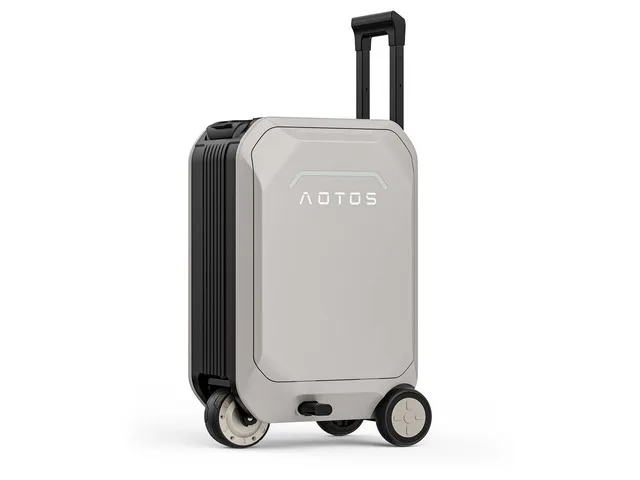
Both use physical accelerator and brake controls. The AOTOS L2 manual and Airwheel's instructions describe pressing both controls together to reverse. Airwheel places acceleration on the right and braking on the left.
Both offer three app-selectable riding levels: Low, Middle and High for Airwheel, and L, M and H in AOTOS's manual. Neither has an exclusive advantage in these basic controls.
A useful hands-on check is whether you can reach the controls comfortably, keep your feet supported and maneuver at low speed. The specifications alone cannot establish seat comfort, steering feel or braking distance.
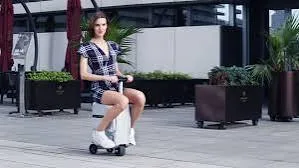
Does AOTOS travel farther?
AOTOS advertises up to 6.2 miles (10 km) per charge and a 6.2 mph (10 km/h) maximum speed. Airwheel's European specifications give up to 8 km per charge and an 8 km/h maximum, approximately 5 miles and 5 mph.
The L2 has the higher published figures. They do not establish how much farther it will travel with the same rider and luggage on the same route. Treat the roughly 1.2-mile advertised range difference as a planning reference, not a dependable reserve for a tight connection.
Maximum speed also matters less when pedestrians, turns or local rules require a slower pace. For short permitted transfers, controllability and the amount of walking or lifting still required may matter more than the top-speed number.
What do the batteries change?
Both detachable batteries can power mobile devices: AOTOS describes its battery as a dual-purpose power bank, and Airwheel specifies USB charging from its removable pack. Charging a phone uses energy that would otherwise remain available for riding. USB support alone does not establish how quickly your phone will charge.
Airwheel specifies 73.26 Wh. AOTOS lists 37 V and 2.5 Ah, which calculate to 92.5 Wh nominal. That calculation is not a reading of the label on your particular battery; check its actual marking before travel.
These figures fall below the FAA's usual 100 Wh limit for passenger lithium-ion batteries, but the airline's rules for the suitcase still apply. If the carrier accepts the bag, remove its battery before it enters checked baggage, including at the gate. Keep the battery in the cabin, protected against damage and short circuits, and follow any additional airline requirements for removal or onboard use.
Where does riding make sense?
Plan around dry, suitable surfaces where riding is permitted. The AOTOS manual prohibits outdoor riding in rain or snow, warns against hazardous surfaces and excludes slopes steeper than a 10% grade. Its IPX4 product rating does not override those instructions. The Airwheel SE3MiniT manual also says to avoid riding in rain, snow or ice.
Rider restrictions matter too. AOTOS's manual prohibits riding for people under 15, over 60, or during pregnancy. Both list maximum loads of about 110 kg (242 lb). If you approach that limit, confirm how packed luggage counts toward it.
For routes dominated by stairs, rough surfaces or areas where riding is prohibited, the practical question is how manageable the suitcase remains while you walk and carry it.
Final Verdict
The AOTOS L2 better suits travelers who need more packing space, provided its weight and rider restrictions fit the trip. Its higher advertised range remains a claim rather than a demonstrated endurance advantage.
The Airwheel SE3MiniT suits lighter packing, with any weight advantage dependent on the exact configuration. Compare complete travel weights before treating it as the easier suitcase to lift. Its detachable phone-charging battery and basic riding controls are features both models share.
For frequent flying, airline acceptance, external dimensions and packed weight should settle the decision. Neither model's removable battery or carry-on description guarantees a workable itinerary.