GOTRAX GXL V2 vs. NAVEE V25: What Matters on a Short Commute
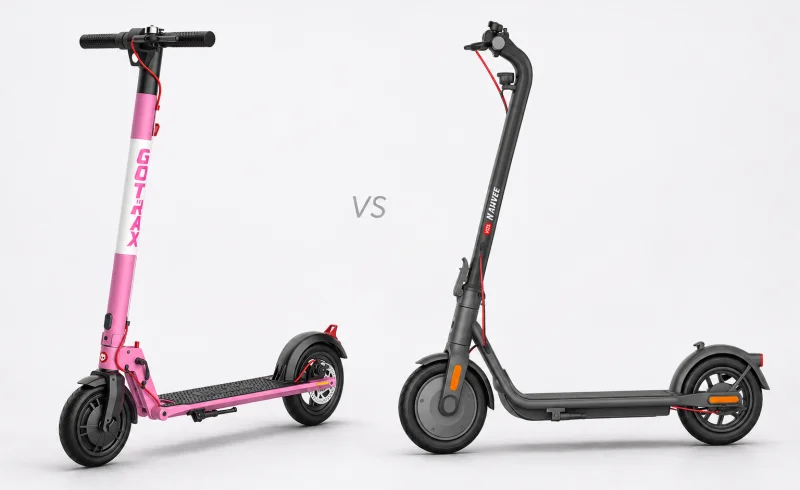
The Gotrax GXL V2 suits lighter carrying and phone-free use, while the NAVEE V25 Electric Scooter offers rear lighting but needs app activation; neither is a clear range winner.
TL;DR
The GOTRAX GXL V2 is the more practical fit for frequent carrying and tight storage. The NAVEE V25 offers larger pneumatic tires and integrated front and rear lighting, with extra weight and app activation as the main tradeoffs.
The details matter: GXL V2 tire configurations differ, and the V25's maximum speed depends on its regional version. Neither scooter's advertised range should be treated as a guaranteed daily distance, particularly on a route with hills or no charging at the destination.
| Feature | Gotrax GXL V2 | NAVEE V25 Electric Scooter |
|---|---|---|
| Everyday riding | ||
| Brake operation | Hand-operated rear disc; front regenerative brake [1]Rider Guide's reviewed configuration. | Release accelerator to slow; squeeze brake lever to brake [2]V25-E/D/P manual describes squeezing the lever for sudden braking. |
| Documented range | 7 mi measured by TechGearLab; 10.1 mi by Rider Guide [3] [1]Separate tests. Rider Guide used a 165 lb rider, fastest mode and a hilly, rough urban loop with stops. TechGearLab reported substantial slowing during its test. | About 25 km (15.5 mi) nominal [2]V25-E/D/P manual: 75 kg load, flat surface, no wind, 25°C and constant 15 km/h—not the same conditions as the GOTRAX review tests. |
| Visibility lighting | Front LED and rear reflector; no taillight [1]Rider Guide found the headlight dim and recommended additional front and rear lights for night commuting. | Headlight, taillight and lever-triggered brake light [2]V25-E/D/P manual. |
| Transport and ownership | ||
| Folded dimensions | 39 × 17 × 14 in [1]Rider Guide reports these folded dimensions; handlebars do not fold. | About 44.9 × 19.1 × 19.3 in [2]V25-E/D/P manual specifies 1140 × 485 × 490 mm; inch conversion rounded. |
| Tire construction and size | 8.5-in pneumatic inner-tube tires [1] | 10-in pneumatic tires [2]V25-E/D/P manual. |
| App connection and activation | No app connection [4]GOTRAX Canada product FAQ. | App registration and binding remove activation speed limit [5]NAVEE's V25 FAQ: unactivated scooters are limited to 10 km/h and cannot access all features. |
📑 Table of Contents
- Start with the tires, because they change the experience
- Stairs and storage favor the GXL V2
- Plan around the entire round trip
- Speed varies by market; hills remain a separate question
- Lighting makes a clearer everyday difference
- Phone setup and cruise control change the routine
- Charging needs space as well as time
- Final verdict
- FAQ
Start with the tires, because they change the experience
The GXL V2 name does not identify a single tire setup. GOTRAX's US page includes honeycomb-tire options while its general description still mentions pneumatic tires. Confirm the configuration of the actual scooter, especially when comparing it with an older review.
There is a simple physical check: pneumatic tires have inflation valves; GOTRAX's honeycomb tires do not. As the company's tire guide explains, honeycomb tires are airless. They eliminate inflation and inner-tube air loss, but that convenience does not establish how comfortably they ride.
The V25 has 10-inch pneumatic tires, compared with the GXL V2's 8.5-inch wheels. Larger wheels generally roll over small pavement irregularities more easily, so the NAVEE's tire size suggests an advantage on patched streets. Actual comfort still depends on tire pressure and the road surface. NAVEE's V25 manual specifies air-filled tires, so pressure checks remain part of the routine.
The pneumatic GXL V2 tested by Rider Guide had no suspension; its tires supplied the cushioning. A honeycomb version should not be assumed to feel the same over bumps.
Stairs and storage favor the GXL V2
GOTRAX Canada lists its pneumatic GXL V2 at 26.85 pounds. The V25-U manual lists 37.7 pounds. That is about 11 extra pounds to lift with the NAVEE. A short lift into a trunk and carrying a scooter up several flights of stairs are very different demands; the difference becomes more consequential with every flight.
Folded dimensions also favor the GOTRAX. Rider Guide lists its tested GXL V2 at about 39 × 17 × 14 inches, versus 44.9 × 19.1 × 19.3 inches for the base V25 in its manual. Measure the storage opening as well as the space inside. The GXL V2's handlebars do not fold, so allow for their full width in a narrow hallway or storage compartment.
Check the GXL V2's folded carrying latch before lifting it by the stem. Rider Guide's sample needed adjustment; TechGearLab's 2022 sample suffered an early failure. These were individual older test units, and the issue concerned retention while folded, not the separate lock securing the stem for riding.
Plan around the entire round trip
A five-mile ride each way is a ten-mile battery requirement. That distinction matters more than the distance printed most prominently in a product description.
Historical tests give some context for the pneumatic GXL V2. In its 2019 review, Rider Guide measured 10.1 miles with a 165-pound rider on an urban loop with stops and hills. TechGearLab's 2022 test reached 7 miles, with substantial slowing as the battery depleted. Those are results from particular scooters and conditions, not a promised range interval for every GXL V2 configuration.
NAVEE's approximately 15.5-mile claim was measured at 9.3 mph, on flat ground without wind, at 77°F, with a roughly 165-pound load. Its range guidance confirms that higher speeds, cold temperatures, hills and repeated acceleration reduce range. The advertised distance therefore does not describe a full-speed commute.
The V25's extra weight does not bring a substantially larger battery: its manual lists 183.6 Wh, close to the 187.2 Wh specified for GOTRAX Canada's pneumatic GXL V2. Similar capacity does not guarantee similar mileage, but it gives little reason to assume the NAVEE has a large endurance advantage simply because it is bigger.
For a ten-mile day without charging, one of those GXL V2 tests barely covered the distance and the other fell short. The V25's favorable-condition claim does not establish that it will cover the same route reliably. Leave a reserve for detours, cold weather and battery aging.
Speed varies by market; hills remain a separate question
GOTRAX lists a 15.5 mph maximum. The American V25-U is rated for 30 km/h, about 18.6 mph, in its US manual. The European manual instead lists 25 km/h for V25-E/P and 20 km/h for V25-D. Check the model suffix; the scooters do not have one universal speed relationship.
Top speed on level pavement says little about a sustained climb. TechGearLab's pneumatic GXL V2 handled a 3.5% grade, but stalled partway up its 10.5% test hill with an adult rider. NAVEE claims approximately 15% climbing ability, without establishing a directly comparable climbing speed or sustained performance. A percentage on the specification sheet is not a promise of maintaining commuting pace uphill.
Both have load limits of roughly 220 pounds, including what the rider carries. Being within that limit does not guarantee strong acceleration or climbing near it. If a steep climb is unavoidable, a demonstration on a similar hill with a similar rider weight matters more than either maximum-speed claim.
Lighting makes a clearer everyday difference
Rider Guide's GXL V2 had a front LED and rear reflector, with no powered taillight. The reviewer also found the headlight dim. For that setup, evening use calls for a separate rear light and potentially a stronger front light, adding accessories to mount and keep charged.
The V25's lighting instructions describe a headlight, taillight and brake-light response. Its integrated rear light needs no separate mounting or charging. NAVEE's US product page also lists an automatic headlight, which handles switching as daylight fades. These are useful conveniences, but they do not establish how well the beam illuminates an unlit road. Assess illumination at your riding speed, not just whether the lamp turns on.
Braking should be judged separately. The GXL V2's documented setup combines front electronic braking with a rear disc brake. NAVEE publishes a V25 rear drum brake service guide, although its US product description calls the rear brake a disc. Confirm the actual hardware before following adjustment instructions. Brake type alone does not establish a shorter stopping distance.
Phone setup and cruise control change the routine
The GXL V2 operates without an app; GOTRAX's FAQ confirms that it has no app connection. Its everyday controls stay on the scooter.
The V25 requires a phone for initial activation. NAVEE's instructions call for downloading the app, registering or signing in, and binding the scooter. Until activation, speed is limited to 10 km/h, about 6.2 mph. Complete that step before the first planned trip.
Cruise control deserves attention before heading into traffic. GOTRAX warns that it may engage after about seven seconds of steady throttle and continue driving after the throttle is released. NAVEE's cruise instructions describe enabling the feature in the app, then holding steady throttle for five seconds; the brake or another throttle input cancels it. Check availability on the regional version. With cruise engaged, releasing the accelerator is not a reliable way to request slowing.
Charging needs space as well as time
The published charging times are close: four to five hours for the GXL V2 and about four to 4.5 hours for the V25. A small difference in charging time is unlikely to determine whether either fits an evening routine.
Outlet access is more consequential. GOTRAX says the GXL V2's battery is not designed for easy removal, and NAVEE's US manual treats battery removal as a service task. Plan a dry charging spot for the entire scooter rather than assuming you can leave it downstairs and carry only the battery inside.
Tire upkeep depends on configuration. GOTRAX's maintenance guide specifies 50 psi for the original pneumatic setup; that instruction does not apply to airless honeycomb tires. For either scooter with pneumatic tires, use the pressure guidance for the fitted tires and applicable manual.
Final verdict
The GXL V2 fits short trips with frequent lifting, limited storage and a preference for controls without an app. Its tire configuration deserves as much attention as its weight, because it changes maintenance and how relevant older ride impressions are.
The V25 fits a routine with less carrying, where larger pneumatic tires and integrated rear lighting are useful. The US version also has a higher stated speed ceiling, while European versions differ. Its additional weight is easier to accommodate with ground-level storage than with several flights of stairs.
For either scooter, a demanding daily hill or a round trip close to the advertised range needs stronger route-specific evidence. Neither the V25's lighting equipment nor the GXL V2's portability resolves those limits.