keka Eye Massager EMS Red Light Therapy Glasses vs Xiaomi Mijia Smart Eye Massager: EMS/Red-Light Glasses or Heated Air-Pressure Mask?
Compare keka's active EMS and red light glasses with Xiaomi's heated air-pressure mask. Explore massage tech, fit, smart features, and ease of use to decide which eye massager fits your routine.
TL;DR
Quick Decision
If your priority is an unusually light, open glasses-style device that uses electrical stimulation and red LEDs around the under-eye area, the keka Eye Massager EMS Red Light Therapy Glasses is the closer fit. The trade-off is unusually thin technical and safety documentation.
If you want actual pneumatic massage plus adjustable warmth, the Xiaomi Mijia Smart Eye Massager is the more fully documented option. Model MJYBAM01YMYY uses air chambers, three massage-intensity levels, three heat levels, physical controls, Mi Home customization, and NFC.
Xiaomi's model-specific documentation does not establish a separate vibration-massage system. Listings that describe four vibration points or only two heat levels appear to be referring to different hardware or inconsistent marketplace metadata.
Neither device should be treated as a substitute for medical evaluation or as proof that eye fatigue, dark circles, dry eye, or another condition will improve.
Key Differentiators
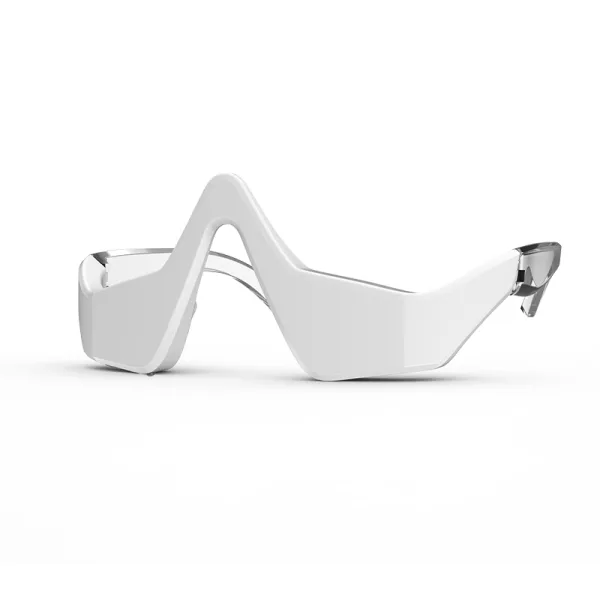
These devices share a category name but not a massage mechanism. The keka is essentially an open under-eye wearable: listings identify red LED light and electrical stimulation, and product databases list the KEKA-4066 design at about 45 grams. Xiaomi is a much larger, roughly 370-gram visor that uses controlled air pressure around the eye socket and adds a heated-compress function.
The documentation gap matters as much as the hardware difference. Public listings for the keka do not provide the red-light wavelength, irradiance, delivered dose, detailed electrical-output specifications, or a clearly attributable model-specific safety manual. Xiaomi publishes far more information about the exact model, including its massage architecture, controls, battery, app behavior, maintenance, and contraindications.
Who Should Skip Both
If the goal is treatment for persistent eye pain, vision changes, postoperative symptoms, dry-eye disease, or another eye condition, neither device should replace appropriate eye care. Extra caution is also warranted around electrical stimulation, pressure, and heat if you have implanted electronic medical devices, recent eye surgery, eye injury, or another relevant medical condition.
First, Make Sure You Are Comparing the Right Xiaomi
The biggest factual trap in this comparison is the name Xiaomi Mijia Smart Eye Massager. Third-party listings attach noticeably different specifications to products using very similar names.
This article is specifically about model MJYBAM01YMYY. Its model-specific documentation lists a 1200mAh battery, roughly 2.5-hour charging time, dimensions of 234 × 115 × 76 mm, and a net weight of about 370 g.
More important, its massage system is described as seven zones controlled by four independent air valves, with three pressure-intensity levels. Xiaomi's materials describe five larger air chambers combined with four smaller ones around the orbital area. Heat is controlled through an NTC temperature system with three adjustable levels.
That does not match listings describing a lightweight mask with two heat settings and four vibration points. Those specifications should not be blended into MJYBAM01YMYY, and this comparison does not treat vibration as a confirmed feature of the Xiaomi model.
Massage Technology: Electrical Stimulation vs Air Pressure
The keka Eye Massager EMS Red Light Therapy Glasses is marketed around two features: electrical stimulation and red light. Other KEKA-4066 listings describe the electrical function as microcurrent, so it is more useful to think of this simply as electrical stimulation around the under-eye area rather than assume that every seller is using EMS terminology in the same technical sense.
The red LEDs deserve similar caution. The presence of red light is documented, but the publicly available specifications do not establish the wavelength, irradiance, energy dose, or exposure protocol. Those details matter when evaluating photobiomodulation claims. A red LED by itself is not evidence that a device will meaningfully change puffiness, dark circles, wrinkles, or eye fatigue.
The Xiaomi Mijia Smart Eye Massager takes a much more mechanical approach. Inflating and deflating air chambers apply changing pressure around the eye socket, and the device can combine that pressure with a heated compress. The three pressure levels give the user some control over how forceful the massage feels.
That makes the practical distinction straightforward: keka delivers an electrical and light-based skin-contact routine, while Xiaomi provides physical compression and warmth. They are not two implementations of the same treatment.
Fit, Weight & Visibility
The physical difference is substantial. The keka uses a compact, open glasses-style frame positioned around and below the eyes. KEKA-4066 listings put the device at roughly 45 g and about 139.6 × 53.5 × 37 mm. Much of the face remains uncovered, and the design does not place a large housing across the entire eye area.
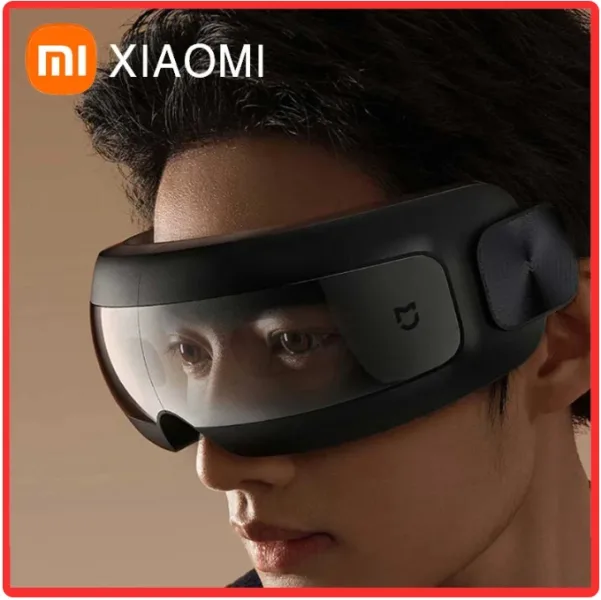
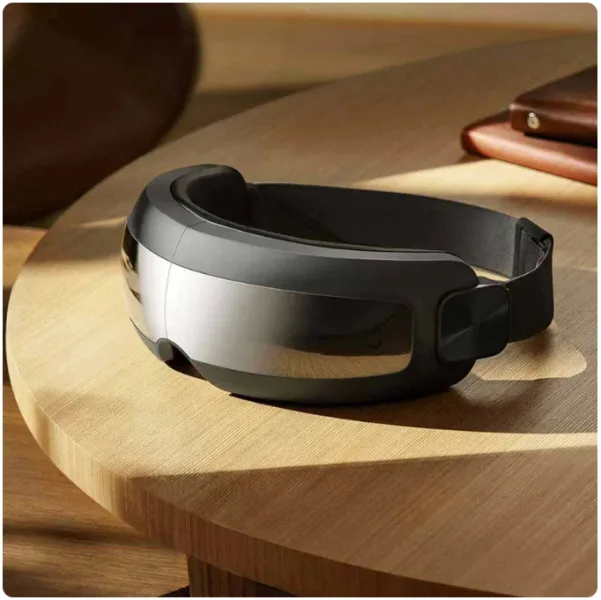
The Xiaomi is closer to a visor. An adjustable elastic strap carries a much larger housing across the face, and its listed weight is approximately 370 g. The device folds at the center for storage, but it is still a considerably larger wearable when in use.
The keka uses an open frame with its contact areas positioned around the lower eye region.
The Xiaomi covers substantially more of the eye area and uses a strapped visor-style housing.
The side view shows the adjustable strap and larger structure required for Xiaomi's pneumatic system.
Xiaomi is not quite a conventional opaque sleep mask, however. Its inner structure is recessed to reduce direct pressure on the eyeballs, and the design includes a semi-transparent viewing area intended to preserve some awareness of the surroundings.
Neither layout is automatically more comfortable. The keka puts far less mass on the face, but electrical stimulation depends on consistent skin contact. Xiaomi covers more surface area and adds substantially more weight, but its strap holds the pneumatic system in a predictable position.
Controls, Mi Home & Region Friction
The keka is the simpler device from a software standpoint. Public KEKA-4066 listings do not document a companion app, wireless connection, account, or cloud feature. Its appeal is therefore mostly in the hardware itself rather than software customization.
The Xiaomi is more nuanced than the original comparison suggests. A phone is not required for every session.
Physical buttons can switch among the device's factory modes and cycle through its three massage-intensity levels. Voice prompts identify operating states and can be disabled. The standard session length is 15 minutes, and the device shuts down when that session ends.
Mi Home extends those controls. The app provides additional massage modes, lets the user create and store custom routines, changes session duration, and controls the heating function and temperature level. A configured mode can also be stored for later offline use.
NFC does not turn the massager into a broader smart-home controller. After the device has been paired, tapping a compatible phone against the NFC area is primarily a shortcut that opens its Mi Home control page.
There is one significant setup complication: the commonly available China-region version requires Mi Home to be set to the China region for pairing. That is more cumbersome than a fully self-contained appliance, particularly for someone who already has Mi Home devices associated with another region.
The important distinction is therefore not "app versus no controls." Xiaomi retains useful physical operation, while the app unlocks its deeper settings.
What the Two Devices Are Likely to Feel Like
The keka's electrical stimulation should not be confused with kneading or compression. Its electrodes deliver electrical pulses through skin contact around the eye area. How noticeable that stimulation feels depends on intensity and contact, but the publicly available KEKA-4066 material does not provide enough technical detail to make responsible claims about the exact sensation or output.
Xiaomi's mechanism is easier to predict from the hardware. Air chambers repeatedly change pressure around different parts of the orbital area, while the heating system can add warmth. The result is mechanically closer to what most people mean when they describe an eye massager.
There are still trade-offs. Xiaomi contains pumps and valves and therefore is not silent; its published specification is up to 50 dB(A) under the manufacturer's stated test conditions. It also weighs far more than the keka. Someone bothered by facial pressure, mechanical noise, or a large wearable may prefer the less enclosing form factor even if air pressure and heat sound appealing on paper.
The reverse is also true: someone expecting pressure and warmth from an "eye massager" may find an electrical-stimulation frame to be a completely different category of experience.
Safety and Evidence Matter More Here Than Feature Count
Eye-area wellness devices deserve more skepticism than an ordinary gadget because small differences in electrical output, heat, light dose, fit, and instructions can matter.
That is the weakest part of the keka proposition. The accessible listings establish that KEKA-4066 uses red LEDs and electrical stimulation, but they do not provide enough model-specific information to independently evaluate the red-light dose or the electrical-stimulation parameters.
This is particularly important because the FDA's general guidance on electrical muscle stimulators notes reports of shocks, burns, bruising, skin irritation, and pain, as well as interference with implanted devices. That guidance is about the EMS category and is not a finding that KEKA-4066 itself is unsafe. It does mean that vague electrical-stimulation specifications should not be treated as a minor omission.
The Xiaomi has much better safety documentation. Its manual lists multiple contraindications and precautions, including implanted cardiac devices, certain implants, pregnancy, acute inflammation, eye injuries, and some postoperative or medical situations. It instructs users to stop if discomfort occurs and to seek medical guidance in specified circumstances.
Its maintenance limits are also clearer: the device should not be washed or immersed, and the manual specifies dry cleaning of the housing rather than treating the visor as a washable sleep mask.
None of this demonstrates that Xiaomi produces a medical benefit. It simply means the operating envelope is documented more clearly.
Long-Term Ownership Is Mostly a Documentation Question
The original comparison tried to predict reliability from component count: fewer parts for keka, more pumps, valves, and heating hardware for Xiaomi. That is not enough evidence to declare either one more durable.
What can be said is that Xiaomi provides a much clearer ownership picture. The model number, battery capacity, charging time, controls, cleaning instructions, app behavior, troubleshooting steps, and safety limitations are documented.
The keka is physically simpler and much lighter, but its public documentation is sparse. One major Korean product database even lists the manufacturer as unconfirmed. That does not mean the device will fail; it means questions about replacement parts, electrical specifications, safety instructions, and long-term support are harder to answer before relying on the device.
For this category, that information gap is a real product characteristic rather than a paperwork detail.
The Bottom Line
These two devices make sense for different routines, but the comparison becomes clearer once the unsupported wellness language is removed.
The keka Eye Massager EMS Red Light Therapy Glasses is the more minimal design: an open, roughly 45-gram wearable built around electrical stimulation and red LEDs. Its physical simplicity is attractive if that specific format is the goal. The major limitation is not the lack of an app or heat; it is the lack of detailed, model-specific information about the light output, electrical stimulation, and safety guidance.
The Xiaomi Mijia Smart Eye Massager MJYBAM01YMYY is a much larger device built around pneumatic massage and adjustable warmth. It offers three pressure levels, three heat levels, physical controls, app customization, NFC access, and substantially better documentation. Its compromises are the 370-gram visor format, mechanical noise, greater complexity, and the China-region Mi Home requirement.
For air-pressure massage and adjustable heat, Xiaomi is the clearer match. For an open electrical-stimulation and red-LED wearable, keka is the closer match, with a meaningful documentation caveat.
Neither should be selected on the assumption that its marketing claims establish treatment for eye disease, dark circles, puffiness, dry eye, or another medical or cosmetic condition.
✦✧✦✧
🏆
Better for Air Pressure and Heat
Best fit for most usersXiaomi Mijia Smart Eye Massager
FAQ
What is the main difference between keka and Xiaomi eye massagers?
The keka uses EMS and red light therapy in an open glasses design for active, targeted muscle and skin treatment. The Xiaomi uses a four-point air-pressure massage with adjustable heat and vibration in a full mask for passive, spa-style relaxation. They address different needs: treatment vs. comfort.
Which eye massager is better for sleep and relaxation?
Xiaomi is better for sleep and relaxation due to its warm heat therapy and rhythmic air-pressure massage, which most find soothing. The keka’s EMS sensation is clinical and lacks heat, making it less calming for wind-down. Choose Xiaomi for comfort, keka for short active sessions.
Does the keka eye massager have an app?
No, the keka is hardware-only. It lacks a companion app, account requirements, or smartphone connectivity. All intensity and mode adjustments are made directly on the device, which simplifies setup and avoids software dependencies, but it also means no saved routines or remote control.
Is the Xiaomi Mijia Smart Eye Massager worth the higher price?
It depends. If you value app control, heat, air-pressure massage, and smart-home integration, Xiaomi justifies a higher price. But the keka offers a different, hardware-only experience without heat or app. This review does not directly compare prices, so value is determined by your feature priorities and budget.
Is the Xiaomi Mijia Smart Eye Massager app available in English?
Not always. Some users report that the Mi Home app for this device is only available in Chinese, making setup and mode adjustments difficult for non-Chinese speakers. The app region often needs to be set to China, adding friction for international buyers outside officially supported regions.
How should I clean and store the Xiaomi Mijia Smart Eye Massager?
The device is not waterproof, so wipe it with a dry cloth and do not wash with water. Store it in a dry, ventilated place away from direct sunlight, high temperatures, or humidity. The inner fabric absorbs skin oil, so regular gentle wiping is recommended.
What is the battery capacity and charging method of the Xiaomi Mijia Smart Eye Massager?
It has an 800mAh lithium battery and charges via USB Type-C, which works with standard adapters or power banks. The device also includes an auto shut-off feature to prevent overuse and conserve battery life. This information comes from retailer specs and is not confirmed in the article.


 Gshopper

 Joom
Joom