
Roku Ultra (2024) vs Amazon Fire TV Cube (3rd Gen): Clean Streaming Box or Alexa-Powered Command Center?
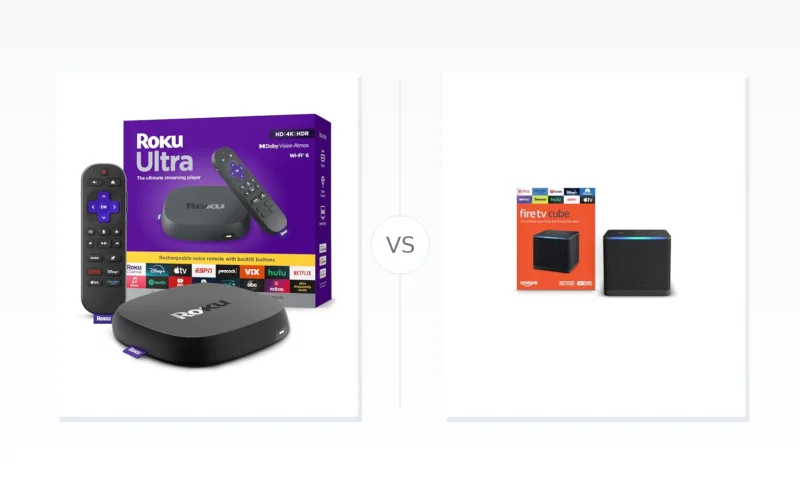
Compare Roku Ultra (2024) and Fire TV Cube (3rd Gen) on voice control, connectivity, interface, and value. Discover which streaming device suits your needs: a clean, simple streamer with a premium remote or an Alexa-powered hub with HDMI passthrough.
TL;DR
Quick Decision:
- If you want a simple app grid, a more premium remote, and less promotional clutter → choose Roku Ultra (2024).
- If you want full Alexa voice control, HDMI passthrough for a cable box, and deeper smart-home integration → choose Amazon Fire TV Cube (3rd Gen).
- If you mainly stream across multiple services and want neutral search results, either works, but Roku feels less biased toward one provider.
Key Differentiators: The Roku Ultra (2024) is a focused streaming endpoint: no HDMI input, basic voice search, and limited smart-home support. Its bundled remote is the stronger daily accessory, with a headphone jack and backlit keys. The Amazon Fire TV Cube (3rd Gen) acts more like a streaming box plus Alexa hub, offering HDMI 2.1 pass-through, far-field mics, Bluetooth, and deeper Amazon ecosystem features at the cost of a busier interface and more ads.
Who Should Skip Both: If you need 4K@120 pass-through for a high-end console or want an ad-free, more open platform, look to a dedicated HDMI 2.1 switch plus an Apple TV 4K or NVIDIA Shield-class device instead.
| Feature | Roku Ultra (2024) | Amazon Fire TV Cube (3rd Gen) |
|---|---|---|
| Audio | ||
| Dolby Atmos Support | Yes | Yes |
| Video | ||
| HLG Support | Yes | Yes |
| HDR10 Support | Yes | Yes |
| HDR10+ Support | Yes | Yes |
| Dolby Vision Support | Yes | Yes |
| Max Video Resolution | 4K UHD (3840 x 2160) | 4K UHD (3840 x 2160) |
| Connectivity | ||
| HDMI Input | Not supported | HDMI 2.1 (no 120Hz passthrough) |
| HDMI Output | HDMI 2.0b | HDMI 2.1 |
| Ethernet Port | Yes | Yes |
| Wi-Fi Standard | Wi-Fi 6 (802.11ax) | Wi-Fi 6E (802.11ax) on 2.4GHz and 5GHz bands |
| Voice & Remote | ||
| Included Remote | Voice Remote Pro (rechargeable, backlit, USB-C charging) | Alexa Voice Remote (3rd Gen, battery-powered) |
| Voice Assistant | Roku Voice | Amazon Alexa |
| Hands-free Voice Control | Yes (via Voice Remote Pro) | Yes (built-in far-field microphone) |
📑 Table of Contents
Voice & Smart Home Control
Both streamers advertise hands-free voice, but the underlying capability is very different.
Roku Ultra (2024) includes the Voice Remote Pro with a microphone, but Roku Voice remains a streaming-focused tool: content search and playback control work, while smart home support is limited to Roku-branded devices and does not support Matter. Its hands-free mode is tied to the remote, and many commands still require pressing the mic button unless using the remote shortcut. Amazon Fire TV Cube (3rd Gen) pairs the same playback commands with full Amazon Alexa, including multi-step routines, Ring video, and broader smart home control; it can also control compatible cable/satellite boxes, soundbars, and receivers via IR and Alexa. A built-in far-field microphone array allows commands from across the room without touching the remote. For assistant depth and smart home reach, the Cube wins clearly.
Roku Ultra avoids an always-listening room microphone, which may appeal to privacy-conscious households; its remote-based voice is less intrusive and easier to mute by simply not pressing the button. Fire TV Cube requires its room microphone to remain active for hands-free operation, though Amazon includes a physical mute button. That is a genuine trade-off, but the Cube’s far-field mic is what enables the always-ready Alexa experience. Roku has the privacy edge, but it sacrifices nearly all smart home capability.
Winner: Amazon Fire TV Cube (3rd Gen). It is a full Alexa smart speaker with hands-free control, routines, and AV equipment integration, while Roku Voice is best understood as a convenient streaming search shortcut.
Connectivity & HDMI Passthrough
Roku Ultra (2024) outputs video over an HDMI 2.0b port and has no HDMI input, so cable boxes, game consoles, or other sources must connect separately to the TV and require manual input switching. Amazon Fire TV Cube (3rd Gen) pairs an HDMI 2.1 input with an HDMI 2.1 output, letting you route an external source through the Cube so a single HDMI cable reaches the TV. The Fire Cube is the clear winner for unified input management, though its input does not support 120Hz passthrough, so high-end gaming rigs are still better connected directly to the display.
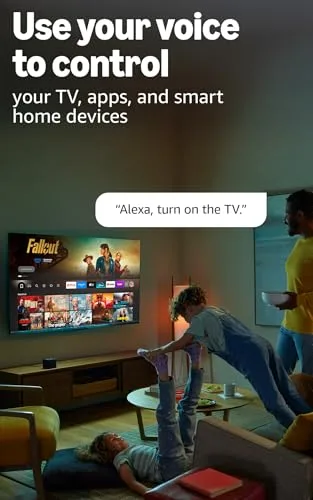
Roku Ultra supports Wi-Fi 6 (802.11ax) and includes an Ethernet port, but the wired connection is capped at 100Mbps. Fire TV Cube upgrades wireless to Wi-Fi 6E (802.11ax) on 2.4GHz and 5GHz bands and also offers Ethernet, with no such 100Mbps cap stated in available specs. On networking, Amazon Fire TV Cube takes the edge, though both are sufficient for stable 4K streaming from mainstream services.
Roku Ultra lacks Bluetooth audio output, so wireless headphones or speakers are not supported directly from the box. Fire TV Cube includes Bluetooth 5.0, enabling wireless speakers, headphones, and game controllers including Xbox and PlayStation pads. That makes the Cube more flexible for private listening and accessory pairing, while Roku remains a more basic streaming endpoint.
Winner: Amazon Fire TV Cube (3rd Gen)
Interface & Content Discovery
The two platforms differ immediately on the home screen: Roku Ultra (2024) is built around a predictable app grid, while Amazon Fire TV Cube (3rd Gen) leads with a content-first feed of recommendations and previews. The right choice depends on whether you want to open an app or browse what’s playing.
Roku Ultra (2024) presents a simple, easy-to-scan app grid with a small advertising banner rather than full-width promotional rows. Amazon Fire TV Cube (3rd Gen) fills the screen with hero images, content rows, and autoplaying trailers that surface titles quickly but can feel visually cluttered. For pure navigation speed and clarity, Roku has the edge; for visual discovery, Fire TV is stronger.
Roku Ultra (2024) universal search is generally neutral, pulling results across major services without strong preference for one provider. Amazon Fire TV Cube (3rd Gen) recommendations heavily favor Prime Video, Amazon Channels, and sponsored placements, many of which cannot be removed. That makes Roku better for multi-service households, while Fire TV favors Amazon-centric users.
Roku Ultra (2024) ads are relatively contained and do not dominate the app grid. Amazon Fire TV Cube (3rd Gen) uses more aggressive promotional content, and a common complaint is that some sponsored rows and autoplaying previews are difficult to suppress. If you want the cleanest interface, Roku has a clear advantage; if you prefer recommendations and previews, Fire TV is more engaging.
Winner: Tie. Roku Ultra (2024) is the cleaner, more neutral interface for app-first users, while Fire TV Cube (3rd Gen) is better for content discovery and Amazon ecosystem users. The decision hinges on whether you value simplicity or recommendation-driven browsing.
Picture & Sound Quality
Roku Ultra (2024) outputs up to 4K UHD (3840 x 2160) with HDR10, HDR10+, Dolby Vision, and HLG. Amazon Fire TV Cube (3rd Gen) matches that exact resolution and HDR format list. For core 4K/HDR playback, the two are functionally identical, so neither has an edge.
Audio is also a wash: Roku Ultra supports Dolby Atmos and Dolby Digital Plus, and Fire TV Cube offers the same Dolby Atmos and Dolby Digital Plus passthrough. Format support is equivalent on both devices.
For sub-4K content, Roku Ultra does not advertise an upscaling feature. Fire TV Cube adds Super Resolution Upscaling, which can improve lower-resolution HD sources. That gives Fire a minor edge only for older HD content; it does not affect native 4K/HDR streams.
Winner: Tie — both deliver equivalent core picture and sound quality, and Fire’s upscaling is a minor sub-4K bonus rather than a decisive win.
Remote & Build Quality
Roku Ultra (2024) bundles the Voice Remote Pro, which adds rechargeable USB-C charging, backlit keys, and a 3.5mm headphone jack for private listening. Amazon Fire TV Cube (3rd Gen) ships with the Alexa Voice Remote (3rd Gen), a battery-powered unit that omits backlighting, remote finder, customizable buttons, and a headphone jack. The Roku remote is clearly the more premium bundled accessory.
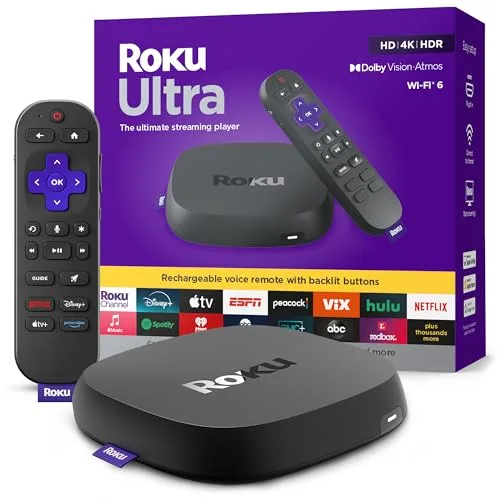
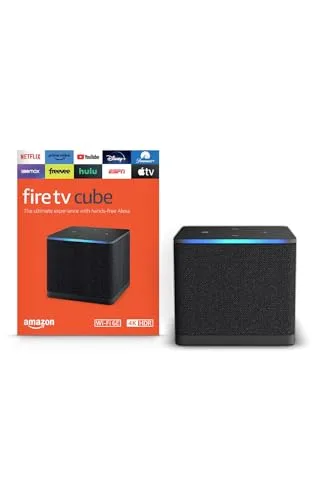
Roku Ultra (2024) requires periodic charging via USB-C, which may become more frequent as the battery ages. Amazon Fire TV Cube (3rd Gen) uses standard batteries, so there is no charging routine, but it also lacks the rechargeable convenience and premium features of Roku's remote. Roku trades occasional recharging for more daily utility; Fire opts for lower maintenance but fewer features.
Roku Ultra (2024) can accept hands-free commands through the Voice Remote Pro, but a lost or dead remote removes that control path. Amazon Fire TV Cube (3rd Gen) has built-in far-field microphones, so core voice control still works if the remote is misplaced or damaged. That mitigates the lack of a remote finder, but it does not close the bundled-remote hardware gap.
Both the Roku Ultra (2024) and Fire TV Cube (3rd Gen) are solid-state boxes with no internal moving parts, so likely failure points are ports, power adapters, and remotes rather than core hardware. Build quality is broadly comparable, with no clear advantage for either device.
Winner: Roku Ultra (2024). The included Voice Remote Pro is materially better equipped than the Cube's Alexa Voice Remote, and the Cube's built-in microphones only soften the impact of that gap.
Ecosystem & App Flexibility
Roku Ultra (2024) runs the lightweight Roku OS with a predictable app-grid home screen, universal search, and infrequent interface overhauls. Amazon Fire TV Cube (3rd Gen) runs Fire OS, a feature-dense, Amazon-centric interface with content-first rows and recommendation-driven navigation. Roku is more neutral and stable, while Fire TV Cube favors discovery and deep Amazon integration.
See how the Fire TV Cube's ecosystem holds up after months of use in this long-term review.
Roku Ultra (2024) covers mainstream streaming services broadly, but niche or regional apps can see delayed or reduced updates. Amazon Fire TV Cube (3rd Gen) pairs a curated Amazon catalog with developer-mode sideloading, Miracast/DLNA support, up to six user profiles, and parental controls. Fire TV Cube is more flexible for tinkerers and larger households; Roku's simpler catalog is easier to scan but less open.
Roku Ultra (2024) uses Roku Voice for search and playback, but smart-home control is limited to Roku-branded devices and lacks Matter. Amazon Fire TV Cube (3rd Gen) embeds Alexa for broader routines, AV-equipment control, and smart-home integration. Fire TV Cube wins on ecosystem depth.
Roku Ultra (2024) shows home-screen ads but stays visually cleaner. Amazon Fire TV Cube (3rd Gen) carries heavier promotional weight, including autoplaying trailers and sponsored placements that are harder to suppress. Roku is less cluttered, though both are ad-supported.
Winner: Tie. Roku wins on neutrality and simplicity, while Fire TV Cube wins on flexibility, profiles, sideloading, and smart-home depth.
The Bottom Line
Your choice depends on what you value most.
Best for Budget-Conscious Streamers: Roku Ultra (2024) — lower entry price with a premium remote and no unused smart-hub features.
Best for Amazon/Alexa Smart Home Users: Amazon Fire TV Cube (3rd Gen) — hands-free Alexa, routines, and tight Ring/Prime Video integration.
Best for Cable/Satellite Box Integration: Amazon Fire TV Cube (3rd Gen) — HDMI input unifies input switching and control.
Best for a Clean, Low-Clutter Interface: Roku Ultra (2024) — simpler app grid and less intrusive ads.
Overall, the Roku Ultra (2024) is the better choice for most people: lower price, superior rechargeable remote, same core 4K HDR/Dolby Atmos streaming, and a cleaner interface. Choose the Fire TV Cube (3rd Gen) only for Alexa hands-free smart home control or HDMI passthrough.
For most streamers, the Roku Ultra is the safer, simpler default.
FAQ
Does the Roku Ultra (2024) have an HDMI input?
Which device has better voice control?
Is the Roku Ultra remote rechargeable?
Can the Fire TV Cube control my cable box?
What Wi-Fi standard does the Roku Ultra (2024) support?
Does the Fire TV Cube (3rd Gen) support Bluetooth audio?
Does the Fire TV Cube (3rd Gen) support 120Hz passthrough?
Can the Roku Ultra (2024) control smart home devices?
"Images are used for editorial and informational purposes only. All trademarks and images belong to their respective owners."