
LOLBOX Music Boxing Pad vs. SHGUMITE BEX-Music Boxing: What Actually Separates Them?
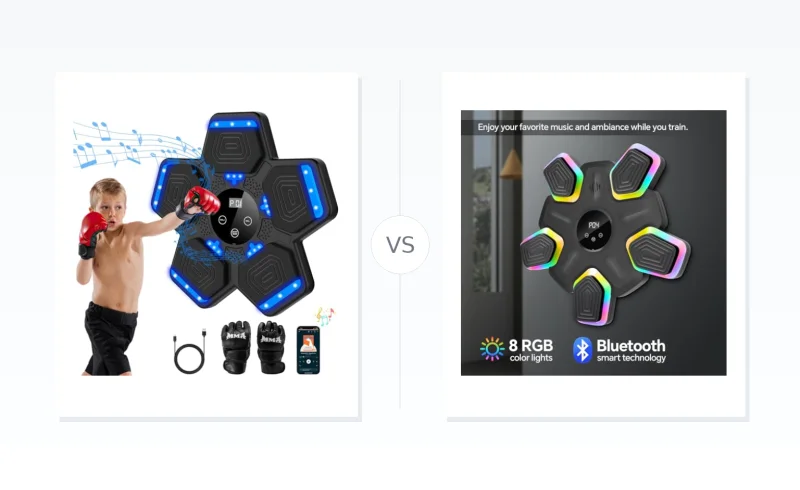
Compare LOLBOX and SHGUMITE music boxing pads for speed control, punch tracking, and build quality. Find out which offers better training feedback for your home workouts.
TL;DR
- These two wall-mounted trainers are much closer in capability than they first appear. Both combine illuminated strike targets, Bluetooth audio, adjustable training behavior, and an LED display.
- LOLBOX Music Boxing Pad explicitly documents 9 adjustable speed levels, Bluetooth music playback, an LED display for striking data, and included boxing gloves.
- SHGUMITE BEX-Music Boxing documents 9 dynamic modes with adjustable speed, 8 RGB training lights, Bluetooth, an LED display that tracks hits, and a parent-child glove set.
- The real distinction is not “tracking versus gloves.” Both provide display-based feedback, and both include gloves. LOLBOX is clearer about its nine-step speed ladder and physical product metadata; SHGUMITE is clearer about its mode count and family-oriented accessories.
- Neither is documented as an app-based coaching platform, a punch-force analyzer, or a substitute for a conventional heavy bag. Public documentation is also too thin to establish a meaningful long-term durability advantage for either model.
| Feature | LOLBOX Music Boxing Pad | SHGUMITE BEX-Music Boxing |
|---|---|---|
| Connectivity | ||
| Bluetooth | Yes | Yes |
📑 Table of Contents
- Start With What These Devices Actually Are
- Speed Control and Training Modes
- Punch Tracking: Both Have It, but Keep Expectations Modest
- Lighting and Visual Guidance
- Bluetooth Is for Audio, Not a Confirmed Coaching Platform
- Gloves and Family Use
- Build, Size, and Mounting
- Where the Differences Matter Most
- The Bottom Line
- FAQ
Start With What These Devices Actually Are
Both products are wall-mounted electronic striking targets. Lights indicate where to hit, Bluetooth lets a phone provide music, and the central electronics register interaction with the pad. That can make short reaction drills, coordination work, and rhythm-based cardio more engaging without dedicating floor space to a freestanding bag.
But the form factor matters. A fixed electronic target does not swing, absorb force, or respond like a heavy bag. Neither product publishes impact-load testing, punch-force measurement, or evidence that its sensors are intended to evaluate technique. The useful comparison is therefore not “which is the more serious boxing system?” It is “which gives you the more useful version of the same light-guided home-training concept?”
This category also contains many visually similar private-label models with overlapping feature lists. For this comparison, the exact identifiers matter: LOLBOX ASIN B0DQ4XR6B7 and SHGUMITE ASIN B0DJP1YQFN. Specs from a look-alike unit should not be transferred automatically to either one.
Speed Control and Training Modes
The strongest documented control on the LOLBOX is its 9 adjustable speed levels. That is a concrete, understandable setting: the light sequence can be slowed down or accelerated as the session becomes easier.
The SHGUMITE is not missing speed control. Its published product information describes 9 dynamic modes with adjustable speed. What is less clear is how many separate speed steps are available inside those modes. That is an important distinction: LOLBOX documents the speed ladder itself, while SHGUMITE documents more mode variety but is less specific about the granularity of its pace control.
In practice, that makes LOLBOX easier to evaluate from the documentation if the main goal is to increase reaction pace in predictable steps. SHGUMITE may offer more variety in how its light patterns are organized, but its public materials do not describe the nine modes well enough to establish that they are meaningfully different training programs rather than variations on target sequencing.
Edge: LOLBOX for clearly documented speed granularity; SHGUMITE for the larger documented mode count.
Punch Tracking: Both Have It, but Keep Expectations Modest
The contrast between “LOLBOX tracks punches” and “SHGUMITE only has lights” does not hold up.
LOLBOX’s published product information states that its LED digital display tracks striking data. Retailer mirrors describe that function more specifically as punch counting, but the core listing itself does not clearly define every field shown on the display.
SHGUMITE likewise lists an LED display and is more explicit: its product information says the display tracks hits and records progress while you work through its modes. So display-based strike feedback is not unique to LOLBOX.
What neither product documents is the kind of analytics associated with a true connected training platform. There is no confirmed account-based session history, no documented punch-force sensor, no verified strike-speed measurement, no technique analysis, and no clearly documented export of workout data to a phone. A running hit total can be motivating, but it should be treated as a simple session metric rather than a complete performance record.
Edge: Neither for advanced analytics; SHGUMITE is more explicit about hit counting, while LOLBOX uses broader “striking data” language in its core listing.
Lighting and Visual Guidance
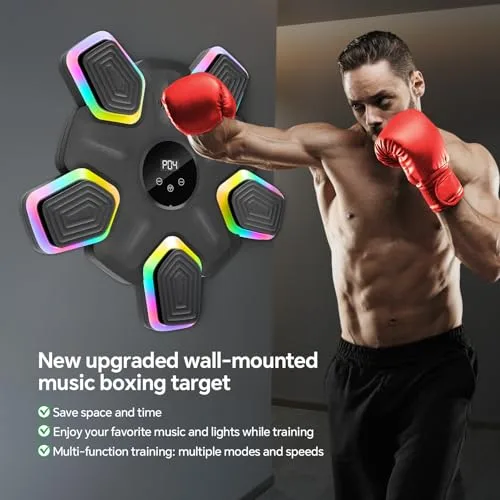
The SHGUMITE is more specific about its lighting hardware: it advertises 8 RGB training lights around the striking interface.
LOLBOX advertises dynamic light effects tied to its targets and speed settings, but its exact LED count and lighting layout are not consistently specified in the text documentation. Product imagery clearly shows illuminated target zones, yet a light count alone would not establish which device is more useful.
The practical questions would be target visibility, response latency, pattern logic, and whether the lights remain easy to follow at higher speeds. Neither product publishes measurements for those factors, and there is not enough independent testing to rank them responsibly.
Edge: SHGUMITE for more specific lighting documentation; no evidence-based winner for responsiveness or training quality.
Bluetooth Is for Audio, Not a Confirmed Coaching Platform
Both devices support Bluetooth music playback. That means a phone can supply a playlist while the pad handles its own lights and strike feedback.
What the listings do not establish is an app ecosystem. Bluetooth support by itself does not mean there is a companion app, cloud history, guided classes, firmware management, or phone-based analytics. LOLBOX’s listing describes Bluetooth primarily as music integration, and SHGUMITE does the same.
There is also no solid basis for claiming that one has more stable Bluetooth than the other. The available documentation does not provide comparable connection-range testing, dropout rates, codec information, or independent latency measurements.
Edge: Tie.
Gloves and Family Use
The SHGUMITE has a legitimate family-oriented difference: its package is marketed with a parent-child glove set.
But gloves are not exclusive to SHGUMITE. The exact LOLBOX product metadata lists boxing gloves in the box as well. The key difference is that LOLBOX does not clearly document multiple glove sizes or a specifically adult-and-child pairing.
That makes SHGUMITE easier to understand for a household expecting more than one age group to use the pad. Even then, “parent-child” is a package description, not a sizing guarantee. The actual glove fit still matters, especially for smaller hands.
Edge: SHGUMITE for the more clearly defined family glove bundle.
Build, Size, and Mounting
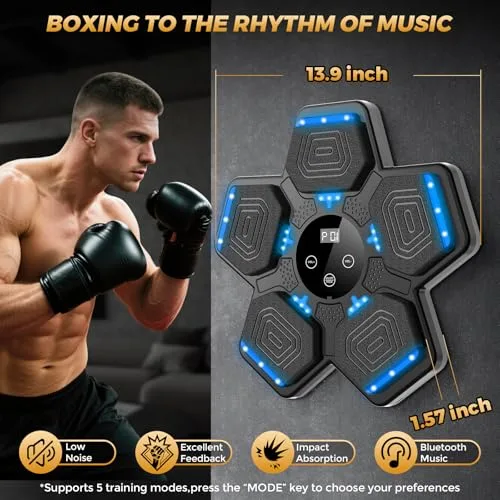
LOLBOX has the clearer physical metadata. Its published listing describes a unit roughly 16 inches wide, weighing about 2.4 pounds, with a plastic outer structure. The brand also claims a thickened construction and soft, high-strength striking material. Those are manufacturer or seller claims rather than independent durability findings.
SHGUMITE’s listing is more specific about the material stack, naming PP, ABS, acrylic, PU, and high-elastic foam, and it describes a no-drill installation using double-sided tape with adjustable mounting height. Again, a materials list does not prove how the pad will handle months of repeated impacts.
The more important limitation is what is missing for both: no published impact rating, no standardized durability test, no clear replacement-pad program, and no detailed service documentation for failed sensors or lights. LOLBOX’s exact product metadata does list a two-year warranty, but the practical coverage and service process should not be inferred beyond that stated term.
For a wall-mounted impact device, installation quality is part of the product experience. A pad can only be as stable as the mounting method and the surface behind it, so the mounting instructions deserve as much attention as the electronics.
Edge: LOLBOX for clearer dimensions and stated warranty metadata; SHGUMITE for more detailed material and mounting descriptions. Long-term durability remains unproven for both.
Where the Differences Matter Most
The LOLBOX makes more sense when the main priority is a clearly documented nine-step speed ladder, basic strike feedback, and a product listing with more complete physical metadata.
The SHGUMITE makes more sense when the appeal is nine training modes, a specifically documented 8-RGB lighting system, and a package framed around both adult and child use.
Those are narrower differences than they may initially appear. Both devices occupy the same basic role: compact, light-guided wall targets for casual reaction work and short home sessions. Neither has enough documented sensing, software, or durability evidence to justify treating it as a serious connected boxing platform.
The Bottom Line
There is no defensible overall winner from the public documentation.
LOLBOX has the clearer case for people who care about precisely documented speed adjustment: nine levels are explicitly stated, the LED display provides striking feedback, gloves are included, and the listing gives more concrete size and warranty information.
SHGUMITE is the more clearly family-oriented configuration: it documents nine dynamic modes, adjustable speed, eight RGB training lights, hit tracking, and a parent-child glove set.
The deciding factor should therefore be the specific feature set you expect to use, not the assumption that one model has tracking while the other only supplies accessories. Both are simple interactive wall pads first, and their “smart” features stop well short of app-based coaching or advanced boxing analytics.
FAQ
Which is better for beginners, LOLBOX or SHGUMITE?
Do these music boxing machines require a subscription or app?
Can the LOLBOX and SHGUMITE be wall-mounted?
What is the main difference between the two products?
How many speed levels does the LOLBOX Music Boxing Pad have?
Does the SHGUMITE BEX-Music Boxing track punches?
What accessories come with the SHGUMITE BEX-Music Boxing?
Is the preloaded music on SHGUMITE a known issue?
"Images are used for editorial and informational purposes only. All trademarks and images belong to their respective owners."