
VEVOR MD-50230A vs EMS Micro-current Smart Foot Pad: Mechanical Massage or Electrical Stimulation?
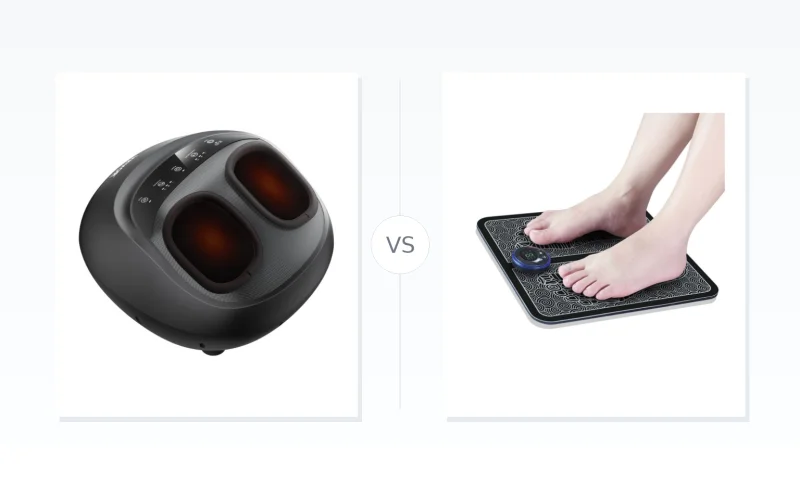
Compare the VEVOR MD-50230A's mechanical Shiatsu and heat with the EMS Micro-current Smart Foot Pad's silent, portable electrical stimulation. Discover which foot massager aligns with your comfort, safety, and use preferences.
TL;DR
- The VEVOR MD-50230A is a corded mechanical foot massager with rollers, air compression, sole heat, three roller speeds, three compression levels, 15- and 30-minute timers, onboard controls, and a remote.
- The EMS Micro-current Smart Foot Pad is a thin electrical-stimulation mat. The listing reviewed for this design describes six modes and both battery-powered and rechargeable versions, but does not publish output current, pulse width, frequency, waveform, or a detailed model-specific safety manual.
- These devices are not two versions of the same idea. The VEVOR physically rolls and compresses the feet; the EMS pad sends electrical pulses through a conductive surface and does not knead tissue.
- For a conventional foot-massage routine, the VEVOR is the more direct and better-documented fit. The EMS pad makes more sense only when compact storage is the main constraint and electrical stimulation is specifically the intended experience.
The most important difference is not heat, portability, or mode count. It is what reaches the foot. One device applies mechanical force; the other depends on electrical contact. That distinction determines the sensation, the setup, and the safety questions that matter.
| Feature | VEVOR MD-50230A | EMS Micro-current Smart Foot Pad |
|---|---|---|
| Massage Technology | ||
| Massage Method | Mechanical massage: deep-kneading Shiatsu, rolling, scraping, kneading, compressing, squeezing | Electrical muscle stimulation (micro-current) |
📑 Table of Contents
- Start With the Mechanism, Not the Feature Count
- Controls: What Can Actually Be Adjusted?
- Sensation, Foot Position, and Fit
- Heat: On or Off, Not Temperature Control
- Space, Power, and Mechanical Noise
- Cleaning and Everyday Friction
- Safety and Medical Claims
- Documentation Matters More Than the Word “Smart”
- Which Device Fits Which Use Case?
- The Bottom Line
- FAQ
Start With the Mechanism, Not the Feature Count
The VEVOR MD-50230A places both feet inside a chamber containing motorized rollers and air-compression sections. Its manual separates roller speed from air-pressure strength, so the user can change how quickly the rollers move and how firmly the chamber squeezes.
The EMS Micro-current Smart Foot Pad is a conductive mat with a small controller and no kneading mechanism. The listing uses both “EMS” and “micro-current,” but those labels are not a substitute for electrical specifications. Without published current amplitude, pulse width, frequency, and waveform, it is not possible to characterize the stimulation precisely or compare it with a documented EMS or TENS device.
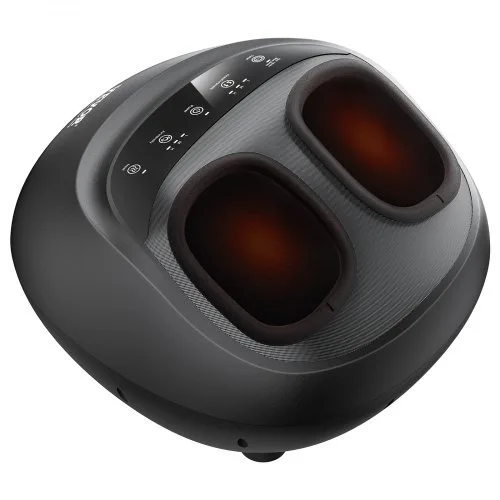
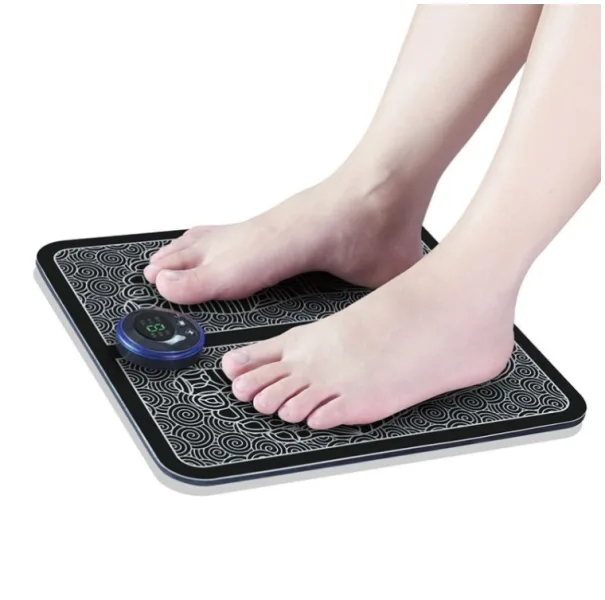
That makes the choice relatively clear at the category level. The VEVOR can create pressure, movement, and compression. The EMS pad is intended to create an electrical sensation, but it cannot reproduce rollers pressing into the sole or air chambers holding the foot in place.
Controls: What Can Actually Be Adjusted?
VEVOR documents three roller-speed settings, three air-pressure levels, a heat button, 15- and 30-minute timers, and a remote that mirrors the main control panel. The default session starts at the lowest roller speed and air-pressure level with heat switched on.
The product page describes rolling, scraping, shiatsu, compression, squeezing, and heating as separate techniques. That language should not be read as six independently selectable programs. The manual presents roller speed, air pressure, heat, and time as the meaningful controls.
The EMS pad’s listing states that it has six modes, but does not explain how those modes differ. It also does not provide a dependable model-specific description of intensity steps. A larger mode count therefore does not establish finer control; it only establishes that the controller cycles through six unnamed patterns.
For repeatable sessions, the VEVOR has the clearer control system. With the EMS pad, the practical behavior depends more heavily on the exact controller supplied with the listing and the quality of the included instructions.
Sensation, Foot Position, and Fit
The VEVOR provides physical movement and pressure because the feet sit inside fixed chambers while the rollers and air pressure operate around them. VEVOR states that the unit accommodates feet up to US men’s size 12 and recommends wearing socks during use. Larger or especially wide feet may have less room to reposition inside the chamber.
The EMS mat does not enclose the foot. Its surface measures about 32.5 by 29.5 centimeters, so storage is simple and there is no rigid chamber limiting foot width. But the soles become part of the electrical contact path, which makes placement and contact quality central to the experience. The sparse listing does not explain how the controller responds to weak or uneven contact.
Neither design automatically adapts to an individual foot. With the VEVOR, the pressure points are determined by the chamber and roller geometry. With the EMS pad, the stimulation is determined by electrode placement, skin contact, and the controller’s undocumented output characteristics.
People who dislike firm pressure may find the mat concept less mechanically intrusive, but that does not mean the electrical sensation will feel mild or comfortable. Conversely, anyone expecting the pad to feel like kneading will be using the wrong comparison standard.
Heat: On or Off, Not Temperature Control
The VEVOR includes sole heating. Its product page lists a heating range of 95°F to 140°F, but the manual provides only an on/off heat control rather than selectable temperature levels. The published range should therefore be treated as a manufacturer specification, not as a thermostat the user can set.
The EMS pad’s documented feature list does not include heat. Any warmth felt during use should not be interpreted as a controlled heating function unless the exact unit’s manual explicitly says otherwise.
In this comparison, heat is a comfort feature. It does not establish that the VEVOR treats pain, neuropathy, plantar fasciitis, circulation problems, or sleep issues. Those claims appear in manufacturer marketing, while the VEVOR manual itself states that the product is not intended for medical use.
Space, Power, and Mechanical Noise
VEVOR lists the MD-50230A at approximately 16.9 by 15.4 by 9.8 inches and 9.5 pounds. It uses a 12-volt adapter and needs an outlet during operation. The footprint is manageable beside a chair, but it is still an appliance that needs floor space and a place for its cable and remote.
The manufacturer advertises operation as low as 50 dB. That figure has not been independently verified here, and a device with rollers, air pressure, and a drive mechanism will still produce mechanical sound.
The EMS mat is much thinner and easier to place in a drawer or cabinet. The same product family appears in an AA-battery version and a rechargeable version, so the exact power arrangement depends on the offer attached to the page. Because the mat has no kneading motor or air pump, it avoids the type of mechanical noise produced by the VEVOR.
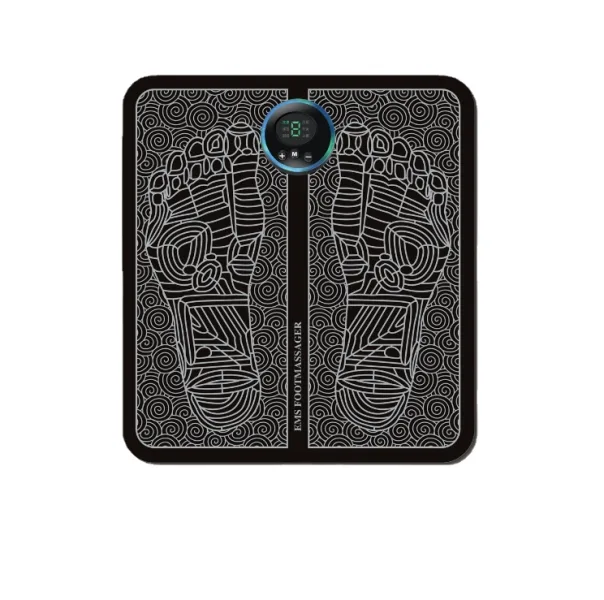
For a fixed chair-side routine, the VEVOR’s size may be acceptable. For frequent storage or movement between rooms, the EMS format is easier to handle. Neither device combines mechanical massage with genuinely compact, cable-free operation.
Cleaning and Everyday Friction
VEVOR states that the foot covers are removable and machine-washable, while the exterior can be wiped clean. The manual also instructs users to disconnect power before cleaning, use a dry cloth on the surface, and avoid corrosive cleaners. Removable liners matter in a device intended for repeated shared or socked use.
The EMS listing identifies PU leather, silver paste, and EVA foam as its materials but does not provide a detailed cleaning procedure. Conductive printing is a functional part of the mat, and the listing does not say whether the pad can be washed, soaked, folded, or treated with household cleaners. The exact care instructions supplied with the unit should control.
This is a small but meaningful ownership difference: VEVOR documents routine cleaning and storage, while the generic pad leaves more of that burden to whatever instructions arrive with the controller.
Safety and Medical Claims
Neither device should be treated as a substitute for diagnosis, rehabilitation, or medical treatment on the strength of its listing language.
VEVOR’s manual says the MD-50230A is intended to provide a comfortable massage rather than medical care. It advises medical consultation before use for people who are pregnant, children, people with certain skin conditions, pacemakers or similar implanted devices, heart disease, malignancy, osteoporosis, abnormal blood pressure, or an ongoing illness or treatment. It also tells people with reduced heat sensitivity to use the heating function carefully and to stop immediately if they feel unwell or notice abnormal heat or odor.
The EMS pad raises a different documentation problem. Its listing promotes “physical therapy,” acupoint stimulation, and fatigue relief, yet does not publish the electrical output data or a comprehensive contraindication list. In the United States, the FDA regulates powered muscle stimulators as medical devices, and its general guidance warns against use with cardiac demand pacemakers and over swollen, infected, inflamed, or damaged areas. The listing reviewed for this pad does not provide enough information to determine how those general precautions map to the exact controller.
That absence should not be filled with assumptions. It is not responsible to label the EMS pad safer because it lacks moving parts, and it is equally inaccurate to label the VEVOR suitable for everyone who should avoid electrical stimulation. VEVOR’s own manual includes pacemaker and other medical cautions.
Anyone with reduced sensation, a circulatory disorder, an implanted electronic device, a recent foot injury, unexplained pain, or an active medical condition should rely on professional guidance and the exact device manual rather than product-page claims.
Documentation Matters More Than the Word “Smart”
No companion app is documented for the VEVOR, and none is needed to operate it. Its model-specific manual explains the controls, timer behavior, cleaning, basic troubleshooting, and safety cautions. That documentation does not validate the company’s therapeutic marketing, but it does make the appliance easier to evaluate as a consumer product.
The EMS pad is sold as an unbranded OEM design, and the wholesale listing explicitly offers custom logos. That helps explain why visually similar mats appear under different names and with different controllers. It also means that specifications, instructions, and support may vary even when two listings use the same product title.
The word “smart” adds no verified capability here. No companion app, connected feature, sensor-based adaptation, or software support is documented. The meaningful questions are simpler: which controller is included, how it is powered, what electrical output it produces, what contraindications apply, and whether a usable manual accompanies the exact unit.
Which Device Fits Which Use Case?
For Mechanical Kneading and Compression
The VEVOR MD-50230A is the relevant option. Its rollers, air pressure, and enclosed chambers create a physical massage that the flat EMS mat cannot reproduce.
For Minimal Storage Space
The EMS Micro-current Smart Foot Pad has the clear size advantage. That benefit is practical only for someone who specifically wants electrical stimulation and can verify the exact variant, controller, instructions, and safety information.
For Heat
The VEVOR MD-50230A is the only one with a documented heating function. The control is on/off, not a user-selectable temperature scale.
For a Medically Validated Treatment
Neither product is established by the available documentation as a treatment for a diagnosed condition. The VEVOR manual explicitly disclaims medical use, while the EMS listing does not provide enough technical or regulatory information to support its therapy language.
For Wireless Portability With Real Pressure
Neither is a complete fit. The EMS mat is compact and available in battery-based versions but provides no mechanical kneading. The VEVOR provides pressure and movement but remains a corded floor appliance.
The Bottom Line
The VEVOR MD-50230A is the more coherent product for someone seeking a conventional foot-massage experience. Its rollers, air compression, heat, timer, remote, fit limit, and care instructions are documented well enough to understand what the device does and how it fits into a routine.
The EMS Micro-current Smart Foot Pad is not a portable version of the same experience. It is a generic electrical-stimulation mat with a much smaller footprint and far thinner documentation. The missing output specifications and incomplete safety information matter more than its six-mode claim.
For mechanical massage, the VEVOR is the stronger fit. For electrical stimulation, the EMS pad should be considered only after confirming the exact model and receiving adequate operating and safety instructions. For treatment of pain, neuropathy, circulation problems, or another medical condition, neither product page is sufficient evidence.
FAQ
Which foot massager is better for plantar fasciitis?
Is the EMS Micro-current Smart Foot Pad safe for everyone?
Does either device have an app or smart features?
Does the VEVOR MD-50230A have adjustable heat?
What massage techniques does the VEVOR MD-50230A offer?
Is the EMS foot pad more portable than the VEVOR?
"Images are used for editorial and informational purposes only. All trademarks and images belong to their respective owners."