
Xiaomi Mijia Smart Neck & Shoulder Massager (MJNKAM01SKS) vs A8 Heat Pulse Neck Massager: Mechanical Kneading or Electrical Stimulation?
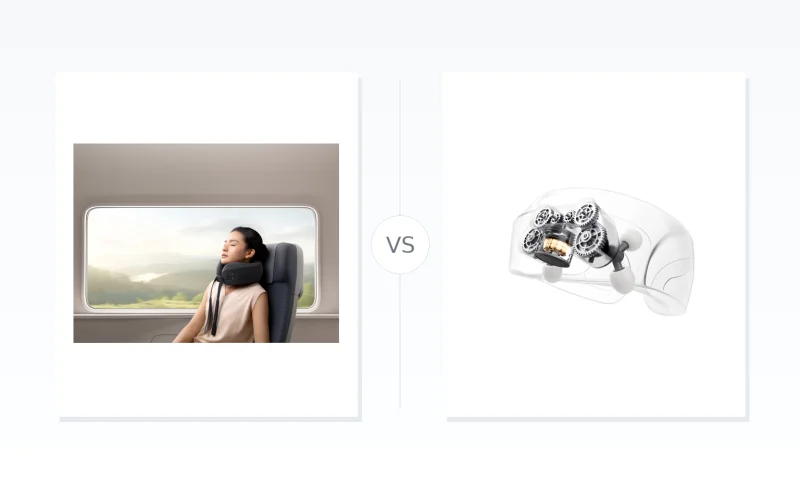
Compare Xiaomi Mijia Smart Neck & Shoulder Massager and A8 Heat Pulse Neck Massager to find the right fit for your relief needs. Discover which excels in deep tissue massage, portability, and smart features.
TL;DR
The short version
- Xiaomi Mijia Smart Neck & Shoulder Massager (MJNKAM01SKS) is the more conventional neck massager: four motorized massage heads physically knead the neck and upper trapezius, the straps let you change how firmly the heads press, and heat can run alongside the massage.
- A8 Heat Pulse Neck Massager is a very different device. It is a roughly 60 g pendant-style electrical stimulator with a small skin-contact area, seller-listed heat, four pulse modes, and 15 intensity levels. It does not knead muscle.
- The A8’s compactness is real, but its documentation is weak. The listings that can be traced describe it as unbranded, use TENS and EMS terminology inconsistently, and disagree on the exact heat range. That uncertainty matters more when a device passes electrical current through skin on the neck.
- If the goal is physical kneading and a clearly identifiable product, the Mijia is the stronger fit. If the goal is electrical stimulation, a device with a traceable manufacturer, manual, intended-use statement, and appropriate regulatory documentation is a better basis for use than a generic A8 listing.
These products should be treated as comfort devices, not as substitutes for diagnosis or treatment of persistent neck pain, injury, nerve symptoms, or cervical-spine conditions.
| Feature | A8 Heat Pulse Neck Massager | Xiaomi Mijia Smart Neck & Shoulder Massager |
|---|---|---|
| Massage Functions | ||
| Heat Therapy | Yes | Yes |
| Massage Technique | Electrical pulse stimulation (TENS) | Deep tissue kneading (4 nodes) |
📑 Table of Contents
- First, make sure you are comparing the right Xiaomi
- The central difference: pressure versus current
- Coverage and fit matter more than mode count
- Heat: both have it, but the specifications are not equally solid
- Controls: the Mijia is smarter, but the app is not required for everything
- Portability is the A8’s strongest case
- Durability: there is not enough evidence to declare a winner
- Safety is where the A8’s documentation problem becomes decisive
- The Bottom Line
- FAQ
First, make sure you are comparing the right Xiaomi
This comparison refers to Xiaomi Mijia model MJNKAM01SKS, introduced in China in 2023 and often translated by international sellers as the “Mijia Smart Neck & Shoulder Massager.” That name can be confusing because Xiaomi later released a different Smart Shoulder and Neck Massager under another model number.
For MJNKAM01SKS, the traceable specifications are a 2550 mAh battery, roughly 260 × 248 × 120 mm dimensions, and a net weight of about 720 g. It uses four massage heads in a trapezoidal layout, supports Mi Home control and NFC access, and provides local button control as well.
The A8 is much harder to pin down. The same pendant design appears through multiple marketplace sellers without a consistent consumer brand. One large marketplace lists the brand simply as Unbranded, while a wholesaler openly offers the model for OEM/ODM customization. The commonly repeated specifications are a 500 mAh battery, USB-C charging, about 60 g weight, a roughly 44 × 54 mm main body, 15-minute sessions, four pulse modes, and 15 intensity levels. Those figures are useful for understanding the form factor, but they are seller specifications rather than a well-documented manufacturer data sheet.
That asymmetry should shape the rest of the comparison. The Mijia is a specific, traceable model. The A8 is better understood as a generic electrical-stimulation design sold under a model name.
The central difference: pressure versus current
The Mijia and A8 should not be judged as two strengths of the same massage technology.
The Mijia creates sensation mechanically. Four motorized heads move against the neck and upper trapezius, and the straps can pull the unit closer to the body. If what you mean by “massage” is something physically pressing, rolling, and kneading the muscle, this is the relevant design.
The A8 creates sensation electrically. Its seller pages describe low-frequency pulse stimulation delivered through a small metal contact surface and recommend using a hydrogel layer or moistening the contact area to improve conduction. Some listings call the function TENS; others call the same product EMS. Those are not interchangeable technical labels, and the available seller documentation is not strong enough to establish exactly how the A8 should be classified.
That distinction also changes what an intensity setting means. On the Mijia, intensity is partly about motor behavior and partly about how tightly the unit is pulled against the body. On the A8, higher intensity means a stronger electrical sensation. More sensation is not evidence of better therapeutic effect.
Where the Mijia has the clearer advantage
For a user specifically looking for physical kneading, the Mijia is the straightforward device. Its four-head layout spreads contact across more of the neck and upper trapezius than the A8’s small pendant contact area. The straps also make it possible to change pressure immediately by hand instead of stepping through electronic intensity levels.
The A8 cannot reproduce that mechanical pressure. Its value proposition is different: very little bulk and no kneading motor.
Coverage and fit matter more than mode count


The Mijia’s size is both its strength and its inconvenience. A roughly 720 g collar is not subtle, but the larger structure gives the massage heads room to sit around the neck and upper trapezius. The straps also let the wearer alter fit and pressure without moving through a phone menu.
The A8 takes the opposite approach. Its main body is only a few centimeters across, so it is dramatically easier to carry. But small size also means localized contact. Electrical stimulation depends on good skin contact, and the seller’s own instructions suggest hydrogel or added moisture when contact is poor. That is a practical difference that matters more than whether a listing calls one pulse pattern “massage,” “percussion,” or “scraping.”
The A8 also lacks a kneading motor, so it avoids the mechanical sound generated by rotating massage heads. There is no reliable published acoustic measurement for either device, however, so claims such as “silent” or “office-quiet” would go beyond the available evidence.
Heat: both have it, but the specifications are not equally solid
The Mijia MJNKAM01SKS includes a heated-compress function that can be turned on separately from the mechanical massage. Product material for this model consistently describes constant-temperature warming, although translated listings do not always agree on the exact temperature. The important practical point is that heat accompanies the physical kneading action rather than replacing it.
The A8 also advertises heat, but its exact specification is less stable across sellers. One listing gives an approximate 38–42°C range; another describes three stages spanning roughly 37–43°C. With no traceable manufacturer manual establishing one specification, those numbers should be treated as marketplace claims, not precision temperature targets.
Neither device should be described as providing “deep therapeutic heat” or as improving circulation on the strength of seller copy alone. In this comparison, heat is better understood as an optional warming feature layered onto two very different mechanisms.
Controls: the Mijia is smarter, but the app is not required for everything
The Mijia supports Mi Home control over Bluetooth and includes NFC. The most useful correction to common seller language is that NFC is not magic instant setup. After the device has been associated with Mi Home, tapping an NFC-capable phone can act as a shortcut into the relevant control screen.
The model also has local controls, so basic sessions do not depend on a phone. App access expands mode selection and customization beyond the presets available directly on the device.
There is an important regional caveat: MJNKAM01SKS is a China-market product, and international listings commonly instruct users to set Mi Home to the Mainland China region for full support. That can be inconvenient for people whose other Xiaomi devices live under a different regional server.
The A8 is simpler: the seller-listed design uses fixed buttons, with no app, cloud account, or wireless pairing. That reduces setup friction, but it should not be confused with better documentation or better long-term support.
Portability is the A8’s strongest case
If the only comparison were size and mass, the A8 would win easily: roughly 60 g versus about 720 g for the Mijia. It is the kind of device that takes almost no room in a bag, while the Mijia is closer to carrying a small neck pillow.
But “portable” is not the same as “appropriate anywhere.” Electrical-stimulation devices come with placement and medical-use precautions, and general TENS guidance commonly warns against use while driving. The A8’s generic documentation also gives little confidence about how consistently those precautions are communicated across sellers.
The Mijia is less discreet and more cumbersome, but its intended interaction is easier to understand: place the massage heads on soft tissue, adjust the straps to a comfortable pressure, and stop if the motion or heat becomes painful or otherwise uncomfortable.
Durability: there is not enough evidence to declare a winner
The original comparison treated fewer moving parts as proof that the A8 should last longer. That conclusion is not supported.
The Mijia contains motors and moving massage heads, while the A8 depends on electronics, a battery, buttons, a metal contact surface, and reliable electrical contact with the skin. Either design can fail. Without controlled longevity testing, repair statistics, or credible long-term reliability data, assigning a durability winner would be speculation.
What can be compared is supportability. The Mijia has a stable model number, identifiable manufacturer lineage, published specifications, Mi Home integration, and documented retail presence. The A8 is sold as an unbranded/OEM product, and the available listings do not establish a consistent manufacturer, manual, warranty structure, or software/support path.
For a device expected to stay in use for years, that documentation gap is more meaningful than a guess about which internal component is most likely to wear first.
Safety is where the A8’s documentation problem becomes decisive
The Mijia applies mechanical pressure and heat. That does not make it risk-free: aggressive pressure on a painful or injured neck can be uncomfortable, and a consumer massager should not be used to diagnose or treat an underlying cervical, neurological, or vascular problem. Position the massage heads on soft tissue rather than forcing them into bony areas, and stop if use causes pain, dizziness, numbness, or other unusual symptoms.
The A8 deserves more caution because it applies electrical stimulation and its own identity is unclear. Marketplace pages alternate between calling it TENS and EMS, while the device is designed specifically for neck contact. Those labels matter because the two technologies have different intended effects and safety guidance. Because some A8 listings call it EMS, FDA guidance for powered muscle stimulators is relevant to that claim: it warns against stimulation over the carotid sinus and against applying stimulation over the neck or mouth. For TENS, NHS guidance warns against front-of-neck electrode placement and advises against use with a pacemaker or epilepsy, and during pregnancy unless a clinician says otherwise.
That does not prove every electrical-stimulation device intended for the posterior neck is unsafe. It does mean the word “TENS” on a marketplace page is not enough. A device used this close to the neck should have a traceable manufacturer, clear electrode-placement instructions, contraindications, intended-use language, and appropriate regulatory documentation for the market where it is used. The A8 listings reviewed do not provide a consistent manufacturer identity or a U.S. clearance identifier.
The available A8 documentation therefore is not strong enough to present it as a medically equivalent or low-risk substitute for a documented TENS device.
The Bottom Line
The useful comparison is not “deep massage versus a smaller massage.” It is mechanical kneading versus a generic electrical-stimulation pendant.
For physical pressure across the neck and upper trapezius, Xiaomi Mijia MJNKAM01SKS is the more coherent product. Its four massage heads, adjustable straps, heat, local controls, and Mi Home features all support the same basic use case. Its main compromises are size, weight, mechanical noise, and the China-region requirement for full app support.
The A8 is dramatically smaller and has no kneading motor, but those advantages do not outweigh the uncertainty around an electrical device worn on the neck. Its seller-listed specifications are easy to find; a consistent manufacturer identity, authoritative manual, and clear regulatory status are not.
So the practical verdict is narrow: choose the Mijia when the goal is a conventional consumer neck massager with mechanical kneading. If the goal is TENS or EMS, look for a clearly identified electrical-stimulation device with explicit safety documentation rather than treating this generic A8 as equivalent.
That is not a claim that the Mijia treats neck pain better. It is a judgment about product definition, mechanism, and the quality of the information available to use the device responsibly.
FAQ
Which is better for neck pain: mechanical or electrical massage?
Can I use the Mijia massager without the app?
Is the A8 Heat Pulse Neck Massager safe for everyone?
Which massager is more portable?
Does the Xiaomi Mijia Smart Neck & Shoulder Massager support app control and NFC pairing?
How many massage nodes does the Xiaomi Mijia massager have?
What are the dimensions and weight of the Xiaomi Mijia massager?
"Images are used for editorial and informational purposes only. All trademarks and images belong to their respective owners."