
Kasa Smart KL400L10 vs Cync CLEDSTR12CDIDB: Two-Strip Automation vs App-First Effects
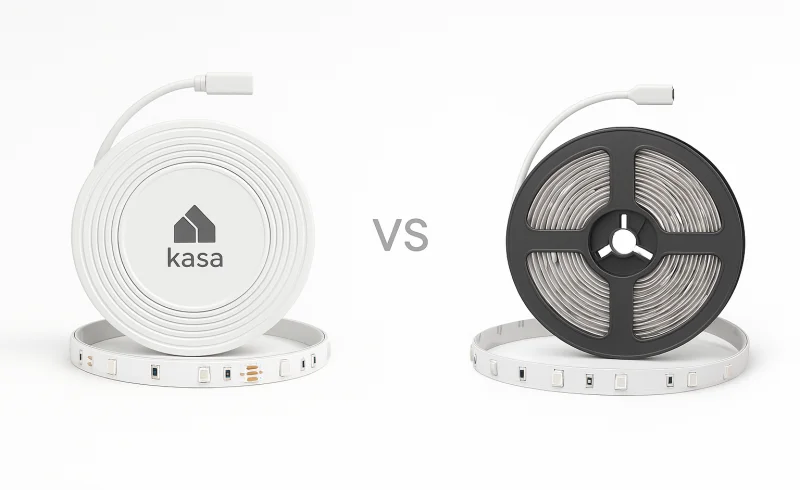
Explore the key differences between Kasa Smart KL400L10 and Cync CLEDSTR12CDIDB light strips. Discover how Kasa's dual-strip automation and Cync's app-based effects cater to distinct lighting needs, focusing on installation flexibility, connectivity, and smart...
TL;DR
- If you want reliable, hands‑off automation with schedules, routines, and cross‑platform voice control → choose Kasa Smart KL400L10
- If you prefer quick, app‑driven color tweaks and don’t mind occasional troubleshooting → choose Cync CLEDSTR12CDIDB
- If you need both out‑of‑box coverage and long‑term stability → Kasa is the safer bet
The fundamental trade‑off: Kasa ships with 32.8 ft total (two 16.4‑ft strips), a slimmer profile, damp‑location rating, and SmartThings support—making it a better infrastructure piece for a growing smart home. Cync packs Bluetooth‑assisted setup and effect‑first daily use, but its single 16‑ft strip, bulkier build, and dry‑only rating limit where and how you can install it. Long‑term, Kasa’s rated lifespan (~25,000 hours) also outpaces Cync’s 15,000‑hour figure.
If you need a light strip that you can reposition often or rely on a single third‑party platform for all advanced effects (without ever opening the native app), consider a professional‑grade option like Philips Hue Play instead.
| Feature | Cync CLEDSTR12CDIDB | Kasa Smart KL400L10 |
|---|---|---|
| Power | ||
| Rated Life | 15,000 hours | Up to 22.8 years (based on 3 hrs/day) |
| Input Voltage | 120Vac, 60Hz | 120 VAC, 60 Hz |
| General | ||
| Mobile App | Cync App | Kasa Smart app |
| Hub Required | No hub required | No hub required |
| Product Type | Smart LED light strip | Smart Wi-Fi light strip |
| Lighting | ||
| Dimmable | Yes | Yes |
| Color Range | 16 million | 16 million colors |
| Tunable White | Yes | Yes |
| Physical | ||
| Strip Width | 0.47 in (12 mm) | 0.39 in (10 mm) |
| Strip Thickness | 0.19 in (5 mm) | 0.06 in (1.6 mm) |
| Included Strip Length | 16 ft (5 m) | 2 × 16.4 ft / 2 × 5 m |
| Cut Increment / Segment Size | 6.6 in | Every 10 cm |
| Connectivity | ||
| Wi-Fi Band | 2.4 GHz | 2.4 GHz |
| Wireless Protocol | Wi-Fi (2.4 GHz) and BLE | Wi-Fi (IEEE 802.11b/g/n) |
| Mobile Platform Compatibility | iOS 13 and above; Android 9 and above | Android, iOS |
| Voice Assistant Compatibility | Amazon Alexa, Google Home | Amazon Alexa, Google Assistant, SmartThings |
| Environmental | ||
| Location Rating | Dry | Dry and damp locations |
| Operating Humidity | RH < 80% at 32°C | 10%-90% RH, non-condensing |
| Operating Temperature | 0°C to 40°C (32°F to 104°F) | -20°C to 40°C (-4°F to 104°F) |
📑 Table of Contents
Lighting & Effects
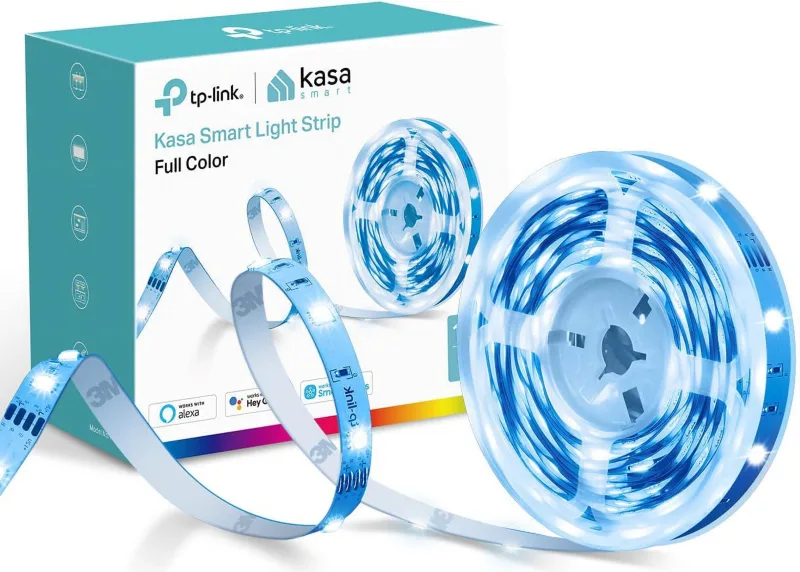
Kasa Smart KL400L10 covers the fundamentals with 16 million colors, tunable white, and dimming. Its bundle also emphasizes «always available» lighting control: it supports the Kasa Smart app plus manual control via the included controller (and voice control through Alexa/Google per provided sources).
Cync CLEDSTR12CDIDB matches the core lighting spec checklist—16 million colors, tunable white, and dimming—and is similarly app-controlled through the Cync App. In real-world use, Cync also gets credit for color quality, as some users note it can maintain accurate colors and white tones (per retailer-sourced feedback).
Conclusion: On baseline color modes and dimming, it’s effectively a tie on paper, with a slight experiential edge for Cync if you prioritize reported color/white accuracy.
Kasa Smart KL400L10 is rated up to 22.8 years (based on 3 hrs/day), which translates to roughly ~24,966 hours under that usage assumption. That higher stated lifespan supports Kasa’s «set it and forget it» positioning for scheduled accent lighting.
Cync CLEDSTR12CDIDB lists a 15,000-hour rated life. That’s still substantial, but it’s notably lower than Kasa’s rating when normalized to hours.
Conclusion: Kasa Smart KL400L10 has the clearer longevity advantage (~24,966 hours vs 15,000 hours).
Kasa Smart KL400L10 ships as 2 × 16.4 ft strips (total 32.8 ft), which can reduce the need to buy add-ons when lighting multiple zones. It also allows finer physical tailoring with cut points every 10 cm.
Cync CLEDSTR12CDIDB includes a single 16 ft strip with 6.6 in cut increments, and the manufacturer notes that once trimmed, extensions can no longer be connected (with a specific exception for a different Dynamic Effects model with a reconnector). Even though Cync’s ecosystem may offer extensions up to 32 ft, that’s not what you’re getting in the base box here.
Conclusion: Kasa Smart KL400L10 wins on out-of-box coverage (32.8 ft vs 16 ft) and offers more flexible cutting (10 cm vs 6.6 in), making it easier to fit longer or more complex runs without extra purchases.
Winner: Kasa Smart KL400L10
Build & Physical Design
Strip profile (how easy it is to hide)
Kasa Smart KL400L10 uses a slimmer strip body at 0.06 in (1.6 mm) thick and 0.39 in (10 mm) wide. That lower profile is easier to tuck under trim, behind monitors, or inside shallow channels where a thicker strip can create visible bumps.
Cync CLEDSTR12CDIDB is notably bulkier at 0.19 in (5 mm) thick and 0.47 in (12 mm) wide. In tighter installs (like behind a TV that sits close to the wall), the extra thickness and width can make it harder to fully conceal.
Conclusion: For clean, hidden installs, Kasa Smart KL400L10 clearly wins on physical profile (0.06 in vs 0.19 in thickness, 0.39 in vs 0.47 in width).
Cut precision and post-cut flexibility
Kasa Smart KL400L10 supports more granular trimming with cut points every 10 cm. That makes it easier to match exact run lengths around desks and cabinets while reducing wasted strip segments.
Cync CLEDSTR12CDIDB has a coarser cut increment of 6.6 in. More importantly, Cync’s own guidance says that once trimmed, extensions can no longer be connected (except a specific Dynamic Effects model that includes one reconnector) (limitation).
Conclusion: If you care about precise fit and keeping options open after trimming, Kasa has the edge (10 cm segments vs 6.6 in, plus fewer post-cut limitations documented for Cync).
What you get in the box (coverage flexibility)
Kasa Smart KL400L10 includes 2 × 16.4 ft (2 × 5 m) strips (about 32.8 ft total). Two separate strips can simplify routing (e.g., splitting left/right sides of a room) without needing a single continuous run.
Cync CLEDSTR12CDIDB includes a single 16 ft (5 m) strip, though it can be extended up to 32 ft with add-ons (per manufacturer documentation in the SoT). That can work well for long continuous runs, but it typically requires buying and managing extensions.
Conclusion: For out-of-box coverage and flexible routing, Kasa wins with double the included length (32.8 ft vs 16 ft), while Cync’s parity depends on purchasing extensions.
Winner: Kasa Smart KL400L10
Connectivity & Smart Home
Kasa Smart KL400L10 is a hub-free strip that connects over 2.4 GHz Wi‑Fi (802.11b/g/n), so it’s designed to sit on your home network as a stable endpoint for schedules and routines. On the ecosystem side, it supports Amazon Alexa, Google Assistant, and SmartThings, which broadens your options if you’re standardizing control in a third-party platform rather than living entirely in one brand app.
Cync CLEDSTR12CDIDB is also hub-free and runs on 2.4 GHz Wi‑Fi, but it adds Bluetooth (BLE) alongside Wi‑Fi, which can make initial discovery/pairing easier on a phone-led setup. Cync’s official guidance also confirms it’s not compatible with 5 GHz networks (so mixed-band routers may require a 2.4 GHz SSID or band-steering tweaks), and its voice support is limited to Amazon Alexa and Google Home.
Conclusion: Both avoid a hub and stick to 2.4 GHz Wi‑Fi, but Kasa Smart KL400L10 has the clearer smart-home advantage thanks to broader platform compatibility (SmartThings support in addition to Alexa/Google) and a more automation-forward positioning, while Cync’s main connectivity edge is BLE-assisted setup.
Winner: Kasa Smart KL400L10
Software & Daily Use
Setup flow and onboarding reliability
Kasa Smart KL400L10 uses the Kasa Smart app and is positioned around predictable Wi‑Fi onboarding and clear device discovery. Spec-wise it’s a straightforward 2.4 GHz Wi‑Fi (802.11b/g/n) device with no hub required, which tends to align with «set it once, then automate» usage. It also supports a direct fallback for recovery: you can factory reset by holding the controller for 10+ seconds (manufacturer instructions).
Cync CLEDSTR12CDIDB uses the Cync app and combines 2.4 GHz Wi‑Fi + BLE, also with no hub required, which can make first pairing feel quicker when Bluetooth cooperates. The trade-off is an extra control path to troubleshoot when something goes wrong, and Cync’s own setup guidance leans on power-cycling and control-box replug sequences to recover the strip (manufacturer instructions). It’s also explicitly not compatible with 5 GHz networks per Cync support docs (though both products are 2.4 GHz in the specs).
Conclusion: For onboarding that’s typically more predictable and «infrastructure-like,» Kasa has the edge; Cync’s Wi‑Fi + BLE can be convenient up front, but it introduces more states to debug if the handoff or responsiveness gets flaky.
Daily control: automation-first vs effect-first
Kasa Smart KL400L10 is better aligned with schedules, routines, and voice-triggered scenes once you’ve set everything up in the Kasa app. On the integration side, it supports Amazon Alexa + Google Assistant + SmartThings, which helps it slot into broader smart-home routines without living inside the app every day. It also supports manual control via the included controller alongside voice control (per retailer/manufacturer documentation), which can reduce friction when your phone isn’t handy.
Cync CLEDSTR12CDIDB is designed to be more app-centric for quick color and effect changes, and it supports Amazon Alexa + Google Home for basic voice control. Where this can break down in practice is that the «good stuff» (fine-tuning effects, troubleshooting, and recovering from odd states) tends to pull you back into the Cync app more often than an automation-forward strip. Some users note intermittent reliability issues severe enough to feel like the strip «breaks» after being unplugged, which can derail day-to-day confidence if you ever need to power-cycle or move it (report).
Conclusion: If your priority is reliable daily operation via routines and cross-platform control, Kasa is the stronger fit; if you primarily want hands-on, app-first decorative effects, Cync can feel more immediate—but with a higher chance of app dependency and occasional troubleshooting.
Winner: Kasa Smart KL400L10
Durability & Installation
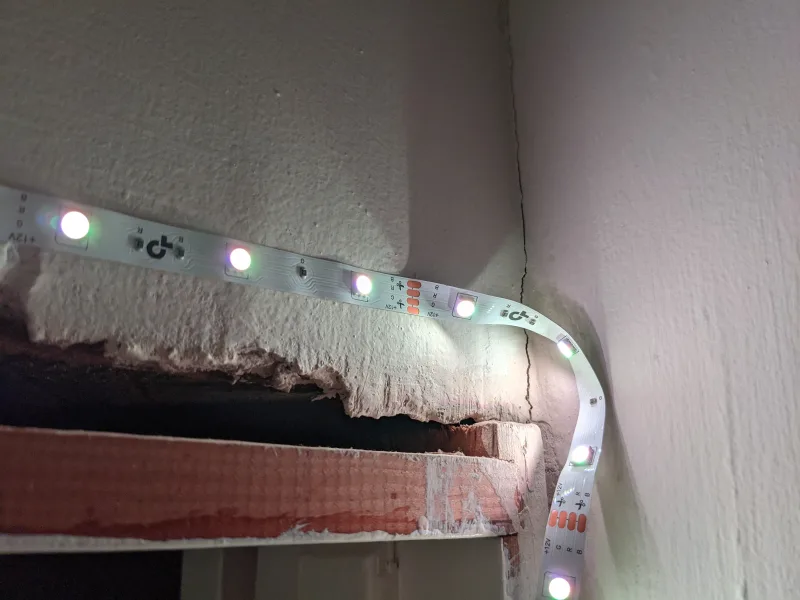
Kasa Smart KL400L10 is explicitly rated for dry and damp locations, which makes it a safer pick for higher-moisture indoor spots like kitchens or laundry areas. It’s also specified for a wider environment window: -20°C to 40°C operating temperature and 10%–90% RH (non-condensing) humidity. Those numbers suggest more tolerance for colder garages/basements and humid rooms than many indoor-only strips.
Cync CLEDSTR12CDIDB is rated for dry locations only, which narrows the recommended install zones compared with Kasa. Its operating range is also tighter on the cold end at 0°C to 40°C, and the humidity spec is RH <80% at 32°C. In practice, that makes it a less flexible choice for cold spaces and any area where dampness is a possibility.
Conclusion: For environmental resilience and «where can I safely put this?» flexibility, Kasa Smart KL400L10 has a clear advantage (damp-rated, -20°C minimum, and up to 90% RH vs Cync’s dry-only, 0°C minimum, and <80% RH).
Kasa Smart KL400L10 is physically slimmer at 0.39 in (10 mm) wide and 0.06 in (1.6 mm) thick, which can make it easier to tuck into tighter channels or hide along trim. It’s also cuttable in 10 cm increments, giving reasonably fine routing control without being overly fiddly. Like most adhesive-backed strips, long-term durability still hinges on surface prep and committing to a route—moving strips later can be messy and may force you to redo organization and routines.
Cync CLEDSTR12CDIDB is a bit bulkier at 0.47 in (12 mm) wide and 0.19 in (5 mm) thick, which can be harder to conceal in shallow profiles. Its cut increment is 6.6 in, which is slightly coarser than 10 cm for precise fits. Also, once trimmed, Cync notes that extensions generally can’t be connected afterward (with a narrow exception for a specific «Dynamic Effects Indoor Light Strip» scenario), which can limit reconfiguration if you change your layout later.
Conclusion: For a lower-profile install and slightly finer trimming control (10 cm vs 6.6 in), Kasa Smart KL400L10 has the edge, while Cync’s post-trim extension limitation makes «measure twice, cut once» even more important.
Winner: Kasa Smart KL400L10
The Bottom Line
After breaking down specs, real-world usability, and installation constraints, the choice comes down to whether you want dependable automation and flexibility or simple, budget-friendly mood lighting.
Best for Automation-Focused Smart Homes: The Kasa Smart KL400L10 is the better pick thanks to more reliable day-to-day control (schedules and routines), broader integration (including SmartThings), and longer out-of-box coverage for multi-zone setups.
Best for Casual Decorative Lighting: The Cync CLEDSTR12CDIDB makes the most sense if you mainly want quick color effects with a lower entry price and Bluetooth-assisted setup, without leaning heavily on automations.
Overall, Kasa Smart KL400L10 earns the win for most buyers: it pairs a longer rated lifespan with a slimmer, easier-to-hide strip, more flexible included length (two 16.4 ft strips), and stronger environmental and ecosystem versatility. Cync still has the edge if you prioritize simple onboarding and a more effect-first, app-driven experience.
If you’re building lighting you’ll automate and forget, go Kasa; if you just want straightforward accent lighting on a tighter budget, Cync will get you there—just plan your layout carefully before trimming.
FAQ
Can I cut and extend these light strips?
Do I need a hub for either strip?
Which works with Alexa and Google Home?
Are these light strips suitable for outdoor use?
Do Cync light strips have issues after being unplugged?
What is the lifespan of these light strips?
Can I use Cync light strips with 5 GHz Wi-Fi?
📄 Used Manuals & Documentation
Kasa Smart KL400L10
"Images are used for editorial and informational purposes only. All trademarks and images belong to their respective owners."