
meross MSS425F vs Geeni GN-SW008-101: Which Smart Power Strip Wins for Your Smart Home?
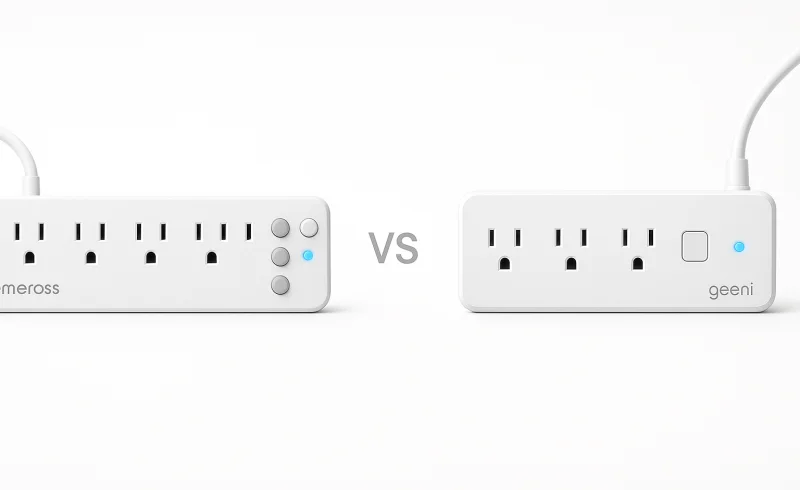
Discover the differences between the Meross MSS425F and Geeni GN-SW008-101 smart power strips. Learn about their platform support, outlet configuration, USB charging capabilities, and safety features to decide which one best suits your smart home needs.
TL;DR
- If you want broad platform support (including Apple HomeKit) plus built-in USB charging → choose meross MSS425F
- If you need more AC outlets and a built-in split between smart-controlled and always-on sockets → choose Geeni GN-SW008-101
- If you’re indifferent to ecosystem and just want a simple app-first strip with lots of plugs → either works, but availability favors Meross
Key Differentiators: The Meross strip covers Apple HomeKit, SmartThings, Alexa, and Google — a massive advantage for Apple-first or multi-platform households — and adds 4 USB ports with schedulable power. The Geeni counters with 8 AC outlets (6 smart + 2 always-on), which is superior for powering an entertainment stack without worrying about accidental router shutoffs. But Geeni is out of stock at time of writing and costs more, while Meross is cheaper and available now.
Who Should Skip Both: If you need a single strip that can both automate a full media center and charge multiple USB devices simultaneously without sacrificing AC ports, consider a higher-capacity USB-equipped strip from a brand like TP-Link Kasa instead.
| Feature | meross MSS425F | Geeni GN-SW008-101 |
|---|---|---|
| Power | ||
| Power cord length | 6 ft or 1.8m | 6-foot |
| General | ||
| Product type | Smart surge protector | Smart surge protector |
| Capacity | ||
| USB ports | 4 | No USB ports |
| Total AC outlets | 4 | 8 |
| Always-on AC outlets | No always-on outlets | 2 |
| Individually controllable AC outlets | 4 | 6 |
| Features | ||
| Separate USB control | Supported | No USB ports |
| Scheduling and automation | Supported | Supported |
| Connectivity | ||
| Wi-Fi band | 2.4 GHz | 2.4 GHz |
| Hub required | No | No |
| Remote app control | Yes | Yes |
| Supported smart home platforms | Apple HomeKit, Amazon Alexa, Google Assistant, SmartThings | Amazon Alexa, Google Assistant |
📑 Table of Contents
Smart Home Ecosystem
Platform compatibility (who it works with)
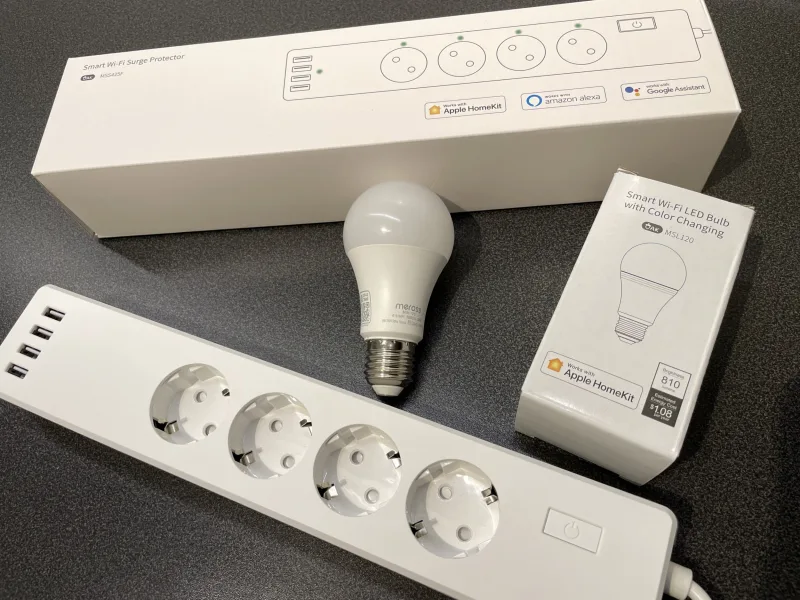
meross MSS425F supports Apple HomeKit, Amazon Alexa, Google Assistant, and SmartThings, which means it can drop into Apple-first homes (Home app + Siri) as well as mixed-assistant households without forcing a platform change. That breadth is also useful if you plan to consolidate devices under a single «control plane» like Apple Home or SmartThings rather than living in vendor apps.
Geeni GN-SW008-101, by contrast, lists compatibility with Amazon Alexa and Google Assistant (no native HomeKit or SmartThings support). In practice, that makes Geeni a more «app-first + basic voice control» strip—fine if Alexa/Google is your endgame, but less flexible if your household standardizes on Apple Home or SmartThings later.
Conclusion: Meross wins clearly on ecosystem support—it covers 4 major platforms vs 2, and HomeKit + SmartThings support is a meaningful gap for Apple users and multi-platform homes.
Automation and control model (what you can actually automate)
meross MSS425F supports scheduling and automation and can automate the on/off state for each outlet plus its USB ports. The USB behavior is still automation-friendly, but the USB ports are controlled collectively rather than per-port, so «one USB device on while another stays off» isn’t supported.
Geeni GN-SW008-101 also supports scheduling and automation, and its 6 smart outlets are app-controllable, with 2 always-on outlets that stay «dumb» by design. That mixed model can be a real advantage if you want automation for lamps/seasonal lights while keeping devices like routers or DVRs permanently powered without having to think about routines.
Conclusion: No single winner here—Meross is better if you want a fully smart-controlled strip experience anchored in major platforms, while Geeni is better if you value a deliberate split between smart (6) and always-on (2) outlets to avoid accidental shutoffs.
Winner: meross MSS425F
Outlet Configuration & Layout
meross MSS425F gives you 4 total AC outlets, and all 4 are individually controllable. That «all-smart» layout makes it simple to assume every plugged-in device can be included in automations—useful for small, tightly managed setups (e.g., a desk or media corner). The trade-off is straightforward capacity: with only 4 outlets, you may hit limits quickly if you’re powering a full entertainment stack.
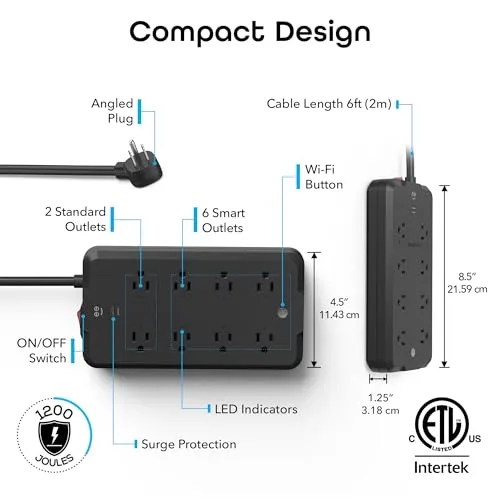
Geeni GN-SW008-101, by contrast, provides 8 total AC outlets, with 6 individually controllable smart outlets plus 2 always-on outlets. That’s a more flexible physical layout for «one strip runs everything,» while still reserving ports for devices that shouldn’t be interrupted (like a router/modem) during schedules or voice routines. Retailer/manual listings also reinforce the 8-outlet / 6-smart design for this model.
Conclusion: Geeni GN-SW008-101 wins on outlet configuration for most people because it combines more total outlets (8 vs 4) with a practical smart + always-on split (6 smart + 2 always-on vs none)—a meaningful advantage when you need one centralized power hub without risking accidental cutoffs for critical devices. Winner: Geeni GN-SW008-101
USB Charging Capabilities
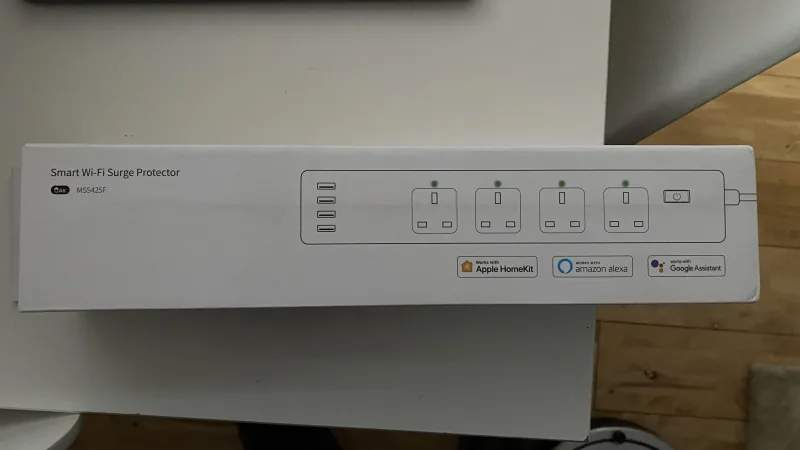
meross MSS425F includes 4 USB ports in addition to its AC outlets, so you can charge phones, tablets, or accessories without burning an AC socket. Importantly, Meross supports separate USB control, and the strip can schedule and automate the on/off status for both the outlets and the USB bank (USB ports behave as a group rather than individually). In practice, that makes it easy to do routines like «USB off at sunrise» to avoid trickle-charging overnight.
Geeni GN-SW008-101, by contrast, has no USB ports, so any USB charging requires an AC-to-USB adapter or a separate charging hub. That not only consumes one of its AC outlets, but it also means USB charging can’t be managed as its own controllable «zone» inside automations. Geeni does support scheduling/automation for its outlets, but there’s simply no USB layer to automate.
Conclusion: Meross MSS425F wins decisively on USB charging because it’s the only one with built-in USB (4 ports) plus app/voice-controllable, schedulable USB power, while Geeni offers none. Winner: meross MSS425F
Surge Protection & Safety
meross MSS425F is positioned as a smart surge protector, but its safety story is primarily certification-based: it’s made from flame-retardant PC material and is ETL and FCC certified. That’s meaningful reassurance for baseline electrical safety, yet Meross does not disclose a surge-energy (joules) rating in the provided specs and sources, making it harder to quantify protection level for sensitive electronics.
Geeni GN-SW008-101, by contrast, publishes a clear surge spec: up to 1200 joules of surge protection, along with a stated maximum load of 3680W. While a joule rating doesn’t guarantee protection against every event, it does give buyers a concrete benchmark for comparing strips and matching protection to typical home electronics loads.
Conclusion: Both are surge protectors, but Geeni’s explicit 1200J rating (and 3680W max load) is more transparent and easier to evaluate than Meross’ certification-only approach, giving Geeni the edge for safety-focused shoppers who want measurable protection.
Winner: Geeni GN-SW008-101
Setup & User Experience
Onboarding & app dependence
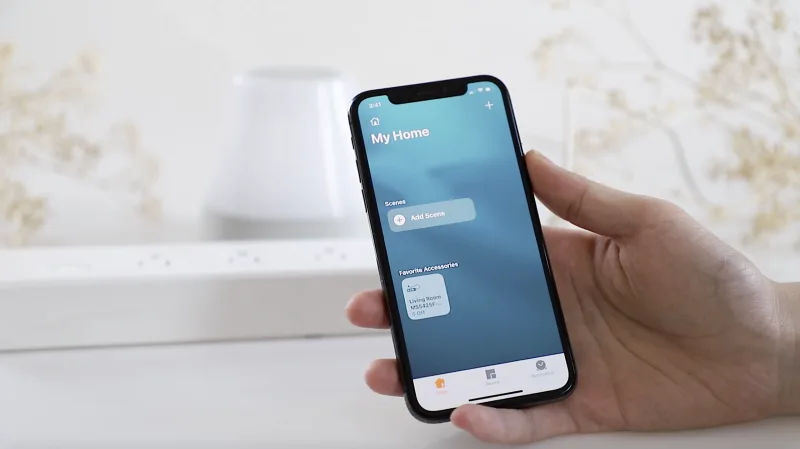
meross MSS425F is built to drop into bigger smart-home setups, with official support for Apple HomeKit, Alexa, Google Assistant, and SmartThings. In practice, that breadth can make first-time pairing feel more «ecosystem-first» (especially if you’re doing HomeKit onboarding), even though it’s still hub-free and 2.4 GHz Wi‑Fi only.
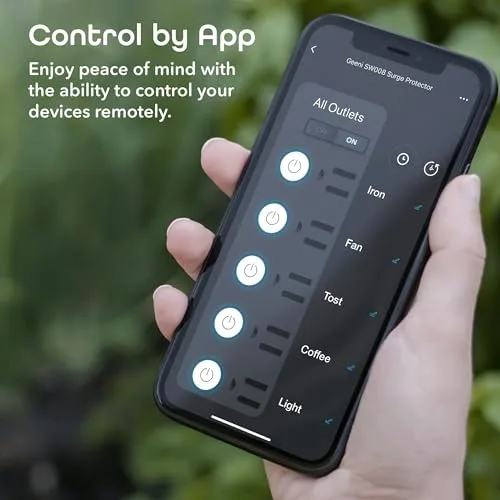
Geeni GN-SW008-101 takes a more app-first path: it supports Alexa and Google Assistant (but not HomeKit or SmartThings) and is also hub-free on 2.4 GHz Wi‑Fi. Geeni’s own documentation highlights app-managed scaling (including multiple locations and unlimited devices), reinforcing that the Geeni app is the center of the experience.
Conclusion: Geeni is typically simpler if you’re fine living in one vendor app, while Meross is better if you want your strip to appear inside a broader smart-home «control plane.» Neither is universally easier—your ecosystem choice drives the UX.
Day-to-day control and «what you automate»
meross MSS425F gives you 4 individually controllable AC outlets plus 4 USB ports, with scheduling/automation supported for outlets and USB (USB control is supported, but the USB ports act as a group rather than per-port). With no always-on outlets, everything on the strip can be placed under automation—useful for «turn the whole desk/media corner off» routines.
Geeni GN-SW008-101 scales better for larger power clusters with 8 total AC outlets, including 6 individually controllable plus 2 always-on outlets. That split is handy for devices you never want cut off (routers, DVRs), but it also means you must plan which plugs should and shouldn’t follow routines.
Conclusion: Geeni has the more flexible physical workflow for mixed always-on vs automated gear (6 smart + 2 always-on), while Meross is cleaner if you want every connected load to be automation-eligible (4 controlled, no always-on).
Winner: Tie — Meross wins on multi-ecosystem consistency (HomeKit + Alexa + Google + SmartThings), while Geeni wins on straightforward, app-centric control and outlet «zoning» (6 smart + 2 always-on).
Price & Value
meross MSS425F is priced at $32.39 and is in stock (per this article’s May 2026 snapshot). At that price, you’re buying a strip with 4 individually controllable AC outlets plus 4 USB ports, with the USB bank supported as a separately controllable group. It also supports a wider range of platforms—Apple HomeKit, Alexa, Google Assistant, and SmartThings—which can reduce the «cost» (and friction) of switching or mixing ecosystems later.
Geeni GN-SW008-101 is listed at $39.99 and is out of stock as of May 2026, which weakens its immediate value proposition even before features are considered. Its main value hook is capacity: 8 total AC outlets with 6 individually controllable smart outlets plus 2 always-on outlets (useful for devices you don’t want automated off). However, it lacks any USB ports and its platform support is narrower—Alexa and Google Assistant only.
Conclusion: On pure dollars-to-features, Meross offers the stronger value because it’s cheaper ($32.39 vs $39.99), available, adds 4 USB ports, and brings broader ecosystem compatibility (including HomeKit and SmartThings). Geeni can still be the better buy if your priority is more AC outlets in one place (8 vs 4) and you specifically want two always-on sockets for «don’t ever cut power» devices.
Winner: meross MSS425F
The Bottom Line
After breaking down platform support, outlet layouts, USB charging, safety transparency, and day-to-day control, the choice comes down to whether you prioritize ecosystem flexibility or sheer outlet capacity.
For Apple HomeKit Users: Choose the meross MSS425F, since it’s the only one here with native HomeKit support for direct Home app and Siri control.
For Maximum Outlet Quantity: Choose the Geeni GN-SW008-101, thanks to its 8-outlet design (6 smart + 2 always-on) that outscales Meross’s 4-outlet, all-smart layout.
For Mixed Smart Home Households: Choose the meross MSS425F, because its Alexa/Google/HomeKit/SmartThings compatibility makes it easier to standardize control without locking into a single vendor app.
Overall, this comparison ends in a tie: Meross is the stronger pick for broader platform support and added everyday convenience (including its controllable USB bank), while Geeni’s advantage is a more expansive, «one strip powers everything» outlet configuration with a practical always-on split.
Pick the strip that matches how you actually run your home—if you want the most flexible smart-home integration, go Meross; if you need more outlets and like the always-on separation, go Geeni.
FAQ
Does the Meross MSS425F work with Apple HomeKit?
Does the Geeni GN-SW008-101 have USB ports?
Which smart surge protector has more outlets?
Does the Geeni GN-SW008-101 support 5GHz Wi-Fi?
Can the Meross MSS425F USB ports be controlled individually?
Does the Geeni GN-SW008-101 have always-on outlets?
Which smart surge protector has a higher surge protection rating?
📄 Used Manuals & Documentation
meross MSS425F
Geeni GN-SW008-101
"Images are used for editorial and informational purposes only. All trademarks and images belong to their respective owners."