
Leeleberd T-100 vs Nexillumi ZTL LX: What Actually Separates These 100-ft RGB LED Strip Kits
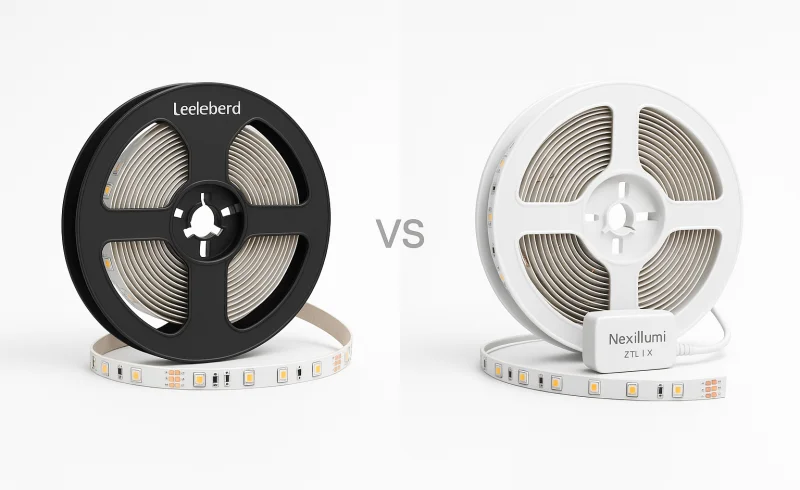
Explore the differences between Leeleberd T‑100 and Nexillumi ZTL LX LED strips. Learn about coverage, LED density, installation tips, and find out which strip suits your lighting needs best. Whether you're lighting a large room or creating an accent area, get...
TL;DR
- Coverage is effectively a tie. The relevant Leeleberd T-100 and Nexillumi ZTL LX configurations both provide about 100 ft of RGB strip, arranged as two long runs rather than one uninterrupted 100-ft line.
- Do not use the catalog “number of light sources” fields to declare a brightness or density winner. Leeleberd is consistently listed at 540 light sources, while Nexillumi metadata for the exact 30M_Nex_ZTL_LX_DE model is inconsistent enough that the widely repeated 100-light-source figure is not a sound basis for an LEDs-per-foot comparison.
- Installation is more similar than different. Both rely on adhesive-backed indoor strip, both can be cut only at marked points, and both require careful controller placement because the two long runs originate near the same control/power hardware.
- Leeleberd has the more specifically documented effects package, including Bluetooth app control, remote control, music sync, timers, DIY modes, and 64 preset scenes in its documentation.
- Nexillumi has the clearer documented power-adapter safety claim: its materials specify a UL-listed fireproof adapter with overload and short-circuit protection. That is a meaningful documentation distinction, though it does not establish that the entire kit is more durable.
- Neither exact model should be treated as an outdoor strip or as a serious smart-home platform device. Both are documented for indoor use and as not water resistant, with their primary controls centered on Bluetooth apps and handheld remotes.
The important point is that this is not really a “maximum coverage versus cleaner design” comparison. These kits are physically much closer than that framing suggests. The useful differences are in their controllers, apps, documented safety details, and the amount of confidence you can place in their published specifications.
| Feature | Leeleberd T-100 | Nexillumi ZTL LX |
|---|---|---|
| Build | ||
| Material | Plastic | Plastic |
| Water resistance | Not Water Resistant | Not Water Resistant |
| Indoor/Outdoor usage | Indoor Only | Indoor |
| Control | ||
| App control | Supported | Supported |
| Remote control | Supported | Supported |
| General | ||
| Color output | Multicolor (RGB) | Multicolor |
| Model number | T-100 | 30M_Nex_ZTL_LX_DE |
| Product type | RGB LED strip lights | RGB LED strip lights |
| Total length | 100 FT (2 Rolls of 50ft) | 30 m |
| Number of light sources | 540 | 100 |
| Features | ||
| Music sync | Supported | Supported |
| Cuttable strip | Supported | Supported |
| Timer function | Supported | Supported |
📑 Table of Contents
- Start With the Exact Models
- Coverage: Essentially a Tie
- LED Density: The Published Numbers Are Not Reliable Enough for a Winner
- Installation: More Alike Than Different
- Controls: Similar Fundamentals, Different Software Details
- These Are Bluetooth Lighting Kits, Not Full Smart-Home Systems
- Power and Safety: Nexillumi Documents More
- Reliability: There Is Not Enough Evidence to Rank Them
- What Each Kit Is Better Suited To
- The Bottom Line
- FAQ
Start With the Exact Models
Long RGB strip listings are unusually prone to specification drift. The same brand name — and sometimes even the same model label — can appear across several lengths, controller revisions, or product generations.
For this comparison, the relevant Leeleberd T-100 is the 100-ft configuration sold as two 50-ft rolls, associated with the 100-ft T-100 documentation. That distinction matters because the T-100 name also appears around other Leeleberd strip lengths.
The Nexillumi side is more specific: model 30M_Nex_ZTL_LX_DE, associated with the roughly 30-meter/100-ft RGB kit. Documentation for this configuration also describes a long indoor RGB setup controlled through a central controller, app, and remote.
That SKU discipline matters throughout this comparison. Features from another 50-ft or 100-ft strip carrying the same brand should not automatically be attributed to these exact configurations.
Coverage: Essentially a Tie
The headline numbers make the two kits look almost identical because, for practical layout planning, they are.
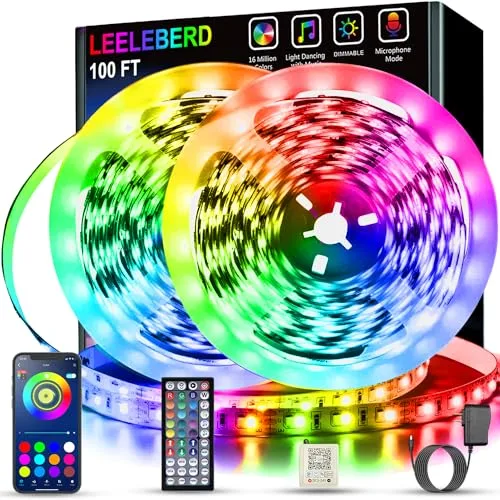
Leeleberd T-100 provides 100 ft total as two 50-ft strips. Its setup documentation instructs the user to connect both strips to the control box when both are being used.
Nexillumi ZTL LX is the 30 m / approximately 100-ft configuration, and documentation for the 100-ft package likewise describes two long strip runs associated with the same controller/power system.
That changes how “100 ft” should be visualized. It is not necessarily a single strip that can start at an outlet and travel continuously for 100 ft in one direction. A more realistic layout has the controller and power hardware near a useful central point, with the two runs extending away from it.
For a bedroom perimeter, for example, the difficult question is not whether one model has enough total strip. Both do. The question is whether the outlet, controller, two strip starting points, furniture, doorways, and corners line up in a way that lets those two runs reach the intended endpoints cleanly.
Coverage verdict: Tie. There is no defensible coverage advantage for Leeleberd simply because it is labeled 100 ft; the comparable Nexillumi configuration is in essentially the same length class.
LED Density: The Published Numbers Are Not Reliable Enough for a Winner
This is where a simple spec-table comparison becomes misleading.
The Leeleberd T-100 documentation consistently lists 540 light sources for the 100-ft version. If that figure represents individual RGB LED packages, it is at least internally plausible for a long decorative strip.
The Nexillumi 30M_Nex_ZTL_LX_DE is widely cataloged with 100 light sources. Taken literally, that would mean roughly one visible LED per foot — an extraordinarily sparse layout for a conventional RGB strip of this type.
The problem is that other listings for the same Nexillumi SKU describe different LED-density information, while the product is also represented as a conventional RGB strip rather than an unusual one-LED-per-foot design. That makes the “100 light sources” field too questionable to turn into a meaningful density calculation.
In other words, dividing 540 by 100 and concluding that Leeleberd has more than five times the LED density gives the calculation an appearance of precision that the source data does not deserve.
There is another important distinction: LED count alone does not establish brightness. Total output also depends on the individual LED packages, current supplied to them, voltage drop over the run, controller behavior, and power-supply design. None of the available specifications provide standardized photometric measurements that would let these kits be compared in lumens, lux, or uniformity.
So there is no responsible basis here for saying that one produces a smoother wall wash, fewer visible hotspots, or dramatically higher output solely from the catalog fields.
Light-output verdict: Undetermined from the available specifications.
Installation: More Alike Than Different
Both products use the familiar long-strip installation formula: plan the route, test the electronics, clean the mounting surface, expose the adhesive backing, and press the strip into place.
That sounds trivial until 50 ft of adhesive-backed PCB is hanging from a wall.
With either kit, layout planning is the real installation task. A small mistake near the beginning can shift every later corner. Repeatedly peeling and repositioning adhesive can also weaken its hold, something explicitly acknowledged in Leeleberd's installation guidance.
Both strips should be placed on a clean, dry, smooth surface, and both should be tested before permanent placement. Nexillumi's instructions also specifically call for fully unspooling the strip before powering it, rather than running it tightly wound on the reel.
Corners deserve particular attention. These are flexible strips, but “flexible” does not mean they should be sharply creased wherever the room changes direction. Leeleberd's documentation recommends gentle bends or compatible corner connectors where appropriate. Nexillumi similarly provides designated cut points and warns against damaging the strip through improper folding or connections.
Both are also cuttable only at the marked locations. Cutting a strip to length is straightforward; reconnecting a separated section is a different task. Compatible 4-pin connectors may be required, and the relevant documentation does not support assuming every needed connector is included.
The original idea that Nexillumi somehow lends itself to a cleaner small installation is therefore not supported by the hardware format. A 10-ft accent installation is manageable with either one. A four-wall perimeter requires roughly the same planning discipline with either one.
Installation verdict: Tie. Controller location, strip routing, surface preparation, and corner handling matter more than the brand name here.
Controls: Similar Fundamentals, Different Software Details
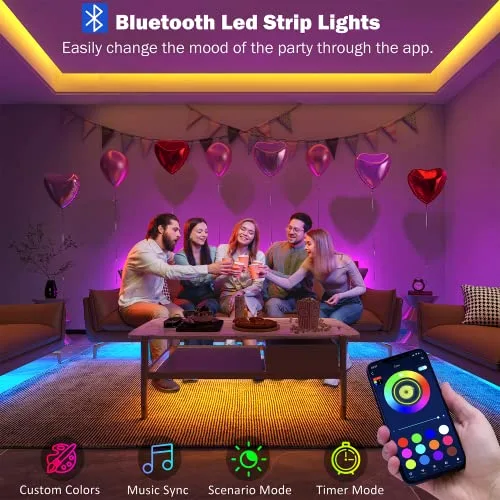
Both kits provide two control paths: a phone app for deeper configuration and a handheld remote for immediate adjustments.
Leeleberd T-100
Leeleberd's documentation identifies Bluetooth app control through the Keepsmile app along with an IR remote.
The app covers color selection, brightness, dynamic effects, music-responsive modes, timers, and custom configurations. The documentation also lists 64 preset scene modes and advertises access to up to 16 million RGB color selections through the software.
That “16 million colors” figure should be understood as the manufacturer's app/color-control claim, not evidence that the strip can reproduce millions of visually distinct colors with calibrated accuracy.
For routine use, the remote handles the things that matter most: power, preset colors, brightness, and effect selection. The IR design means the receiver generally needs a usable line of sight.
Nexillumi ZTL LX
Nexillumi uses its illumi Home app alongside a remote control. Its documentation describes brightness adjustment, color controls, music synchronization, scenes, timers, and DIY lighting configurations.
Music response can use the controller's built-in microphone or app-related microphone functionality.
There is one small practical wrinkle: Nexillumi documentation notes that different remote designs may appear in different production batches. Their basic capabilities are described as similar, but the exact button layout should not be assumed from a single product image.
Nexillumi's remote also documents a direct 30-minute turn-off timer, while broader scheduling functions live in the app.
What this means in daily use
Neither product forces constant phone use. If the strip is normally set to one color or brightness level, the remote is likely to handle most routine adjustments.
The app matters more when using timers, custom colors, scenes, or music-responsive effects. That also means the practical difference between these products depends partly on which app and controller implementation proves more convenient on the specific phone being used — something spec sheets alone cannot establish.
Controls verdict: Tie overall. Leeleberd documents more preset scenes; Nexillumi has its own comparable app-and-remote architecture.
These Are Bluetooth Lighting Kits, Not Full Smart-Home Systems
The word “smart” can imply more than these exact products actually document.
Both models center their connected features on a Bluetooth phone app plus a remote control. Their manuals do not present Matter, Apple Home, Google Home, or Alexa integration as the foundation of the experience.
That distinction matters if the goal is not merely changing colors from a phone but putting the lights into a larger automation system with voice assistants, standardized scenes, sensors, or cross-brand routines.
Generic marketplace metadata sometimes labels inexpensive Bluetooth products as “smart-home compatible,” but that is not specific enough to establish platform support for an exact SKU.
For these two models, the safe expectation is therefore local app and remote control first. Any broader platform integration should be treated as SKU-specific unless explicitly documented for the exact unit.
Power and Safety: Nexillumi Documents More
Both kits are described as indoor-only and not water resistant.
That rules out exposed outdoor installations and any location where the strip, controller, or adapter can reasonably encounter water. Decorative use in a kitchen does not turn an indoor strip into a splash-rated one.
There is, however, one substantive documentation difference.
Nexillumi states that its kit includes a UL-listed fireproof power adapter with a protective circuit intended to shut down during overload or short-circuit conditions. That is a manufacturer documentation claim tied specifically to the supplied adapter, not a blanket safety certification for every component in the lighting system.
Leeleberd's documentation specifies use of the supplied adapter and lists the 100-ft T-100 at 24 V and 36 W, but the materials reviewed for this exact configuration do not make an equivalent UL-listing claim for its adapter.
The electrical numbers in marketplace specification tables also should not be compared too literally. Nexillumi listings may show figures such as 120 V that refer to the mains side of the power arrangement, while Leeleberd specifies 24 V in its kit specifications. Without the complete input/output labels for both adapters, those fields do not establish which strip operates more efficiently or produces more light.
Power-and-safety documentation verdict: Nexillumi has the edge, specifically because its supplied adapter is more explicitly documented.
Reliability: There Is Not Enough Evidence to Rank Them
A reliability comparison needs more than isolated troubleshooting posts.
One report of flickering, failed Bluetooth pairing, color problems, or a loose connection does not establish that an entire product line is unreliable. Long RGB strips from many brands can experience those same symptoms when a connector is loose, a section is damaged, the controller is misconfigured, or the power path is interrupted.
The manufacturers' own troubleshooting material reflects that reality.
Leeleberd discusses app connection failures, remote line-of-sight issues, loose power connections, and adhesive that can weaken after repositioning.
Nexillumi covers many of the same categories: loose connections, dimming or flickering, app pairing, microphone permissions, damaged strip sections, and controller alignment.
That tells us what can go wrong. It does not tell us how often it goes wrong.
There is no controlled long-term failure-rate data here, no standardized durability test, and no sufficiently strong independent evidence to declare either brand more dependable.
The physical installation itself can also dominate longevity. A perfectly functional strip placed across dusty paint, stretched around sharp corners, or left supporting the weight of its own controller cable can fail mechanically without there being an electronics defect.
Reliability verdict: No defensible winner.
What Each Kit Is Better Suited To
For a room perimeter or another long decorative run, these products are much closer than their marketing descriptions suggest. Both provide roughly the same total strip length, and both require the layout to work around two long branches and a central control/power point.
For a short accent installation behind a desk, headboard, shelving unit, or TV area, neither has an inherent routing advantage. In fact, both provide far more strip than many small installations require, making cut points and leftover-strip plans more important than total advertised length.
For someone who expects to spend time creating scenes and dynamic effects, Leeleberd has the more specifically documented preset-scene count, with 64 modes listed in its materials.
For someone who places extra emphasis on the supplied power adapter's documented protections, Nexillumi has the clearer specification because it explicitly identifies the included adapter as UL listed and describes overload and short-circuit protection.
For smart-home automation beyond a proprietary Bluetooth app, neither exact model stands out from the available documentation.
And for anyone whose decision depends specifically on maximum brightness, true LED density, uniformity, white-point quality, or measured color performance, the published marketplace specifications are not strong enough to settle the comparison. Those characteristics would require reliable component specifications or controlled side-by-side measurements.
The Bottom Line
The most important correction to this comparison is simple: Leeleberd T-100 is not the obvious “coverage” model, and Nexillumi ZTL LX is not inherently the “clean installation” model. Their relevant 100-ft configurations are structurally too similar for that distinction to hold up.
Leeleberd provides a well-documented Bluetooth-and-remote feature set, including music modes, timers, custom effects, and 64 listed scenes. Nexillumi offers a broadly similar control system and distinguishes itself most clearly through the documentation surrounding its UL-listed protected power adapter.
What the available evidence does not establish is equally important. It does not support the claim that Leeleberd has five times the meaningful LED density, that it is automatically brighter or smoother, that Nexillumi is easier to install, or that either model has superior long-term reliability.
There is therefore no honest overall winner from the verified specifications alone. The useful decision is narrower: Leeleberd has the more explicitly documented effects package, while Nexillumi has the stronger documented adapter-safety story. For coverage, installation architecture, basic controls, and indoor-only limitations, they are much more alike than different.
FAQ
Which LED strip has better app control?
Can I cut both strips to size?
Which is more reliable long-term?
Is Nexillumi cheaper?
Which LED strip has higher light density?
Which LED strip is better for large room coverage?
Are these LED strips waterproof?
"Images are used for editorial and informational purposes only. All trademarks and images belong to their respective owners."