DJI Osmo 360 II vs Insta360 X6: 8K motion or longer recording?
TL;DR
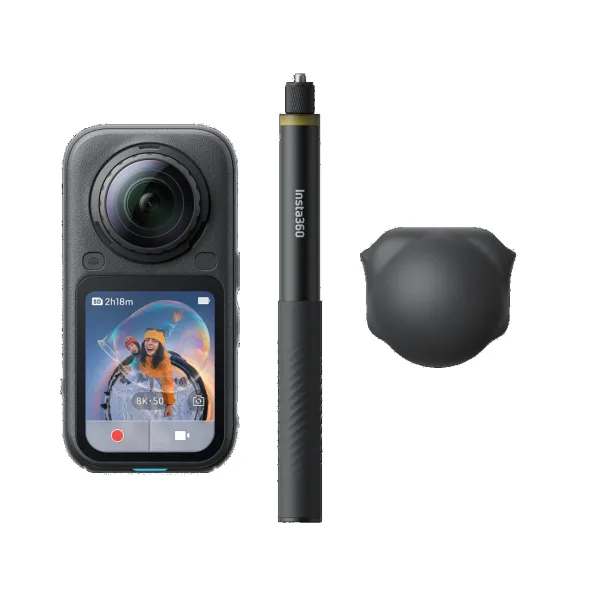
DJI has not released the Osmo 360 II in the US, so there is no official US price, and an imported unit leaves returns and repairs to the seller. The Insta360 X6 sells officially in the US at $699.99 for the Standard Bundle.
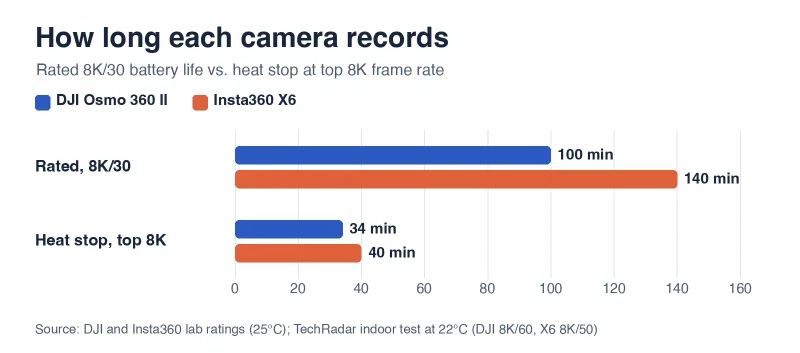
Where both are on sale, the X6 is the better all-rounder: TechRadar's Sam Kieldsen gave it a small image-quality edge by day and at night, and Insta360 rates it for 140 minutes of 8K/30 recording against DJI's 100. The Osmo 360 II wins on 8K/60 capture, including its night mode, and on internal storage, with 105 GB available against 47 GB.
| Specification | DJI Osmo 360 II | Insta360 X6 |
|---|---|---|
| Sensors | Dual 1/1.1-inch square CMOS | Dual 1/1.1-inch square CMOS |
| Standard 360 video | Up to 8K/60 fps | Up to 8K/50 fps |
| Night 360 mode | SuperNight up to 8K/60 fps | PureVideo up to 8K/30 fps |
| Single-lens video | Up to 4K/120 fps | Up to 5K/60 fps or 4K/120 fps |
| Weight | 183 g | 196 g |
| Screen | 2.0-inch touchscreen | 2.32-inch OLED touchscreen |
| Battery | 2,150 mAh | 2,600 mAh |
| Rated runtime, 360 8K/30 | Up to 100 min | About 140 min |
| Internal memory available | 105 GB of 128 GB | 47 GB of 64 GB |
| Removable storage | microSD, up to 1 TB | microSD, up to 1 TB |
| Depth rating | 10 m bare, 50 m in housing | 20 m bare, 60 m in housing |
| Log profile | D-Log M, 10-bit | I-Log |
| Operating temperature | -20°C to 45°C | -20°C to 40°C |
| Official US price | Not sold in the US | $699.99 |
| Official UK price | £509 | £619 |
Runtime ratings are at 25°C with the screen off, DJI's with Wi-Fi off and Insta360's with Wi-Fi on.
📑 Table of Contents
- Image quality: the X6 edges it by day and at night
- Action footage: 8K/60 sphere or 5K/60 single lens
- Battery life: the X6 lasts longer at 8K/30
- Handling: a shorter body or a larger screen
- Water and lens care
- Storage: DJI holds twice as much without a card
- Editing: ProRes on Insta360, Resolve plugin on DJI
- Final Verdict
- FAQ
Image quality: the X6 edges it by day and at night
In TechRadar's car-mounted comparison, Sam Kieldsen preferred the X6's daylight footage for detail and cleanliness, while the Osmo 360 II held more detail in bright skies. Running DJI's footage through DJI Studio noise reduction narrowed the gap.
At night
TechRadar's night comparison went narrowly to the X6, with more punch and a green-yellow default tint.
Movement is where the Osmo 360 II takes over. Its SuperNight mode records 8K at 60 fps, while the X6's PureVideo mode stops at 8K/30. For a night ride you plan to slow down or cut into a 60 fps edit, DJI is the only one of the two with a matching low-light mode.
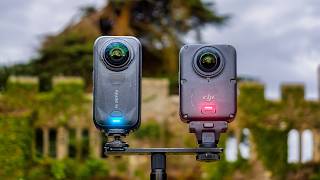
Hugh Hou's night-mode chapter (10:57) puts the two night modes side by side.
Action footage: 8K/60 sphere or 5K/60 single lens
For a bike ride you want to reframe afterward, the Osmo 360 II records the whole sphere at 8K/60; the X6 tops out at 8K/50. Point one lens forward and use the camera like a conventional action cam, and the order flips: the X6 records 5K/60, while DJI stops at 4K. Both reach 4K/120 in single-lens mode.
Keep in mind that 8K describes the full sphere. A tightly reframed view uses only part of it, so the flat clip you export carries far fewer pixels than the headline number suggests.
Both cameras offer horizon-locked stabilization: RockSteady and HorizonSteady on DJI, FlowState and 360° Horizon Lock on Insta360.
Battery life: the X6 lasts longer at 8K/30
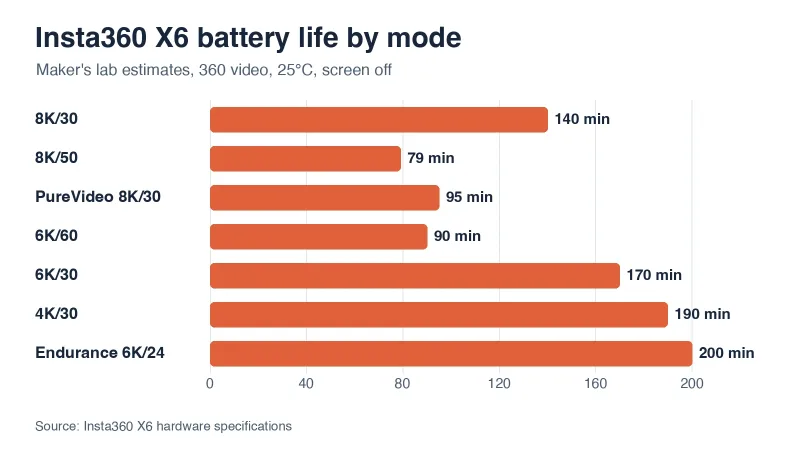
Insta360 rates the X6 at about 140 minutes of 8K/30 recording, DJI rates the Osmo 360 II at 100 minutes. The X6 manual also shows what each mode costs: 79 minutes at 8K/50, 95 minutes in PureVideo and 170 minutes at 6K/30.
Heat cuts a long take shorter than either battery rating. In TechRadar's 22°C indoor test at each camera's top 8K frame rate, the Osmo 360 II stopped to cool after about 34 minutes at 8K/60 and the X6 after about 40 minutes at 8K/50. For a tripod time-lapse or a long interview, plan around those numbers.
To stretch a long take on the X6, drop the resolution: going from 8K/50 to 6K/30 more than doubles its rated runtime, from 79 to 170 minutes.
Handling: a shorter body or a larger screen
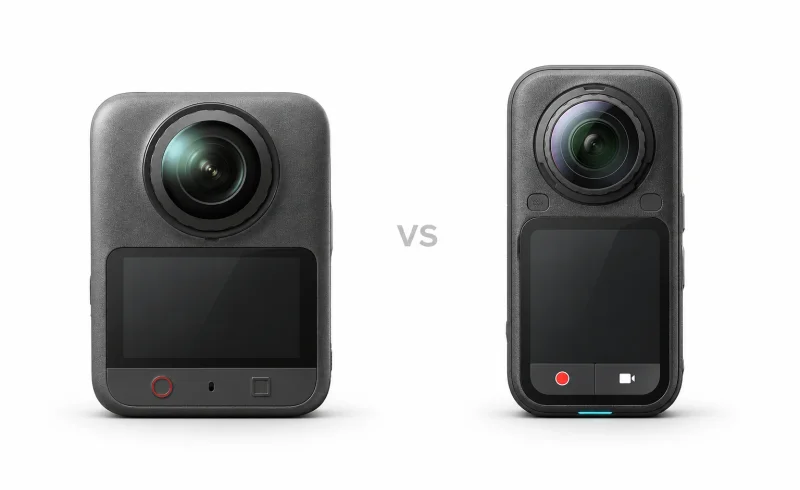
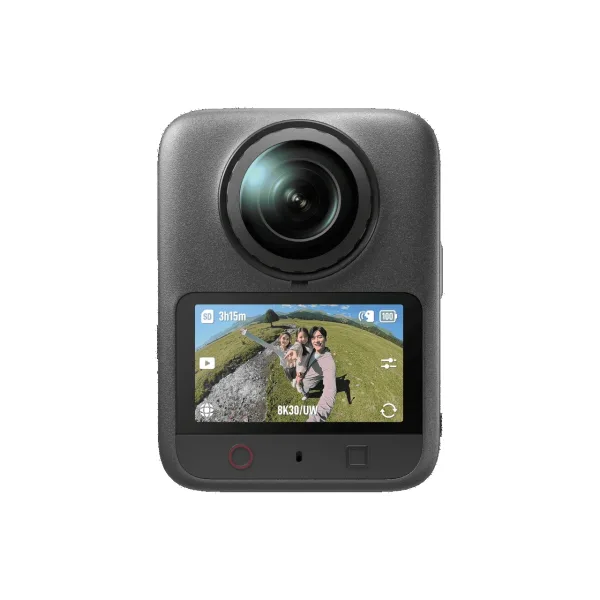
The Osmo 360 II weighs 183 g, against 196 g for the X6, and stands 81 mm tall against 100 mm. That makes it the easier camera to slip into a jacket pocket. The X6 answers with a larger 2.32-inch OLED screen, which gives you more room to frame and tap through menus.
Water and lens care
The X6 goes deeper without a housing, 20 m against DJI's 10 m. For clean underwater stitching, both makers still point you to a case: DJI warns that its convex lenses cause refraction and stitching errors underwater, and Insta360 recommends its Dive Case. In their housings the ratings rise to 50 m for DJI and 60 m for the X6. Insta360's Lens Guard does not fit inside the Dive Case, so you swap one for the other before a dive.
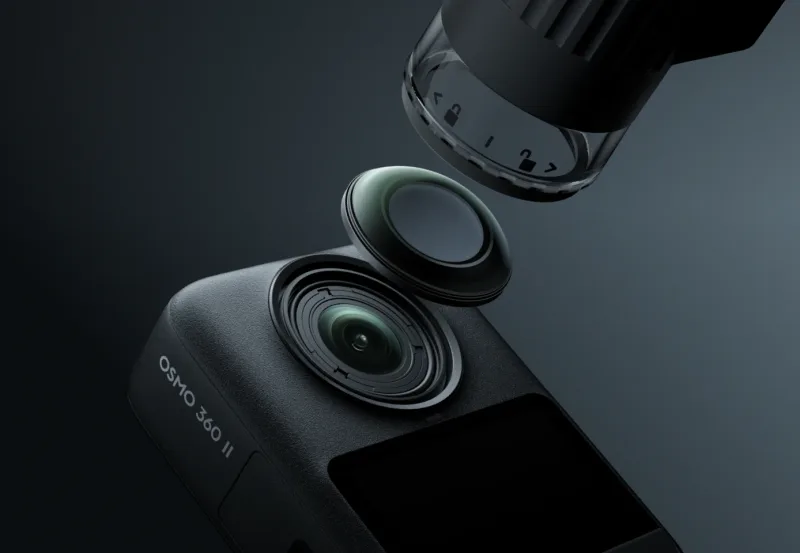
Both cameras let you replace a scratched lens element yourself. Insta360 asks for a dry, dust-free workspace and a stitching calibration afterward.
Storage: DJI holds twice as much without a card
The Osmo 360 II has 105 GB of usable internal storage, the X6 has 47 GB. Forget the microSD card in your laptop and DJI still gives you more than twice the room to keep shooting. Both accept cards up to 1 TB.
Editing: ProRes on Insta360, Resolve plugin on DJI
Both cameras save their own 360 files (OSV on DJI, INSV on Insta360) and reframe them in the phone apps, DJI Mimo and the Insta360 app, or on a computer in DJI Studio and Insta360 Studio. For color grading, DJI offers D-Log M and the X6 offers I-Log; on the X6, I-Log in flat video works only in InstaFrame 2.0 mode.
Your export target can decide it. Insta360 Studio exports ProRes; TechRadar found no equivalent in DJI Studio. DJI offers a DaVinci Resolve plugin instead, which Hugh Hou walks through at 17:56. If your projects end in ProRes, take the X6; if they already live in Resolve, DJI fits in.
Final Verdict
For most buyers, the Insta360 X6 is the better pick: it edged the Osmo 360 II on image quality in TechRadar's comparison, lasts longer at 8K/30, and it is the one you can buy officially in the US.
- US buyers: Insta360 X6, because DJI has not launched the Osmo 360 II there.
- Fast action you will slow down later: DJI Osmo 360 II, for 8K/60 capture.
- Moving shots at night: DJI Osmo 360 II, for SuperNight at 8K/60.
- Long recordings at 8K/30: Insta360 X6, for its 140-minute rating and later heat stop.
- Forward-facing action-cam use: Insta360 X6, for 5K/60 single-lens video.
- Shooting without a memory card: DJI Osmo 360 II, for 105 GB of internal storage.