
GoveeLife H7151 vs Ivation IVADUWIFI50WP: Smart Controls or Built-In Pump?
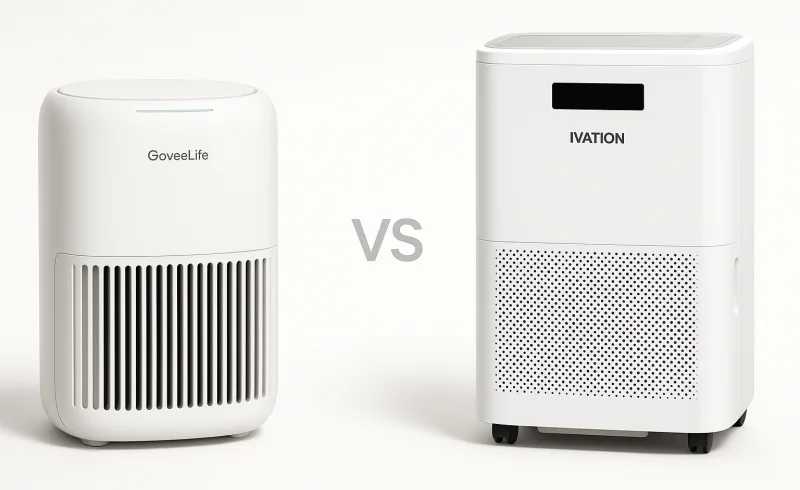
Explore the differences between GoveeLife H7151 and Ivation 4,500 Sq Ft dehumidifiers, focusing on smart features, drainage options, and usage scenarios. Determine which model best suits your needs based on voice control capabilities and water management flexi...
TL;DR
Both of these are portable compressor dehumidifiers in essentially the same standardized 50-pint/day class, and both carry Energy Star certification. Their advertised 4,500 sq. ft. coverage is a manufacturer sizing claim; it should not be read as a guarantee that either unit can maintain the same humidity in every space of that size.
The meaningful differences are elsewhere:
- GoveeLife H7151 is the stronger fit for a connected home. Its manual explicitly supports the Govee Home app, Amazon Alexa, and Google Assistant, and it operates from 41–95°F. Continuous drainage is gravity-fed, so the hose must run downward from the unit.
- Ivation IVADUWIFI50WP is the more flexible drainage system. In addition to ordinary gravity drainage, it has a built-in pump with a supplied 16-foot pump hose, allowing condensate to be routed upward when a floor-level drain is not available. Its operating range is 41–89.6°F.
- With a usable floor drain below the dehumidifier, the Ivation pump becomes much less important because both models can drain continuously by gravity.
- Without continuous drainage, Ivation's 2.25-gallon reservoir is slightly larger than GoveeLife's 2.0-gallon reservoir, but the difference is not large enough to fundamentally change the routine of manual emptying.
- Neither model is intended for sustained operation below 41°F.
| Feature | GoveeLife H7151 | Ivation 4,500 Sq Ft Smart Wi-Fi Energy Star Dehumidifier |
|---|---|---|
| Capacity | ||
| Coverage Area | Up to 4,500 sq. ft. | Up to 4,500 sq. ft. |
| Water Reservoir Capacity | 2.0 gallons | 2.25 gallons |
| Moisture Removal Capacity | 50 pints/day | 50 pints/day |
| Controls | ||
| Built-In Timer | Yes | Yes |
| Humidity Setting Range | 30%-80% RH | 30%-90% RH |
| Adjustable Humidity Control | Yes | Yes |
| Drainage | ||
| Built-In Pump | Absent | Integrated 16W pump |
| Continuous Drain Hose Connection | Yes | Yes |
| Features | ||
| Auto Defrost | Yes | Yes |
| Washable Air Filter | Yes | Yes |
| Full Bucket Auto Shutoff | Yes | Yes |
| Energy Star Certification | Yes | Yes |
| Dimensions | ||
| Product Dimensions | 11.61"D x 15.39"W x 24.41"H | 11.1"D x 15.28"W x 23.5"H |
| Performance | ||
| Operating Temperature Range | 41-95°F (5-35°C) | 41-89.6°F |
| Connectivity | ||
| Wi-Fi | Yes, 2.4 GHz | Yes |
| App Control | Govee Home app | My Ivation app |
| Voice Assistant Support | Alexa, Google Assistant | Not supported |
📑 Table of Contents
- Drainage Is the Biggest Practical Difference
- Smart Features: Both Have Apps, but GoveeLife Has Confirmed Voice Integration
- Moisture Removal: The Headline Performance Is Essentially a Tie
- Energy Efficiency and Operating Temperature
- Daily Controls and Humidity Settings
- Maintenance and Reliability
- Size and Placement
- The Bottom Line
- FAQ
Drainage Is the Biggest Practical Difference
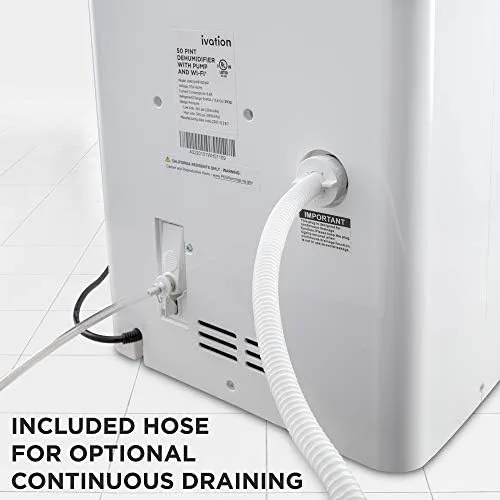
A dehumidifier can remove a substantial amount of water during humid weather, so the way that water leaves the machine often matters more than another app feature or a small difference in dimensions.
GoveeLife: continuous drainage requires gravity
The GoveeLife H7151 supports bucket collection and continuous hose drainage. Its manual is explicit about the limitation of the latter: the drain point needs to be lower than the dehumidifier's outlet, and the hose should slope downward without kinks or bends.
That is straightforward when the unit sits near a basement floor drain. It becomes much less convenient when the nearest sink, window, standpipe, or other suitable drain point is higher than the machine.
Without a workable gravity route, condensate collects in the 2.0-gallon tank. The H7151 shuts down automatically when the tank is full and resumes normal operation after the bucket has been emptied and reinstalled.
Ivation: gravity drain plus a separate pump system
The Ivation IVADUWIFI50WP offers the same basic alternatives—reservoir collection and continuous gravity drainage—but adds a dedicated pump outlet.
Its manual includes a 16-foot pump hose. Connecting that hose automatically activates the pump, and the hose can be routed horizontally or vertically. Condensate then bypasses normal tank collection and is pumped toward the selected drainage point.
There is an unusual operational detail worth knowing: according to Ivation's manual, the pump remains active while its hose is connected and the appliance remains plugged in, even when the dehumidifier itself has been switched off, so residual water can still be expelled. Disconnecting the pump hose disables that function.
For a basement where the only practical outlet is above the dehumidifier, this is a fundamentally different capability rather than a minor convenience feature.
The larger Ivation bucket helps, but only slightly
Ivation's reservoir holds 2.25 gallons, compared with 2.0 gallons for the H7151.
That extra quarter gallon gives Ivation a little more time between full-tank interruptions, but neither reservoir is especially large relative to the amount of water a 50-pint-class machine can remove under demanding conditions. If continuous drainage is impossible, manual emptying remains part of life with either model.
Practical result: If the drain point is higher than the dehumidifier, Ivation has the important hardware advantage. If a floor drain is already available below the unit, both can avoid routine bucket emptying and the distinction becomes much smaller.
Smart Features: Both Have Apps, but GoveeLife Has Confirmed Voice Integration
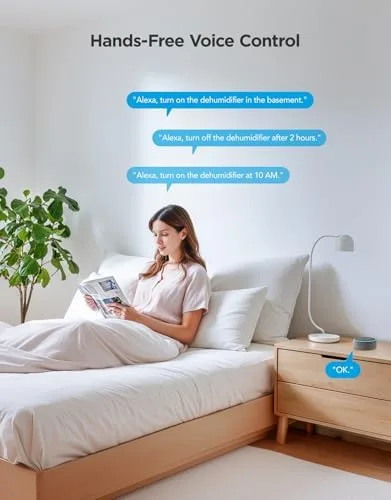
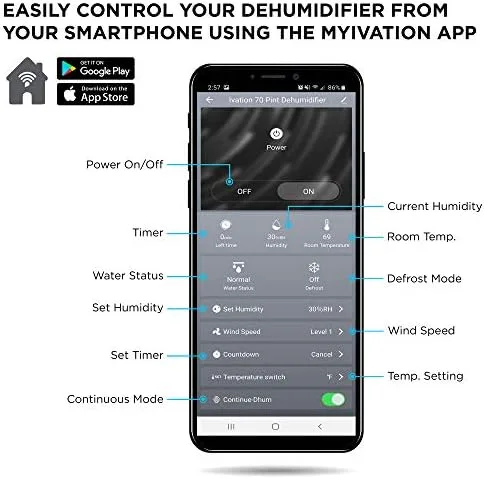
The original distinction between a highly connected GoveeLife and a nearly conventional Ivation is too simplistic. Both are genuine Wi-Fi dehumidifiers, and Ivation's app does considerably more than basic remote power control.
What GoveeLife adds
The H7151 connects through the Govee Home app. Initial setup requires a 2.4 GHz Wi-Fi network, with Bluetooth used during pairing.
The manufacturer's manual explicitly states that the H7151 can be connected through Govee Home to Amazon Alexa or Google Assistant. That makes voice integration a confirmed advantage for homes already using either platform.
The physical control panel remains fully useful, however. The H7151 is not an app-only appliance: it provides on-unit power, fan-speed, mode, humidity, timer, and lock controls.
Ivation's app is more capable than the original comparison suggested
Ivation uses the My Ivation app. Its manual documents remote access to:
- power;
- current humidity;
- room temperature;
- reservoir status;
- defrost status;
- target humidity;
- fan speed;
- timer settings;
- continuous operation mode.
The app also supports device naming, sharing, grouping, and firmware-update checks.
That is a substantial remote-control feature set. The important distinction is not that Ivation is merely a conventional appliance with a superficial app; it is that GoveeLife has clearly documented Alexa and Google Assistant integration, while Ivation's own manual focuses on its app-based controls rather than voice-assistant operation.
Practical result: GoveeLife makes more sense when voice integration is part of the intended setup. For remote humidity checks and ordinary smartphone control, both models cover the important functions.
Moisture Removal: The Headline Performance Is Essentially a Tie
The most useful capacity numbers here are the standardized moisture-removal ratings, not the largest number printed in a product title.
Both are approximately 50-pint/day machines under the standard test condition
GoveeLife's H7151 manual rates it at 49.72 pints/day at 65°F and 60% relative humidity.
Ivation's manual rates the IVADUWIFI50WP at 50 pints/day at 64.9°F and 60% RH. Current Energy Star data similarly places the model at approximately 50 pints per day.
Those figures are close enough that the specifications provide no meaningful basis for predicting one will dry a room substantially faster than the other under equivalent conditions.
Why GoveeLife sometimes appears as a “109-pint” dehumidifier
GoveeLife also publishes higher removal figures for hotter and more humid conditions. Its manual lists:
- 49.72 pints/day at 65°F and 60% RH
- 66 pints/day at 80°F and 60% RH
- 109 pints/day at 86°F and 80% RH
Those numbers describe different test environments. The 109-pint figure should therefore not be compared directly with Ivation's standardized 50-pint rating as though the GoveeLife had more than twice the standardized capacity.
Ivation's documentation has a similar historical wrinkle: its manual identifies the model as a 50-pint dehumidifier that was formerly labeled 70 pint, while noting that the machine's capacity itself did not change. Older listings may therefore show a different headline number for the same model.
Treat “4,500 sq. ft.” as a sizing claim, not a performance guarantee
Both manufacturers associate these models with spaces of up to 4,500 sq. ft., but floor area alone does not determine the moisture load.
A relatively dry, conditioned open floor and a damp basement with water intrusion can have radically different dehumidification requirements despite having the same square footage. Temperature, starting humidity, air leakage, room layout, and the amount of moisture entering the space all affect how hard the machine has to work.
For comparing these two units, the standardized roughly 50-pint/day rating is more informative than the matching 4,500-sq.-ft. label.
Energy Efficiency and Operating Temperature
Both models are Energy Star certified, and current certification data puts them in essentially the same efficiency territory.
The H7151 manual lists an Integrated Energy Factor of 1.90 L/kWh at the standardized test condition. Current Energy Star data for the Ivation model also lists approximately 1.9 L/kWh.
That leaves no defensible efficiency winner from the published numbers alone.
Temperature limits provide a clearer, though fairly narrow, distinction:
- GoveeLife H7151: 41–95°F
- Ivation IVADUWIFI50WP: 41–89.6°F
GoveeLife therefore has a little more specified headroom in a hot utility room or other warm indoor location. For most conditioned interiors, however, the more important number is the identical 41°F lower limit.
Both machines include automatic defrost behavior, but auto defrost should not be confused with true cold-space capability. Ivation's manual specifically instructs users to switch the unit off if room temperature remains below 41°F, and the H7151 lists the same minimum operating temperature.
For an unheated space that routinely drops below that threshold, neither is the appropriate type of dehumidifier.
Daily Controls and Humidity Settings
One of the biggest problems with describing the H7151 as “app-centric” is that it understates how much can be done directly on the machine.
GoveeLife H7151
The H7151 has touch controls for power, fan speed, operating mode, timer, humidity adjustment, and control lock.
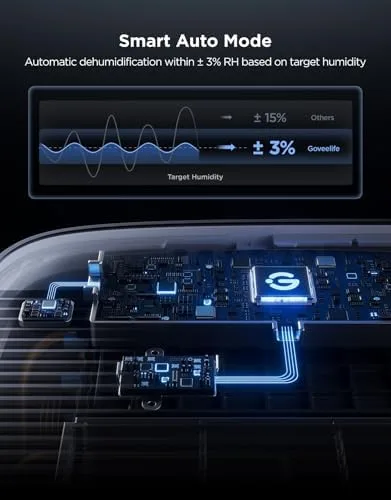
In Auto Mode, the target can be adjusted in 5% increments from 30% to 80% RH. The unit then responds to the measured room humidity rather than running continuously.
It also provides a Laundry Drying Mode, which runs more aggressively for drying clothes in an appropriate indoor space.
Ivation IVADUWIFI50WP
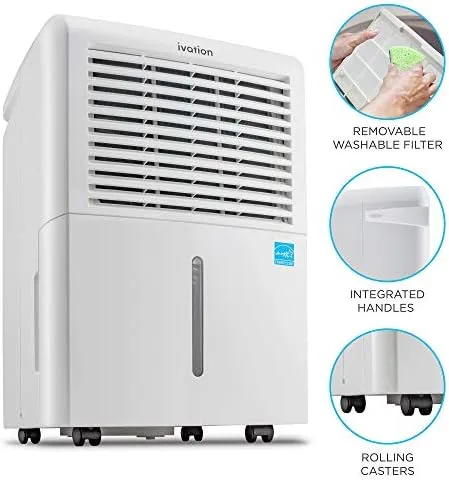
Ivation likewise provides a complete physical control panel rather than forcing routine interaction through a phone.
Its manual specifies a humidity setting range of 30% to 90% RH, adjusted in 5% increments. The display can show current humidity and temperature along with timer, reservoir, defrost, and Wi-Fi status.
The wider upper humidity limit is technically a difference, but it is not a compelling practical advantage by itself. Both models cover the humidity settings normally relevant to household dehumidification.
Practical result: Either model can function normally without day-to-day app interaction. GoveeLife's additional appeal is voice integration; Ivation's physical interface and app still provide the controls that matter for ordinary dehumidification.
Maintenance and Reliability
There is not enough credible long-term failure data here to declare either machine inherently more reliable.
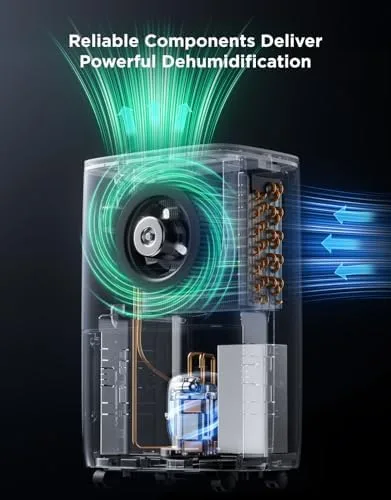
Both are compressor dehumidifiers with the familiar maintenance requirements: keep the air path clear, clean the filter, keep the reservoir clean if it is used, and make sure drainage hoses remain correctly positioned.
GoveeLife instructs users to clean the bucket every few weeks to limit mold, mildew, and bacterial growth, and to clean the filter when it becomes dirty. Ivation's manual recommends cleaning its filter about every two weeks for optimal efficiency.
The Ivation pump adds another mechanical component to the water-handling system. That does not prove it is less reliable, but it does make the drainage arrangement more complex than GoveeLife's gravity-only hose system. Conversely, the pump may eliminate repeated handling of a full reservoir in installations where gravity drainage is impossible.
Both manufacturers specify approximately one year of limited warranty coverage for these models.
The sensible distinction is therefore about complexity and installation requirements, not an unsupported prediction about lifespan.
Size and Placement
The original comparison incorrectly treated Ivation as slightly smaller in every direction. The two machines actually have different proportions.
GoveeLife H7151 is approximately:
- 15.3 in wide
- 11.6 in deep
- 24.4 in high
Ivation IVADUWIFI50WP is approximately:
- 11.1 in wide
- 15.28 in deep
- 23.5 in high
Ivation is therefore narrower and slightly shorter, but also deeper. GoveeLife is wider but shallower.
Their overall floor footprints are close enough that neither has a decisive space advantage. What may matter is the shape of the available location: Ivation can fit a narrower gap, while GoveeLife protrudes less from the wall before allowing for the clearance required for airflow and hoses.
The Bottom Line
There is no useful universal winner here because the two dehumidifiers solve the same basic moisture problem but differ in two very specific ways.
The Ivation IVADUWIFI50WP is the more capable water-management design when the drain point sits above the appliance. Its built-in pump can route condensate where a gravity-only hose cannot, and that can determine whether continuous drainage is practical at all.
The GoveeLife H7151 has the clearer advantage in a home where Alexa or Google Assistant integration matters. It also has a slightly broader specified operating-temperature range, extending to 95°F instead of 89.6°F.
If a floor drain already sits below the intended location, both models can use gravity drainage and the Ivation pump becomes less consequential. At that point, the comparison is largely between GoveeLife's voice integration and the different control interfaces and physical proportions.
On core dehumidification performance, there is little to separate them: both sit at roughly 50 pints/day under the standardized test condition, both are Energy Star certified, and both bottom out at 41°F.
The decision therefore comes down to the installation:
- Drainage must travel upward: Ivation has the relevant hardware.
- Gravity drain is available and voice control matters: GoveeLife has the clearer connected-home advantage.
- No continuous drain is available: Ivation's 2.25-gallon bucket is slightly larger, but both still require manual emptying.
- The room routinely falls below 41°F: neither model is designed for that environment.
FAQ
Which dehumidifier works with Alexa?
Can I use a continuous drain with both models?
How often should I clean the filter?
Which dehumidifier is better for a basement?
What happens if the drain outlet cover is missing on the GoveeLife H7151?
How do I maintain the drain hose on the Ivation dehumidifier?
What is the operating temperature range for these dehumidifiers?
Does the GoveeLife H7151 come with a warranty?
📄 Used Manuals & Documentation
Ivation 4,500 Sq Ft Smart Wi-Fi Energy Star Dehumidifier
"Images are used for editorial and informational purposes only. All trademarks and images belong to their respective owners."