
Shinco 7,000 Sq.Ft with Pump & WiFi vs Waykar Max 80 Pint: Capacity, Drainage, and Everyday Use Compared
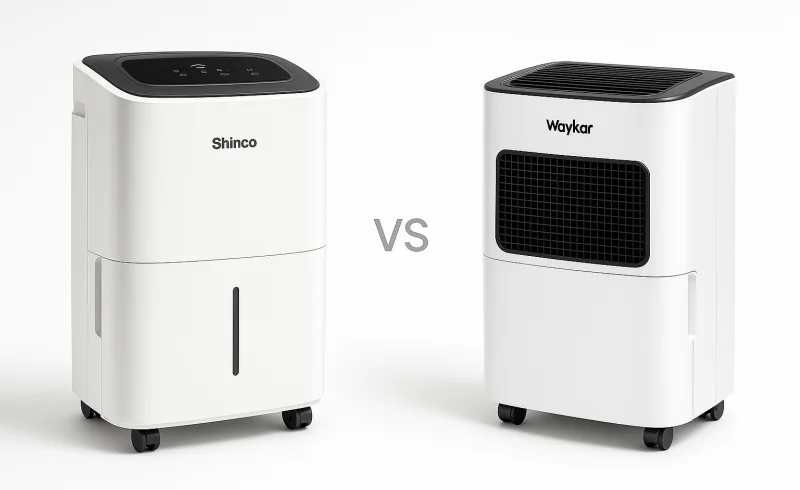
Explore the key differences between Shinco's 7,000 Sq.Ft dehumidifier with pump and WiFi, and Waykar's Max 80 Pint model, focusing on drainage options, smart features, coverage, and usability. Determine which model best meets your needs without the hassle of c...
TL;DR
The most important difference between these two dehumidifiers is not the advertised 7,000 vs. 5,000 sq. ft. coverage. It is moisture-removal capacity under comparable conditions.
- Shinco SDZ1-150P/P-W is the stronger fit for a persistently damp basement or other high-moisture space. Shinco reports 50 pints/day at 65°F and 60% RH, the DOE-style condition used for portable dehumidifier ratings.
- Waykar YDZ-80 is rated at 24 pints/day at the same 65°F and 60% RH conditions. Its headline 80-pint figure is measured under much hotter and more humid conditions, so it should not be compared directly with a DOE rating.
- Shinco also has the more flexible drainage system: bucket, gravity drain, or a built-in pump that can move condensate to a drain above the unit.
- Waykar uses a bucket or gravity drainage only. That is perfectly workable when a floor drain or another lower drain point is available.
- Shinco adds Wi-Fi and app control. Waykar is a locally controlled appliance without Wi-Fi.
- Waykar lists one year of warranty coverage plus a second-year extension subject to its stated activation terms. Shinco lists a 12-month warranty.
For a basement with substantial moisture, an inconvenient drain location, or a need for remote monitoring, Shinco has meaningful functional advantages. Waykar makes more sense when the moisture load is moderate, gravity drainage is easy to arrange, and connected controls are unnecessary.
| Feature | Waykar Max 80 Pint Energy Star Dehumidifier | Shinco 7,000 Sq.Ft Energy Star Dehumidifier with Pump and WiFi |
|---|---|---|
| Power | ||
| Refrigerant | R32 | R32 |
| Power Source | 115V, 60Hz | 115V, 60Hz |
| Energy Star Certification | Certified | Certified |
| Minimum Operating Temperature | 41°F | 41°F (5°C) |
| Capacity | ||
| Coverage Area | 5,000 Sq. Ft. | 7,000 Sq.Ft. |
| Water Tank Capacity | 1.06 Gal | 1.85 Gallons |
| Features | ||
| Auto Defrost | Supported | Supported |
| 24-Hour Timer | Supported | Supported |
| Continuous Drainage | Supported | Supported |
| Washable Air Filter | Supported | Supported |
| Adjustable Humidity Control | Supported | Supported |
| Warranty | ||
| Manufacturer Warranty | 1-year warranty + 2nd-year warranty extension | 12 months |
| Connectivity | ||
| Wi-Fi | Not supported | Supported |
📑 Table of Contents
- First, Make Sure These Are the Same Models
- Moisture Removal: The Most Important Difference
- Drainage: Pump vs. Gravity Is a Real Installation Difference
- Wi-Fi and Controls
- What Daily Operation Is Actually Like
- Energy Efficiency: Capacity Matters More Than the Badge Alone
- Warranty and Long-Term Ownership
- Which One Fits Different Basement Scenarios?
- The Bottom Line
- FAQ
First, Make Sure These Are the Same Models
The Shinco unit discussed here is the SDZ1-150P/P-W, the 7,000-sq.-ft.-class model with a built-in pump and Wi-Fi. Shinco also sells models with similar-looking names and cabinets, including the SDX1-86P, but that is a different dehumidifier with different capacity and drainage features.
The Waykar in this comparison is the YDZ-80, commonly listed as the Max 80 Pint model.
That distinction matters because dehumidifier listings often combine a model name, a maximum moisture-removal number, and a square-foot figure that were measured or assigned in different ways. Comparing the headline numbers alone can produce a misleading result.
Moisture Removal: The Most Important Difference
Ignore the 7,000 vs. 5,000 sq. ft. numbers at first
Shinco advertises coverage up to 7,000 sq. ft., while Waykar advertises up to 5,000 sq. ft. Those figures describe how the manufacturers position the products, but they are not the DOE capacity metric used to compare portable dehumidifiers.
Actual moisture load depends on much more than floor area: starting relative humidity, temperature, air leakage, water intrusion, ceiling height, whether the basement is open or divided into rooms, and how much moisture continuously enters the space.
A pints-per-day rating measured under the same temperature and humidity is therefore much more useful.
At comparable conditions, Shinco is substantially more powerful
Shinco's current specifications report:
- 50 pints/day at 65°F and 60% RH
- 70 pints/day at 80°F and 60% RH
Waykar's YDZ-80 manual reports:
- 24 pints/day at 65°F and 60% RH
- 35 pints/day at 80°F and 60% RH
- 62 pints/day at 86°F and 80% RH
- 80 pints/day maximum
The 65°F/60% RH figure is particularly useful because DOE uses those conditions for portable-dehumidifier capacity testing. On that basis, Shinco's stated capacity is a little more than twice Waykar's.
That is a much more meaningful difference than the product names suggest. A basement that continuously receives moisture from foundation walls, outside air, laundry, or minor seepage gives the Shinco substantially more capacity headroom.
Waykar's 80-pint name is not inaccurate when read with its stated test conditions, but it should not be interpreted as an 80-pint DOE capacity rating. Similarly, Shinco's much larger headline pint figure should not replace its 50-pint rating at 65°F/60% RH when comparing normal basement performance.
Capacity advantage: Shinco.
Drainage: Pump vs. Gravity Is a Real Installation Difference
Shinco offers three drainage methods
The Shinco supports:
- Manual bucket collection
- Continuous gravity drainage
- Built-in pump drainage
The pump is the important part. Gravity drainage requires the destination to remain below the drain outlet. A pump can move condensate upward, which opens up installations where the practical destination is a utility sink, standpipe, window-level outlet, or another drain point higher than the dehumidifier.
The pump does not eliminate installation requirements. Its hose still needs to be connected and routed correctly, and the installation must remain within the manufacturer's limits. But it solves a problem that gravity drainage cannot solve by itself.
Waykar depends on gravity for continuous drainage
Waykar's YDZ-80 supports its removable bucket and a continuous drain connection, but it does not have a condensate pump.
Its manual specifically calls for a smooth downhill hose path. That is straightforward when the dehumidifier sits near a floor drain or another lower drainage point. If the only practical drain is above the unit, an external solution would be required.
This is not evidence that the Shinco pump is inherently more reliable or that the Waykar will last longer. It is simply a difference in plumbing complexity: Shinco includes another drainage subsystem, while Waykar has fewer drainage components to configure.
Bucket capacity matters mainly when there is no drain
Shinco lists a 7-liter / 1.85-gallon bucket.
Waykar's own current product page is inconsistent on this specification: its feature copy states 3.5 liters / 0.92 gallon, while its specification table lists 1.06 gallons for the YDZ-80. Either figure leaves the Waykar with a considerably smaller reservoir than the Shinco.
For occasional bucket use, that difference is noticeable. In a continuously damp basement, however, both units are much easier to manage with a permanent drain arrangement than with repeated manual emptying.
Drainage flexibility advantage: Shinco.
Wi-Fi and Controls
Shinco's Wi-Fi connection allows compatible app-based monitoring and control in addition to the controls on the appliance. That can be useful when the unit operates somewhere that is not checked frequently, such as a basement, storage area, workshop, or secondary residence.
Remote access is most useful for confirming operating status, viewing humidity information, and changing settings without being physically next to the dehumidifier. Those functions naturally depend on a working home network and the manufacturer's app infrastructure.
Waykar's YDZ-80 is not a connected dehumidifier. Its ENERGY STAR listing identifies it as not connected-capable, and its humidity target, modes, fan controls, and timer are managed from the unit itself.
That is not automatically a disadvantage. If the dehumidifier will sit beside a floor drain and run from a fixed humidity setting, remote access may add little to the job it needs to do.
If remote visibility matters, however, only Shinco provides it in this comparison.
Connectivity advantage: Shinco.
What Daily Operation Is Actually Like
Both can regulate humidity automatically
Both models include a humidistat and can cycle operation around a selected relative-humidity target rather than running continuously regardless of conditions.
For a typical basement, maintaining relative humidity around 30% to 50% is consistent with EPA guidance. Extremely low settings are generally unnecessary, increase runtime, and do not address the underlying source of water if the basement has leaks or seepage.
Both are designed for cooler spaces, but temperature still matters
Both manufacturers specify operation down to approximately 41°F / 5°C, and both include automatic defrost.
Auto-defrost is useful because frost can form on a refrigerant dehumidifier's cold coil as room temperature falls. It does not mean that moisture-removal performance stays constant in cold air. The sharp difference between ratings measured under hot, humid conditions and those measured at 65°F illustrates why basement temperature matters so much.
Filters and internal drying are similar
Both units use washable filters and require periodic cleaning to maintain airflow.
Waykar advertises a self-drying function, and current Shinco documentation for the pump/Wi-Fi model also describes an inside-drying/self-drying function. That makes this much less of a differentiator than it first appears.
Both also include common convenience functions such as automatic restart, automatic shutoff, adjustable humidity control, and a 24-hour timer.
Energy Efficiency: Capacity Matters More Than the Badge Alone
Both products are presented as ENERGY STAR models in their current product materials, and the Waykar YDZ-80 appears in the ENERGY STAR Product Finder with a certified capacity of 24 pints/day.
ENERGY STAR status is useful, but it does not mean two dehumidifiers will consume the same amount of electricity in the same basement. Runtime depends on moisture load, target humidity, temperature, airflow, and how much capacity the unit has relative to the space.
That is especially important here because the two models do not have similar standard-condition capacity. A lower-capacity appliance may need to run for longer in a wet basement, while a higher-capacity appliance may reach the humidity target sooner and cycle off. Without controlled side-by-side measurements in the same environment, an annual operating-cost winner cannot be established from the available specifications alone.
The refrigerant type is also not a useful deciding factor here: current documentation lists R32 for both models.
Warranty and Long-Term Ownership
Shinco lists a 12-month warranty for the SDZ1-150P/P-W.
Waykar lists one year of standard coverage plus a second-year warranty extension, with the additional year tied to the conditions described by Waykar, including its registration or activation instructions.
That gives Waykar the longer stated coverage period when the extension requirements are completed.
The original temptation is to turn Waykar's lack of a pump and Wi-Fi into a reliability claim, but the specifications do not support that conclusion. Fewer subsystems mean fewer setup dependencies; they do not prove a lower failure rate. There is no sufficiently controlled reliability evidence here to declare either model more durable.
Warranty advantage: Waykar, subject to its extension terms.
Which One Fits Different Basement Scenarios?
Persistently wet or high-load basement
Shinco is the stronger fit. Its stated 50-pint/day capacity at 65°F/60% RH gives it substantially more moisture-removal headroom than the Waykar YDZ-80's 24 pints/day under the same conditions.
That difference matters more than either manufacturer's square-foot claim.
Basement with a floor drain beside the dehumidifier
Either drainage design can work. Waykar can continuously discharge through a properly sloped gravity hose, so the absence of a pump may be irrelevant in this layout.
Capacity then becomes the more important question. A modest moisture load may not require Shinco's additional output; a wet basement may.
Drain or sink located above the unit
Shinco has the functional advantage. Its built-in pump is designed specifically for situations where condensate cannot simply flow downhill.
Basement or secondary property checked infrequently
Shinco offers more remote visibility because of its Wi-Fi and app controls. Waykar requires local interaction.
Remote controls should not be confused with protection against plumbing problems, leaks, or power failures, however. A connected dehumidifier is still only one part of moisture management.
Straightforward installation with no need for connected controls
Waykar is the simpler configuration. With a suitable gravity drain, the YDZ-80 can operate without a pump subsystem or network setup, while still providing automatic humidity control, defrost, a timer, self-drying, and continuous drainage.
The Bottom Line
The specification that changes this comparison is standard-condition moisture removal.
The Shinco SDZ1-150P/P-W is not merely a similar dehumidifier with a pump and Wi-Fi added. According to the manufacturers' published figures, it is also a substantially higher-capacity machine under basement-relevant conditions: 50 pints/day at 65°F and 60% RH versus 24 pints/day for the Waykar YDZ-80.
That makes
the more suitable of these two for demanding moisture loads, difficult drainage layouts, or situations where remote controls are useful.The Waykar Max 80 Pint YDZ-80 remains a reasonable match for spaces with a more moderate moisture load and an easy gravity-drain path. Its main practical advantages are a less complicated drainage arrangement and a longer stated warranty period when the second-year extension requirements are met.
Neither model should be sized from the 7,000 sq. ft. or 5,000 sq. ft. headline alone. Basement temperature, starting humidity, ongoing water entry, room layout, and the measured pints-per-day capacity matter far more.
If humidity must be controlled throughout several closed rooms or an entire house rather than one relatively open area, a ducted whole-home dehumidifier is a different class of equipment and may be the more appropriate solution.
FAQ
Does the Shinco dehumidifier require the pump to drain?
Can I use a drain hose with the Waykar?
Which dehumidifier is better for a large basement?
Is the Shinco's app reliable?
What is the water tank capacity of the Shinco dehumidifier?
How many pints per day can the Waykar remove?
Does the Waykar dehumidifier have a built-in pump?
📄 Used Manuals & Documentation
Shinco 7,000 Sq.Ft Energy Star Dehumidifier with Pump and WiFi
Waykar Max 80 Pint Energy Star Dehumidifier
"Images are used for editorial and informational purposes only. All trademarks and images belong to their respective owners."