
Ninja Foodi DZ201 DualZone Air Fryer vs Midea Dual Basket Air Fryer Oven 11-Quart with Wi-Fi: Simplicity vs. Smart Versatility
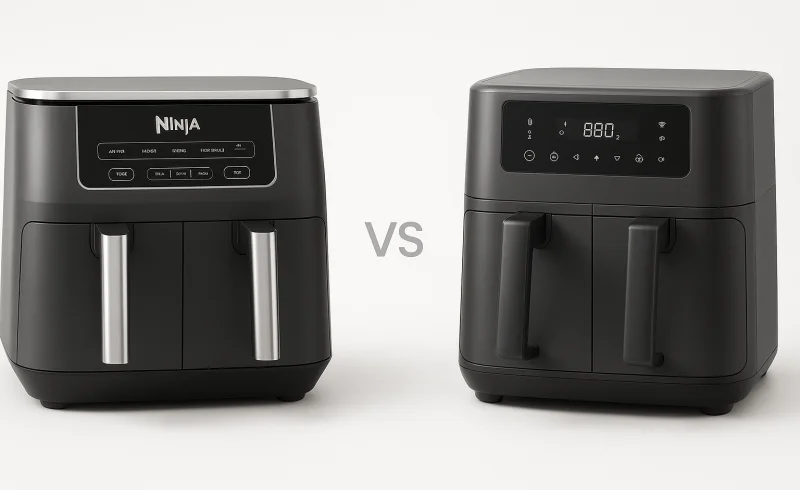
Explore the differences between the Ninja Foodi DZ201 DualZone Air Fryer and the Midea Dual Basket Air Fryer Oven. Learn about simplicity versus smart versatility and decide which air fryer best suits your cooking needs with their distinct designs and features...
TL;DR
Quick Decision
- If you want a predictable, no-fuss air fryer that works the same way every time with zero app setup → choose Ninja Foodi DZ201 DualZone Air Fryer.
- If you want oven-like flexibility for awkward shapes, extra capacity, and the convenience of Wi‑Fi monitoring → choose Midea Dual Basket Air Fryer Oven 11-Quart with Wi‑Fi.
- If you just need two independent zones and can handle a little active involvement, either can get dinner on the table—but the day-to-day cooking feel is worlds apart.
Key Differentiators
The Ninja’s identical 4‑qt baskets encourage muscle-memory air frying and bypass software risk entirely; the trade-off is real: you’ll be shaking baskets and managing hot surfaces more often. Midea trades one basket for an oven-style cavity, which handles bulky items and toast-style tasks more naturally, but demands more placement awareness and adds long-term reliance on an app that may not stay seamless over time.
Who Should Skip Both
If you want a truly hands-off, large single-cavity air fryer that handles whole meals without splitting food across zones or needing mid-cook turning, look at a large one-basket air fryer or a spacious air fryer toaster oven instead.
| Feature | Ninja Foodi DZ201 DualZone Air Fryer | Midea Dual Basket Air Fryer Oven 11-Quart with Wi-Fi |
|---|---|---|
| Power | ||
| Voltage | 120 V | 120 V |
| Rated Power | 1690 W | 1700 W |
| General | ||
| Warranty | 1 year limited warranty | 1 year limited warranty |
| Product Type | Dual-basket air fryer | Dual-zone air fryer oven |
| Capacity | ||
| Total Capacity | 8 qt | 11 qt |
| Independent Cooking Zones | 2 independent zones | 2 independent zones |
| Cooking Zone Configuration | 2 independent 4-qt baskets | 6-qt upper basket + 5-qt lower oven cavity |
| Dimensions | ||
| Product Weight | 17.86 lbs | 20.17 lbs |
| Product Dimensions (L x W x H) | 15.63 x 13.86 x 12.4 in | 16.73 x 12.79 x 15.94 in |
| Temperature | ||
| Maximum Temperature | 450°F | 450°F |
| Connectivity | ||
| Wi-Fi | Not supported | Supported |
| App Control | Not supported | MSmartHome app |
| Voice Assistant Support | Not supported | Alexa compatible |
| Cooking Programs | ||
| Cooking Functions | Air Fry, Air Broil, Roast, Bake, Reheat, Dehydrate | Air Fry, Grill, Dehydrate, Bake, Roast, Broil, Reheat, Toast |
| Synchronized Finish | Smart Finish | Sync Finish Technology |
| Number of Cooking Functions | 6 | 8 |
📑 Table of Contents
Design & Zone Configuration
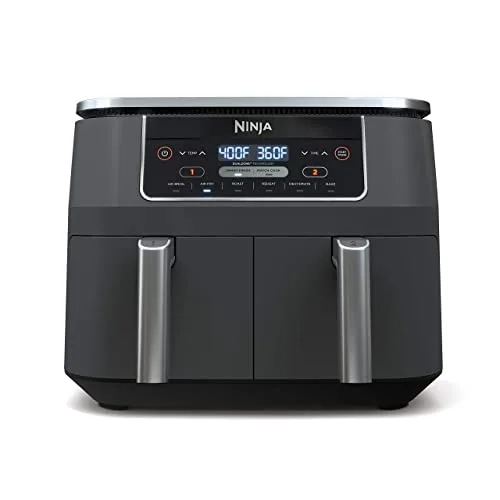
Ninja Foodi DZ201 DualZone Air Fryer uses two identical 4‑qt baskets (8 qt total), each with its own basket-based airflow path designed for repeatable air-fry results. The symmetry means you can cook two foods with similar «basket rules» (spacing, shaking) without rethinking technique between zones. In practice, that layout favors consistent browning habits across both compartments.
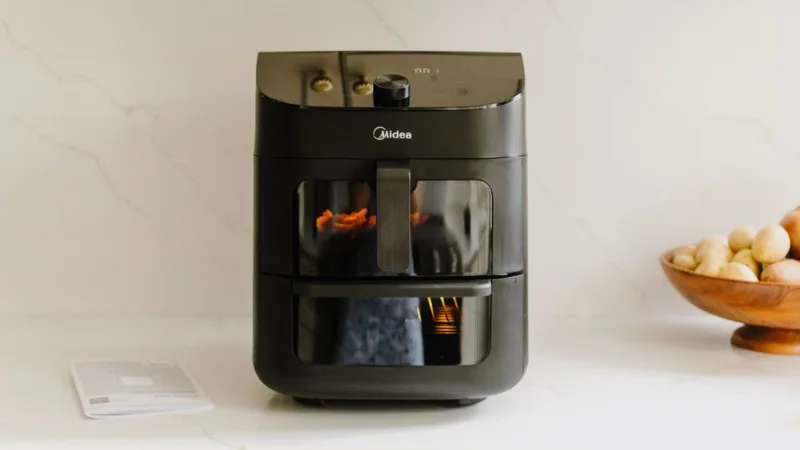
Midea Dual Basket Air Fryer Oven 11‑Quart with Wi‑Fi uses a mixed layout: a 6‑qt upper basket + 5‑qt lower oven cavity (11 qt total). That adds flexibility for odd-shaped or «small-oven» items in the cavity, but it also shifts cooking from basket-style predictability to more oven-like variables (rack placement, spacing, and potential hot spots). Editor guidance notes this can mean more checking and learning compared with two matching baskets.
Conclusion: For consistent, low-variance basket air frying in both zones, Ninja’s two-identical-basket design is the clearer fit; Midea counters with more shape flexibility thanks to the oven-style lower zone.
Ninja Foodi DZ201 is also more compact overall at 15.63 × 13.86 × 12.4 in and lighter at 17.86 lb, which tends to be friendlier for tighter counters and easier to move for cleaning or storage. The lower height can matter under cabinets where vertical clearance is limited.
Midea is larger and especially taller at 16.73 × 12.79 × 15.94 in and 20.17 lb, demanding more height clearance and feeling more «appliance-like» on the counter. That extra height aligns with the oven-cavity concept, but it’s a real constraint in kitchens with low upper cabinets.
Conclusion: On footprint practicality—especially height (12.4 in vs 15.94 in) and weight (17.86 lb vs 20.17 lb)—Ninja has the edge.
Winner: Ninja Foodi DZ201 DualZone Air Fryer
Capacity & Cooking Flexibility
The Ninja Foodi DZ201 DualZone Air Fryer provides 8 qt total split into two 4-qt baskets, giving you two identical, independent zones for running different foods at once. That symmetry is useful when you’re cooking a «protein + side» routine because both zones behave the same, so you can rely on repeatable times and airflow. The practical limit is basket geometry—despite decent total capacity, oversized single items can be awkward to fit without crowding.
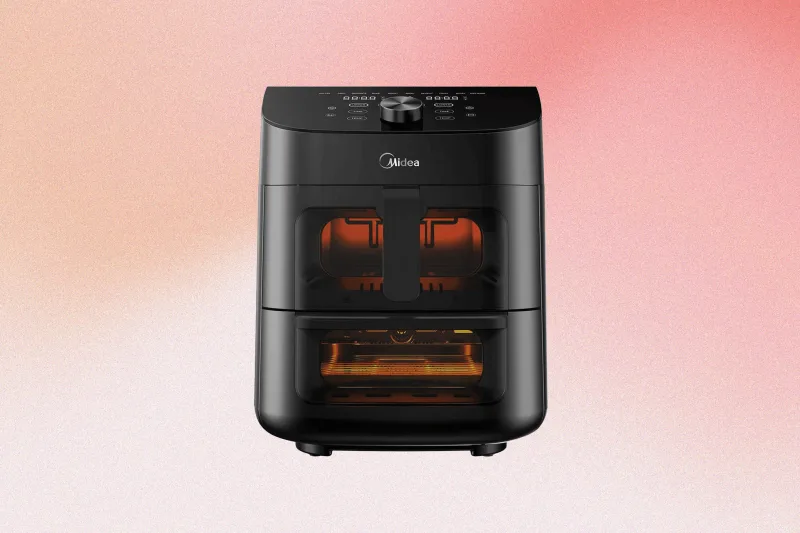
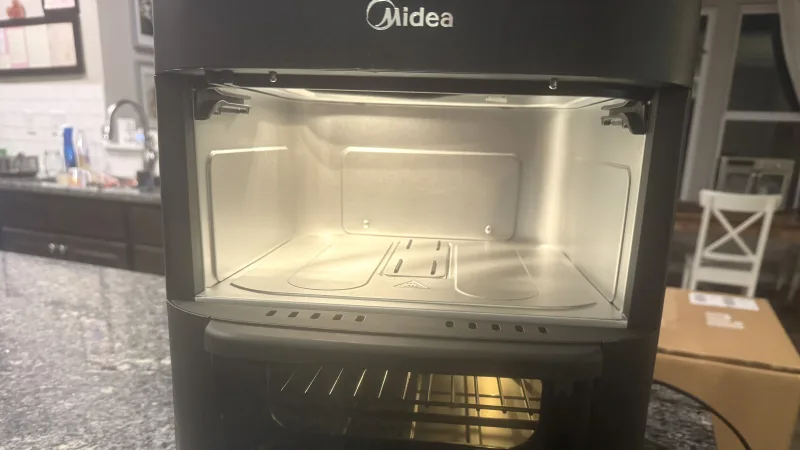
The Midea Dual Basket Air Fryer Oven 11-Quart with Wi‑Fi steps up to 11 qt total with a 6-qt upper basket + 5-qt lower oven cavity, which changes what «fits» more than the raw number suggests. The larger individual zones can reduce crowding for multi-portion batches, and the lower cavity’s oven-style space (with a rack) is better suited to taller/wider items that don’t sit well in a basket. In real use, that’s the difference between «two baskets» and «basket + mini oven,» especially for bulky mains.
Conclusion: On capacity and fit, Midea has the edge—11 qt vs 8 qt, plus a more flexible oven-style lower zone that handles bulky or bake/toast-style items more naturally than two 4-qt baskets.
Winner: Midea Dual Basket Air Fryer Oven 11-Quart with Wi‑Fi
Cooking Functions
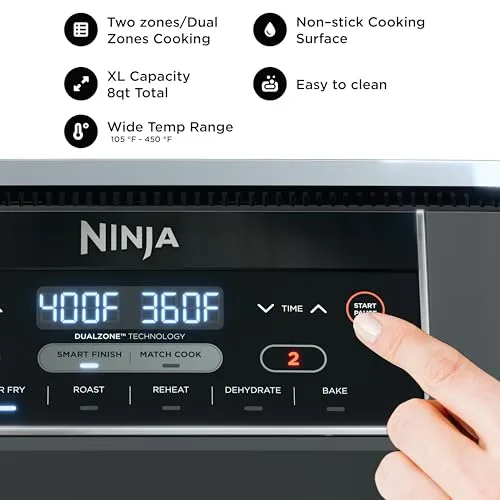
Ninja Foodi DZ201 DualZone Air Fryer keeps its menu tight with 6 functions: Air Fry, Air Broil, Roast, Bake, Reheat, Dehydrate. That focus pairs naturally with its two identical 4-qt baskets, so you’re typically running the same style of airflow-driven cooking on both sides with predictable results. It also supports Smart Finish to align cook times across the two zones.
Midea Dual Basket Air Fryer Oven 11-Quart with Wi‑Fi expands the playbook to 8 functions: Air Fry, Grill, Dehydrate, Bake, Roast, Broil, Reheat, Toast. The extra Grill and Toast modes align with its mixed hardware layout (6-qt upper basket + 5-qt lower oven cavity), which supports more «small-oven» style tasks alongside classic basket air frying. It includes Sync Finish Technology for same-time serving across zones.
Conclusion: On pure cooking-mode breadth, Midea wins with 8 functions vs 6, and its Toast/Grill options (plus oven-style zone) make it meaningfully more versatile than Ninja’s more standardized dual-basket approach.
Ninja Foodi DZ201 DualZone Air Fryer targets high-heat air-fry performance with a 450°F max temperature and 1690 W rated power. In practice, that’s plenty for browning and finishing, but Ninja’s strengths stay centered on basket-style cooking rather than toast-oven behavior.
Midea Dual Basket Air Fryer Oven 11-Quart with Wi‑Fi matches the same 450°F max temperature and comes in at 1700 W, so there’s no spec-based advantage for searing or crisping potential. Where it differs is workflow: the oven cavity can better accommodate toast-style layouts and broader baking tasks, but SoT notes that oven-style results can be more variable based on rack position and spacing.
Conclusion: For heat output, it’s effectively a tie (450°F and ~1700 W on both)—the real functional difference is that Midea’s oven-style zone enables more types of cooks, while Ninja’s two-basket design favors repeatable, basket-optimized routines.
Winner: Midea Dual Basket Air Fryer Oven 11-Quart with Wi‑Fi
Ease of Use

Setup & onboarding
The Ninja Foodi DZ201 DualZone Air Fryer is inherently low-friction because it has no Wi‑Fi or app control to configure. In practice, the «wash, place, run» workflow aligns with its straightforward dual-basket design: two independent 4‑qt baskets with Smart Finish to sync timing across zones. That simplicity is especially helpful when multiple people in a household use the air fryer and you want identical results without account or network variables.
The Midea Dual Basket Air Fryer Oven 11‑Quart with Wi‑Fi adds smart setup steps because Wi‑Fi is supported, it uses the MSmartHome app, and it’s Alexa compatible. While that can unlock remote monitoring/control, it also introduces onboarding dependencies (router settings, app permissions, logins) that can slow down first-time use compared to a fully local appliance.
Conclusion: Ninja is easier to start using immediately, while Midea trades simplicity for smart convenience—useful when it works, extra friction when it doesn’t.
Day-to-day cooking workflow (repeatability vs flexibility)
The Ninja DZ201 is built around symmetry: two identical basket zones encourage repeatable routines once you learn your usual times and temps (up to 450°F). The trade-off is that basket cooking often benefits from mid-cook interaction—shaking/flipping and avoiding crowding—to keep browning even.
The Midea splits its capacity into a 6‑qt upper basket + 5‑qt lower oven cavity, which can reduce «basket Tetris» for odd-shaped or tray-like foods. But the oven-style zone typically requires more active judgment (rack position, spacing, checking doneness), so results can be more variable than a simple basket workflow.
Conclusion: Ninja is the more repeatable, muscle-memory option, while Midea can feel easier for awkward foods but demands more monitoring and placement discipline.
Physical handling & kitchen clearance
The Ninja involves frequent handling of two removable hot baskets, which can add counter workflow (where to set baskets, serving directly from them, etc.). Its footprint is shorter at 12.4 in tall (15.63 x 13.86 x 12.4 in), which can make it easier to tuck under cabinets, but you still manage two separate inserts.
The Midea is larger and taller at 15.94 in (16.73 x 12.79 x 15.94 in) and heavier (20.17 lb vs 17.86 lb), so it’s less convenient to move and more likely to need a dedicated spot. Its oven-style door/rack approach can reduce basket-lifting, but it typically needs more front clearance to open and access the cavity comfortably.
Conclusion: Ninja tends to fit more kitchens and is easier to reposition, while Midea may be more comfortable if you prefer door-and-rack access and have the counter depth to accommodate it.
Winner: Ninja Foodi DZ201 DualZone Air Fryer
Smart Features & Long-Term Use
Connectivity, app control, and voice assistants
Ninja Foodi DZ201 DualZone Air Fryer is deliberately offline: no Wi‑Fi, no app control, and no voice assistant support. Practically, that means there’s no pairing step and no dependency on phone OS changes, account logins, or cloud services for day-to-day cooking—usage stays the same as long as the appliance heats and the buttons work.
Midea Dual Basket Air Fryer Oven 11-Quart with Wi‑Fi adds Wi‑Fi, MSmartHome app control, and Alexa compatibility, plus 50+ in-app recipes (manufacturer). The upside is remote monitoring and notifications that can reduce kitchen hovering, but it also introduces onboarding friction (router compatibility, permissions, account setup) that simply doesn’t exist on the Ninja.
Conclusion: Midea wins for smart features and remote convenience, while Ninja wins for zero-friction setup and a fully local workflow.
Long-term reliability risk (software vs. simplicity)
Ninja Foodi DZ201 DualZone Air Fryer has fewer subsystems that can fail in ways that change the user experience—because there’s no smart module to maintain. With both brands offering the same 1-year limited warranty, Ninja’s long-term bet is that maintenance is mostly physical (keeping baskets and inserts clean) rather than digital.
Midea Dual Basket Air Fryer Oven 11-Quart with Wi‑Fi matches the 1-year limited warranty but carries extra long-term variables: app updates, phone OS support, and network stability. Even if the heating hardware continues to perform, a degraded app experience can reduce the value of paying for Wi‑Fi features—especially if you come to rely on alerts or remote status checks.
Conclusion: Ninja has the more defensible long-term reliability profile because it avoids software lifecycle risks that can erode the experience over time.
Value of «smart» depends on whether you’ll actually use it
Ninja Foodi DZ201 DualZone Air Fryer focuses on repeatable, muscle-memory operation across 2 independent 4‑qt baskets (8 qt total), and its feature set stays consistent because there’s nothing to update. You give up remote start/notifications entirely, but you also don’t pay (in time or troubleshooting) for features you may not use.
Midea Dual Basket Air Fryer Oven 11-Quart with Wi‑Fi is positioned for people who will actively use app features: Wi‑Fi + app + Alexa and a larger 11 qt dual-zone layout (6‑qt upper basket + 5‑qt lower oven cavity). If you don’t plan to use the app, that added complexity becomes overhead with no cooking benefit; if you do use it, any future app regressions are more disruptive than they would be on a purely local appliance.
Conclusion: This point is priority-driven—Midea is the better fit if you’ll consistently use smart control, but Ninja is the safer choice if you want the same experience every time without digital dependencies.
Winner: Ninja Foodi DZ201 DualZone Air Fryer
Cleaning & Maintenance
Ninja Foodi DZ201 DualZone Air Fryer uses two removable 4‑qt baskets (8 qt total), so grease and crumbs largely stay confined to parts you can pull out and scrub. In practice, that basket-only layout makes mess and wear-and-tear easy to spot early—if a nonstick coating starts to degrade, you’ll notice it on the baskets/crisper plates you handle every cook. The trade-off is volume of parts: two zones means doubling up on removable pieces that need washing.
Midea Dual Basket Air Fryer Oven 11-Quart with Wi‑Fi pairs a 6‑qt upper basket with a 5‑qt lower oven cavity (11 qt total), which changes cleanup from «wash the basket» to «wipe an oven.» That lower cavity can collect splatter in less obvious areas (corners, beneath racks), and cleaning tends to be more tedious because you’re dealing with a larger interior surface area rather than just basket components. If you let it go, buildup is more likely to turn into lingering odor or smoke over time because residue can bake onto interior surfaces.
Conclusion: On maintenance workload and how easily you can keep the cooking area consistently clean, Ninja’s all-basket design is the more straightforward system, while Midea’s oven-style lower zone is more flexible but demands more diligent wipe-downs to prevent hidden buildup.
Winner: Ninja Foodi DZ201 DualZone Air Fryer
The Bottom Line
After breaking down design, capacity, features, and daily workflow, the decision comes down to whether you value repeatable basket cooking or a more versatile basket-plus-oven layout.
For no-fuss, reliable air frying: The Ninja Foodi DZ201 DualZone Air Fryer is the better pick thanks to its two identical baskets, simpler controls, and consistent, low-variance results without app or network friction.
For smart-home enthusiasts: The Midea Dual Basket Air Fryer Oven 11-Quart with Wi-Fi is the clear choice if you’ll actually use Wi‑Fi features, with app monitoring/notifications and Alexa compatibility baked into the experience.
For large families or entertaining: The Midea Dual Basket Air Fryer Oven 11-Quart with Wi-Fi wins on sheer cooking flexibility, pairing a larger 11‑quart total capacity with an oven-style lower zone that fits bulkier dishes more naturally.
For budget-conscious buyers: The Ninja Foodi DZ201 DualZone Air Fryer is the stronger value play, especially if you’re considering the lower-cost 8QT entry model that keeps the core dual-zone performance intact.
Overall, the Ninja Foodi DZ201 DualZone Air Fryer takes the win for most kitchens: it’s more compact, easier to live with day-to-day, and avoids long-term software/app dependencies while delivering consistently repeatable basket results. The trade-off is that Midea is more versatile (and smarter) if you want the oven-cavity format and connected features.
If you want the simplest path to dependable dual-basket air frying, go Ninja; if your priority is maximum capacity and smart control—and you’re comfortable with a larger, more involved appliance—Midea is the better fit.
FAQ
Which air fryer is better for cooking a whole chicken?
Does the Ninja DZ201 have Wi-Fi or app control?
Can you use both zones at once to cook different foods?
Is the Midea app easy to use?
Which dual-basket air fryer is easier to clean?
Is the Ninja DZ201 more compact than the Midea dual basket?
What cooking functions does the Midea offer that the Ninja DZ201 doesn't?
📄 Used Manuals & Documentation
Ninja Foodi DZ201 DualZone Air Fryer
Midea Dual Basket Air Fryer Oven 11-Quart with Wi-Fi
"Images are used for editorial and informational purposes only. All trademarks and images belong to their respective owners."