
Bosch B36CL80ENS vs GE Profile PVD28BYNFS: Counter-Depth Fit or Full-Depth Capacity?
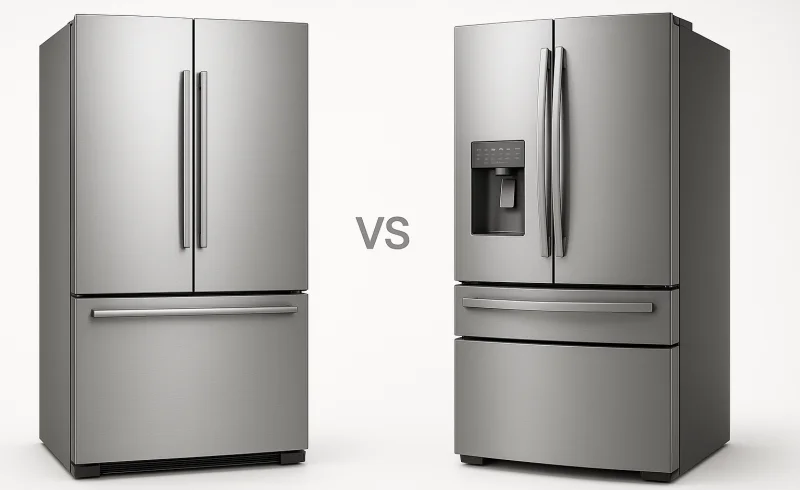
Compare Bosch B36CL80ENS with GE Profile PVD28BYNFS in terms of design integration, storage capacity, and cooling technology. Discover which fridge suits your needs, from seamless cabinetry install to family-ready convenience with external water and ice access...
TL;DR
- Bosch B36CL80ENS fits kitchens where depth matters. It is a 36-inch counter-depth refrigerator with 20.5 cu. ft. of rated capacity, an internal filtered-water dispenser, a freezer ice maker, and separate dual-compressor / dual-evaporator cooling hardware.
- GE Profile PVD28BYNFS is the capacity-first option. Its standard-depth cabinet provides 27.9 cu. ft., plus an external water and cubed/crushed-ice dispenser, Hands-Free AutoFill, Door-in-Door access, and a four-setting temperature-controlled drawer.
- The biggest practical difference is not a minor feature: the GE is about 7.4 cu. ft. larger, while the Bosch is specifically designed around a shallower counter-depth installation.
- Bosch is rated at 568 kWh/year versus 758 kWh/year for the GE. That is a meaningful difference in annual electricity use, but it should be read alongside the GE’s much larger capacity rather than treated as proof that Bosch is categorically more efficient.
- Availability note: GE’s U.S. product page currently identifies the PVD28BYNFS as no longer being manufactured. The comparison still matters for existing units and replacement decisions, but the model’s market availability may vary.
If a panel-ready refrigerator that visually disappears into cabinetry is the requirement, neither model is the right match. And if the requirement is specifically counter-depth plus an external door dispenser, these two models split those priorities rather than combining them.
| Feature | Bosch B36CL80ENS | GE Profile PVD28BYNFS |
|---|---|---|
| General | ||
| Door-in-door storage | Not supported | Supported |
| ENERGY STAR certified | Yes | Yes |
| Product configuration | French door bottom mount refrigerator | 4-door French-door refrigerator with bottom freezer |
| Installation depth class | Counter-depth | Full depth |
| Capacity | ||
| Middle drawer | VitaFreshPro full-width temperature and humidity controlled drawer | Adjustable temperature-controlled center drawer with 4 settings |
| Total capacity | 20.5 cu. ft. | 27.9 cu. ft. |
| Fresh food shelves | 5 | 4 |
| Freezer storage sections | 3 drawers | 3 total (2 baskets + 1 tilt-out bin) |
| Humidity-controlled drawers | 2 | 2 |
| Water & Ice | ||
| Ice maker | Yes | Yes |
| Water filter | UltraClarityPro | XWFE |
| Ice dispenser | Not supported | External cubes and crushed ice dispenser |
| Water dispenser type | Internal | External |
| Connectivity | ||
| Wi-Fi enabled | Yes | Yes |
| Smart platform | Home Connect | SmartHQ |
| Controls & Lighting | ||
| Control type | Touch control panel | External electronic digital temperature display |
| Interior lighting | Recessed LED light bars | LED light wall |
| Dimensions & Weight | ||
| Net weight | 350 lbs | 388 lb |
| Depth without door | 24" | 29" |
| Depth without handle | 28 3/4" | 34 1/4" |
| Overall dimensions (H x W x D) | 72" x 35 5/8" x 28 3/4" | 70" x 35 5/8" x 36 3/4" |
| Height without hinges / to top of case | 71 1/2" | 68 5/8" |
| Cooling & Preservation | ||
| Airflow system | MultiAirFlow | Multiflow Air System |
| Cooling system | Dual compressors / dual evaporators | TwinChill dual evaporators |
| Defrost system | Frost-free refrigerator; automatic freezer | Frost Guard |
| Electrical & Efficiency | ||
| Current | 15 A | 15 A |
| Voltage | 115 V | 120 V |
| Frequency | 60 Hz | 60 Hz |
| Annual energy use | 568 kWh/yr | 758 kWh/yr |
📑 Table of Contents
Design & Installation
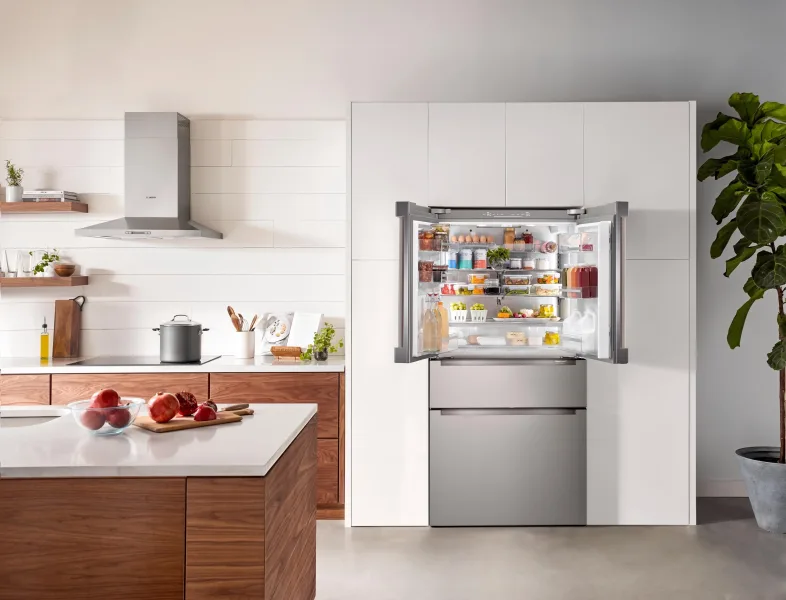
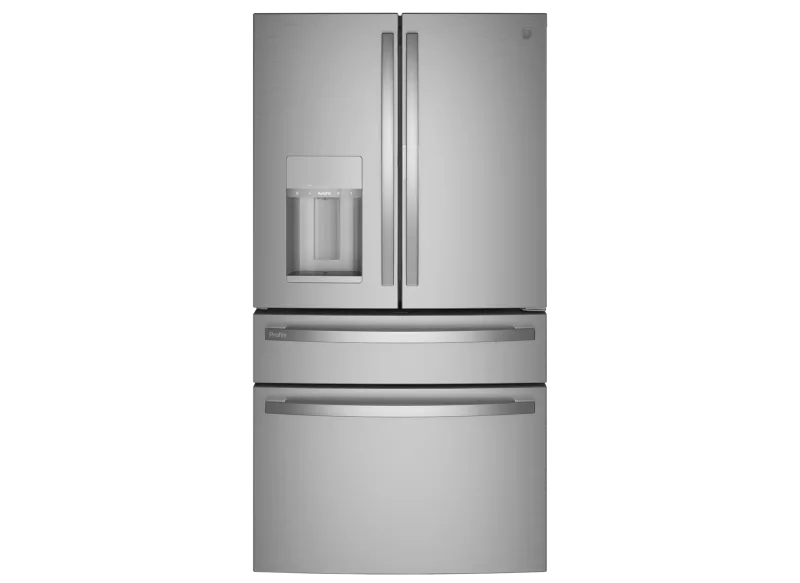
The Bosch and GE may both be 36-inch-class French-door refrigerators, but they are not designed for the same installation.
The Bosch B36CL80ENS is counter-depth. Bosch specifies a 24-inch cabinet depth without the doors and a 25-inch required cutout depth, with the appliance measuring 35 5/8 inches wide and 72 inches high. That lets the refrigerator body sit much closer to standard-depth cabinetry than a conventional full-depth model.
Counter-depth does not mean fully integrated. The Bosch is still a freestanding stainless-steel refrigerator, not a panel-ready built-in, and its doors need to project far enough forward to open properly. The practical benefit is reduced intrusion into the room, especially in kitchens where a refrigerator faces an island or sits near a narrow traffic path.
The GE Profile PVD28BYNFS is explicitly a standard-depth model. GE lists a 29.5-inch case depth without the door, 34.25 inches without the handle, and 36.75 inches overall. It is 35 5/8 inches wide and 69 7/8 inches high. GE also specifies a depth of 48 3/8 inches with a door open 90 degrees, so clearance in front of the refrigerator matters as much as the nominal cabinet opening.
That makes the installation decision unusually straightforward: Bosch trades interior volume for a shallower footprint; GE uses more floor depth to create a larger storage box.
The weight difference—350 lb for Bosch and 388 lb for GE—is real, but it is not a useful reason to favor one model after installation. Door swing, cutout dimensions, ventilation clearances, water-line placement, and the path into the kitchen matter more than a 38-pound difference between two refrigerators of this size.
For a kitchen where projection beyond the cabinetry is a real constraint, Bosch has the meaningful advantage. Where a conventional full-depth refrigerator fits comfortably, GE can use that extra depth for storage instead.
Capacity & Storage
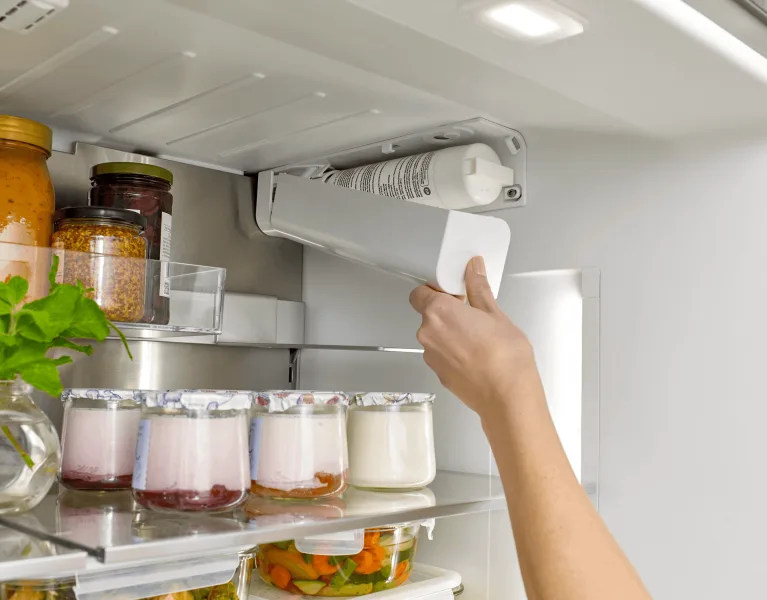
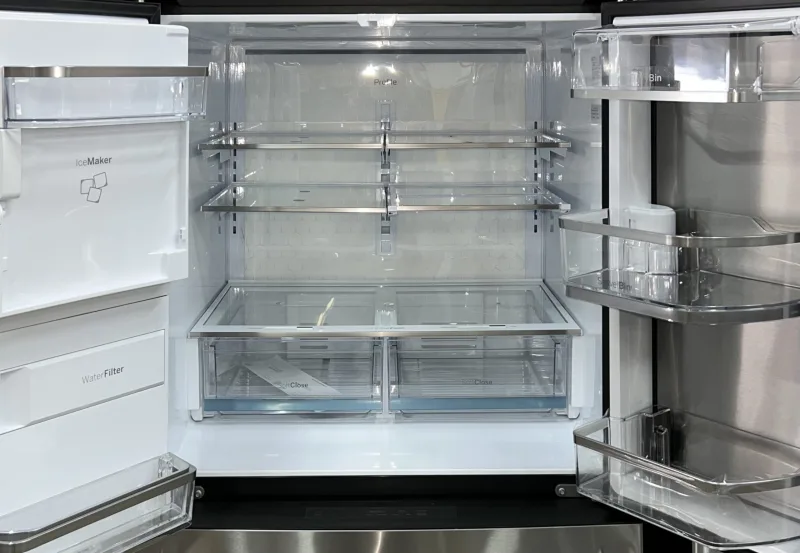
Capacity is where the GE changes the character of this comparison.
The Bosch is rated at 20.5 cu. ft. total: 14.5 cu. ft. for the refrigerator and 6.0 cu. ft. for the freezer. The GE is rated at 27.9 cu. ft. total, a difference of about 7.4 cu. ft., or roughly 36% more rated volume.
That gap is large enough to matter in ordinary use. A counter-depth refrigerator can be easier to see into because food is not stored as far from front to back, but wide platters, beverage stock, bulky containers, and a heavily loaded freezer consume its available volume quickly. The GE gives a household more margin before shelves and drawers become densely packed.
Bosch does not simply leave the smaller interior as an empty compromise. It provides five refrigerator shelves, four of them adjustable half-width shelves, along with a FlexBar storage system, two humidity-control compartments, a full-width VitaFreshPro drawer, and three freezer drawers. The organization is designed around separating foods into defined zones rather than maximizing a single open cavity.
GE takes a different approach. It has four adjustable glass shelves, including a Quick Space shelf that can be repositioned for taller items, two adjustable-humidity drawers, six fresh-food door bins, and a 3.6-cu.-ft. adjustable-temperature center drawer. That drawer has four presets for meat, beverages, snacks, and wine. The freezer uses two baskets plus a tilt-out bin.
The GE also adds Door-in-Door storage with a rotating bin. The point is not additional capacity so much as access: frequently used bottles and containers can be reached without opening the entire fresh-food door. Bosch has no equivalent secondary door.
The Bosch’s VitaFreshPro drawer and the GE’s center drawer also solve different problems. Bosch specifies temperature and humidity control for VitaFreshPro, making it a preservation-focused zone. GE’s drawer is more flexible as a household staging area because its four temperature presets are aimed at different food and beverage categories.
For raw volume, flexible overflow space, and quick-access door storage, GE has the clear advantage. Bosch makes thoughtful use of its smaller counter-depth interior, but organization cannot erase a 7.4-cu.-ft. capacity gap.
Water & Ice Access
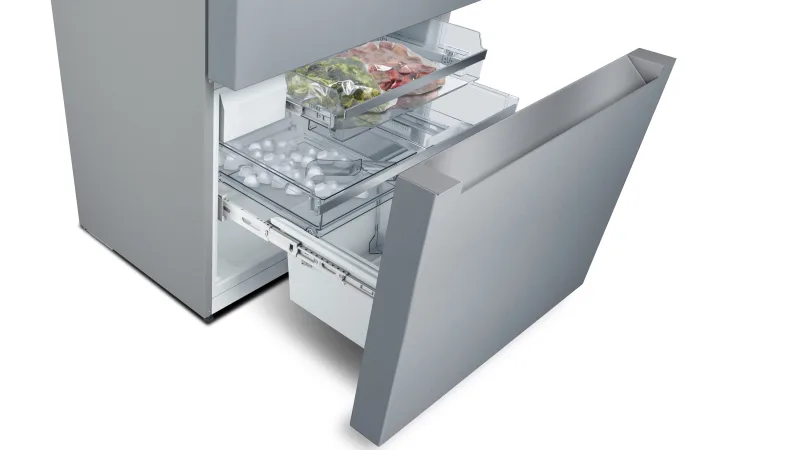
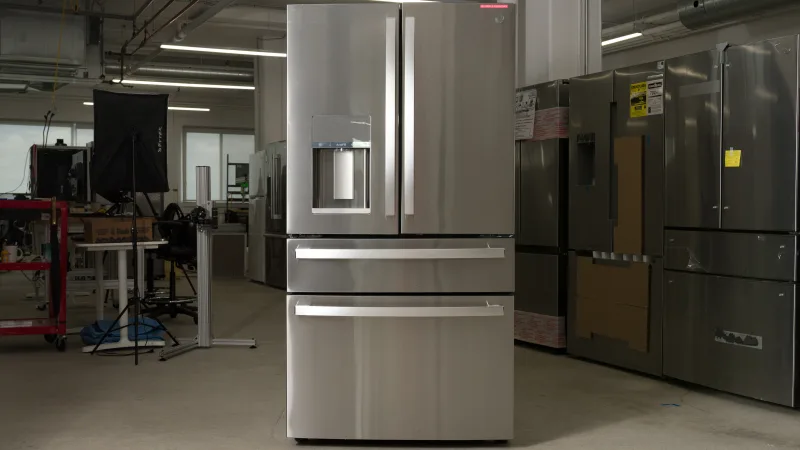
This is another area where the products make opposite design choices.
The Bosch B36CL80ENS keeps the front visually uninterrupted. Filtered water is dispensed inside the refrigerator, using Bosch’s UltraClarityPro filter, while the automatic ice maker feeds an internal freezer ice bin. That means water requires opening a fresh-food door, and ice requires opening the freezer.
The GE Profile PVD28BYNFS puts water and ice on the exterior. Its dispenser provides filtered water, cubed ice, and crushed ice, and GE adds Hands-Free AutoFill, which uses sensors to stop a water fill automatically. The dispenser also has proximity-activated lighting.
For a household filling water bottles repeatedly or serving ice throughout the day, GE removes several door-opening steps. Bosch instead keeps the exterior simpler and avoids dedicating a large section of the front to a dispenser recess.
Neither approach is inherently superior. An external dispenser is a convenience feature that becomes valuable only when it matches the household’s routine. An internal dispenser preserves the cleaner front but makes every water refill a two-step interaction.
GE therefore has the functional advantage for frequent dispensing. Bosch makes more sense when the uninterrupted exterior matters more than immediate water and ice access.
Cooling Technology & Food-Preservation Controls
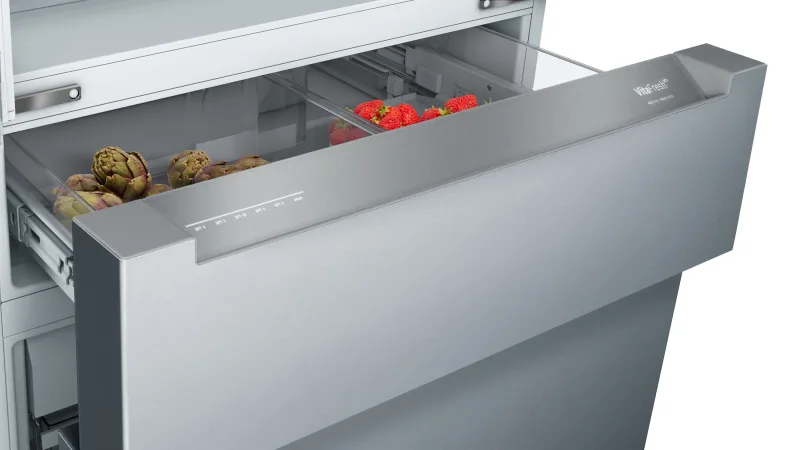
Bosch has the more unusual refrigeration architecture on paper. The B36CL80ENS uses two compressors and two evaporators, giving the refrigerator and freezer separate cooling systems. Bosch says this arrangement supports more precise temperature and humidity control while limiting odor transfer between the two compartments. It also uses MultiAirFlow to distribute air through the cabinet.
The GE uses TwinChill dual evaporators and a Multiflow Air System. GE says the separate evaporators keep freezer air colder and drier while maintaining a more humid environment in the fresh-food section. GE’s published specifications identify dual evaporators but do not present the PVD28BYNFS as a dual-compressor refrigerator.
That distinction is meaningful as hardware, but it should not be stretched into a performance result that the specifications alone cannot prove. Two compressors give Bosch greater physical separation between the refrigerator and freezer cooling circuits; they do not, by themselves, establish how much steadier temperatures will be in a particular kitchen or how long a specific food will remain fresh.
The more practical difference may be the dedicated drawers. Bosch’s VitaFreshPro is specified as a full-width temperature- and humidity-controlled drawer. GE’s center drawer uses four selectable temperature modes rather than a stated humidity-control system. GE still has two separate adjustable-humidity produce drawers in the main fresh-food compartment.
Bosch has the more independently separated cooling architecture and the more preservation-focused full-width drawer. GE still provides dual-evaporator climate separation and a more flexible preset-based center drawer. Without comparable independent temperature testing, the hardware difference should not be turned into a claim that one model universally keeps food fresh longer.
Energy Use
Both refrigerators are ENERGY STAR certified, but their annual ratings differ substantially.
The Bosch is rated at 568 kWh/year. The GE is rated at 758 kWh/year, a difference of 190 kWh annually. On the label numbers alone, Bosch therefore uses about 25% less electricity per year.
The context is important: GE’s rated total capacity is about 36% larger. A rough capacity normalization works out to about 27.7 kWh per rated cubic foot for Bosch and 27.2 kWh per rated cubic foot for GE. That calculation is not an official efficiency metric, but it illustrates why the 190-kWh gap should not be interpreted as a pure technology comparison.
In practical terms, Bosch has the lower expected annual electricity consumption. GE consumes more electricity while also providing considerably more refrigerated and frozen volume.
The useful conclusion is simply that Bosch puts a smaller annual load on the household electricity bill; the rating does not demonstrate that its refrigeration system is inherently more efficient than GE’s on an equal-capacity basis.
Smart Features & Connectivity
Both models connect to Wi-Fi, and in both cases the connected features are secondary to the refrigerator’s core job.
Bosch Home Connect supports remote temperature monitoring and adjustment, door-open notifications, SuperCool and SuperFreeze controls, filter reminders, and remote diagnostics on supported connected refrigerators. For the B36CL80ENS, that makes the app most useful as an alert and settings layer rather than something that requires constant interaction.
GE SmartHQ also provides remote control and alerts. On the PVD28BYNFS, GE lists temperature adjustments, high-temperature alerts, door-alarm alerts, water-filter status, ice-maker control, LED light-wall brightness, and Turbo Cool/Turbo Freeze functions. GE also lists compatibility with Amazon Alexa, Google Home, and IFTTT.
The GE exposes more appliance-specific controls in its published feature list, while Bosch’s Home Connect integration emphasizes monitoring, refrigeration settings, notifications, and diagnostics.
GE has the broader published set of connected controls and third-party integrations. Bosch covers the functions that matter most for remote refrigerator monitoring. Neither model depends on Wi-Fi for ordinary refrigeration.
Maintenance, Warranty & Long-Term Ownership
The original comparison between “simpler Bosch hardware” and “easier GE service” is not a defensible reliability conclusion without comparable repair-rate data. The presence of an exterior dispenser or Door-in-Door mechanism tells us that GE has more user-facing components, but it does not establish how often either refrigerator will fail.
What can be compared directly is routine maintenance and warranty coverage.
Both models use replaceable water filters: UltraClarityPro for Bosch and XWFE for GE. GE specifies a six-month interval for the XWFE filter under normal use, subject to water conditions and usage. Bosch also provides filter-replacement reminders through Home Connect for supported connected refrigerators.
For the refrigerator itself, both manufacturers publish a limited one-year parts-and-labor warranty for the entire appliance in the United States. Service availability is location-dependent, so neither brand should be given a blanket advantage without checking authorized coverage for the installation address.
The GE’s current product page also identifies the PVD28BYNFS as no longer being manufactured. That does not make an existing unit obsolete, and GE continues to provide manuals, parts listings, and service resources for the model, but it is an important ownership-context difference compared with a currently listed Bosch model.
There is not enough manufacturer data here to declare either refrigerator more reliable. The whole-appliance warranties are broadly similar, and local access to authorized service is more relevant than assumptions based on the number of visible features.
The Bottom Line
These refrigerators are easiest to understand as two different answers to the same 36-inch kitchen opening.
The Bosch B36CL80ENS fits situations where the refrigerator should stay close to cabinet depth and the household values a cleaner exterior, lower rated annual energy use, dual-compressor cooling architecture, and a temperature- and humidity-managed storage zone. Its limitation is equally clear: 20.5 cu. ft. is substantially less room than the GE provides, and water and ice require opening a door or drawer.
The GE Profile PVD28BYNFS is better suited to a kitchen that can absorb a full-depth refrigerator and needs more storage throughput. Its 27.9 cu. ft. capacity, external water and cubed/crushed ice, Hands-Free AutoFill, Door-in-Door compartment, and configurable center drawer all reduce friction in a high-use household. The trade-offs are the deeper footprint, higher annual energy-use rating, and the fact that GE now identifies this model as no longer being manufactured.
There is no useful universal winner here because the depth classes are different. If limiting how far the refrigerator projects into the room is the primary constraint, the Bosch is the logical fit. If the kitchen has the space and the priority is maximum capacity plus exterior dispensing, the GE is the more capable configuration.
FAQ
What is the main difference between the Bosch B36CL80ENS and GE Profile PVD28BYNFS?
Which refrigerator is better for large families?
Is the Bosch B36CL80ENS worth the extra cost?
Do these fridges have smart features?
Which fridge is more energy efficient?
How deep is the Bosch B36CL80ENS, and will it fit flush with my cabinets?
Which refrigerator is quieter, the Bosch or the GE?
📄 Used Manuals & Documentation
Bosch B36CL80ENS
"Images are used for editorial and informational purposes only. All trademarks and images belong to their respective owners."