
Yale YRD410 vs Schlage BE489WB: Push-Button Convenience or Higher Security Ratings?
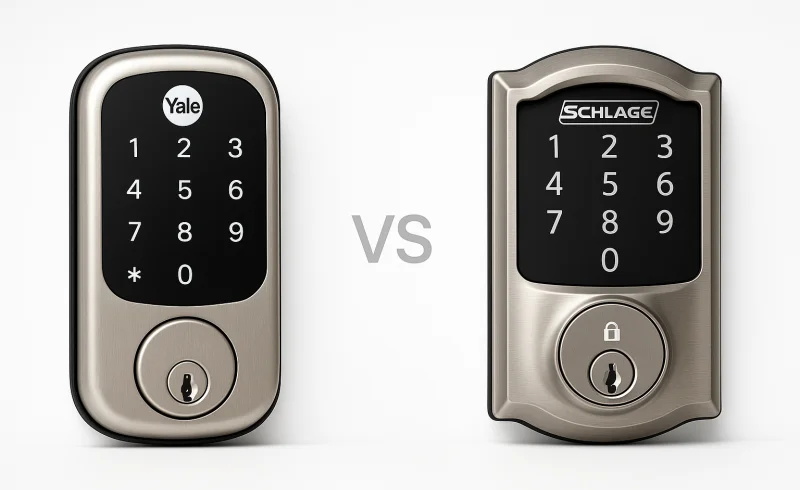
Discover the key differences between the Yale YRD410 and Schlage BE489WB smart locks. Compare usability features such as Yale's tactile keypad and DoorSense technology against Schlage's higher security ratings and touchscreen. Learn which lock best fits your n...
TL;DR
- Yale YRD410 is better suited to households that value a physical push-button keypad, DoorSense door-position sensing, Apple HomeKit/Siri support, and a larger access-code capacity.
- Schlage BE489WB has the stronger published security credentials, adding ANSI/BHMA Grade AAA and Commercial Grade 1 certifications plus a built-in alarm for forced-entry attempts.
- Yale supports up to 250 entry codes in the Yale Access app; Schlage supports up to 100. Earlier claims of unlimited YRD410 codes are not supported by Yale's current documentation.
- Yale's DoorSense can distinguish between an open and closed door before Auto-Lock acts. Schlage's Auto-Lock is based on a configurable time delay and does not provide equivalent door-position sensing.
- Both depend on a smoothly operating deadbolt. A dragging bolt or poorly aligned strike should be corrected rather than treated as something either smart lock will solve.
Important model note: This comparison covers the standard keyed Yale Assure Lock 2 YRD410, which uses a push-button keypad. Connectivity sections assume the YRD410-WF1 Wi-Fi configuration. Yale also uses similar model numbering for newer fingerprint-equipped Assure Lock 2 Touch variants; those are different products.
| Feature | Yale YRD410 | Schlage BE489WB |
|---|---|---|
| Power | ||
| Battery Type | 4 AA batteries (included) | 4 AA alkaline batteries |
| Electronics Warranty | 2 years | 3 years |
| Mechanical / Finish Warranty | Limited lifetime | Limited lifetime |
| Access | ||
| Auto-Lock | Yes, with DoorSense | Yes, with time delay options |
| Access Code Capacity | Unlimited codes | 100 code capacity |
| Activity / Lock History | Supported | Supported |
| Product | ||
| Product Type | Keyed smart deadbolt | Keyed smart deadbolt |
| Exterior Input Type | Keypad | Touchscreen |
| Physical Backup Key Included | Yes, 1 key included | Yes, 1 key included |
| Security | ||
| Certification | ANSI/BHMA Grade 2 | ANSI/BHMA A156.40-2015 Grade AAA in Security, Durability and Finish; ANSI/BHMA A156.36 Commercial Grade 1 |
| Fingerprint-Resistant Exterior | Yes, matte keypad | Yes, fingerprint-resistant touchscreen |
| Connectivity | ||
| Mobile App | Yale Access App | Schlage Home app |
| Remote Access | Supported | Supported |
| Wireless Connectivity | Wi-Fi and Bluetooth | Built-in Wi-Fi |
| Voice Assistant Support | Amazon Alexa, Google Assistant, Siri | Amazon Alexa, Google Assistant |
| Installation | ||
| Backset | 2 3/8" or 2 3/4" | 2-3/8" or 2-3/4" |
| Door Thickness | 1 3/8" to 2-1/4 | 1-3/8 in to 1-3/4 in |
| Operating Temperature | Outside: -22 F to 140 F; Inside: 5 F to 158 F | Outside lock body: -31F (-35C) to 150.8F (66C); Inside lock body: 14F (-10C) to 120.2F (49C) |
📑 Table of Contents
- Security: Schlage Has the Stronger Certification Case
- Everyday Entry: Push Buttons vs Touchscreen
- DoorSense Is Yale's Most Useful Everyday Difference
- Access Codes: 250 vs 100, Not Unlimited vs 100
- Connectivity and Smart-Home Support
- Battery Life Is a Meaningful Schlage Advantage
- Installation and Door Compatibility
- Warranty and Long-Term Ownership
- Which One Fits Which Household?
- The Bottom Line
- FAQ
Security: Schlage Has the Stronger Certification Case
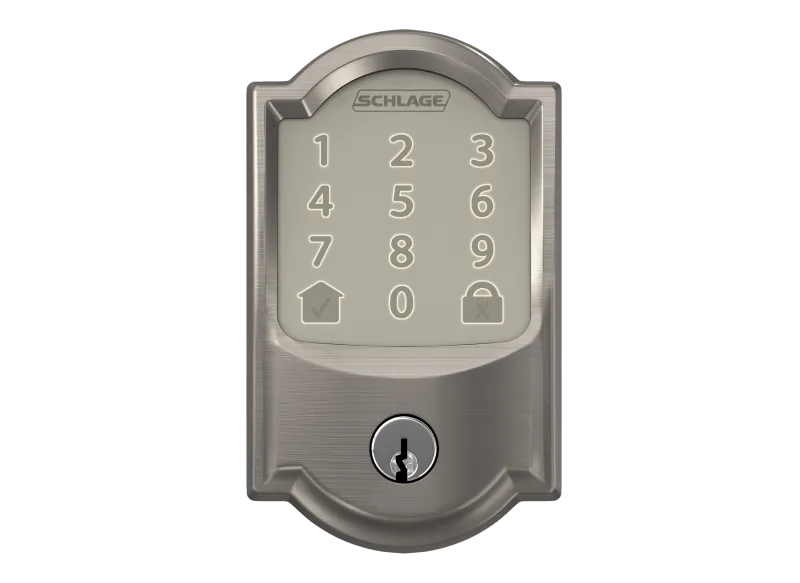
The most substantial difference between these locks is not the keypad technology or their apps. It is the level of certification each manufacturer publishes.
The Yale YRD410 is certified ANSI/BHMA Grade 2. That is a recognized residential hardware rating covering mechanical performance and durability, and it places the Assure Lock 2 well beyond an untested electronic latch.
The Schlage BE489WB Encode carries two more demanding published credentials: ANSI/BHMA A156.40-2015 Grade AAA in Security, Durability, and Finish, plus ANSI/BHMA A156.36 Commercial Grade 1. Schlage also includes a customizable built-in alarm designed to detect door movement and forced-entry attempts.
Those labels should not be read as a guarantee against every method of attack. Door construction, frame reinforcement, strike installation, and the surrounding hardware remain part of the security system. But when the comparison is limited to independently defined hardware standards, Schlage has the stronger documented position.
Both models retain a conventional mechanical cylinder and include a backup key. That is useful if batteries are exhausted or the electronics become unavailable, though it also means neither model is a key-free design.
Security advantage: Schlage BE489WB.
Everyday Entry: Push Buttons vs Touchscreen
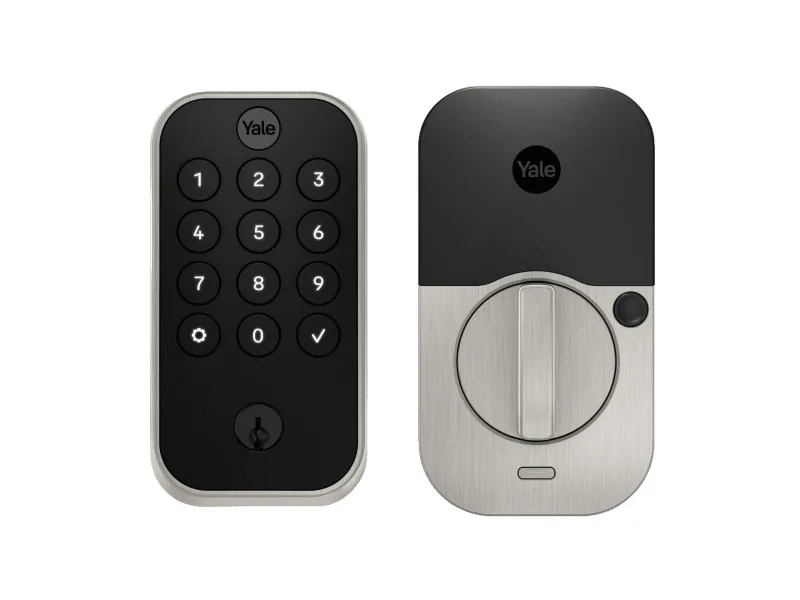
The Yale and Schlage take noticeably different approaches to entering a PIN.
The YRD410 uses physical push buttons. Each number provides a defined physical target rather than requiring input on a flat touch surface. Yale's troubleshooting documentation explicitly distinguishes these models from the company's touchscreen versions.
The BE489WB uses a fingerprint-resistant touchscreen. Its numbers appear on the exterior touch surface, and Schlage provides audible feedback during interaction. The flat front is visually cleaner and easy to wipe, but it does not provide the same physical key movement as Yale's buttons.
That distinction matters more than aesthetics suggest. A keypad is something household members may use several times every day, often without looking closely at the lock. Physical buttons provide another form of feedback beyond illumination and sound; the Schlage instead prioritizes a smooth touchscreen interface.
There is no sound basis for claiming that the Yale will always work better with gloves, rain, or wet fingers. Those outcomes depend on conditions and should not be inferred simply from the control type. The defensible difference is narrower: Yale provides physical button travel; Schlage provides a flat touchscreen.
For users who specifically prefer tactile controls, the YRD410 has the more appropriate interface. For those who prefer a flush touchscreen exterior, the Schlage provides it.
DoorSense Is Yale's Most Useful Everyday Difference
The more consequential convenience feature is DoorSense.
Yale supplies DoorSense with the Assure Lock 2 so the system can determine whether the door is open or closed. When Auto-Lock is configured around DoorSense, the lock can wait for the door to be detected as closed before relocking.
That is fundamentally different from merely starting a countdown.
The Schlage BE489WB also supports Auto-Lock, but Schlage describes it through configurable time-delay options. The lock can relock automatically after the selected interval, but the BE489WB does not provide the equivalent door-position sensor found on the Yale.
Consider a common situation: someone opens the door, carries something outside, and leaves the door open for longer than expected. A timer knows only that its interval has elapsed. DoorSense adds another piece of information: whether the door has actually closed.
That does not mean DoorSense fixes a poorly fitted door. The sensor reports door position; the deadbolt still needs a clear path into the strike. Yale itself advises eliminating deadbolt friction because resistance can interfere with operation and increase battery consumption.
Auto-Lock advantage: Yale YRD410.
Access Codes: 250 vs 100, Not Unlimited vs 100
One of the largest factual problems with older comparisons of these two models is Yale's code capacity.
Current Yale documentation states that the Assure Lock 2 can hold up to 250 entry codes within the Yale Access app. The YRD410 therefore has more capacity than the Schlage, but describing that capacity as unlimited is inaccurate.
The Schlage BE489WB supports up to 100 access codes. Codes can be managed and scheduled through the Schlage Home app.
For an ordinary household, either limit is substantial. A family can maintain separate credentials for household members and still have room for relatives, cleaners, pet care, contractors, or other temporary access.
The difference becomes more relevant when codes are intentionally kept separate for many recurring or short-lived users. In that scenario, Yale's 250-code ceiling leaves considerably more room before old credentials need to be removed.
Both ecosystems also provide activity history and notifications, so a unique code can carry more meaning than a shared household PIN.
Access-management advantage: Yale YRD410.
Connectivity and Smart-Home Support
The connectivity comparison is more nuanced than simply saying Yale has Bluetooth and Schlage does not.
The Yale YRD410 has Bluetooth built into the Assure Lock 2 platform. In the YRD410-WF1 configuration, Yale's Wi-Fi Smart Module adds remote access through the Yale Access app without requiring a separate bridge. The Wi-Fi configuration supports Amazon Alexa, Google Assistant, Apple HomeKit, and Siri, along with additional integrations supported by Yale.
The Schlage BE489WB has built-in Wi-Fi for remote access through the Schlage Home app. Schlage's current app materials also describe local Bluetooth operation for Encode-family locks. Its primary voice integrations are Amazon Alexa and Google Assistant.
The important difference is therefore the ecosystem rather than the mere existence of Bluetooth.
The original BE489WB Encode does not provide the Apple Home/Home Key functionality associated with the Schlage Encode Plus. Schlage's Apple-focused model is the Encode Plus BE499WB, a different lock.
Yale's YRD410-WF1 supports Apple HomeKit and Siri, although it should not be confused with Yale's Assure Lock 2 Plus, which adds Apple home keys. HomeKit support and Apple home keys are separate capabilities.
For an Apple-centered home where HomeKit integration matters, Yale has a clear advantage over this particular Schlage model. For Alexa or Google Assistant households, both cover the core voice-control requirement.
Battery Life Is a Meaningful Schlage Advantage
Both locks run on four AA alkaline batteries, but their manufacturer estimates differ.
Yale says the Assure Lock 2 with Wi-Fi can provide up to about three months of battery life under typical conditions. Yale specifically notes that Wi-Fi signal strength, deadbolt friction, router settings, and frequency of operation can affect that figure.
Schlage rates the BE489WB at up to six months with typical use.
These are manufacturer estimates rather than controlled head-to-head measurements, so they should not be treated as guaranteed service intervals. Even so, they point to a practical ownership difference: the Schlage is specified for a longer interval between battery changes.
The underlying lesson applies to both locks. A motor that has to fight a misaligned deadbolt consumes more energy, and a weak wireless connection can also increase power use. Door preparation and network conditions therefore matter after installation, not only during setup.
Both provide low-battery warnings and retain a physical key as a fallback.
Battery-maintenance advantage: Schlage BE489WB, based on manufacturer estimates.
Installation and Door Compatibility
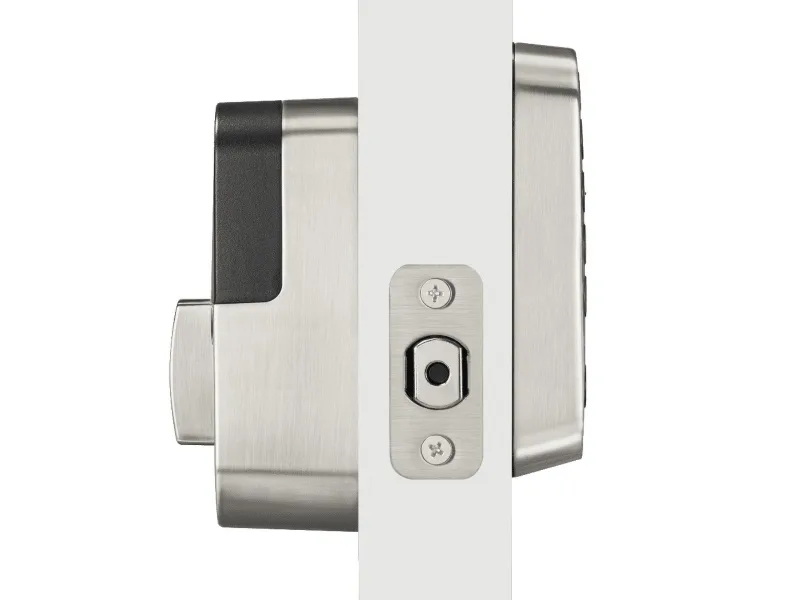
Both models are designed to replace a conventional single-cylinder deadbolt and use the common 2-3/8-inch or 2-3/4-inch backset. Neither requires hardwiring.
The Yale YRD410 supports doors from 1-3/8 to 2-1/4 inches thick in its standard specification.
The Schlage BE489WB standard configuration supports 1-3/8 to 1-3/4 inches. Schlage also documents a separate thick-door kit that extends compatibility to thicker installations, so the standard range should not be mistaken for an absolute hardware limit.
Yale therefore accommodates a broader range of door thicknesses without an additional kit.
Climate specifications tilt in the other direction. Yale rates the exterior portion of the YRD410 from -22°F to 140°F, while Schlage specifies -31°F to 150.8°F for the exterior portion of the BE489WB. For most installations that difference will never become relevant, but Schlage publishes the wider exterior operating range, particularly at the cold end.
More important than either dimension table is bolt alignment. A motorized deadbolt should extend and retract without having to pull the door into position. If the existing deadbolt binds unless someone pushes or lifts the door, correcting the strike or door alignment is part of preparing for either model.
Warranty and Long-Term Ownership
Schlage specifies a three-year limited electronics warranty for the BE489WB, along with a limited lifetime mechanical and finish warranty.
Yale's current U.S. warranty, updated in June 2026, lists two years of electronic coverage for Yale Assure Series locks, with lifetime mechanical and finish coverage for qualifying consumer installations under the warranty terms.
That gives Schlage one additional year of stated electronics coverage.
For a connected lock, electronics coverage matters because the keypad, wireless hardware, control board, sensors, and motor system are central to normal operation. Mechanical lifetime coverage alone does not cover every component that distinguishes a smart lock from a conventional deadbolt.
Warranty advantage: Schlage BE489WB.
Which One Fits Which Household?
The Yale YRD410 makes more sense when the priority is everyday access flexibility. Its push-button keypad gives physical feedback, DoorSense adds actual door-position information to Auto-Lock, its current platform supports up to 250 entry codes, and the Wi-Fi configuration works with Apple HomeKit and Siri as well as Alexa and Google Assistant.
The Schlage BE489WB is the stronger fit when formal hardware credentials carry greater weight. Its Grade AAA residential rating, Commercial Grade 1 certification, built-in forced-entry alarm, three-year electronics warranty, and longer manufacturer-estimated battery interval form a coherent set of advantages.
Neither is automatically the right answer for a door with mechanical problems. DoorSense can tell Yale whether the door is open or closed, but it cannot make a dragging deadbolt move freely. Schlage's motor has the same basic requirement: the bolt needs to travel into the strike without significant resistance.
There is also no reason to select between these two models solely because one has a keypad and the other a touchscreen. The larger differences are door-state sensing and Apple integration on Yale versus stronger published hardware certifications, an intrusion alarm, and longer stated battery and electronics coverage on Schlage.
The Bottom Line
The original comparison overstated Yale's access-code capacity and placed too much weight on assumptions about how the two keypads behave in difficult conditions.
The corrected distinction is clearer.
Yale YRD410 is the more flexible everyday-access design: physical push buttons, DoorSense, up to 250 codes, broad smart-home compatibility, and Apple HomeKit/Siri support in the Wi-Fi configuration.
Schlage BE489WB is the more certification-focused design: Grade AAA residential ratings, Commercial Grade 1 certification, a built-in forced-entry alarm, a three-year electronics warranty, and an exterior operating specification that extends farther into extreme cold.
Overall,
for households where door-state awareness, physical keypad controls, Apple integration, and larger code capacity matter most. The Schlage BE489WB remains the stronger match when published security standards and lower-maintenance ownership characteristics carry more weight.FAQ
Which smart lock is more secure, Yale YRD410 or Schlage BE489WB?
Does Yale YRD410 work with Apple HomeKit?
What is the price difference between Yale YRD410 and Schlage BE489WB?
What is DoorSense on the Yale YRD410?
What should I do if my Schlage BE489WB keypad is unresponsive?
Can I control the Schlage BE489WB remotely?
How many access codes can each smart lock store?
"Images are used for editorial and informational purposes only. All trademarks and images belong to their respective owners."