
Xiaomi Mijia Smart Skipping Rope 2 vs 75pai F20 Pro: Simple Smart Tracking or Heart-Rate–Guided Training?
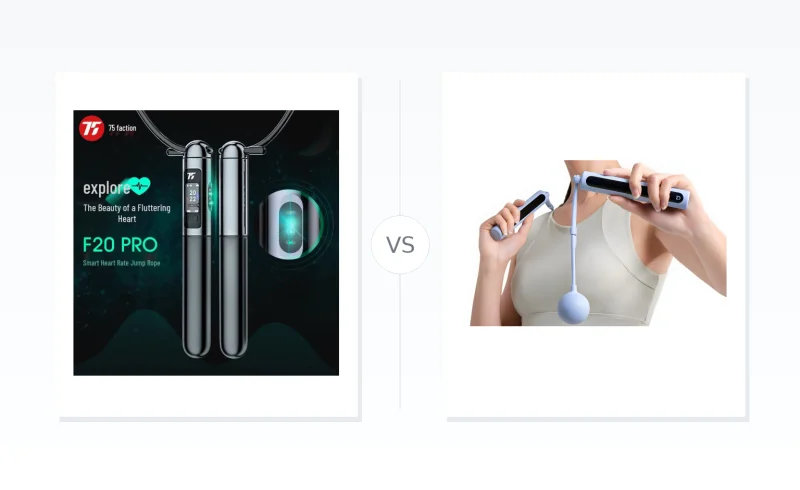
Compare Xiaomi Mijia Smart Skipping Rope 2 and 75pai F20 Pro: tracking, app, training modes, build quality, battery, setup, and long-term reliability. Find out which smart jump rope fits your workout style.
TL;DR
- Choose the Xiaomi Mijia Smart Skipping Rope 2 if you mainly want reliable automatic counting, useful interval and target modes, corded and cordless jumping, straightforward workout history, and USB-C charging without paying for biometric hardware.
- Choose the 75pai F20 Pro Smart Jump Rope if its defining feature matters to you: heart-rate sensing built into the handle, paired with spoken feedback and more elaborate motion sensing.
- Xiaomi is more capable than a basic Bluetooth counter. It supports six documented training modes, app-based courses and voice guidance, and offline workout storage.
- 75pai's advantage is not simply a "better app." The F20 Pro adds PPG heart-rate hardware, dual AMR magnetic sensors, a 3-axis motion sensor, voice prompts, and a color display.
- Neither manufacturer's counting-accuracy claims give us a trustworthy head-to-head winner. They were produced under different test conditions and have not been independently compared.
- If you are importing either model, check app region, language, warranty, and seller support before worrying about the last few lines of the spec sheet.
The practical choice is simpler than the feature lists make it look. Xiaomi is the better fit if you want to jump, count, set a target, and get on with the workout. The F20 Pro makes more sense if you specifically want the rope itself to tell you something about exercise intensity, not just how many times it has turned.
| Feature | 75pai F20 Pro Smart Jump Rope | Xiaomi Mijia Smart Skipping Rope 2 |
|---|---|---|
| Power | ||
| Power Source | Built-in rechargeable lithium battery | Built-in rechargeable lithium battery |
| Battery Capacity | 200 mAh | 200 mAh |
| Display | ||
| Display Type | LED | LED |
| Displayed Metrics | Jump count, time, calories burned | Jump count, workout duration, calories burned |
| Integrated Display | Yes | Yes |
| Physical | ||
| Adjustable Rope Length | Yes | Yes |
| Connectivity | ||
| Bluetooth | Supported | Supported |
| Compatible Apps | 75pai App | Mi Home, Xiaomi Sports Health |
📑 Table of Contents
- The Difference You Will Actually Notice
- Counting: Do Not Overread the Accuracy Numbers
- Heart Rate Is the F20 Pro's Real Reason to Exist
- Live Feedback: Screen Versus Something You Can Hear
- Xiaomi's Training Modes Are Better Than the "Simple Tracker" Label Suggests
- Corded or Cordless: Xiaomi Has the More Obvious Small-Space Advantage
- App Experience: The Bigger Risk Is Region and Language
- The F20 Pro Has More Training Data, but More Data Is Not Automatically More Useful
- Build and Handling: Ignore Unsupported Material Superlatives
- Battery Life: Both Claims Need Context
- Buying One Outside China
- Which One Should You Buy?
- FAQ
The Difference You Will Actually Notice
Most smart ropes perform the same basic trick: a sensor in the handle watches the rope rotate, software turns those rotations into repetitions, and an app saves the workout.
Both of these do that. The split comes afterward.
The Xiaomi Mijia Smart Skipping Rope 2 is essentially a well-developed smart counter. It tracks repetitions, duration, estimated calories, interruptions, and workout history; it supports structured sessions; and it can be used with either a normal rope or weighted cordless swing balls.
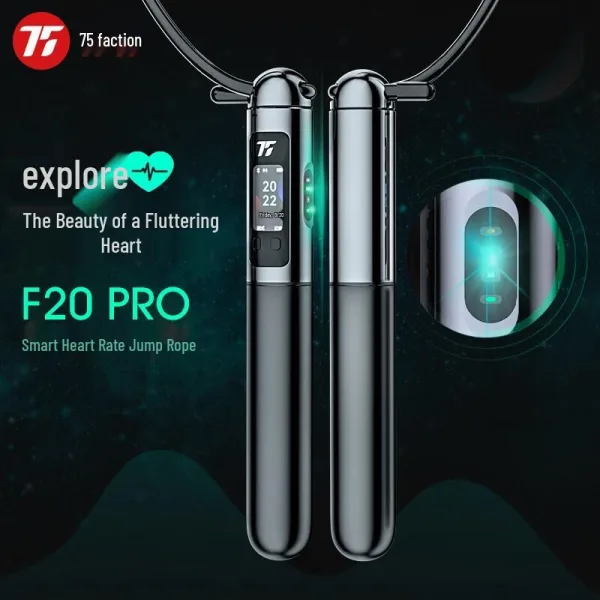
The 75pai F20 Pro adds another layer: it tries to monitor the person holding the rope. A PPG optical sensor in the handle measures heart rate, while the rope can use voice prompts to communicate workout information without making you stop to read a phone.
That sounds like a small difference on a comparison chart. During a workout, it changes the purpose of the product.
If your question is, "Did I finish 1,000 jumps?" Xiaomi already addresses it well.
If your question is, "How hard am I working while I do those 1,000 jumps?" the F20 Pro has hardware Xiaomi lacks.
Counting: Do Not Overread the Accuracy Numbers
The Xiaomi Mijia Smart Skipping Rope 2 uses three Hall sensors and Xiaomi's counting algorithm to detect rotation and filter movements it considers invalid, including interruptions and partial rotations. Xiaomi also documents situations in which counting can diverge from what your feet actually did — especially in cordless mode, where the handles can only infer jumps from the way you swing the weighted balls.
That last point matters. A cordless smart rope cannot know that your feet left the floor simply because your wrists completed another rotation. If your hands and feet drift out of sync, the count can drift with them.
The 75pai F20 Pro uses a more elaborate sensor package. Published product materials describe dual industrial-grade AMR magnetic sensors plus a 3-axis motion sensor. 75pai says that combination helps the rope distinguish advanced patterns such as double-unders and triple-unders instead of treating every handle rotation identically.
75pai has also advertised 99.8% counting accuracy for the F20 platform. Treat that as a manufacturer claim, not as evidence that it is 99.8% accurate in your workout or demonstrably more accurate than Xiaomi. Xiaomi makes similarly confident statements about its own filtering and counting system, but there is no controlled independent comparison that puts the two percentages on equal footing.
So the useful conclusion is not "75pai counts better."
It is that 75pai has the richer motion-sensing system, while Xiaomi already has enough sensing hardware for ordinary repetition tracking.
Advantage: 75pai F20 Pro for sensor capability; no verified winner for absolute counting accuracy.
Heart Rate Is the F20 Pro's Real Reason to Exist
The Xiaomi Mijia Smart Skipping Rope 2 has no built-in heart-rate sensor. The rope knows how long you trained and how many rotations it counted. Its calorie figure is therefore an estimate derived from workout data rather than a direct measurement of metabolic effort.
The 75pai F20 Pro puts a PPG optical heart-rate sensor in the handle. It is designed to take readings while you maintain a normal grip, and the rope can provide voice prompts related to heart rate and exercise intensity.
That creates a genuinely different training loop: start an interval, hear feedback while you are moving, adjust the pace, then review heart-rate information afterward.
There are two reasons not to oversell it.
First, this is consumer fitness sensing, not medical monitoring. PPG works by detecting changes in blood volume optically, and vigorous movement plus grip pressure can introduce measurement noise. A number on the handle should not be treated as a clinical reading.
Second, the feature loses some of its value if you already train with another heart-rate source you trust. In that case, you are paying for a second sensor embedded in the rope.
But if you do not wear a watch or chest strap and specifically want heart-rate feedback while skipping, Xiaomi cannot provide an equivalent feature on its own.
Winner: 75pai F20 Pro Smart Jump Rope
Live Feedback: Screen Versus Something You Can Hear
A display on a jump-rope handle sounds more useful than it often is. Your hands are moving quickly, your attention is on the rope and your feet, and looking at a small screen in the middle of a set is hardly ideal.
The Xiaomi Mijia Smart Skipping Rope 2 uses an oval dot-matrix display. It can show jump count, workout duration, estimated calories, battery status, Bluetooth status, and device-update information. A button on the handle cycles through the primary workout metrics.
That is perfectly adequate when you finish a set, raise the handle, and want to know whether you stopped at 487 or 503 jumps.
The 75pai F20 Pro pairs its display with voice output. Product documentation and design-award materials describe a TFT color display, while 75pai's published materials say the handles can announce workout information including heart rate and repetition count. Voice prompts can also warn when exercise intensity crosses a configured threshold.
For skipping, audio is arguably the more useful interface. You can hear information without changing your rhythm or turning a moving handle toward your face.
The catch is obvious if you exercise around other people: spoken feedback is not automatically desirable just because it is technologically clever.
Winner: 75pai F20 Pro if you want live feedback without looking at a screen.
Xiaomi's Training Modes Are Better Than the "Simple Tracker" Label Suggests
The Xiaomi should not be dismissed as the inexpensive rope that merely uploads a number to Mi Home.
Its documented training options include:
- repetition-target training;
- time-target training;
- calorie-target training;
- free training;
- interval training;
- offline training.
The interval mode is the useful one to notice. Instead of staring at a cumulative counter, you can structure work and rest periods and use the app's guidance to turn a rope into a basic interval-training tool.
Xiaomi also offers instructional material through its software, including demonstrations, video content, and voice guidance. Workout records can be reviewed over longer periods rather than disappearing once you clear the handle.
More importantly, offline mode means the phone does not have to become part of every workout. Xiaomi documents local storage for previous exercise records that can later be retrieved by the app. That is exactly how a fitness accessory should behave: the Bluetooth connection adds value without making the physical product useless when your phone is elsewhere.
The 75pai F20 Pro also supports structured training through the Pai Health ecosystem, but its appeal is less about having another preset on a menu and more about combining repetition data, motion analysis, heart rate, courses, and spoken feedback.
If you just want to specify "500 jumps" or "10 minutes," Xiaomi gets you there without much ceremony.
If you want the rope to participate more actively in intensity-based training, the F20 Pro has more to work with.
Corded or Cordless: Xiaomi Has the More Obvious Small-Space Advantage
One of Xiaomi's most practical features has nothing to do with an algorithm.
The Mijia Smart Skipping Rope 2 can be configured with a normal rope or with cordless swing balls. The second-generation model uses enlarged weighted balls — Xiaomi's launch materials describe a pair weighing about 108 g, roughly double the previous generation.
Cordless jumping is useful in a low ceiling, a small room, or any place where repeatedly striking a lamp, sofa, desk, or neighbor's floor is more likely than completing a graceful training session.
There is a trade-off: you are no longer practicing exactly the same skill. Without a rope passing under your feet, there is no real rope to catch a bad jump, and the handles infer repetitions from your wrist motion. Cordless mode is therefore better understood as a space-saving cardio option than as a perfect substitute for technique practice with a real rope.
With the physical rope attached, Xiaomi supplies an adjustable 3-meter rope and a quick-adjustment mechanism for different heights.
The F20 Pro is also sold in configurations supporting different rope and training accessories, including weighted options, but Xiaomi makes the corded/cordless transition unusually central to the product.
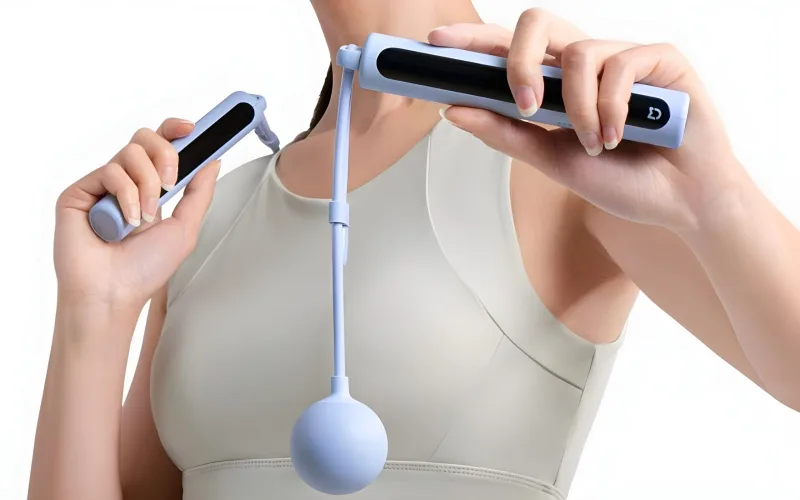
Winner: Xiaomi Mijia Smart Skipping Rope 2 for small-space cordless exercise.
App Experience: The Bigger Risk Is Region and Language
This is where an inexpensive imported smart fitness accessory can become unexpectedly annoying.
The Xiaomi Mijia Smart Skipping Rope 2 supports Mi Home and Xiaomi Sports Health/Mi Fitness in its China-market documentation. Xiaomi also states that model MJTS02YM is intended for mainland China, and connection instructions for imported units commonly require the app region to be set to Chinese mainland.
That matters if your Xiaomi account is already running a house full of devices assigned to another region. A product can work perfectly as a piece of hardware and still be inconvenient because of regional device catalogs, account settings, or support restrictions.
The 75pai F20 Pro uses Pai Health. The app records jump-rope metrics and provides the broader training ecosystem around 75pai's hardware.
There is one notable interoperability advantage: Pai Health's current iOS App Store listing explicitly declares HealthKit support. The app says it can write several health and fitness metrics to Apple Health, including heart rate and active energy. That does not establish that every F20 Pro workout field or rope-specific metric appears in Apple Health, but the integration itself is documented.
The bigger warning is language. The same App Store listing currently identifies Simplified Chinese as the supported interface language.
That may be a nonissue if you read Chinese. If you do not, it is more consequential than whether one rope records one extra training field.
For international buyers, software compatibility should be checked before purchase, not discovered after unboxing.
The F20 Pro Has More Training Data, but More Data Is Not Automatically More Useful
Pai Health can record the basics you would expect from a connected rope: repetitions, time, estimated calories, cadence or frequency-related information, and workout history. With the F20 Pro, heart-rate information adds another dimension.
75pai also promotes courses, challenges, community activities, and competition-oriented functions.
That sounds comprehensive, but it is worth separating data you will actually use from data that simply makes a dashboard look impressive.
For someone doing three ten-minute cardio sessions each week, total time, repetitions, interval structure, and consistency may be enough. Xiaomi already handles that job.
For someone deliberately training double-unders, working within heart-rate zones, or analyzing pace changes across sessions, the additional F20 Pro sensors become more defensible.
A smarter rope is not automatically a better rope. It is better only when the extra measurements change what you do next.
Build and Handling: Ignore Unsupported Material Superlatives
The Xiaomi's construction is fairly easy to document. The Mijia Smart Skipping Rope 2 weighs about 230 g, uses slim handles with anti-slip silicone strips, and employs 360-degree bearings for the rope mechanism. Xiaomi also enlarged the cordless swing balls compared with the first generation.
The F20 Pro is positioned as the more performance-oriented product, with a color display, AMR sensing, a dedicated motion-sensing platform, and a bearing system described by its manufacturer as designed for stable, low-friction rotation at higher speeds.
Some retailer descriptions go further with grand material claims. Those claims should not be the reason to buy it unless the seller or manufacturer documentation for the exact SKU verifies them.
What matters more in practice is the extra hardware packed into the F20 Pro handles. It is doing more sensing and providing more feedback than Xiaomi, which is the meaningful premium rather than vague language about "flagship materials."
Battery Life: Both Claims Need Context
The Xiaomi Mijia Smart Skipping Rope 2 has unusually clear battery documentation:
- 200 mAh rechargeable battery;
- USB-C charging;
- Bluetooth 5.1;
- manufacturer-rated endurance of about 20 days when used for 30 minutes per day.
That usage condition makes the number at least interpretable.
Published materials for the 75pai F20 Pro describe approximately 30 days of battery life. The problem is that the available claim is not presented with the same clearly normalized daily-use condition as Xiaomi's 20-day figure.
So "30 days versus 20 days" is not a clean ten-day victory for 75pai. Battery claims measured under different assumptions should not be treated like stopwatch results from the same test.
For most people, neither rope is a device that should need charging after every few workouts. Xiaomi simply provides the clearer public specification.
Winner: No meaningful battery-life winner from comparable evidence. Xiaomi wins on specification clarity.
Buying One Outside China
This deserves more attention than it usually gets in product comparisons.
The Mijia Smart Skipping Rope 2 model MJTS02YM is a mainland-China product, and Xiaomi's documentation says official after-sales service for the model is provided in mainland China. Importing one does not magically turn it into a locally supported Xiaomi product.
The hardware can still be attractive precisely because it is inexpensive, but check:
- whether your seller is providing an imported Chinese-market unit;
- which app and region are required;
- whether you are comfortable changing account-region settings;
- who handles a defective battery or handle;
- whether replacement ropes or attachments are readily available.
The F20 Pro presents a similar import calculation. Pai Health is still present and maintained on Apple's App Store, but the iOS interface is listed only in Simplified Chinese. Seller stock, accessories, warranty arrangements, and localized instructions can vary.
At the price level where these products are often imported, some buyers will happily accept those compromises. Just do not mistake "the app installs on my phone" for "this product has full local-market support."
Which One Should You Buy?
Choose the Xiaomi Mijia Smart Skipping Rope 2 if you want a smart rope primarily to make ordinary workouts easier to track.
Its strongest combination is surprisingly sensible:
- automatic repetition tracking;
- time and calorie estimates;
- six useful training modes;
- interval sessions;
- corded and cordless operation;
- app-based instruction and voice guidance;
- offline workout storage;
- an adjustable full-length rope;
- USB-C charging;
- a clearly documented 20-day battery claim.
It does enough that the word "basic" feels unfair. What it deliberately does not do is measure your heart rate.
Choose the 75pai F20 Pro Smart Jump Rope if that missing biometric layer is the feature you care about.
Its case rests on:
- a PPG heart-rate sensor in the handle;
- spoken workout and intensity feedback;
- heart-rate-based training functions;
- dual AMR magnetic sensors;
- a 3-axis motion sensor;
- manufacturer-claimed recognition of double-unders and triple-unders;
- a TFT color display;
- richer rope-specific training analysis;
- Pai Health and documented HealthKit integration.
The F20 Pro is the more technically ambitious product. That does not make it the automatic purchase.
If your routine is "jump for 15 minutes, keep count, occasionally do intervals," Xiaomi already covers the job and its cordless mode may be more useful every day than a heart-rate sensor.
If you are buying a smart rope specifically because you want the rope to measure and communicate training intensity, the F20 Pro is the one with the hardware to justify the upgrade.
The 75pai F20 Pro wins on capability. The Xiaomi Mijia Smart Skipping Rope 2 wins the simpler argument: it does most of what a smart jump rope needs to do without turning every workout into a data project.
FAQ
Does the Xiaomi Mijia Smart Skipping Rope 2 work without the Mi Home app?
Can the 75pai F20 Pro export data to Apple Health or Google Fit?
Which smart jump rope is better for beginners?
Are both ropes adjustable for different heights?
Does the Xiaomi Mijia Smart Skipping Rope 2 support ropeless jumping?
What training modes does the Xiaomi Mijia Smart Skipping Rope 2 have?
How accurate is the Xiaomi Mijia Smart Skipping Rope 2 jump counter?
"Images are used for editorial and informational purposes only. All trademarks and images belong to their respective owners."