
Reolink RLK8-520D4-5MP vs Night Owl BTWN81-F4-4L: Wired Reliability vs Wireless Convenience
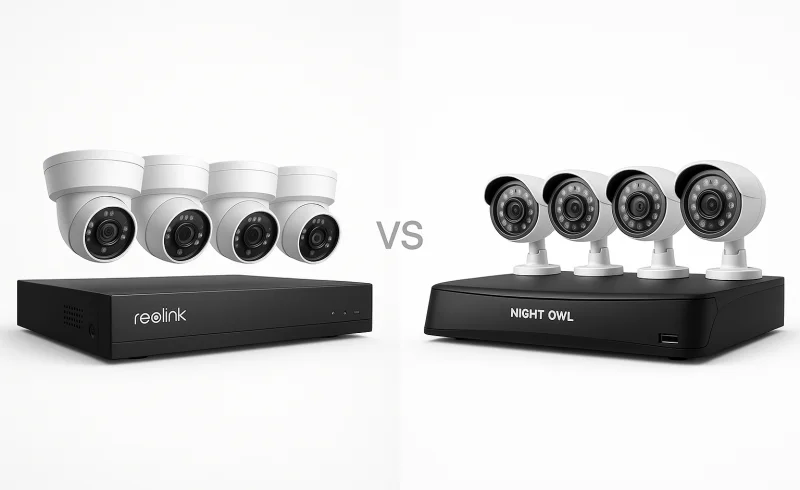
Explore the differences between Reolink RLK8-520D4-5MP and Night Owl BTWN81-F4-4L security systems. Learn about wired reliability with PoE, sharper video detail, and extensive storage from Reolink, against Night Owl's flexible wireless setup and two-way audio...
TL;DR
- If you want rock-solid uptime and sharper video detail → choose Reolink RLK8-520D4-5MP
- If you can’t run Ethernet and need quick, flexible placement → choose Night Owl BTWN81-F4-4L
- If you have strong Wi‑Fi at all camera locations and value a shorter install day → either works, but expect Night Owl to need more occasional network babysitting.
Reolink’s wired PoE system delivers more predictable long-term reliability, better 5MP video resolution, double the included storage (2TB vs 1TB), and a 2-year warranty. Night Owl counters with easier setup that skips cable runs and adds 2‑way audio for real-time conversations, but its Wi‑Fi dependence can create intermittent disconnects—especially at exterior corners or after network changes. The trade‑off is clear: Reolink favors ownership consistency, Night Owl favors installation speed.
If you need 4K resolution, cloud‑based integration, or a system that’s completely wireless (no power cables either), look at dedicated wire‑free cameras like Arlo or battery‑powered Ring instead—neither here is truly cable‑free.
| Feature | Night Owl BTWN81-F4-4L | Reolink RLK8-520D4-5MP |
|---|---|---|
| General | ||
| Included cameras | 4 | 4 |
| Camera resolution | 2560 x 1440 (2K / 4MP) | 2560 x 1920 (5MP) |
| Recorder channels | 10-channel | 8-channel |
| Indoor/Outdoor use | Indoor/Outdoor | Indoor/Outdoor |
| Storage | ||
| Included HDD | 1TB | 2TB |
| Features | ||
| Smart detection | Human detection with facial capture | Person, vehicle, and animal detection |
| Audio capability | 2-way audio | Built-in microphone; audio recording |
| Warranty | ||
| Limited warranty | 1 year | 2 years |
| Connectivity | ||
| Camera power source | Cable with AC adapter / plug-in | PoE (IEEE 802.3af); DC 12V optional |
| Camera connection type | Wi-Fi | PoE Ethernet |
| Environmental | ||
| NVR operating temperature | 32°F to 104°F | 14°F to 113°F |
| Weather resistance rating | IP65 | IP66 |
| Camera operating temperature | -4°F to 140°F | 14°F to 131°F |
| Video & Imaging | ||
| Night vision distance | Up to 100 ft | Up to 100 ft |
📑 Table of Contents
Connectivity & Reliability
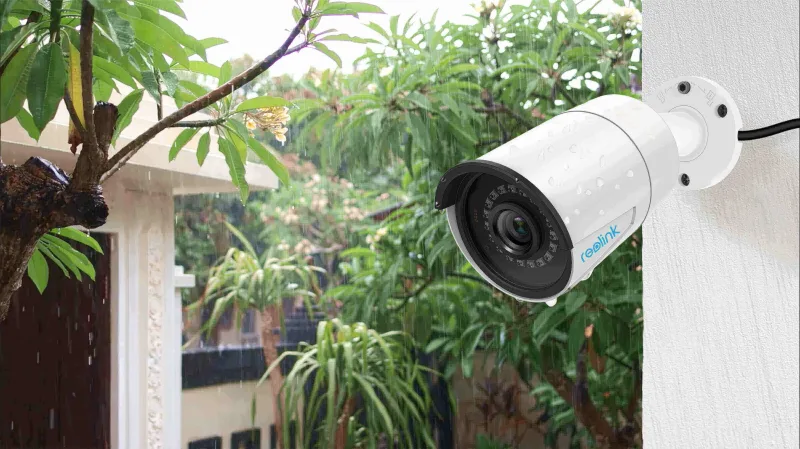
Reolink RLK8-520D4-5MP is a PoE Ethernet system (IEEE 802.3af) with optional DC 12V power, which typically translates to stable bandwidth and low-latency live view because each camera rides a wired link back to the NVR. In practical terms, a wired topology is largely insulated from Wi‑Fi congestion and RF dead zones, so uptime depends more on cable/termination quality than on the home’s wireless conditions. It also aligns with a «local-first» NVR setup that keeps core recording working even when the broader home network is having a bad day.
Night Owl BTWN81-F4-4L connects cameras over Wi‑Fi, while still requiring plug-in power (AC adapter) at each camera—so you avoid Ethernet runs, but you don’t eliminate wiring entirely. Because the video link is wireless, reliability is more sensitive to camera placement, wall materials, and channel congestion, and that sensitivity grows as distance and interference increase. Multiple reviewers report persistent disconnects and app reliability problems in retailer reviews for this model (Home Depot reviews).
Comparative conclusion: On pure connection stability, Reolink’s PoE Ethernet is the more defensible bet than Night Owl’s Wi‑Fi, especially in RF-challenging homes or when you want consistent live view and recording with fewer «camera offline» surprises.
Reolink RLK8-520D4-5MP does impose a reliability trade-off up front: the system’s dependability hinges on doing the physical install well—clean cable routing, weatherproofed junctions, and solid terminations. Once that’s done, day-to-day operation is typically predictable because it’s not coupled to Wi‑Fi quality or router/AP changes. For environments where you can run Ethernet (homes under renovation, small businesses, attic/basement access), that install effort often buys you long-term consistency.
Night Owl BTWN81-F4-4L is the more flexible option when you can’t pull Ethernet: you can place cameras where power is available and where Wi‑Fi is «good enough,» which is attractive for rentals or finished homes. But that same flexibility can come with iterative troubleshooting—moving cameras, adjusting mesh nodes, or revisiting settings after network changes—because the cameras’ performance is tightly tied to Wi‑Fi health. If your Wi‑Fi is strong at the mounting points, it can run well; if not, the system’s weakest link is usually the wireless environment, not the recorder.
Winner: Reolink RLK8-520D4-5MP
Video Quality
Reolink RLK8-520D4-5MP records at 2560 × 1920 (5MP), giving it more vertical pixels than 1440p-class systems. In practice, that extra pixel density can make a difference when you’re trying to resolve small details like package labels, facial features at mid-range, or fine textures (e.g., clothing patterns) in playback.
Night Owl BTWN81-F4-4L captures at 2560 × 1440 (2K / 4MP). That’s still a meaningful step above 1080p, but with fewer total pixels than 5MP, it generally has less headroom for digital zoom and tight crops before details start to look soft.
Conclusion: On pure sharpness and detail capture, Reolink has the clear edge with 5MP (2560×1920) vs 2K/4MP (2560×1440).
Reolink RLK8-520D4-5MP lists up to 100 ft of night vision range, matching what most midrange IR bullet systems aim for on paper. Its cameras are also rated IP66, which matters for maintaining image consistency over time—less chance of water/dust intrusion that can haze lenses or introduce artifacts.
Night Owl BTWN81-F4-4L also claims up to 100 ft night vision. Its cameras are rated IP65, which is still weather-resistant, but one step down in sealing compared with IP66 for harsher exposure.
Conclusion: For low-light range, it’s essentially a tie at 100 ft vs 100 ft, but Reolink slightly advantages on durability-related consistency with IP66 vs IP65.
Winner: Reolink RLK8-520D4-5MP
Recording Storage
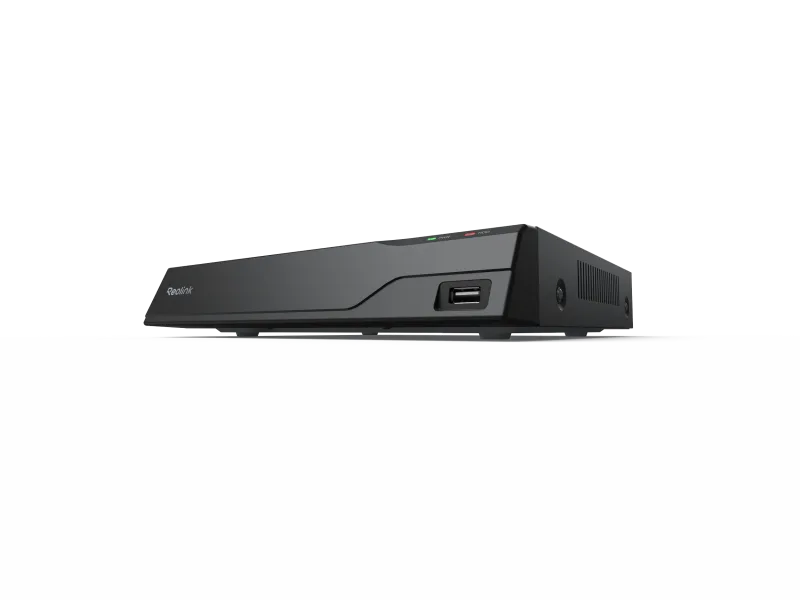
Reolink RLK8-520D4-5MP ships with a 2TB HDD, and the manufacturer explicitly positions it for continuous recording. With 4 cameras in the kit and a higher 5MP (2560×1920) stream per camera, that larger baseline drive directly translates into more usable retention before older footage gets overwritten.
Night Owl BTWN81-F4-4L includes a 1TB hard drive with its wireless NVR system, as listed by both retailers and the manufacturer. Since it also comes with 4 cameras (at 2K/4MP, 2560×1440), the smaller included drive generally means shorter retention at comparable recording settings.
Conclusion: On included storage capacity alone, Reolink clearly wins—2TB vs 1TB is a meaningful gap for most buyers because it typically buys longer recording history before looping.
Reolink RLK8-520D4-5MP uses an 8-channel NVR, which caps how many cameras can record to that internal storage without replacing the recorder. For many homes starting at 4 cameras, that still leaves room to grow, but it’s a hard ceiling if you plan a larger build-out.
Night Owl BTWN81-F4-4L has a 10-channel NVR and is described as «4K ready,» which may appeal if you expect to add more cameras later. The trade-off is that its included storage starts smaller at 1TB, so expanding camera count can compress retention even faster unless storage can be upgraded (not confirmed in the provided specs).
Conclusion: Night Owl has the channel-count edge (10 vs 8), but for most users focused on recording history out of the box, Reolink’s larger included drive is the more immediately valuable advantage.
Winner: Reolink RLK8-520D4-5MP
Smart Detection & Audio
Smart detection: what triggers alerts
Reolink RLK8-520D4-5MP supports person, vehicle, and animal detection, giving you three distinct object categories to filter motion events. In practice, that breadth is useful for reducing «everything is motion» noise—especially for driveways (vehicles) and yards (animals) where basic motion triggers can overwhelm timelines.
Night Owl BTWN81-F4-4L lists human detection with facial capture, which is narrower in scope than multi-class detection. If your priority is identifying people specifically, facial capture can be valuable, but you won’t get the same built-in event separation for vehicles and animals.
Conclusion: For purely security-driven alert triage, Reolink has the edge because person/vehicle/animal detection is more broadly useful than human-only detection in mixed-activity outdoor scenes.
Audio: recording vs two-way talk
Reolink RLK8-520D4-5MP provides a built-in microphone for audio recording, but it does not list 2-way audio (no talk-back speaker). That makes it better suited to evidentiary capture (hearing what happened) than interacting with visitors.
Night Owl BTWN81-F4-4L includes 2-way audio, enabling both listening and speaking through the camera. That’s a functional advantage for front-porch use cases—warnings, delivery instructions, or real-time verification without going outside.
Conclusion: For interactive deterrence and communication, Night Owl wins because 2-way audio is a clear capability step up over mic-only recording.
Winner: Tie — Reolink is stronger on detection breadth (person/vehicle/animal), while Night Owl is stronger on communication with 2-way audio; the better pick depends on whether you prioritize smarter alert classification or talk-back interaction.
Durability & Warranty
Reolink RLK8-520D4-5MP cameras are rated IP66, which indicates stronger sealing against water jets than lower IP tiers—useful for exposed eaves and storm-prone mounting points. Its core reliability story also benefits from a «wired-infrastructure» approach (PoE Ethernet), where long-term uptime is less dependent on Wi‑Fi conditions once the physical install is solid.
Night Owl BTWN81-F4-4L cameras are rated IP65, still weather-resistant but a small step down versus IP66 for water ingress protection. Because the cameras are Wi‑Fi connected, real-world durability can also include «operational durability»—how consistently the system stays connected in variable RF environments.
Conclusion: On weatherproofing alone, Reolink has a modest but real edge (IP66 vs IP65), especially for harsher rain exposure.
Reolink RLK8-520D4-5MP includes a 2-year limited warranty, which materially reduces risk if a camera or NVR fails after the first season of outdoor exposure. That longer coverage pairs well with the expectation that PoE installs are more «set it up once» and keep running, provided cabling and weatherproofing are done correctly.
Night Owl BTWN81-F4-4L comes with a 1-year limited warranty, which is more typical for consumer-grade kits but offers less cushion for multi-year ownership. In addition, multiple reviewers report connectivity and app reliability issues, which can translate into more support friction even if the hardware itself is intact.
Conclusion: Reolink clearly wins on warranty coverage (2 years vs 1 year), and the SoT feedback adds weight to prioritizing a system with fewer potential «downtime» headaches.
Reolink RLK8-520D4-5MP lists a camera operating range of 14°F to 131°F and an NVR range of 14°F to 113°F, which fits many climates but is less ideal for extreme cold. If your install sees sub-freezing winters, the lower bound (14°F) is the key constraint to watch.
Night Owl BTWN81-F4-4L specifies a wider camera operating range of -4°F to 140°F, suggesting better tolerance for very cold winters and hotter summers at the camera location. However, its NVR is rated 32°F to 104°F, which can become the limiting factor if the recorder is placed in an unconditioned garage or outbuilding.
Conclusion: Night Owl has the edge on camera temperature tolerance (-4°F to 140°F vs 14°F to 131°F), but the overall system still depends on keeping the NVR within spec.
Winner: Reolink RLK8-520D4-5MP — IP66 sealing and a 2-year warranty are straightforward durability advantages, while Night Owl’s main counterpoint is better camera temperature range rather than stronger weatherproofing or coverage.
Installation & Setup
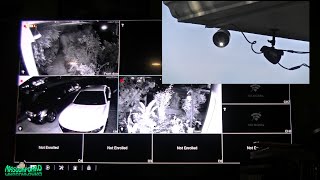
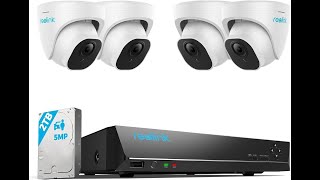
Up-front install effort (cabling vs placement flexibility)
Reolink RLK8-520D4-5MP is a wired PoE system, with cameras connecting over PoE Ethernet (IEEE 802.3af) and optional DC 12V. In practice, that means your main work is physical: routing Ethernet to each camera and doing clean, weather-safe terminations—more like a traditional CCTV/NVR install than a «stick it anywhere» camera. The upside is that once the cable is run, cameras tend to show up on the NVR with fewer pairing steps.
Night Owl BTWN81-F4-4L uses Wi‑Fi cameras that are plug-in (AC adapter) powered, so you avoid long cable runs while still needing a power outlet near each mounting point. This typically makes first-day installation faster in finished homes or rentals because you’re mostly optimizing camera placement and Wi‑Fi reach rather than drilling and fishing Ethernet. Retail listings also position it as a «Wireless NVR Security System» with 4 plug-in wireless cameras, reinforcing that convenience-first design intent.
Conclusion: Night Owl is the easier, faster install for most households because it skips Ethernet routing, while Reolink demands more labor up front due to PoE cabling.
Setup stability and «how much troubleshooting after it’s mounted»
Reolink RLK8-520D4-5MP leans «wired-infrastructure,» so day-to-day operation is less dependent on RF conditions once the physical install is solid. If you’re expanding later, the 8-channel NVR design also matches a conventional approach—add cameras by running more cable, which is predictable over longer distances. The trade-off is that any install mistake (poor weatherproofing, cable strain points) becomes the main source of future headaches, not connectivity.
Night Owl BTWN81-F4-4L is more sensitive to Wi‑Fi placement and interference—especially at exterior corners, detached garages, or dense walls where signal drops are common. Multiple reviewers report connectivity issues (cameras losing signal) and app reliability complaints, which can turn «quick setup» into iterative troubleshooting (move camera, re-test, adjust network, repeat). It does offer more headroom for growth with a 10-channel recorder, but expansion still has to live within real Wi‑Fi limits.
Conclusion: Reolink has the edge for post-install stability because PoE avoids Wi‑Fi variability, while Night Owl can be smoother on day one but more troubleshooting-prone if your Wi‑Fi environment is marginal.
Conclusion: If your priority is minimal installation effort and flexible placement, Night Owl’s plug-in Wi‑Fi approach is compelling; if your priority is predictable, infrastructure-style setup with fewer connectivity interruptions after installation, Reolink is the safer bet. Winner: Tie
Long-Term Reliability
Reolink RLK8-520D4-5MP is built around PoE Ethernet cameras (IEEE 802.3af) rather than Wi‑Fi, which generally reduces the number of variables that can knock cameras offline over months/years (router swaps, channel congestion, mesh changes). It also has a 2-year limited warranty and a slightly tougher outdoor rating (IP66) plus a wider NVR operating range (14°F to 113°F), both of which support the «install it and let it run» ownership model.
Night Owl BTWN81-F4-4L uses Wi‑Fi cameras that are plug-in powered (AC adapter), so long-term stability depends heavily on RF conditions and consistent network configuration. It comes with a 1-year limited warranty and IP65 weather resistance; its NVR is rated for 32°F to 104°F, which is a narrower tolerance band for harsher environments.
Conclusion: On the core reliability axis—predictable uptime and fewer «why is this camera offline?» moments—Reolink has the clearer structural advantage due to wired PoE and longer warranty coverage.
Reolink RLK8-520D4-5MP tends to be less sensitive to household network drift because its camera links are on Ethernet; the main long-term risk shifts to physical factors like cable wear, terminations, and weatherproofing quality (i.e., reliability hinges on install workmanship). With 2TB included storage, it also supports a more «appliance-like» continuous-recording posture without immediately having to manage retention pressure.
Night Owl BTWN81-F4-4L can be reliable in strong Wi‑Fi conditions, but multiple reviewers report persistent connectivity problems—cameras losing signal and app reliability complaints in retailer reviews (Multiple reviewers report…). The practical result is more ongoing «network hygiene» (placement tweaks, router/AP changes, re-validation after SSID/password changes) compared with a wired NVR system.
Conclusion: Reolink again has the edge for long-term consistency, while Night Owl’s reliability outcome is more conditional on Wi‑Fi environment quality and can require more iterative troubleshooting.
Winner: Reolink RLK8-520D4-5MP
The Bottom Line
After weighing connectivity, video, storage, smart features, and long-term ownership, the decision comes down to whether you can realistically run Ethernet to your camera locations.
Best for DIY wired install & long-term reliability: Choose the Reolink RLK8-520D4-5MP for its stable PoE connection, stronger out-of-the-box storage, and «set it and forget it» day-to-day consistency.
Best for renters or quick wireless setup: Pick the Night Owl BTWN81-F4-4L when you can’t pull Ethernet, since its Wi‑Fi approach reduces install friction in finished spaces (with the trade-off that performance is more sensitive to your wireless environment).
Overall, Reolink RLK8-520D4-5MP wins because it pairs PoE reliability with sharper 5MP detail, a larger included 2TB drive, tougher IP66 sealing, and a longer 2-year warranty—advantages that matter most once the system is up and running. Night Owl does better on installation flexibility (and adds 2-way audio plus more channels), but it’s the weaker bet if you’re prioritizing consistent uptime and dependable recording.
If you can run Ethernet, go Reolink and invest the effort in a clean, weatherproof install; choose Night Owl only when wiring is genuinely off the table and your Wi‑Fi coverage at the mounting points is strong.
FAQ
Which system has better night vision?
Which is easier to install?
Which has a longer warranty?
Can I expand the number of cameras later?
Does the Night Owl system have two-way audio?
Does the Reolink system support person, vehicle, and animal detection?
Are there known connectivity issues with the Night Owl system?
"Images are used for editorial and informational purposes only. All trademarks and images belong to their respective owners."