
WEIYING C1 vs P24: Projection HUD vs LCD Instrument – Which Car Display Should You Choose?
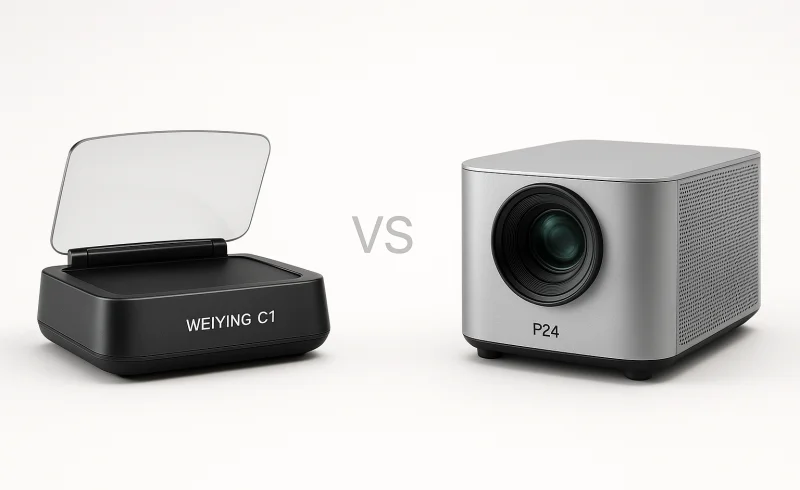
Discover the core differences between the WEIYING C1's subtle, reflective projection HUD and the P24's consistent, feature-rich LCD display. This guide will help you choose the ideal car display based on readability, features, and installation preferences.
TL;DR
- If you want a subtle, glanceable projected readout that keeps your dash clean → choose WEIYING C1
- If you prefer a clear, feature-rich LCD screen that works as a secondary instrument cluster → choose P24
- If you drive multiple vehicles or want consistent readability without placement fuss → either works, but P24 is more forgiving
The core trade-off is display philosophy: WEIYING C1 uses a reflective 1.8-inch optical imaging HUD that blends into the windshield—great for minimalists, but readability varies with windshield coatings, sun angle, and seating position. P24 uses a direct 3.5-inch full LCD that’s far more consistent and adds extras like low oil pressure alerts, slope tilt, and a digital odometer. P24 is easier to install (360° bracket) and more feature-complete; C1 is lighter on the dash but has reported auto-off quirks and demands precise positioning.
If you need smartphone syncing, regular firmware updates, or an app-based ecosystem, look at a modern OBD2 scanner or a full infotainment upgrade instead—neither device offers meaningful software support.
Market price overview

 Banggood
 Banggood
| Feature | P24 | WEIYING C1 |
|---|---|---|
| Power | ||
| Working Voltage (OBD Mode) | 11V~18VDC (12VDC/200mA) | 11~18VDC (12VDC/200mA) |
| Display | ||
| Display Size | 3.5 inches | 1.8 inches |
| Display Type | Full LCD instrument | Optical imaging HUD |
| Speed Unit Switching | KM/H, MPH | KM/H, MPH |
| Temperature Unit Switching | °C, °F | °C, °F |
| Automatic Brightness Adjustment | Yes | Yes |
| General | ||
| Product Type | Car head-up display (HUD) | Car head-up display (HUD) |
| Features | ||
| Alarm Functions | Overspeed, RPM, water temperature, voltage, oil pressure, slope and other vehicle alerts | Overspeed, RPM, voltage, water temperature, fatigue reminder, engine fault alert |
| Auto Power On/Off | Yes | Yes |
| Performance Tests | Acceleration test, braking test | Acceleration test, braking test |
| Fault Code Read/Clear | Yes | Yes |
| Live Data / PID Stream | Yes | Yes |
| Dimensions | ||
| Size (L x W x H) | 127 x 73 x 37 mm | 128 x 110 x 42 mm |
| Connectivity | ||
| Operating Modes | OBD2 + GPS | OBD2 + GPS |
| Satellite Positioning | GPS + Beidou | GPS + Beidou |
| GPS Mode External Power | USB cable supported | USB cable supported |
| Compatibility | ||
| GPS Mode Compatibility | All vehicles | All vehicles |
| OBD Mode Compatibility | OBD2/EOBD gasoline vehicles; GPS mode for all vehicles; not compatible with electric vehicles or modified ECUs in OBD mode | Requires compatible OBD2 vehicle; GPS mode can be used when OBD mode is unsupported |
📑 Table of Contents
Display & Readability
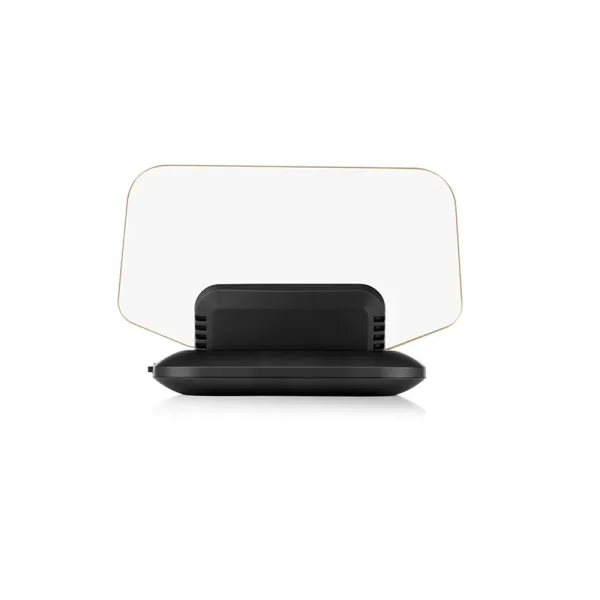
WEIYING C1 uses a 1.8-inch optical imaging HUD, which is designed to create a reflected, «projected» readout rather than a conventional on-dash screen. In real use, this style is more sensitive to windshield coatings/tint, dash curvature, driver eye position, and sun angle, so getting a clean image often comes down to careful placement and angle tuning (and small changes can noticeably affect legibility). It does include automatic brightness adjustment, but that can’t fully solve reflection/glare variability inherent to the projection approach.
P24, by contrast, uses a 3.5-inch full LCD instrument display—nearly double the diagonal size (3.5" vs 1.8") and a direct-view panel that’s typically more consistent across seating positions. It also supports automatic brightness adjustment, and the spec/design combination aligns with a more «instrument-like» secondary cluster that stays readable without relying on the windshield as part of the optical path. Practically, that makes it more forgiving for daily driving, even if it’s also more visually present on the dash.
Conclusion: On pure readability consistency, P24 has the clear advantage: the larger 3.5-inch direct LCD is inherently less context-sensitive than the C1’s 1.8-inch reflective optical HUD, whose legibility can swing with windshield/lighting conditions.
Winner: P24
Features & Alerts
Core alerts & diagnostics (overlap)
WEIYING C1 covers the essentials most drivers buy an add-on HUD for: overspeed, RPM, water temperature, and voltage alarms, plus fault code read/clear and a live data/PID stream. It also includes two extra safety-oriented items in its alarm list—fatigue reminder and engine fault alert—that aren’t called out in the P24 spec table. On paper, it’s positioned as a «set-and-forget» HUD once you’ve chosen which basic alerts matter.
P24 matches those same baseline capabilities—overspeed, RPM, water temperature, and voltage alarms, along with fault code read/clear and a live data/PID stream. Beyond the shared basics, its alarm set explicitly expands into additional vehicle-health monitoring, including low oil pressure as part of its alarm functions (also supported by the manual/retailer fact set). That makes it more of a small «instrument cluster» add-on than a minimal overlay.
Conclusion: Tie on the fundamentals (both cover core speed/engine/voltage alerts plus diagnostics), but P24 starts to pull ahead if you value broader vehicle-condition monitoring rather than just the headline basics.
Extra functions: oil pressure, slope, and odometer
WEIYING C1 does not list oil pressure or slope monitoring in its alarm/functions spec, focusing instead on fatigue reminder and engine fault alert alongside the standard overspeed/RPM/temp/voltage set. It supports the same two operating modes (OBD2 + GPS) as P24, but the feature list suggests fewer «specialty» readouts. In practical terms, it’s geared toward a quick, glanceable HUD-style status readout rather than being a multi-metric gauge replacement.
P24 adds three concrete, differentiating functions: a low oil pressure alarm, slope tilt measurement, and a digital odometer (each explicitly called out in its features/alarms specs and corroborated by the provided source facts). Those additions are meaningful because they expand the device from «alerts + basic telemetry» into «alerts + extra instruments,» especially for drivers who want more than speed/RPM/temp on display. If you’re using the unit as a secondary cluster, these are the kinds of metrics that justify the larger, more instrument-like approach.
Conclusion: P24 wins on feature breadth, thanks to oil pressure + slope tilt + digital odometer, while C1’s differentiators (fatigue reminder, engine fault alert) are narrower and don’t replace those additional instrument-style readouts.
Winner: P24
Compatibility & Installation
Mode compatibility (OBD vs GPS)
WEIYING C1 supports OBD2 + GPS and GPS + Beidou, and it can fall back to GPS when OBD mode is unsupported. However, its spec language is less explicit about exactly which vehicles are covered in OBD mode («requires compatible OBD2 vehicle»), so «full function» is more dependent on whether your specific car exposes the expected data reliably.
P24 also runs OBD2 + GPS with GPS + Beidou, but it’s clearer about how it handles edge cases: GPS mode is listed as compatible with «all vehicles», while OBD mode is limited to OBD2/EOBD gasoline vehicles and excludes electric vehicles and modified ECUs (in OBD mode). The manufacturer explicitly states it can switch to GPS mode if the car’s OBD2 protocol «is not open,» maintaining broad basic compatibility via GPS.
Conclusion: P24 has the edge on compatibility clarity and predictable fallback behavior (explicit «all cars» GPS mode plus stated OBD limits), while C1 can work broadly but is more «it depends on your car» for full OBD functionality.
Physical installation and placement sensitivity
WEIYING C1 is an optical imaging HUD with a smaller 1.8-inch unit, and that projection/reflection approach typically makes positioning more critical—dash angle, windshield coatings, and driver eye position can all determine whether the image looks clean or distracting. In practice, that means installation time often goes into micro-adjusting placement rather than just mounting and going.
P24 uses a 3.5-inch full LCD instrument display, which is generally more forgiving because you’re reading a direct screen. It also specifies a split bracket with 360° rotation to fine-tune angle and height, which directly reduces the «find the one perfect spot» problem during setup.
Conclusion: P24 wins for ease of installation thanks to its direct-view screen and 360° rotating bracket, while C1 demands more careful placement to get a stable, readable «HUD-style» result.
Power and wiring expectations
WEIYING C1 lists the same 11–18VDC (12V/200mA) working range in OBD mode and supports USB power in GPS mode, so it can be used without OBD power if needed. That said, getting the «set-and-forget» behavior users want still hinges on clean cable routing and a mount that doesn’t drift over time.
P24 matches the electrical baseline at 11V–18VDC (12V/200mA) and also supports USB power for GPS mode. Because it’s designed to operate as a small dash instrument, its install tends to be more about picking a location that doesn’t block vents/controls than about projection geometry.
Conclusion: It’s effectively a tie on power and wiring flexibility (both support OBD power and USB in GPS mode), with the bigger practical difference coming from each unit’s display style and mounting approach.
Winner: P24 — it’s more defensibly «universal» in day-to-day setup thanks to an explicitly supported all-vehicle GPS mode and a 360° rotating bracket, while the C1’s projection-style design makes placement more sensitive even when basic GPS fallback is available.
User Experience
WEIYING C1 is built around an optical imaging HUD with a 1.8-inch display module, which tends to work best as a glanceable, «projected» readout that doesn’t feel like you added a new screen to the dashboard. In practice, that experience is more sensitive to initial positioning: small changes in angle, dash shape, and where the reflection lands can determine whether it looks integrated or distracting (a known reality of reflected HUD-style designs). Conclusion: C1 has the edge for drivers prioritizing a minimal, set-and-forget cockpit—assuming you can dial in placement for your windshield and seating position.
P24 uses a 3.5-inch full LCD instrument display, so you’re reading a direct screen rather than relying on a reflected image. That generally makes placement more forgiving, and the unit’s split bracket with 360° rotation supports angle/height adjustments to get the screen where you can read it cleanly. Conclusion: P24 wins for straightforward «put it where you can see it» usability, but it’s inherently more visually present on the dash.
WEIYING C1 includes basics like auto power on/off plus standard units (KM/H/MPH and °C/°F) and automatic brightness adjustment, reinforcing a workflow where you set it once and mostly stop touching it. However, some users note it may not turn off reliably with the vehicle and may show display delay, which can undermine the «invisible helper» experience. Conclusion: C1 is better when it behaves like a passive overlay, but its UX is more vulnerable to small reliability annoyances because you’re counting on it to quietly do its job every drive.
P24 also supports auto power on/off, automatic brightness adjustment, and dual units, but its UX leans more «instrument cluster add-on» because it exposes more functions you might actively check. Beyond core readouts, it lists broader alerting (including oil pressure and slope alerts) and even shows slope tilt measurements and a digital odometer, which can encourage longer glances and more page switching than a minimalist HUD. Conclusion: P24 is more compelling if you actually want to interact with more data, but that same clarity and density can increase distraction risk if you’re prone to monitoring metrics while driving.
WEIYING C1 and P24 both operate as on-device firmware products rather than an app ecosystem, and both support OBD2 + GPS modes with GPS + Beidou positioning. Real-world satisfaction is therefore heavily tied to vehicle data behavior (what your car exposes in OBD, how stable it is) and to installation quality, not to ongoing software updates or app refinements. Conclusion: Neither has a meaningful software/platform UX advantage—expect to live with the menus and behavior you buy.
Winner: Tie — C1 is the better UX fit for a subtle, glance-first HUD feel (with more sensitivity to placement and some reported power-off/delay friction), while P24 is easier to read and adjust like a small instrument (but invites more interaction and visual presence).
Long-Term Reliability
WEIYING C1 is more sensitive to installation variables long-term because its optical imaging HUD relies on stable alignment and a consistent reflection path; small shifts in mounting or dash angle can degrade readability over time. Reliability-wise, some users note it may not turn off with the vehicle and can show display delay, which can turn into ongoing annoyance (and, in the worst case, a battery-drain concern) if your car’s power behavior doesn’t match the HUD’s auto-off logic. While it supports Auto Power On/Off: Yes, the real-world reports suggest that behavior isn’t consistently dependable across vehicles.
P24 uses a 3.5-inch Full LCD instrument readout, which is generally less fussy over months of use because you’re not depending on windshield/dash reflection quality to keep the display «locked in» visually. It also supports Auto Power On/Off: Yes, and the provided sources don’t surface persistent power or lag complaints in the same way as the C1. On the hardware side, the P24’s split bracket with 360° rotation can reduce long-term mounting frustration by making it easier to re-angle the unit if adhesives loosen or your preferred placement changes.
Conclusion: P24 has the more defensible long-term reliability profile because it avoids the C1’s reported auto-off/display-lag issues and is typically more forgiving to mounting and angle drift. Winner: P24
The Bottom Line
After comparing display performance, features, install realities, and long-term reliability, the decision comes down to whether you want a reflected HUD experience—or the clearest, most consistent instrument-style readout.
Best for Minimalists & Clean Dash Look: Choose the WEIYING C1 if you specifically want that subtle, projected HUD feel and don’t mind spending time dialing in placement for your windshield, dash, and seating position.
Best for Feature Lovers & Daily Drivers: Pick the P24 for its larger 3.5-inch direct-view LCD, broader data set (including oil pressure, slope tilt, and a digital odometer), and a setup that’s simply more forgiving day to day.
Best Value on a Budget: The P24 is the easy call at $33.83, delivering more features and fewer compromises than the pricier C1.
Overall,
because it was consistently stronger where it matters most: readability consistency, richer feature coverage, clearer compatibility/fallback behavior, easier mounting via its 360° rotating bracket, and fewer long-term concerns. The WEIYING C1 still does one thing better—delivering a more «HUD-like,» screenless cockpit aesthetic—but it asks you to accept more sensitivity to placement and more potential day-to-day friction.If you want the most confidence per dollar and the least hassle, go P24—and only choose the C1 if the reflected HUD experience is your top priority.
FAQ
Are both HUDs compatible with all cars?
Which HUD is easier to read in sunlight?
Do these HUDs display navigation directions?
Does the P24 monitor oil pressure or slope?
Does the WEIYING C1 turn off automatically with the vehicle?
Is the P24 compatible with electric vehicles?
What is the difference in display size between the C1 and P24?
"Images are used for editorial and informational purposes only. All trademarks and images belong to their respective owners."