
Vornado TRANSOM AE vs. Comfort Zone 9″ Smart Reversible Twin Window Fan: Alexa Integration or Flexible Installation?
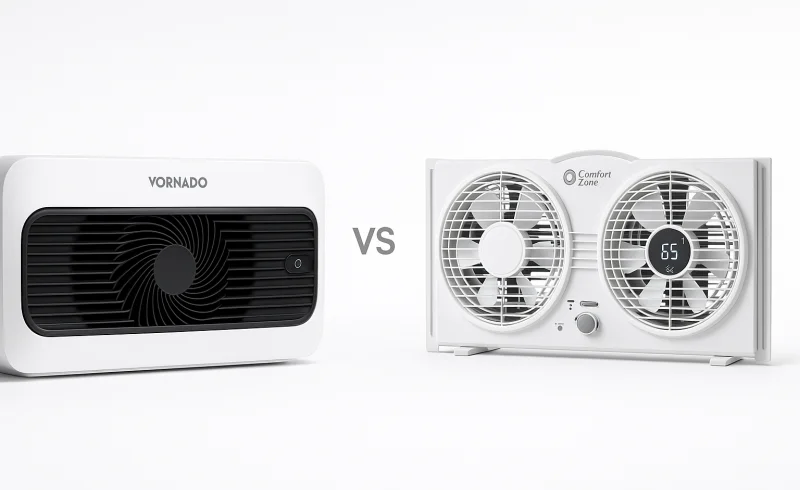
Explore the trade-offs between the Vornado TRANSOM AE and Comfort Zone 9" Smart Window Fans. Discover which model suits Alexa integration, flexible mounting, or non-ecosystem-dependent smart control, considering factors like warranty, ease of installation, and...
TL;DR
- The Vornado TRANSOM AE is the stronger fit for an Alexa-centered home and a window where the fan can stay installed for long stretches. It supports Alexa voice and app control, four speeds, electronic airflow reversal, automatic temperature control, and a 26–40-inch installation range.
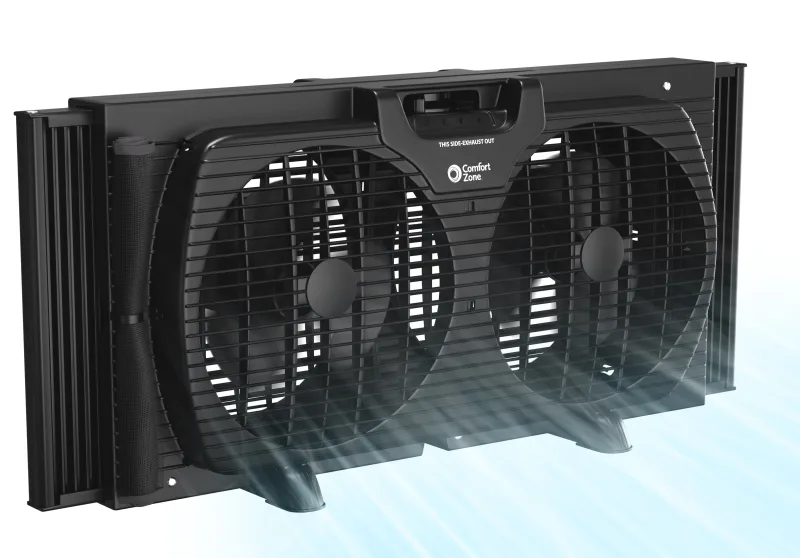
- The Comfort Zone 9″ Smart Reversible Twin Window Fan makes more sense when installation flexibility matters more. Comfort Zone documents horizontal or vertical mounting, app control, a handheld remote, three airflow modes, three speeds, a thermostat, and tabletop use.
- Neither has a defensible performance win from specifications alone. The manufacturers do not provide directly comparable airflow and noise data for these two models, and four speed settings do not automatically mean stronger airflow than three.
- The largest smart-home difference is narrower than the original comparison suggested: Vornado explicitly documents Amazon Alexa, while Comfort Zone documents its own app and remote for the current smart model. The current Comfort Zone listing does not clearly identify Alexa, Google Assistant, or Apple Home compatibility for this exact model.
- For documented long-term coverage, Vornado has the advantage with a five-year warranty versus Comfort Zone's one-year warranty.
One important caveat: Comfort Zone's current product page for model CZ13517 is internally inconsistent. It identifies the product as a 9-inch Smart Reversible Twin Window Fan but elsewhere describes a three-fan layout. Because those statements conflict, fan count is not used here as a basis for comparison.
| Feature | Vornado TRANSOM AE Window Fan | Comfort Zone 9" Smart Reversible Twin Window Fan |
|---|---|---|
| Power | ||
| Voltage | 120 V | 120 V |
| Power Cord Length | 8 ft | 60 in |
| Warranty | ||
| Warranty Length | 5 years | 1 year |
| Connectivity | ||
| Control App | Amazon Alexa app | Comfort Zone app (iOS/Android) |
| Remote Control | App-based remote control via Amazon Alexa app | Included remote control and app control |
| Smart Connectivity | Alexa-enabled (2.4 GHz Wi-Fi setup) | Wi-Fi-enabled |
| Voice Assistant Control | Amazon Alexa | Supported |
| Dimensions & Weight | ||
| Weight | 8.3 lb | 7 lb |
| Product Dimensions | 5.73 x 26 x 7.16 in (D x W x H) | 11.9 x 5.5 x 22.5 in (H x L x W) |
| Performance & Controls | ||
| Airflow Modes | Fan / Off / Exhaust | Cooling / Exhaust / Circulate |
| Speed Settings | 4 | 3 |
| Reversible Airflow | Electronically reversible | Reversible |
| Temperature Control | Auto Temp Control | Built-in adjustable thermostat |
| Installation & Compatibility | ||
| Screen Handling | Existing window screen can remain in place | Removable bug screen included |
| Mounting Orientation | Horizontal only | Horizontal or vertical |
| Supported Window Type | Single-hung and double-hung windows | Double-hung windows |
| Minimum Window Opening | At least 8 in high | At least 25 in wide and 8 in high |
| Supported Window Width | 26 to 40 in | 23.5 to 37 in |
📑 Table of Contents
Design & Installation
Vornado is more specialized; Comfort Zone is more adaptable
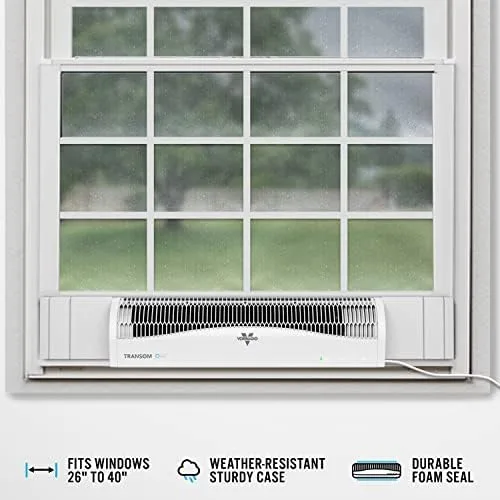
The Vornado TRANSOM AE is designed specifically for single- and double-hung windows. Vornado specifies a 26–40 in window width, at least 8 in of vertical opening, and horizontal installation only.
Its low-profile body is part of the appeal. Rather than using large accordion panels around a conventional twin-fan frame, Vornado uses its Soft-Fit foam-block system to fill the remaining space beside the unit. Vornado's installation guide recommends leaving the existing window screen in place.
That makes the TRANSOM AE particularly logical in a window where the fan will remain for much of the season. It is less attractive when the available opening falls outside its relatively narrow installation rules.
The Comfort Zone takes almost the opposite approach. Its expandable frame is listed for 23.5–37 in, although the same product page separately specifies a minimum double-hung window opening of 25 in wide by 8 in high. Given those two specifications, 25 inches should be treated as the manufacturer's stated minimum opening for window installation rather than assuming every 23.5-inch opening will work.
Comfort Zone also documents horizontal or vertical mounting, removable feet for tabletop operation, locking accordion expanders, and a removable bug screen. Those options matter in apartments, guest rooms, or other spaces where the same fan may not stay in one window all season.
Practical difference: Vornado offers the more purpose-built window installation. Comfort Zone offers more ways to position and reuse the unit.
Screen handling is different
Vornado specifically designed the TRANSOM AE around keeping an existing window screen in place. That can reduce one of the annoyances of seasonal fan installation: removing and storing the screen.
Comfort Zone instead includes its own removable bug screen. That is useful when the fan itself needs to provide the insect barrier, but the expandable frame still has to fit the actual window geometry correctly.
Neither design eliminates the need to measure the window before installation. Frame width alone does not describe sill depth, sash clearance, trim, locks, or other obstructions that can interfere with a window fan.
Cord length and portability
The TRANSOM AE weighs about 8.3 lb and has an 8 ft power cord. Comfort Zone lists its model at about 7 lb with a 60 in cord.
The weight difference is modest. The more meaningful distinction is the physical format: Comfort Zone's feet, multiple mounting orientations, and expandable twin-fan layout make it inherently easier to repurpose, while the TRANSOM AE is shaped around remaining in a window.
Installation verdict: No universal winner. Vornado is better suited to a compatible window where a clean, low-profile installation is the priority. Comfort Zone is substantially more flexible when orientation or tabletop use matters.
Smart Features & Controls
Vornado is explicitly an Alexa product
The TRANSOM AE does not use a separate Vornado smart-home app. Setup runs through the Amazon Alexa app, and Vornado's manual requires the phone to be connected to a 2.4 GHz Wi-Fi network during pairing.
Once connected, Vornado documents Alexa commands for:
- power
- four fan speeds
- direct or exhaust airflow
- Auto Mode
- thermostat settings
The Alexa app can also function as a remote interface, and the fan retains onboard controls for operation at the unit itself.
That is a coherent setup if Alexa is already the household control layer. It is also an important limitation: Vornado's manual specifically documents Alexa, not a broader selection of smart-home ecosystems.
A separate handheld remote is not documented for the TRANSOM AE. That distinction matters because the non-AE TRANSOM is a different model and is sold with a remote; the two versions should not have their control specifications mixed together.
Comfort Zone provides a conventional remote plus its app
For the current Comfort Zone CZ13517 listing, Comfort Zone documents Wi-Fi control through the Comfort Zone app on iOS and Android as well as remote control.
That gives Comfort Zone one simple advantage independent of smart-home integration: someone can change settings from across the room without a phone or voice assistant.
What should not be assumed is broader ecosystem compatibility. Comfort Zone has sold other connected fans that work with voice assistants, but the current product page for this exact model does not clearly name Amazon Alexa, Google Assistant, or Apple Home. Those integrations therefore should not be treated as confirmed here.
The correct distinction is:
- Vornado: explicit Alexa integration
- Comfort Zone: manufacturer app plus handheld remote
- Other smart-home platforms: verify against the exact Comfort Zone model and current app integration before relying on them
Modes and temperature control
The TRANSOM AE has four speeds, electronically reversible airflow, and Direct and Exhaust operation. Its integrated thermostat supports an Auto Mode, with Vornado documenting temperature settings from 60°F to 90°F.
Comfort Zone lists three speeds and three airflow functions: Cooling, Exhaust, and Circulating. It also lists an adjustable thermostat.
These systems should not be compared simply by counting modes. Vornado's fourth speed gives another manual airflow step, while Comfort Zone's additional named circulation mode changes how the twin-fan format can be used.
Likewise, both manufacturers describe temperature-responsive operation, but that does not make either fan an air conditioner. A window fan can change or exchange air; it cannot actively refrigerate incoming air.
Smart-control verdict: It depends on the control system. Vornado is the clearer fit for Alexa automation. Comfort Zone is more accessible without Alexa because it provides its own app and a handheld remote.
Airflow & Ventilation
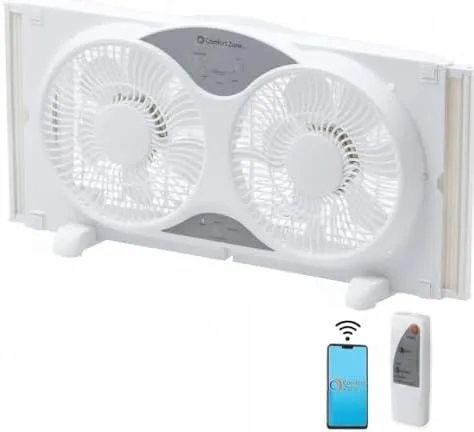
Specifications do not establish an airflow winner
This is where the original comparison overreached.
The TRANSOM AE has four speed levels while Comfort Zone has three, but the number of steps says nothing by itself about maximum airflow. A four-speed motor can move less air at its highest setting than a three-speed motor, and speed labels are not standardized across manufacturers.
The available manufacturer information also does not provide sufficiently comparable airflow and acoustic measurements for these exact models to make a credible claim that one moves more air, cools a room faster, or runs more quietly.
Without controlled measurements, the defensible comparison is about how airflow can be managed, not which product is more powerful.
Both are ventilation devices, not active cooling systems
In intake operation, a window fan brings outdoor air inside. That is most useful when outdoor conditions are more comfortable than the air indoors—for example, during a cool evening after a warm day.
In exhaust operation, the fan pushes indoor air outside. Exhaust can be particularly useful for removing accumulated warm air, but its effectiveness depends on replacement air being able to enter elsewhere in the home.
If the outdoor air is hotter than the indoor air, continuously drawing it inside can make the room warmer rather than cooler. Neither thermostat changes that basic limitation.
Vornado emphasizes automated intake/exhaust control
The TRANSOM AE can reverse airflow electronically, so changing between direct airflow and exhaust does not require physically turning the unit around.
Its Auto Mode adds thermostat-based operation. Vornado states that the fan automatically adjusts airflow based on room temperature, reducing the need for repeated manual changes.
That is most relevant for someone who wants the fan to behave more like a fixed appliance than a portable window accessory.
Comfort Zone offers a broader set of airflow modes
Comfort Zone lists Cooling, Exhaust, and Circulating modes. The distinction is useful because a reversible multi-fan design can do more than simply move all airflow in or all airflow out.
The important point is versatility rather than raw performance. The available specifications do not establish that Comfort Zone's circulation mode moves more total air than Vornado, nor that Vornado's fourth speed produces greater maximum airflow.
Airflow verdict: Tie on documented performance. Vornado provides more speed granularity and electronic reversal; Comfort Zone provides a more varied mode set. Comparable testing would be required to rank actual airflow or noise.
Ease of Use & Daily Experience
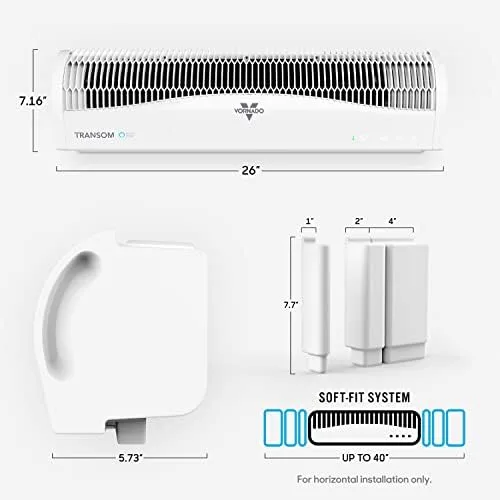
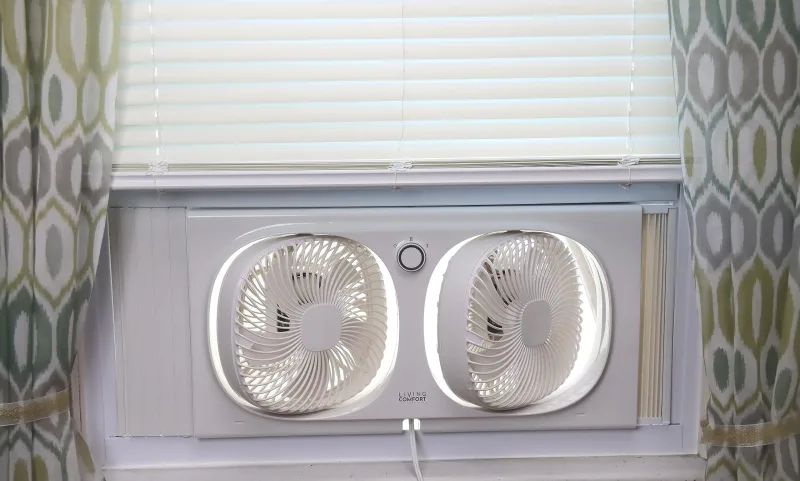
Vornado reduces physical interaction once installed
The TRANSOM AE's strongest usability case comes from combining:
- electronic airflow reversal
- four onboard speed levels
- thermostat-based Auto Mode
- Alexa control
- an installation designed to retain the existing screen
Once the fan is secured in a compatible window, most routine changes can be made without touching the fan itself.
There is one obvious dependency: much of the remote smart experience assumes Alexa is acceptable as the control layer. Someone who does not use Alexa still has the onboard controls, but loses much of what differentiates the AE model from a conventional electronically controlled window fan.
Comfort Zone offers more ways to use the hardware
Comfort Zone approaches convenience through physical flexibility instead.
The handheld remote avoids requiring a phone for routine adjustments. The Comfort Zone app adds connected control, while horizontal or vertical window installation and included tabletop feet make the same unit useful in more physical configurations.
That can be more practical than deeper automation when a fan moves among rooms or is only installed temporarily.
Window geometry may decide the comparison before smart features do
A fan that does not fit the intended opening is the wrong model regardless of its app.
Vornado's rules are unusually clear: single- or double-hung, 26–40 in wide, at least 8 in high, horizontal only.
Comfort Zone lists a wider range of positioning options but specifies a double-hung window and separately lists a minimum window opening of 25 × 8 in.
Those restrictions should be checked before treating either smart platform as the deciding factor.
Ease-of-use verdict: Vornado has the cleaner automation story in an Alexa home. Comfort Zone has the more flexible physical-control and placement story.
Build Quality, Weather Exposure & Warranty
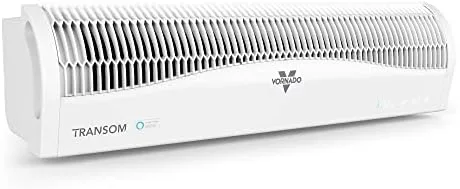
Vornado documents a weather-resistant enclosure—but that has limits
Vornado describes the TRANSOM AE enclosure as weather resistant. That is relevant for a device installed at the boundary between indoor and outdoor air.
It should not, however, be interpreted as permission to expose the fan freely to rain or outdoor conditions. Vornado's own safety instructions state that the product should not be used outdoors or exposed to weather or the elements, and its controls are intended to face indoors.
The meaningful advantage is therefore the documented enclosure design, not an assumption that the fan is weatherproof.
Comfort Zone does not make an equivalent weather-resistant enclosure claim for the CZ13517 on its current product page.
Warranty coverage strongly favors Vornado
Vornado warrants the TRANSOM AE against defects in materials or workmanship for five years for the original consumer or owner, subject to the warranty terms.
Comfort Zone lists a one-year manufacturer's warranty for the CZ13517.
Warranty length does not prove that one fan will physically last five times longer than the other. It does, however, provide a concrete difference in how long the manufacturers stand behind defects covered by their respective policies.
Durability verdict: Vornado, based on documented enclosure specifications and substantially longer warranty coverage.
The Bottom Line
These fans overlap in purpose but are built around different ideas of convenience.
The Vornado TRANSOM AE is the more coherent option for a compatible single- or double-hung window when Alexa integration, electronic reversal, four speed levels, thermostat-based automation, low-profile installation, and longer warranty coverage matter most.
The Comfort Zone 9″ Smart Reversible Twin Window Fan makes more sense when horizontal or vertical placement, a handheld remote, the Comfort Zone app, tabletop use, and three distinct airflow modes are more useful than Alexa-specific automation.
Neither deserves a performance win based on the available specifications. There is not enough directly comparable airflow or noise information to claim that one will ventilate a room faster or operate more quietly.
Likewise, Comfort Zone should not be presented as the obvious answer for Google Home or Apple Home users without confirming support for the exact model. The current CZ13517 product information clearly documents its own app and remote, but not those named ecosystems.
The practical decision is therefore mostly about window compatibility and control preference, not a universal ranking.
FAQ
Can I use these fans without connecting to an app or voice assistant?
What’s the biggest difference in installation?
Which fan is more energy efficient?
Is the 5‑year warranty on the Vornado worth the price?
Does the Vornado TRANSOM AE support Alexa?
What are the operating modes of the Comfort Zone fan?
Why is the Vornado more expensive than the Comfort Zone?
"Images are used for editorial and informational purposes only. All trademarks and images belong to their respective owners."