
Vgate vLinker MC vs KONNWEI KW906: Which OBD2 Adapter Wins for Your Diagnostics Workflow?
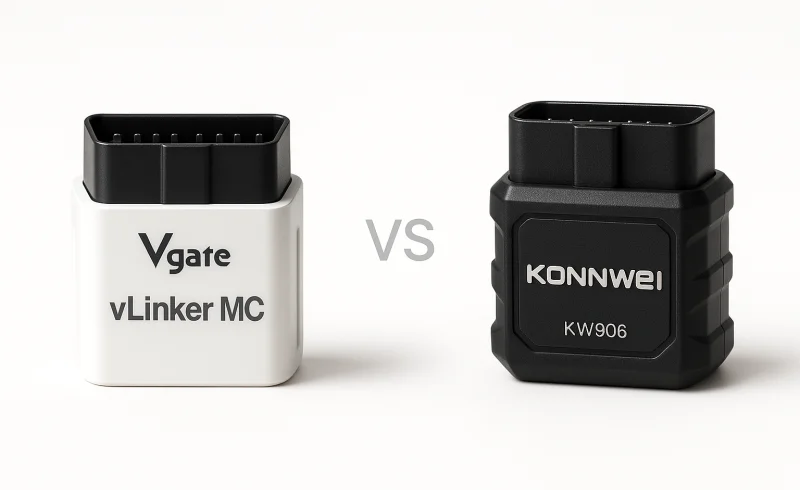
Explore the differences between Vgate vLinker MC and KONNWEI KW906 OBD2 adapters. Learn which adapter suits your diagnostic needs with insights on protocol support, device compatibility, and performance, ensuring you make an informed decision for your diagnost...
TL;DR
- If you want a reliable tool for repeated diagnostics, app switching, and deeper network access → choose Vgate vLinker MC
- If you need iOS support, a quick phone-first setup, or the lowest upfront cost for basic code reads → choose KONNWEI KW906
- If you only plan to clear a check-engine light once or twice a year with a single app → either works well enough, but expect fewer headaches with the KW906
The Vgate vLinker MC pulls ahead for users who treat their OBD adapter as a long-term diagnostic companion: it supports SW‑CAN/MS‑CAN networks, offers faster scan speeds, and feels more predictable across multiple apps and sessions. The KONNWEI KW906 wins on platform flexibility (iOS + Android + Windows), a newer Bluetooth 5.2 radio, and a simpler «pair and go» experience — but its lack of extended network support and occasional app‑dependent quirks limit its usefulness for advanced workflows.
Who should skip both: If you need factory‑level diagnostics (coding, programming, bi‑directional controls) or want a single official app with guided features, consider a dedicated scan tool like the BlueDriver or a professional‑grade interface instead.
Market price overview

Vgate vLinker MC

 Joom
Joom Joom
Joom Banggood
KONNWEI KW906
Banggood| Feature | KONNWEI KW906 | Vgate vLinker MC |
|---|---|---|
| General | ||
| Product type | Bluetooth OBD-II adapter | Bluetooth OBD-II adapter |
| Connectivity | ||
| Wireless interface | Bluetooth 5.2 | Bluetooth 3.0 |
| Compatibility | ||
| iOS support | Supported | Not supported |
| Android support | Supported | Supported |
| Windows support | Supported | Supported |
| Power Management | ||
| Sleep mode | Automatically enters sleep mode after 30 minutes when communication is terminated | BatterySaver sleep function |
| Diagnostic Protocols | ||
| SW-CAN / MS-CAN access | Not supported | Supported |
| Standard OBD-II protocols | SAE J1850 PWM, SAE J1850 VPW, ISO 9141-2, ISO 14230-4 KWP, ISO 15765-4 CAN | SAE J1850 PWM, SAE J1850 VPW, ISO 9141-2, ISO 14230-4, ISO 15765-4 |
📑 Table of Contents
Diagnostic Protocol Support
Standard OBD-II protocol coverage
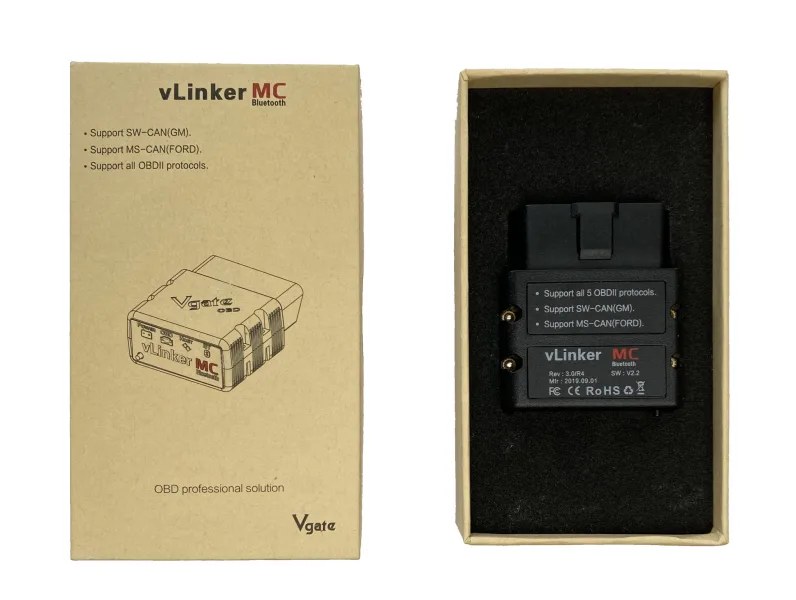
Vgate vLinker MC supports the core, legislated OBD-II stacks: SAE J1850 PWM/VPW, ISO 9141-2, ISO 14230-4, and ISO 15765-4 CAN. That’s the set most generic code-reading and live-data apps depend on for post-1996 vehicles, so it covers the baseline for emissions/engine diagnostics. A manual source also lists the same protocol family, reinforcing that its standard coverage isn’t «marketing-only» in nature.
KONNWEI KW906 also advertises full support for standard OBD-II, listing J1850 VPW, J1850 PWM, ISO 9141-2, KWP2000 (ISO 14230), and CAN. In other words, for typical check-engine-light triage and basic PID monitoring, it’s targeting the same minimum protocol set as Vgate. Manufacturer claims align with the common expectation for an ELM327-style Bluetooth scanner.
Conclusion: Tie for standard OBD-II—both list the mainstream protocol set needed for generic engine/emissions diagnostics.
Extended networks (SW-CAN / MS-CAN)
Vgate vLinker MC explicitly adds SW-CAN & MS-CAN access beyond standard OBD-II. That matters because SW-CAN/MS-CAN can be the difference between «engine codes only» and being able to communicate more broadly on certain vehicle network architectures (where supported by the car and app), which is why the vLinker line is often treated as a more tool-like adapter for deeper workflows. Manufacturer/retailer documentation repeatedly calls out this expanded network access.
KONNWEI KW906 is listed as not supporting SW-CAN / MS-CAN access. Even if it performs well for generic OBD-II, this spec limitation narrows the ceiling for advanced, vehicle-network-aware diagnostics scenarios where those buses are required. Practically, that can push you back into «basic reads/clears and generic live data» territory.
Conclusion: Vgate vLinker MC wins—its SW-CAN/MS-CAN support is a clear, spec-backed capability advantage that can unlock broader module/network access in compatible vehicles and apps.
Winner: Vgate vLinker MC
Device Compatibility & OS Support
Vgate vLinker MC is positioned primarily for Android and Windows users: its spec sheet lists iOS support: Not supported, while Android support: Supported and Windows support: Supported. That makes it a straightforward fit for PC-based diagnostics setups and common Android OBD apps, but it’s a non-starter if your primary device is an iPhone.
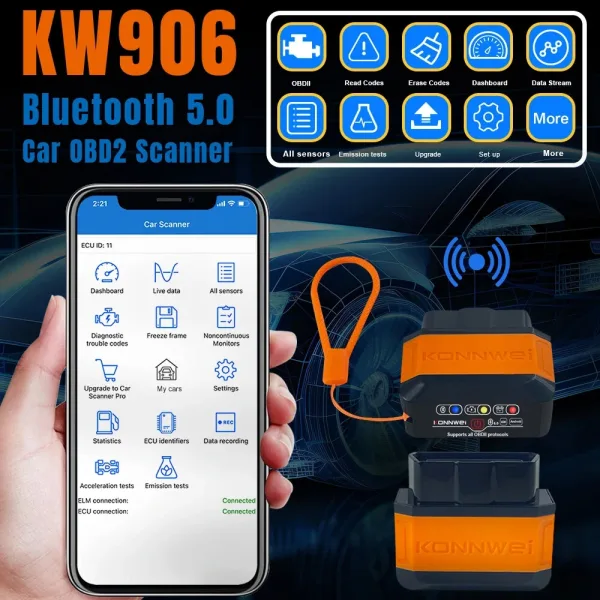
KONNWEI KW906 covers a wider device spread with iOS: Supported, Android: Supported, and Windows: Supported, matching the manufacturer’s positioning as an adapter «suitable for Android and iOS smartphones.» It also uses a newer Bluetooth stack—Bluetooth 5.2 vs the vLinker MC’s Bluetooth 3.0—which can matter as phone OS Bluetooth behavior evolves.
Conclusion: KW906 has the clear compatibility advantage because it supports iOS + Android + Windows, while vLinker MC is limited to Android + Windows. If you need iPhone support (or want the broadest «works with whatever device I have» coverage), KW906 is the safer pick.
Winner: KONNWEI KW906
Connectivity & Performance
Wireless link (Bluetooth version & platform impact)
Vgate vLinker MC uses Bluetooth 3.0, which is older on paper and can matter for modern phone pairing expectations. It’s also not supported on iOS (spec), so for iPhone users the «connectivity» story effectively stops before performance even comes into play.
KONNWEI KW906 uses Bluetooth 5.2 (spec), a newer standard that’s typically associated with more robust phone-side behavior. It’s explicitly supported on iOS and Android (spec), making it the more flexible choice when the primary goal is «connect quickly from a phone.»
Conclusion: For pure wireless modernity and phone-first compatibility—especially iOS—KW906 has the edge thanks to Bluetooth 5.2 vs 3.0 and iOS support vs none.
Diagnostic speed & session «responsiveness»
Vgate vLinker MC is positioned as a faster tool: the vLinker MC series is described as an upgrade with «up to 4× faster performance» than prior models (SoT). In practice, that kind of headroom tends to show up most during repeated scans and heavier live-data use where adapter throughput and timing matter.
KONNWEI KW906 doesn’t make a comparable speed claim in the provided specs or SoT; the emphasis is on Bluetooth version and core OBD functions (e.g., reading/clearing codes and viewing live metrics). Without a concrete throughput claim or benchmark, it’s hard to argue it outpaces the vLinker MC in scan/poll performance based on the data here.
Conclusion: On performance claims alone, Vgate vLinker MC wins with a stated up to 4× faster improvement, while KW906 provides no equivalent speed spec.
Winner: Vgate vLinker MC — it has the only explicit, quantified performance advantage (up to 4× faster), even though KW906 is the better pick if your priority is Bluetooth 5.2 and iOS phone connectivity.
Ease of Use & Setup
Vgate vLinker MC is workable to get running, but it tends to be less «handheld» in early setup because the experience leans on choosing the right third‑party app and matching the correct adapter/connection settings. It’s also Android + Windows only (per specs, no iOS support), which can complicate setup if your household is iPhone-first or you switch between devices.
KONNWEI KW906 is more plug-and-play for typical phone routines: it supports Android + iOS + Windows (including iOS support in the specs), so you’re less likely to hit a platform roadblock before you even start. Its newer Bluetooth 5.2 (vs Bluetooth 3.0 on vLinker MC) also aligns with «pair → connect → read data» expectations for casual users, and it includes a physical ON/OFF switch (SoT) that can simplify the «is it powered/visible?» step during pairing.
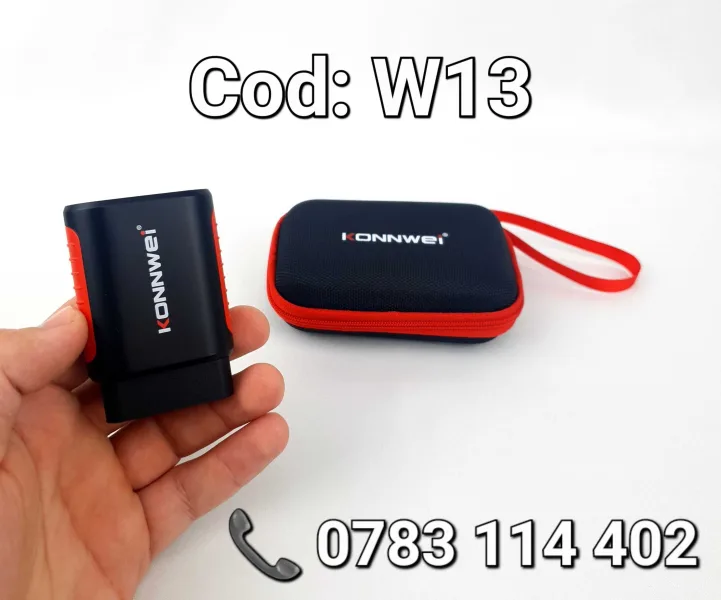
Conclusion: For pure setup simplicity—especially if you want iPhone compatibility and a mainstream pairing flow—KONNWEI KW906 is the more straightforward choice, while Vgate vLinker MC asks for more app/config awareness to get the most out of it.
Winner: KONNWEI KW906
Long-Term Value & Reliability
Vgate vLinker MC is positioned as a more «set-and-forget» adapter for repeat diagnostic work: it includes a BatterySaver sleep function and is explicitly described as having automatic sleep and wake-up functions to conserve power. It also supports SW-CAN / MS-CAN, which can matter over years of ownership if you end up needing broader network access beyond basic engine-code reads.
KONNWEI KW906 also has power management, automatically entering sleep after 30 minutes once communication is terminated, and it adds a physical ON/OFF switch for manual control. However, the long-term experience is more dependent on staying within a «simple workflow» (one app, quick sessions), since this adapter is aimed at phone-first use rather than extended troubleshooting routines.
Conclusion: For long-term ownership where predictability and «it just reconnects and works» matter, Vgate vLinker MC has the clearer reliability/value profile, mainly due to its sleep/wake behavior and broader diagnostic-network capability (SW-CAN/MS-CAN). KW906 can still be the better long-term value if your usage stays basic and you specifically benefit from its simpler, phone-oriented routine and manual power switch.
Winner: Vgate vLinker MC
The Bottom Line
After breaking down protocol coverage, device support, performance, and long-term value, the choice comes down to whether you need deeper capability or broader phone compatibility.
For iOS Owners: The KONNWEI KW906 is the clear pick because it supports iOS out of the box, while the vLinker MC is explicitly not supported on iPhone.
For Advanced Diagnostics & Enthusiasts: The Vgate vLinker MC wins thanks to SW-CAN/MS-CAN support, a stated «up to 4× faster» performance claim, and stronger long-term reliability positioning for repeat, heavier workflows.
For Casual, Budget-Conscious Users: The KONNWEI KW906 makes more sense if you’re mainly reading/clearing codes and checking basic live data, with simpler setup and a more phone-first experience.
Overall,
for users who want deeper diagnostic headroom and a more dependable, long-term tool-like adapter—while acknowledging the KW906 does better on iOS support, newer Bluetooth, and plug-and-play simplicity.If you’re building a diagnostics kit you’ll keep reaching for, go Vgate vLinker MC; if you just want quick, inexpensive phone-based checks (especially on iPhone), the KW906 will get the job done with less friction.
FAQ
Which OBD2 scanner works with iPhone?
Does Vgate vLinker MC support SW-CAN?
Is KONNWEI KW906 compatible with Android?
Is Vgate vLinker MC faster than other OBD2 scanners?
Does Vgate vLinker MC have automatic sleep mode?
Does KONNWEI KW906 have a physical power switch?
Which OBD2 scanner is better for DIY diagnostics?
📄 Used Manuals & Documentation
Vgate vLinker MC
"Images are used for editorial and informational purposes only. All trademarks and images belong to their respective owners."