
Tovala Smart Oven Pro vs CHEF iQ MiniOven: Guided, No-Fuss Meals or Do-It-All Countertop Flexibility?
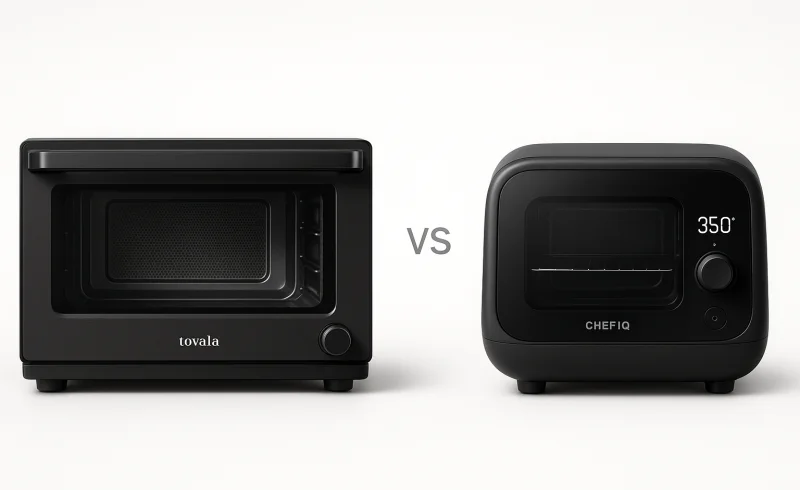
Explore the key differences between Tovala Smart Oven Pro and CHEF iQ MiniOven in terms of functionality, cooking modes, and user interface. Learn which oven suits your cooking style whether you prioritize guided recipes or versatile cooking options.
TL;DR
Quick Decision
- If you want a set-it-and-forget-it system that automates weeknight cooking with scan-to-cook simplicity and steam for moist, juicy results → choose Tovala Smart Oven Pro
- If you need a versatile mini oven that handles everything from proofing dough to air frying with adjustable high‑speed convection and a vast temperature range → pick CHEF iQ MiniOven
- If you mostly reheat, toast, and rarely use app‑driven features, both work, but Tovala’s physical buttons make everyday basics a little faster
Key Differentiators
Tovala builds its experience around steam cooking and a curated, scan‑guided workflow that trades improv freedom for repeatable results. CHEF iQ answers with 11 modes—including dehydration and proofing—enabled by an adjustable 3200 RPM fan and a 70°F–500°F range, but that breadth adds menu‑hopping and a steeper setup. The control philosophy splits too: dedicated buttons on the Tovala vs a color touchscreen on the CHEF iQ that centralizes power yet introduces smudge-prone, software‑dependent aging.
Who Should Skip Both
If you frequently cook for a crowd, need full‑size oven capacity, or want an appliance that never requires Wi‑Fi or an app account for its best performance, look at a large traditional toaster oven or a standard convection oven instead.
| Feature | CHEF iQ MiniOven | Tovala Smart Oven Pro |
|---|---|---|
| Cooking | ||
| Steam Cooking | Not supported | Supported |
| Convection Fan | Adjustable RPM DC motor (up to 3200 RPM) | One-speed convection fan |
| Cooking Functions | Bake, Roast, Air Fry, Dehydrate, Toast, Slow Cook, Broil, Air Broil, Reheat, Keep Warm, Proof | Bake, Broil, Toast, Reheat, Air Fry, Steam |
| Multi-Stage Cooking | Dual Cook | Automated Multi-Mode Cooking |
| Cooking Functions Count | 11 | 6 |
| Capacity | ||
| Pizza Capacity | Fits 13" pizza | Fits 10" pizza |
| Rack Positions | 3 | 3 |
| Controls | ||
| Control Interface | Color touchscreen control panel | Button-based control panel |
| Connectivity | ||
| Mobile App | CHEF iQ App | Tovala App |
| Standalone Operation | Yes, works by itself after first-use account linking | Yes, basic cook modes via oven buttons |
| Wireless Connectivity | Wi-Fi and Bluetooth | Wi-Fi |
| First-Use App/Account Setup | Yes | Yes |
| Dimensions & Weight | ||
| Weight | 37.41 lbs / 16.96 kg | 20.9 lb |
| Exterior Dimensions | 16.1 in W x 16.4 in D x 14.4 in H | 18.5" (L) x 14.32" (D) x 11.75" (H) (with Handle) |
| Interior / Cavity Dimensions | 13.54 in W × 13.15 in D x 6.38 in H | 12.75" (L) x 11" (D) x 8" (H) |
| Power & Temperature | ||
| Power | 1750W/120V | 1525 watts |
| Temperature Range | 70ºF - 500ºF | 225°F - 450°F |
📑 Table of Contents
Cooking Functions & Versatility
Mode breadth (what you can do)
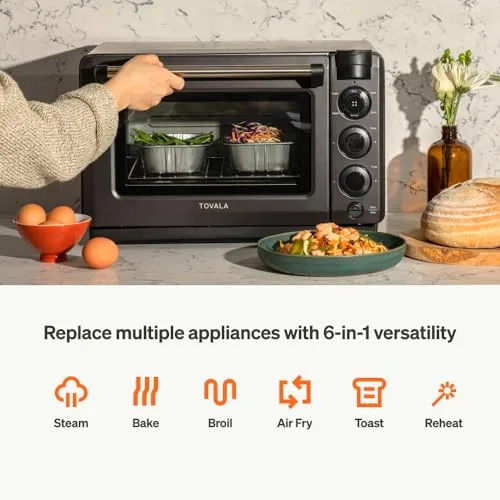
Tovala Smart Oven Pro focuses on a curated set of 6 cooking functions: Bake, Broil, Toast, Reheat, Air Fry, and Steam. That lineup is clearly optimized around day-to-day convenience (reheating, toasting, quick bakes) plus one differentiator—steam—rather than covering every specialty task.
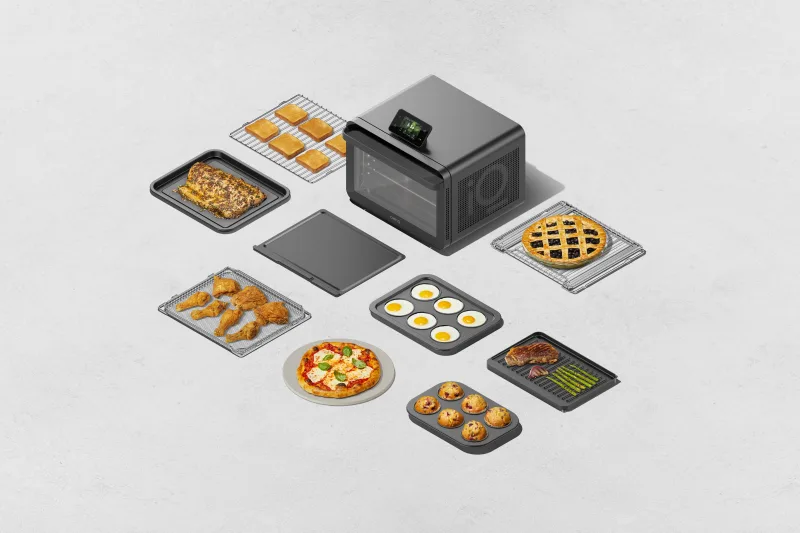
CHEF iQ MiniOven goes broader with 11 cooking functions: Bake, Roast, Air Fry, Dehydrate, Toast, Slow Cook, Broil, Air Broil, Reheat, Keep Warm, and Proof (also cited by the manufacturer and reviewers). The presence of Proof and Dehydrate is a real versatility gain for bread projects and low-temp drying tasks that Tovala doesn’t natively target.
Conclusion: CHEF iQ MiniOven wins on raw versatility, with 11 modes vs 6 and more specialty functions (notably proofing and dehydrating).
Steam vs no steam (food texture and reheat performance)
Tovala Smart Oven Pro explicitly supports Steam Cooking, and it’s a dedicated headline mode alongside bake/broil/air fry. In practice, steam is the feature most likely to change results for proteins, vegetables, rice, and leftovers, because it prioritizes moisture retention rather than just blasting hot air.
CHEF iQ MiniOven does not support steam cooking, so it can’t replicate steam-first reheating or steam-assisted cooking outcomes inside the same appliance. Its «Reheat» and other modes can still be effective, but they’ll rely on dry heat/convection rather than injected moisture.
Conclusion: Tovala Smart Oven Pro wins for steam-enabled cooking and reheating, since steam is supported vs not supported on CHEF iQ.
Convection control (air-fry crispiness and browning control)
Tovala Smart Oven Pro uses a one-speed convection fan, which simplifies operation but limits how much you can tune airflow for different foods. That matters most in «air fry»-style cooking, where airflow is the lever for crispness vs drying out.
CHEF iQ MiniOven uses an adjustable-RPM DC motor convection fan (up to 3200 RPM). Being able to change fan speed gives you a more direct way to balance browning, dehydration, and surface crisping, especially across different loads and foods.
Conclusion: CHEF iQ MiniOven wins for convection flexibility, because adjustable fan speed (up to 3200 RPM) beats a one-speed fan for manual crisping and browning control.
Multi-stage cooking (automation vs manual flexibility)
Tovala Smart Oven Pro offers Automated Multi-Mode Cooking, designed to switch between modes without you intervening mid-cook. Per the editor’s context, this is where Tovala’s «system» approach shines: it’s optimized for repeatable, low-effort outcomes, but can feel less flexible if you like improvising.
CHEF iQ MiniOven supports Dual Cook, which also enables multi-stage cooking, but sits within a broader, more manual «mini oven» toolkit. The editor’s context flags CHEF iQ as better for hands-on cooks who want breadth, with the trade-off that more options can mean more decision-making and menu navigation.
Conclusion: No clear winner—Tovala has the edge if you want automation and repeatability, while CHEF iQ fits better if you want general-purpose flexibility without committing to a guided workflow.
Winner: Tie — CHEF iQ MiniOven clearly leads on mode breadth (11 vs 6) and convection control (up to 3200 RPM vs one-speed), while Tovala Smart Oven Pro has a uniquely meaningful advantage in steam cooking (supported vs not supported) and a more automation-centric approach that some users will prefer.
Temperature Control & Power
Temperature range & low-temp precision
Tovala Smart Oven Pro is specified at 225°F–450°F, which covers the practical core of toasting, reheating, air frying, and typical baking. That narrower window aligns with its more guided, preset-driven approach, but it also means you can’t truly do low-temp holds for proofing or extended gentle cooks without workarounds.
CHEF iQ MiniOven runs from 70°F–500°F (manufacturer-stated), explicitly enabling Proof and Dehydrate modes alongside standard bake/roast/air-fry tasks. That 70°F floor vs 225°F is the key functional divider for dough proofing, yogurt-style low heat, and dehydration-style projects that simply don’t fit inside Tovala’s stated range.
Conclusion: On temperature flexibility—especially low-temperature control—CHEF iQ MiniOven clearly wins because 70°F–500°F opens categories of cooking that 225°F–450°F cannot.
Heating power & likely preheat/recovery
Tovala Smart Oven Pro is rated at 1525W, which is adequate for a compact countertop oven and supports its core modes (including a dedicated Steam function per manufacturer). However, with less rated wattage, it has less headroom on paper for fast heat-up and rapid temperature recovery after opening the door.
CHEF iQ MiniOven is rated at 1750W/120V, giving it a 225W advantage over Tovala. While wattage alone doesn’t guarantee performance, the extra power plus its performance-forward positioning (including a review claim of cooking «up to 40% faster than traditional ovens) suggests better potential for preheating and maintaining temp under load.
Conclusion: For raw heating power, CHEF iQ MiniOven has the edge with 1750W vs 1525W, which is a meaningful spec advantage for faster preheat and recovery in many real-world cooks.
Winner: CHEF iQ MiniOven
Connectivity & Smart Ecosystem

Connectivity options & «works without the app» reality
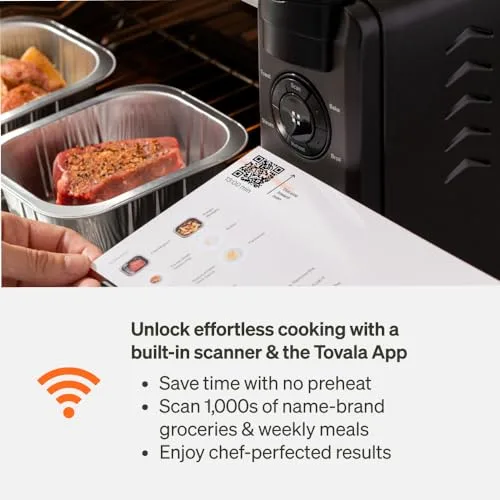
Tovala Smart Oven Pro connects over Wi‑Fi and supports basic cook modes via the oven buttons even if you’re not living in the app day-to-day. Its «smart» value is less about remote-control flexibility and more about a structured system—especially barcode scanning and guided programs—where the oven executes pre-defined steps for repeatable results. You still need first-use app/account setup, but the device remains more usable as a conventional countertop oven afterward.
CHEF iQ MiniOven supports Wi‑Fi and Bluetooth, and it also requires first-use account linking before it «works by itself» in standalone mode. In practice, the product’s differentiation is more app-centered: the ecosystem is designed as a command hub for selecting modes, getting guidance, and staying current with updates, so you’ll typically interact with software more often. That’s consistent with its broader function set (it’s built to do more, and the app helps manage that complexity).
Conclusion: Tovala has the edge for resilience and low-friction basic operation (buttons-first, Wi‑Fi optional for simple cooking), while CHEF iQ wins on connectivity breadth (Wi‑Fi + Bluetooth) but tends to keep you more tied to the app for the «full» experience.
Ecosystem design: guided «closed loop» vs feature-rich control center
Tovala Smart Oven Pro is intentionally organized around a tighter ecosystem: 6 cooking functions (Bake, Broil, Toast, Reheat, Air Fry, Steam) and automated multi-mode cooking that’s optimized for guided workflows. That «walled-garden» approach can reduce decision fatigue—when you follow the intended scan/recipe logic, you’re mostly choosing what to cook, not constantly managing how to cook it. Real-world reviews also note the Tovala app is required for optimal use, specifically to access barcode scanning and the signature guided experience.
CHEF iQ MiniOven positions the app more like a control center for a wider set of capabilities: 11 cooking functions (including Dehydrate, Slow Cook, Keep Warm, and Proof) plus Dual Cook for multi-stage-style workflows. The benefit is range—its broader mode set and guidance can support more varied «projects»—but the trade-off is more onboarding and navigation because more features live behind software flows. That aligns with the common friction pattern for app-forward devices: more menus and prompts can mean more setup friction and more opportunities for update-driven UI quirks over time.
Conclusion: Tovala’s ecosystem is clearer and more frictionless if you want scan-to-cook consistency, while CHEF iQ’s ecosystem is more powerful for users who want a broader, app-managed toolset and don’t mind the extra software engagement.
Winner: Tovala Smart Oven Pro
Capacity & Interior Space
Tovala Smart Oven Pro has an interior of 12.75 × 11 × 8 in (W×D×H), which leans taller for its footprint. That extra height supports bulkier items, and Tovala states it can cook a 4 lb chicken and fit up to 4 Tovala meal trays at once. The trade-off is flat, wide cookware: its stated pizza capacity tops out at 10 inches.
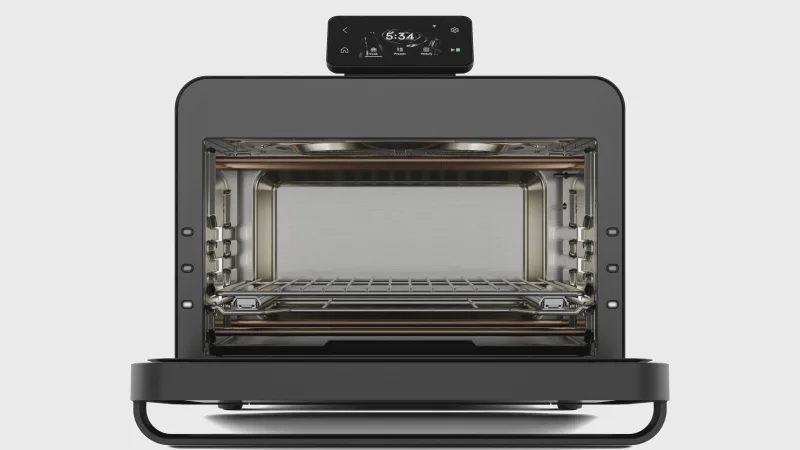
CHEF iQ MiniOven has a cavity of 13.54 × 13.15 × 6.38 in (W×D×H), prioritizing width and depth over height. That translates into more usable «floor area» for common bakeware, including a 13-inch pizza and even a 9×13-inch baking tray (per the MiniOven FAQ). While it’s shorter inside than Tovala (6.38 in vs 8 in), its wider platform tends to suit sheet-pan style meals and larger round items better.
Conclusion: For most day-to-day cooking, CHEF iQ’s larger floor area and 13-inch pizza / 9×13 tray support are more broadly useful than Tovala’s added height, so CHEF iQ MiniOven has the edge on capacity practicality.
Both ovens offer 3 rack positions, so vertical adjustability is comparable even though the cavities are shaped differently. With equal rack counts, the more decisive difference is the cavity geometry: Tovala’s taller 8-inch interior is most valuable for specific tall items, while CHEF iQ’s wider 13.54-inch cavity better accommodates standard family-size bakeware.
Winner: CHEF iQ MiniOven
Control Interface & Usability
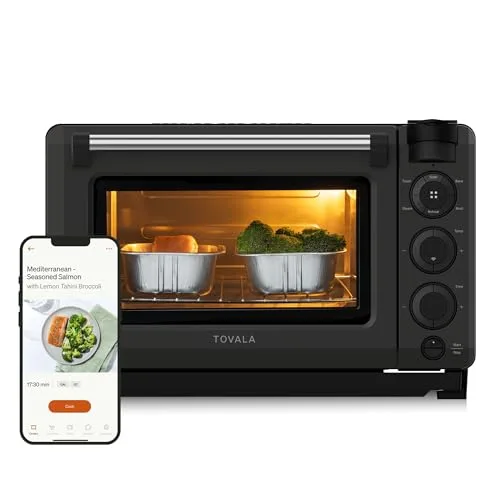
Tovala Smart Oven Pro uses a button-based control panel, which makes core actions feel immediate: you can jump straight into its 6 functions (bake, broil, toast, reheat, air fry, steam) without menu navigation. In practice, that «appliance-first» layout reduces day-to-day friction when you just want to start cooking and adjust later if needed. It also includes steam, giving you a distinct one-touch mode that isn’t merely a temperature/airflow variant.
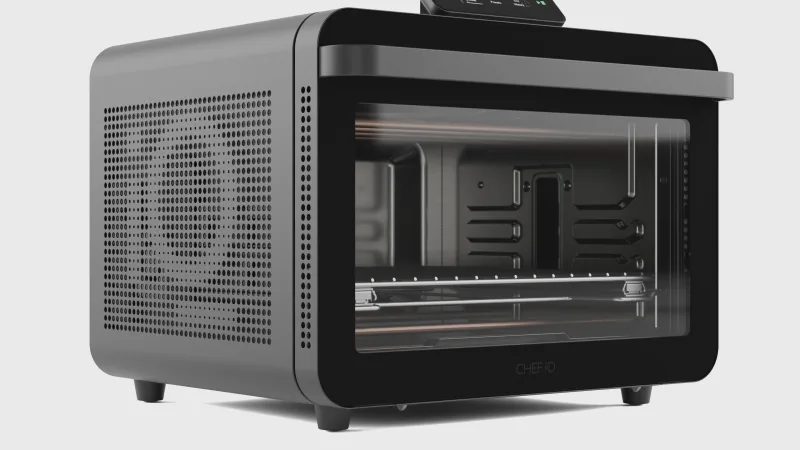
CHEF iQ MiniOven relies on a color touchscreen control panel to access its 11 functions (including dehydrate, slow cook, keep warm, and proof) from a single interface. That centralization supports more variety, but the trade-off is typically more taps to reach a specific mode—and touchscreen realities like smudges when used around oils and flour. The onboarding also tends to feel more «app-forward,» with more time spent pairing and learning the control logic.
Conclusion: For pure speed and predictability at the oven, Tovala’s physical buttons are the cleaner, lower-friction approach; CHEF iQ’s touchscreen is better if you value more modes in one place and don’t mind more UI steps.
Tovala Smart Oven Pro can operate in a genuinely standalone way for basics—its specs explicitly call out «basic cook modes via oven buttons,» even though optimal use leans on the app for scanning workflows. That scan/place/start pattern is intentionally low-decision, but it can feel like workflow lock-in if you prefer improvising mid-cook. The upside is repeatability: fewer choices to second-guess, especially for weeknight meals.
CHEF iQ MiniOven also supports standalone cooking, but only «after first-use account linking,» which makes it less plug-and-go if you want to avoid app setup. Its broader set of 11 modes can enable more projects, but it also increases the odds of menu-hopping or picking the wrong mode when you’re moving fast. If you like hands-on control, the touchscreen can be quick once learned—but it carries a clear «complexity tax.»
Winner: Tovala Smart Oven Pro — its button-first, low-decision interface is more consistently usable day-to-day, while CHEF iQ’s touchscreen and broader mode set trade simplicity for flexibility.
Physical Footprint & Weight
Tovala Smart Oven Pro takes up 18.5" (L) × 14.32" (D) × 11.75" (H) (with handle). Its footprint skews wider-but-shallower, which can work well on narrower counters while keeping depth under control for under-cabinet placement.
CHEF iQ MiniOven measures 16.1" (W) × 16.4" (D) × 14.4" (H). It’s a bit more square on the counter and noticeably taller, which can matter if you’re fitting it under low cabinets or shelving.
Conclusion: On pure counter space, it’s close to a wash—Tovala is wider and shorter, while CHEF iQ is deeper and taller, so the better fit depends on your kitchen’s clearances.
Tovala Smart Oven Pro is much easier to move: it’s listed at 20.9 lb (and also appears as 18.25 lb in a manufacturer spec), and the included handle helps when sliding it forward for venting or tucking it back. That lighter build aligns with renters or anyone who rotates appliances in and out of storage.
CHEF iQ MiniOven is dramatically heavier at 37.41 lb (16.96 kg). In practice, that mass tends to encourage a «permanent parking spot» on the counter rather than frequent repositioning, even if it can feel more planted during use.
Conclusion: Tovala clearly wins for portability and day-to-day repositioning (about 16.5 lb lighter using 20.9 lb vs 37.41 lb), while CHEF iQ’s weight is only an advantage if you value a more immovable, anchored feel.
Winner: Tovala Smart Oven Pro
Long-Term Ownership & Maintenance
Cleaning workload and what «regular maintenance» actually means
Tovala Smart Oven Pro adds steam cooking to its core toolkit (Steam is supported), which can be a real benefit for food quality but also introduces an extra upkeep variable: any steam-capable appliance can eventually require descaling depending on water hardness and usage patterns. Its cooking feature set is narrower (6 functions: bake, broil, toast, reheat, air fry, steam), which typically means fewer niche modes that create unique messes or accessory sprawl.
CHEF iQ MiniOven does not support steam, so there’s no steam-path maintenance to consider in the first place. However, its broader set of modes (11 functions including air fry, dehydrate, slow cook, proof) can translate into more varied residue types and more frequent «deep clean» moments if you actually use those programs regularly; it also ships with multiple accessories (e.g., ceramic-coated baking tray, air fryer/dehydrator rack).
Conclusion: Trade-off. Tovala’s steam may add occasional descaling-type upkeep, while CHEF iQ’s wider mode variety (11 vs 6) is more likely to create a higher cleaning burden over time if you lean into those features.
Controls that age: buttons vs touchscreen
Tovala Smart Oven Pro uses a button-based control panel, which avoids touchscreen-specific aging concerns like responsiveness drift, UI lag, or cosmetic wear affecting readability. It also supports basic cook modes via oven buttons, so the oven remains usable in a straightforward way even when you’re not actively engaging with the app.
CHEF iQ MiniOven relies on a color touchscreen control panel, which can be fast once learned but inherently adds a «screen» as a long-term wear item (smudging, potential responsiveness changes, and a UI layer that can feel heavier over time). It does work standalone after first-use account linking, but the interaction model still centers on software-like navigation rather than simple tactile controls.
Conclusion: Tovala has the edge for long-term control durability and low-friction day-to-day operation because physical buttons generally introduce fewer aging variables than a touchscreen.
Software dependence and long-run predictability
Tovala Smart Oven Pro is optimized around a guided, repeatable workflow (including app-driven scanning for the «signature» experience), but the ecosystem is relatively focused—fewer modes (6 total) and fewer places for the interface to sprawl. That «system» approach can make the appliance feel habitual for predictable meals, with less decision fatigue once you commit to the workflow.
CHEF iQ MiniOven has a heavier software surface area by design: more modes (11) and an experience that can change meaningfully with firmware/app updates (sometimes for the better, sometimes introducing new quirks). Over long ownership, that breadth can create a «complexity tax,» where some features go unused and the perceived value depends on how stable and intuitive the software remains.
Conclusion: Tovala is more predictable long-term because its experience is more focused (6 functions) and less exposed to touchscreen/UI-driven variability than CHEF iQ’s feature-rich, update-sensitive setup (11 functions).
Winner: Tovala Smart Oven Pro
The Bottom Line
After breaking down modes, controls, capacity, and smart features, the takeaway is that each oven is «best» for a different kind of cook—not a different budget tier.
For Meal‑Kit and Hands‑Off Cooks: The Tovala Smart Oven Pro is the clear pick thanks to scan-to-cook automation and its steam capability for consistent, low-effort results.
For Versatile Home Chefs and Tinkerers: Choose the CHEF iQ MiniOven for its wider toolset—more cooking modes, adjustable convection, and low-temp options that better support experimentation.
For Budget‑Conscious Buyers: The CHEF iQ MiniOven delivers more features per dollar, pairing stronger spec breadth (modes, power, temperature range) with a smart ecosystem.
For Small Kitchen with Frequent Relocation: The Tovala Smart Oven Pro wins on day-to-day livability with its lighter build and easier portability, without making you live in touchscreen menus to cook the basics.
In the head-to-head, this lands as a true split decision: CHEF iQ leads on versatility (11 modes, adjustable fan, broader temperature range, and more practical floor space), while Tovala counters with the meaningful edge of steam plus a simpler, button-first experience that stays predictable long-term.
If you want an oven that «runs the play» for you—especially with steam and guided cooking—go Tovala Smart Oven Pro; if you want a countertop workhorse that rewards hands-on control across more techniques, the CHEF iQ MiniOven is the better fit.
FAQ
Does the Tovala Smart Oven Pro work without a subscription?
Can the CHEF iQ MiniOven really replace my full-size oven?
Which oven is easier to clean?
Does the Tovala Smart Oven Pro have an air fryer function?
What is the maximum temperature of the CHEF iQ MiniOven?
How heavy is the CHEF iQ MiniOven?
Which oven is better for baking bread?
"Images are used for editorial and informational purposes only. All trademarks and images belong to their respective owners."