
SunFounder PiDog vs Hiwonder MechDog-S: Open-Source Linux Robot Dog vs Guided Learning Platform
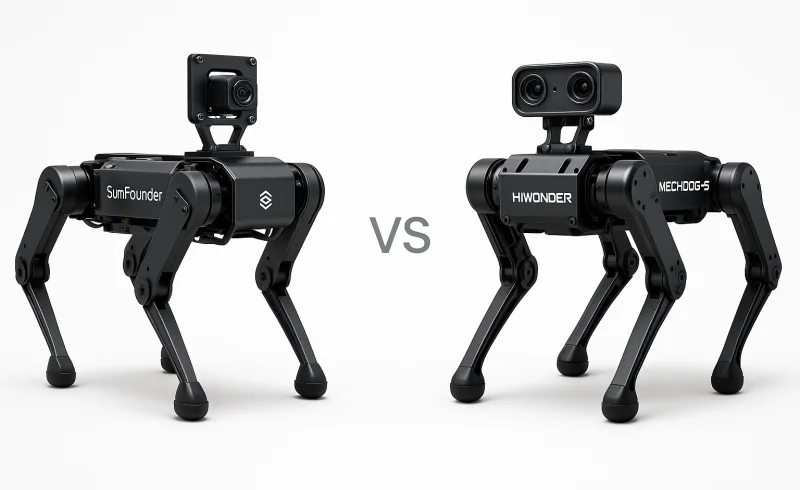
Explore the differences between SunFounder PiDog and Hiwonder MechDog-S. PiDog offers flexible programming with Raspberry Pi, ideal for advanced robotics and vision experiments. MechDog-S provides guided learning, multi-language coding, and stability for begin...
TL;DR
- If you want maximum programming flexibility and a full Linux computer on legs → choose SunFounder PiDog.
- If you care about guided learning, out-of-box stability, and multiple coding languages (Scratch, Python, Arduino) → choose Hiwonder MechDog-S.
- If you’re a classroom teacher needing repeatable demos with minimal OS administration overhead → either works, but MechDog-S’s vendor-cohesive flow will save time.
Key Differentiators: PiDog runs on a Raspberry Pi (5/4/3B+/Zero 2W) with a 5MP camera (2592×1944) and 12 metal gear servos—ideal for deep computer vision experiments and complex gaits if you’re comfortable with Linux maintenance. MechDog-S uses an ESP32+ESP32-S3 compute profile, 8 coreless servos, and a 320×240 camera, offering a self-balancing algorithm and a more appliance-like experience. PiDog wins on openness and raw vision potential; MechDog-S wins on guided onboarding and day-to-day reliability.
Who Should Skip Both: If you need a rugged field robot for outdoor patrol or a platform with heavy onboard AI compute, consider a more powerful embedded SBC like the NVIDIA Jetson-based alternatives instead.
| Feature | SunFounder PiDog | Hiwonder MechDog-S |
|---|---|---|
| Build | ||
| Material | Aluminum alloy | Hard aluminum alloy |
| Power | ||
| Rechargeable battery | Included | Included |
| Battery specification | 2×18650 Li-ion battery pack, 2000mAh, 14.8Wh | 7.4V 1500mAh 5C LiPo battery |
| Motion | ||
| Servo type | Metal gear servos | HPS-0618SG coreless servos |
| Servo count | 12 servos | 8 servos |
| Sensors & Vision | ||
| IMU | 6-DOF IMU | Built-in IMU sensor |
| Vision hardware | 5MP Raspberry Pi camera module (OV5647) | ESP32-S3 vision module |
| Camera resolution | 2592×1944 | 320*240 |
| Ultrasonic sensor | Ultrasonic module | Glowy ultrasonic sensor |
| Platform & Software | ||
| Product type | Raspberry Pi robot dog kit | Desktop quadruped robot dog |
| Controller platform | Raspberry Pi 5/4B/3B+/3B/Zero 2W | ESP32 robot controller + ESP32-S3 vision module |
| Programming languages | Python | Python, Scratch, Arduino |
| Connectivity & Control | ||
| Mobile app control | Supported via SunFounder Controller app | Supported |
| Wi-Fi video transmission | Supported, real-time FPV | Supported via WiFi hotspot |
📑 Table of Contents
Build & Motion
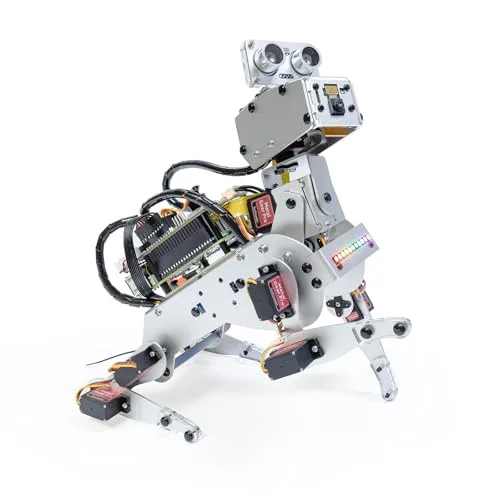
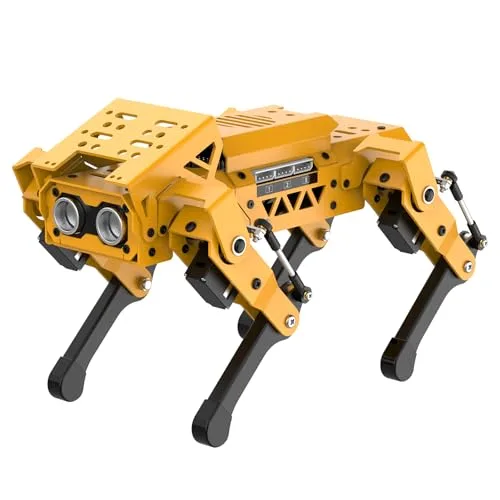
SunFounder PiDog is built around an aluminum alloy structure and uses 12 metal gear servos, which is a big contributor to how «articulated» it can be. With more actuated joints, PiDog is inherently better suited to complex poses and multi-step behaviors (the spec sheet’s 12 vs 8 servo split matters more than small cosmetic design differences). In practice, it’s the kind of platform where your gait quality will track how well you tune/calibrate the robot.
Hiwonder MechDog-S also uses an aluminum alloy chassis (listed as hard aluminum alloy) but relies on 8 HPS-0618SG coreless servos. Fewer servos generally means fewer degrees of freedom to exploit for expressive motion, but the coreless approach is positioned for speed and responsiveness in the joints it does have. The net effect is a simpler motion system that aims to look good with less tweaking.
Conclusion: PiDog has the hardware advantage for articulation thanks to 12 metal gear servos vs 8 coreless, while MechDog-S prioritizes simpler, speed-oriented actuation in a more compact layout.
SunFounder PiDog includes a 6-DOF IMU, but there’s no spec-backed claim here of an onboard self-balancing gait system; as a Raspberry Pi kit, it leans on the user to iterate on gait logic and calibration. That can be powerful for learning, but it can also expose more «robot project» friction—multiple forum threads report issues around servo calibration and general operational stability on PiDog (app crashes/sound problems/calibration challenges) in the wild (Multiple reviewers report…). This matters for motion because calibration quality directly affects stance, foot placement, and repeatability.
Hiwonder MechDog-S pairs its built-in IMU sensor with a stated dynamic balance algorithm for self-balancing, which is explicitly aimed at keeping the gait stable out of the box. That kind of control layer can mask minor variations in surface friction or battery state better than a purely user-tuned gait, especially for beginners. The trade-off is that you’re benefiting from (and partially bounded by) the vendor’s control model rather than a fully DIY gait stack.
Conclusion: MechDog-S has the clearer out-of-box gait stability story due to its dynamic balance algorithm + IMU, whereas PiDog’s ceiling is higher but depends more on user tuning and calibration quality.
Winner: Tie — PiDog wins on motion potential and pose complexity (12 servos), while MechDog-S wins on out-of-box gait smoothness/stability with its dynamic balance self-balancing approach.
Vision & Sensors
Camera hardware & resolution
SunFounder PiDog uses a 5MP Raspberry Pi camera module (OV5647) with a stated resolution of 2592×1944. In practical terms, that pixel count supports more reliable vision experiments (fine-grained features, smaller targets at distance, and clearer frames for debugging in Python/OpenCV-style workflows). It also aligns with PiDog’s broader «robot-as-a-Linux-computer» approach, where the camera is often central to iterative perception code.
Hiwonder MechDog-S, by contrast, uses an ESP32-S3 vision module with a listed camera resolution of 320×240. That’s enough for basic «AI vision recognition, tracking, and line following» demos in vendor tooling, but it leaves far less detail for custom CV pipelines or anything requiring robust detection under varied lighting/backgrounds. The lower-resolution feed also limits how far you can push cropping, digital zoom, or feature-based tracking before images become too noisy.
Conclusion: On camera capability for computer vision learning, PiDog has a clear, defensible advantage (2592×1944 vs 320×240) and is the stronger platform for detailed detection and tracking tasks.
Proximity sensing (ultrasonic)
SunFounder PiDog includes an ultrasonic module, which is typically used for short-range obstacle detection and distance-triggered behaviors. While the spec doesn’t state range/refresh, pairing ultrasonic with a Pi camera is a common and flexible pattern for «avoid + follow + search» behaviors in code-first projects.
Hiwonder MechDog-S also includes an ultrasonic sensor—specifically listed as a «glowy ultrasonic sensor»—supporting similar proximity use cases like obstacle avoidance. Because MechDog-S leans into packaged behaviors and demos, ultrasonic tends to be used more as an input to predefined routines rather than a sensor you constantly re-plumb in a Linux stack.
Conclusion: With both offering ultrasonic sensing (and no range/accuracy numbers provided), this point is effectively a tie.
IMU / balance sensing
SunFounder PiDog lists a 6-DOF IMU, which is the baseline for attitude estimation and stabilization experiments. In a Raspberry Pi environment, that’s useful not just for balance, but for logging and teaching concepts like sensor fusion and control loops.
Hiwonder MechDog-S specifies a built-in IMU sensor and explicitly pairs it with a dynamic balance algorithm for self-balancing per vendor documentation. Even without a stated DOF count, the emphasis here is a more integrated «works out of the box» stability stack rather than an IMU you primarily use for custom experiments.
Conclusion: MechDog-S has the edge for guided self-balancing behavior, while PiDog is better suited to «close-to-the-metal» IMU learning and tinkering; neither is a universal win.
Winner: SunFounder PiDog — its 5MP (2592×1944) camera is a meaningful, spec-backed advantage for computer vision work, while ultrasonic and IMU capabilities are broadly comparable with different integration priorities.
Platform & Compute
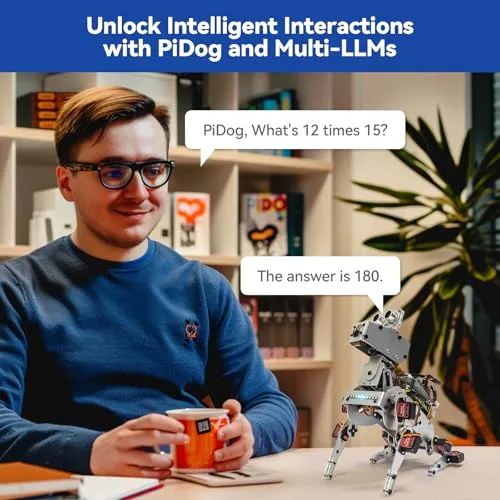
SunFounder PiDog is explicitly a Raspberry Pi–based kit, with stated compatibility across Raspberry Pi 5 / 4B / 3B+ / 3B / Zero 2 W. In practice, that means you’re running a full Linux computer on the robot, which opens the door to standard tooling (SSH, package managers, Python environments) and more ambitious workloads than typical microcontroller-class boards. That flexibility is also reflected in how PiDog is commonly positioned in the sources as a Raspberry Pi project you can iterate on heavily.
Hiwonder MechDog-S uses an ESP32 robot controller + ESP32‑S3 vision module, which is a very different compute profile than a Pi-class SBC. The upside is a tighter, more embedded-style system that generally prioritizes predictable control loops and lower overhead versus «desktop Linux on legs.» The trade-off is lower compute headroom for heavier perception stacks or multi-service networking compared with a Raspberry Pi platform.
Conclusion: PiDog clearly wins on raw compute flexibility and headroom (Pi 5/4/3/Zero 2 W options vs ESP32/ESP32‑S3), while MechDog‑S is built for a more integrated embedded approach that can feel more appliance-like.
SunFounder PiDog largely assumes a code-first workflow on Linux, and that openness comes with real setup and maintenance overhead. Multiple reviewers report operational friction—such as app crashes, sound issues, and servo calibration challenges—showing up in real ownership, beyond what a spec sheet suggests (Multiple reviewers report…). Some users also note difficulty stopping programs cleanly via the Stop button or Ctrl+C, which matters when the «platform» is a general-purpose OS running your own processes (Some users note…).
Hiwonder MechDog-S is designed around vendor-controlled firmware/modules, and its programmability is packaged to be approachable: Python, Scratch, and Arduino are all officially supported. While it’s more constrained than Linux for deep stack changes, this kind of platform typically reduces the number of early «system administration» decisions and keeps learners focused on behaviors and examples rather than OS plumbing. In other words, the platform is less open-ended, but often more guided and repeatable for demos and structured learning.
Conclusion: MechDog‑S has the advantage for guided, beginner-friendly compute/software flow, while PiDog has the advantage for advanced, Linux-native experimentation—but that comes with more user-managed complexity.
Winner: Tie — PiDog is the stronger choice if you want Raspberry Pi/Linux flexibility and compute headroom; MechDog‑S is the better fit if you prioritize a more integrated, beginner-oriented embedded platform with fewer moving parts to manage.
Programming & Ecosystem
Programming languages & learning curve
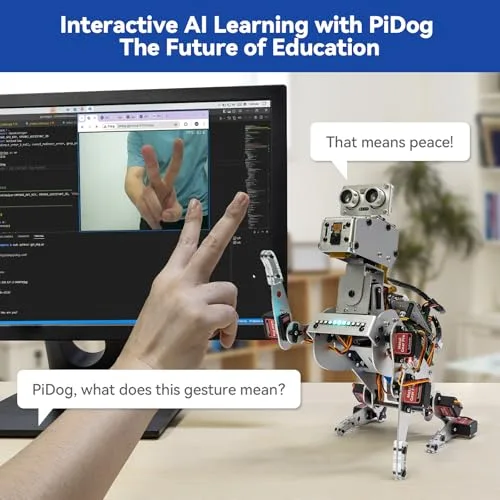
SunFounder PiDog is a Raspberry Pi robot dog kit that lists Python as its programming language, aligning with «code-first» learning on a full Linux computer. In practice, that tends to push users toward editing Python on the Pi (often over SSH) and treating the robot like a developer sandbox rather than a guided curriculum.
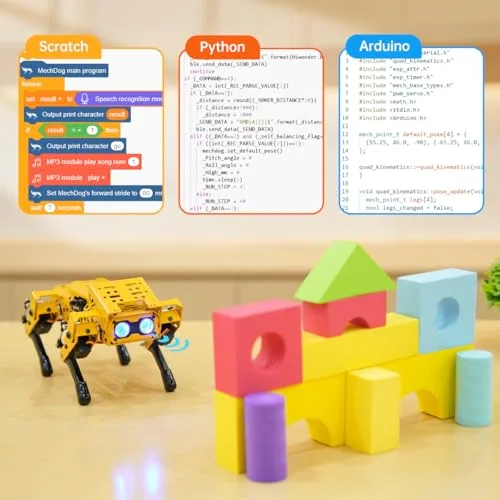
Hiwonder MechDog-S supports Python, Scratch, and Arduino, which is a broader language/tooling surface than PiDog’s Python-only approach. That matters in classrooms and clubs: Scratch can lower the barrier for first-time coders, while Arduino-style workflows can appeal to learners focused on embedded concepts.
Conclusion: MechDog-S has the edge for accessibility and curriculum flexibility thanks to 3 programming options vs PiDog’s Python-only focus, especially for mixed-skill groups.
Openness vs vendor ecosystem cohesion
SunFounder PiDog runs on Raspberry Pi 5/4B/3B+/3B/Zero 2W, so it inherits the Raspberry Pi ecosystem: standard Linux tooling and a deep pool of third-party Python libraries for vision, networking, and robotics. That openness also makes it easier to integrate external services and unconventional workflows, but it comes with the «general-purpose computer» complexity tax (dependency management and OS-level maintenance).
Hiwonder MechDog-S uses an ESP32 robot controller + ESP32-S3 vision module, and it’s positioned around a cohesive vendor workflow (including a mobile app and packaged examples). It can integrate «various sensors and electronic modules,» but the most reliable path typically stays inside Hiwonder’s tooling rather than reshaping the full software stack like you would on Linux.
Conclusion: PiDog wins for openness and extensibility, while MechDog-S wins for a cohesive, guided ecosystem—the better choice depends on whether you prioritize «build anything» flexibility or predictable, vendor-supported flows.
Long-term support & maintenance realities
SunFounder PiDog benefits from long-lived Raspberry Pi community knowledge, and SunFounder also claims strong official support via documentation and tutorials. However, multiple reviewers report operational friction like app crashes and servo calibration challenges on PiDog, which fits the broader reality that upstream Linux/library changes can create integration drift for Pi-based projects (Multiple reviewers report…).
Hiwonder MechDog-S reduces moving parts by centering on ESP32-based control, which generally avoids «OS update broke my stack» scenarios and can keep a demo unit in a known-good state more easily. The trade-off is that long-term improvements and fixes are more dependent on vendor update cadence and documentation quality than on broad community infrastructure.
Conclusion: MechDog-S has an advantage for keeping day-to-day operation consistent, while PiDog has an advantage for long-term resilience through the broader Raspberry Pi ecosystem—but it may demand more troubleshooting ownership.
Winner: Tie — MechDog-S is stronger for beginner-to-intermediate learning paths (Python + Scratch + Arduino) and cohesive tooling, while PiDog is stronger for open-ended Raspberry Pi development and third-party ecosystem depth, even if it can be more maintenance-heavy.
Ease of Use
Setup & onboarding friction
SunFounder PiDog is explicitly a Raspberry Pi robot dog kit designed to work with Raspberry Pi 5/4B/3B+/3B/Zero 2W, which tends to make first-time setup feel like a Pi project: OS imaging, software dependencies, and the usual Linux permissions/update pitfalls. SunFounder does provide detailed online documentation and video tutorials (per manufacturer/docs), but that doesn’t remove the inherent «general-purpose computer» setup overhead. In practice, you’re onboarding both a robot and a small Linux computer at the same time.
Hiwonder MechDog‑S is a desktop quadruped built around an ESP32 robot controller + ESP32‑S3 vision module, and its standard packaging includes an assembled robot, charger, and user manual—so there’s less assembly and fewer platform choices to make up front. The vendor onboarding flow is more «productized,» aiming to get you from unbox to first demo quickly, and the official docs even specify simple first-use steps like charging the battery for ~1 hour before first use. That combination (assembled unit + guided steps) generally reduces early-stage decision points compared with a Pi-based stack.
Conclusion: For straightforward onboarding with fewer moving parts, MechDog‑S has the clearer ease-of-use advantage; PiDog is workable but asks more of the user immediately because the Raspberry Pi environment is part of the product.
Day-to-day operation & reliability friction
SunFounder PiDog supports mobile app control via the SunFounder Controller app and can stream real-time FPV over Wi‑Fi, but daily ownership often becomes code- and system-centric (SSH sessions, editing Python, managing services). On the downside, multiple reviewers report operational rough edges— including app crashes and servo calibration challenges—in SunFounder’s own community threads (Multiple reviewers report…). There are also some users who note difficulty stopping programs via the Stop button or even Ctrl+C (Some users note…), which can add friction in classrooms where «reset and repeat» matters.
Hiwonder MechDog‑S also supports app control and Wi‑Fi operation (via hotspot) but is typically used in a more behavior-centric way—launch the control interface, run packaged examples, then tweak parameters. Its software path is reinforced by broader beginner-friendly entry points: it supports Scratch, Arduino, and Python, so groups can pick a lower-friction starting interface before moving up to code. While that vendor framework can limit «escape hatches» for unconventional projects, it usually means fewer day-to-day Linux maintenance tasks.
Conclusion: For consistent repeatable demos and lower ongoing troubleshooting overhead, MechDog‑S is easier to live with; PiDog is more hands-on and can be more fragile in routine use due to reported app/calibration friction.
Classroom consistency vs tinkering freedom (ease-of-use trade-off)
SunFounder PiDog is easiest to recommend when «ease» means development freedom: it’s a Python-programmable robot built on a Raspberry Pi, and that openness makes it an excellent sandbox for learners who want to iterate on perception/control code and treat the robot like a Linux computer with sensors attached. The trade-off is that this kind of openness often turns simple goals into broader environment-management work, which can slow down time-boxed lessons.
Hiwonder MechDog‑S is easier for guided learning and predictable outcomes because its controller/vision stack (ESP32 + ESP32‑S3) and vendor tooling are designed as a cohesive package. The ability to start in Scratch and graduate to Python/Arduino also supports mixed-skill classrooms, where not everyone is ready for Linux administration. The trade-off is that advanced users may hit a behavior/framework ceiling sooner than they would on a full Raspberry Pi stack.
Conclusion: MechDog‑S wins if your priority is «get to working behaviors fast and repeatably,» while PiDog can feel «easier» only for users who already want the Raspberry Pi tinkering workflow.
Winner: Hiwonder MechDog‑S
The Bottom Line
After digging into build quality, motion control, sensors, compute, and day-to-day usability, the choice comes down to whether you want an open Raspberry Pi robotics sandbox or a more productized learning platform.
For deep robotics learning and tinkering: The SunFounder PiDog is the better fit thanks to its open platform, higher-end camera, more articulated hardware (12 servos), and stronger features-per-dollar emphasis.
For guided learning and quick demos: The Hiwonder MechDog-S is the clear pick because its easier setup, polished software flow, and IMU-backed dynamic balance deliver more stable results with less calibration and troubleshooting.
For computer vision projects: The SunFounder PiDog wins on the strength of its 5MP camera, which the comparison showed is a meaningful, spec-backed advantage over MechDog-S’s much lower-resolution vision module for real CV experimentation.
Overall, this is a genuine «it depends» matchup: PiDog consistently leads on openness, compute flexibility, and vision hardware, while MechDog-S counters with the better out-of-box experience, guided programming options, and smoother gait stability through its self-balancing approach.
Your choice depends on your goal: choose SunFounder PiDog for maximum openness, expandability, and raw features per dollar, or Hiwonder MechDog-S for a hassle-free, beginner-friendly experience that gets you moving quickly. Both are excellent learning tools; the best one is the one that matches your technical comfort and project ambitions.
FAQ
Which robot dog is better for beginners?
Can I use PiDog without a Raspberry Pi?
Does MechDog-S support Python?
Which robot dog has a better camera?
Does the PiDog have known reliability issues?
What processor does the MechDog-S use?
Does MechDog-S have self-balancing?
📄 Used Manuals & Documentation
SunFounder PiDog
"Images are used for editorial and informational purposes only. All trademarks and images belong to their respective owners."