
Segway Navimow i105N vs ECOVACS GOAT O1000 RTK: Which Wire-Free Robot Mower Fits Your Lawn?
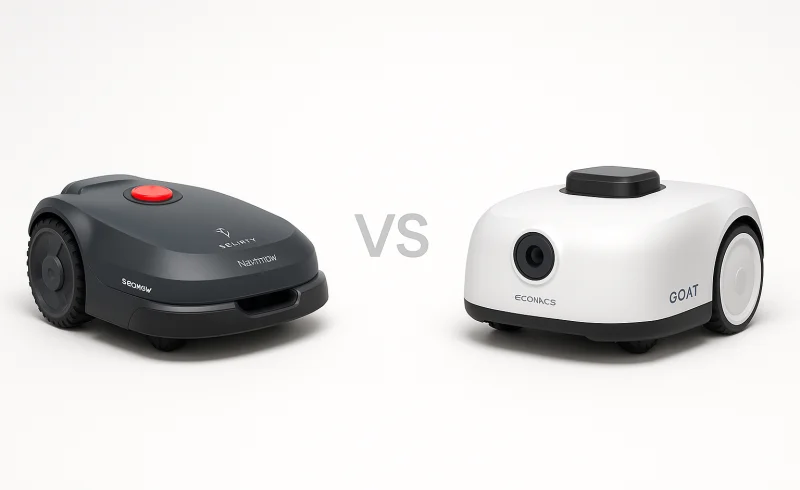
Discover the strengths and weaknesses of the Segway Navimow i105N and ECOVACS GOAT O1000 RTK. Learn which wire-free robot mower suits your yard's needs, from handling complex terrains to offering advanced obstacle avoidance and cutting features.
TL;DR
- If you want a predictable, appliance-like wire-free mower for a standard suburban lawn → choose Segway Navimow i105N.
- If you need a more capable mower for complex, multi-zone lawns with frequent obstacles → choose ECOVACS GOAT O1000 RTK.
- If your lawn is small and simple with few changes → either works well.
The GOAT O1000 RTK brings a wider cutting deck, higher slope tolerance (45% vs 30%), and more advanced obstacle detection (200+ objects with 3D ToF). The Navimow i105N counters with a more conservative, consistent navigation style and a better dust/water protection rating (IP66 vs IPX6). Edge trimming is stronger on paper with the GOAT, but both may require occasional manual touch-ups.
If you need a mower for a yard larger than 1/4 acre or demand near-perfect edge cutting without any follow-up trimming, consider a traditional wired robot or a larger model like a Husqvarna Automower.
| Feature | Segway Navimow i105N | ECOVACS GOAT O1000 RTK |
|---|---|---|
| Power | ||
| Battery type | Lithium-ion battery | Lithium-ion |
| Charging time | About 90 min | About 100 min |
| Battery voltage | 21.6 V DC | 18V |
| Battery capacity | 2.55 Ah / 55 Wh | 4000mAh |
| Runtime per full charge | About 60 min | About 65 min |
| Cutting | ||
| Cutting width | 7.1 in | 8.66 inch |
| Cutting height range | 2 - 3.6 in | 1.2''-3.2'' |
| General | ||
| Product type | Robotic lawn mower | Robotic lawn mower |
| Recommended mowing area | 0.125 acre | 1/4 acre |
| Physical | ||
| Weight | 24.03 lbs | 24.25 lb |
| Dimensions | 21.4 x 15.1 x 11.2 in | 23.62 x 15.75 x 10.35 inch |
| Durability | ||
| IP rating | IP66 | IPX6 |
| Performance | ||
| Noise emission | 58 dB(A) | 57 dBA |
| Mowing efficiency | 60-100 ㎡ (0.015-0.025 acre) per hour | Delicate: about 1507 ft²/h; Efficient: about 1938 ft²/h |
| Maximum slope at boundary | 10%(6°) | 17% |
| Maximum slope in work area | 30% (17°) | 45% |
| Navigation & Setup | ||
| App control | Yes | Yes |
| Edge mowing | Precise edge mowing / Ride-on boundary | TruEdge zero-edge cutting |
| Zone management | Multi-zone management | Multiple zone management |
| Navigation system | EFLS 2.0 | RTK + Camera + 3D ToF (LiDAR-Enhanced RTK Navigation) |
| Obstacles detected | 150+ obstacles | 200+ obstacles |
| Positioning precision | cm-level accuracy | 2cm positioning precision |
| Boundary wire requirement | No perimeter wire required | No physical boundaries required |
| Obstacle avoidance system | VisionFence image obstacle avoidance | AIVI 3D (3D ToF + Camera) |
📑 Table of Contents
Navigation & Setup
Navigation stack & positioning precision
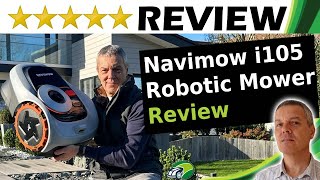
Segway Navimow i105N uses EFLS 2.0 with GNSS + IMU and advertises cm-level accuracy, creating virtual boundaries with no perimeter wire required. In practice, its approach is intentionally conservative: the workflow is guided, but you should expect some «map → observe → tighten boundaries» iteration, especially around irregular edges or transitions. It also pairs this with VisionFence image-based obstacle avoidance.
ECOVACS GOAT O1000 RTK combines RTK + Camera + 3D ToF («LiDAR-enhanced RTK navigation») and claims 2 cm positioning precision. That additional sensor fusion is designed to hold a cleaner line through tricky geometry and reduce the amount of boundary «fussing» needed after initial mapping. The trade-off is that onboarding can feel more like configuring a robot platform, and when things don’t go smoothly, troubleshooting tends to be more technical and app-driven.
Conclusion: GOAT O1000 RTK has the edge on navigation fidelity on paper (2 cm vs cm-level) and is better positioned for yards where you want tighter, more repeatable positioning with less boundary babysitting.
Multi-zone handling & obstacle scale
Segway Navimow i105N supports multi-zone management and is generally the easier «first wire-free mower» experience when your layout is simple and stable. Its obstacle catalog is rated at 150+ obstacles, which is solid for everyday yard fixtures but can still require boundary tuning when borders are irregular or change seasonally.
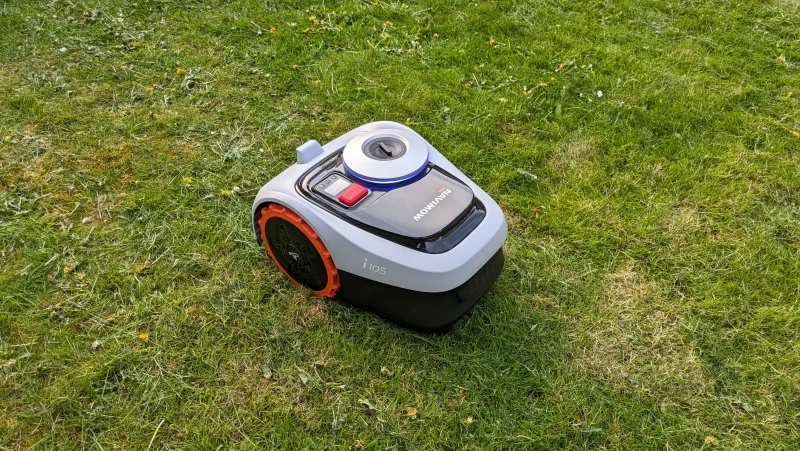
ECOVACS GOAT O1000 RTK also supports multiple zone management, but it’s built to stretch further in both space and complexity: it’s rated for 1/4 acre vs the Navimow’s 0.125 acre. It also lists 200+ obstacles and uses AIVI 3D (3D ToF + Camera), which aligns with the real-world expectation that it can be more forgiving in «active» yards with frequently moved items—at the cost of sometimes less predictable, perception-driven choices.
Conclusion: GOAT O1000 RTK wins for complex, multi-zone yards thanks to the larger stated coverage (1/4 acre vs 0.125 acre) and the more ambitious perception/avoidance stack (200+ vs 150+ obstacles).
Winner: ECOVACS GOAT O1000 RTK
Cutting Performance
Cutting width & mowing speed (how quickly you cover the lawn)
Segway Navimow i105N uses a 7.1-inch cutting width, which inherently requires more passes to cover the same area. Its listed mowing efficiency is 60–100 m²/h (about 646–1,076 ft²/h), aligning with its smaller recommended mowing area of 0.125 acre (1/8 acre). In practice, that points to a «steady maintenance» cadence rather than rapid catch-up mowing.
ECOVACS GOAT O1000 RTK steps up to an 8.66-inch cutting width, which can reduce total mowing time by widening each pass. It also claims about 1,507 ft²/h (Delicate) up to about 1,938 ft²/h (Efficient), and it’s rated for 1/4 acre, suggesting a higher-throughput design. Even with a similar ~65 min stated runtime, the per-hour coverage figure implies more work completed per charge cycle.
Conclusion: On raw cutting throughput, GOAT O1000 RTK wins with a wider deck (8.66" vs 7.1") and notably higher stated efficiency (up to ~1,938 ft²/h vs ~646–1,076 ft²/h).
Cutting height range (grass-length flexibility)
Segway Navimow i105N offers a 2.0–3.6 in height range, which favors lawns kept at moderate-to-taller cuts. The 3.6-inch maximum is higher than the GOAT’s, making it the better fit if you regularly prefer a taller finish (or want more buffer during hot/dry spells when longer grass can help reduce stress).
ECOVACS GOAT O1000 RTK spans 1.2–3.2 in, giving it a much lower minimum for shorter, tighter cuts. The trade-off is a lower ceiling (3.2 in vs 3.6 in), so it’s slightly less accommodating if your «normal» height is on the tall side.
Conclusion: This is a trade-off: GOAT O1000 RTK has the edge for short cuts (1.2"), while Navimow i105N has the edge for taller grass (up to 3.6").
Edge finishing (how close it cuts to borders)
Segway Navimow i105N lists «Precise edge mowing / Ride-on boundary,» which is designed to let the mower approach and partially ride along defined borders. The real-world limiter is that edge quality still depends heavily on boundary tuning and «robot-friendly» edging—especially with irregular transitions—so you may need iterative adjustments to minimize the leftover strip.
ECOVACS GOAT O1000 RTK advertises «TruEdge zero-edge cutting,» explicitly targeting reduced uncut margin along borders. In more complex, «active» yards, its broader sensor/navigation stack can also help it behave more cautiously around edges and obstacles—useful when borders are shared with beds, furniture, or frequently moved items—but that can sometimes mean less consistent edge aggression depending on conditions.
Conclusion: Both aim to reduce edge leftovers, but on stated intent GOAT O1000 RTK has the stronger edge-cutting claim («zero-edge»), while Navimow i105N can still be compelling if you value a more conservative, predictable approach to boundary riding.
Winner: ECOVACS GOAT O1000 RTK
Obstacle Avoidance
Segway Navimow i105N uses VisionFence image obstacle avoidance and is rated to detect 150+ obstacles. In practice, its avoidance strategy tends to feel more conservative—often prioritizing steady, repeatable behavior over trying to «solve» every ambiguous object in the yard. That conservatism can reduce surprises, but it may also mean you still spend time fine-tuning boundaries around tricky transitions (mulch-to-grass edges, irregular borders).
ECOVACS GOAT O1000 RTK pairs AIVI 3D (3D ToF + Camera) with its navigation stack and is rated to detect 200+ obstacles. The added 3D ToF depth sensing is a meaningful hardware advantage for interpreting object shape and distance, which typically translates to more confident detection in cluttered, active lawns (toys, furniture, frequently moved items). The trade-off is that more perception can mean more «judgment calls,» and its behavior may vary more with lighting and shadows—especially when borderline obstacles look different run to run.
Conclusion: On obstacle avoidance capability alone, ECOVACS GOAT O1000 RTK has the edge thanks to 200+ obstacle detection vs 150+ and a more sophisticated 3D ToF + camera sensing approach, while the Navimow i105N counters with a more predictable, conservative style that some owners may prefer.
Winner: ECOVACS GOAT O1000 RTK
Slope & Terrain
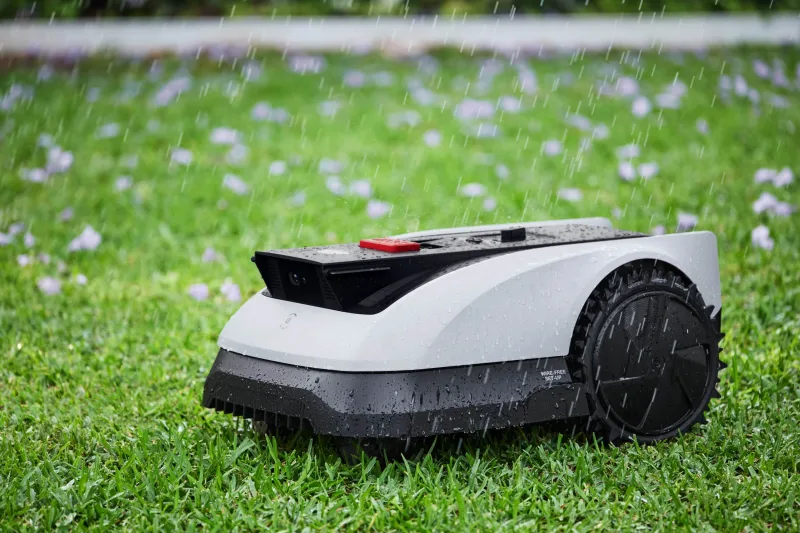
Segway Navimow i105N is rated for a maximum slope in the work area of 30% (17°), which is adequate for mild-to-moderate grades common in flatter suburban yards. However, its maximum boundary slope is just 10% (6°), which can matter if your perimeter includes berms, swales, or sloped edges where the mower needs to track boundaries precisely.
ECOVACS GOAT O1000 RTK, by comparison, is specced for a 45% maximum slope in the work area, giving it substantially more headroom on hilly lawns and uneven terrain. It also allows a steeper 17% maximum slope at the boundary, which should reduce the need to «flatten» virtual borders or create conservative no-go strips around sloped edges.
Conclusion: On slope capability, ECOVACS GOAT O1000 RTK clearly wins—45% vs 30% in the work area and 17% vs 10% at the boundary is a meaningful gap that directly affects where (and how confidently) you can deploy the mower.
Winner: ECOVACS GOAT O1000 RTK
Battery & Runtime
Segway Navimow i105N uses a 2.55 Ah / 55 Wh lithium‑ion battery (at 21.6 V DC) and is rated for about 60 minutes of mowing per charge. In practice, that’s aligned with its smaller recommended coverage of 0.125 acre (1/8 acre), where you’re expecting multiple short sessions rather than marathon runs.
ECOVACS GOAT O1000 RTK is listed with a 4000 mAh lithium‑ion pack (at 18 V) and a spec-matrix runtime of about 65 minutes, essentially the same neighborhood as the Segway. However, ECOVACS’ own support materials also claim a 5200 mAh battery and up to 180 minutes runtime—numbers that don’t line up cleanly with the provided spec matrix, so they’re harder to treat as a dependable expectation for day-to-day planning.
Conclusion: On realistic runtime expectations, this is effectively a tie—~60 min vs ~65 min won’t change most mowing outcomes, and both should manage routine maintenance mowing for small lawns with automatic recharging as needed.
Segway Navimow i105N recharges in about 90 minutes, which helps it get back out quickly if it has to split work into multiple sessions. That slightly faster turnaround can matter more than peak runtime on small lawns, since it reduces idle time between runs.
ECOVACS GOAT O1000 RTK charges in about 100 minutes, close enough that it’s unlikely to affect weekly schedules, but it is slower on paper. Given the GOAT’s larger stated coverage target (1/4 acre), you should still expect it to rely on return-to-base cycles for full-area upkeep.
Conclusion: Navimow i105N has a small edge on charging time (~90 min vs ~100 min), but the gap is modest and typically not decisive unless you’re frequently forcing multi-session mowing windows.
Winner: Tie
Build Quality & Durability
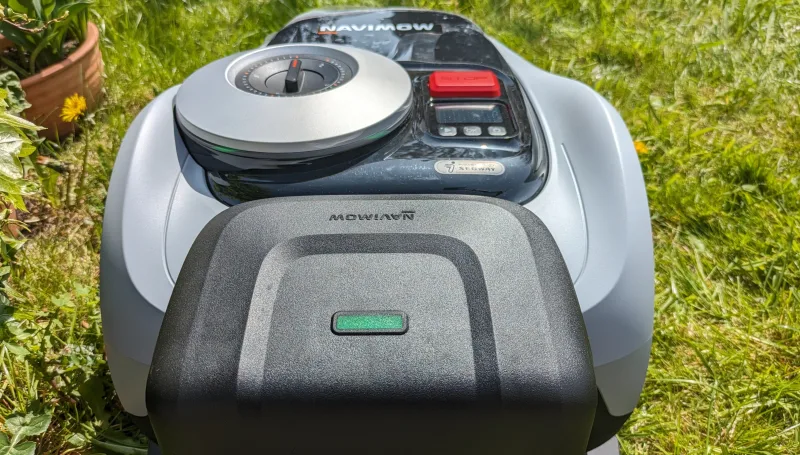
Segway Navimow i105N is rated IP66, meaning it’s dust-tight and protected against powerful water jets—a meaningful advantage for machines that live in dirty, wet environments. With a 24.03 lb chassis and 21.4 x 15.1 x 11.2 in footprint, it’s also sized like a typical mid-compact robot mower rather than a lightweight gadget.
ECOVACS GOAT O1000 RTK is rated IPX6, which covers powerful water jets but does not specify dust protection the way an «IP6X» dust rating does. It’s effectively the same class of machine physically at 24.25 lb and 23.62 x 15.75 x 10.35 in, so durability differences are more about sealing than size or heft.
Conclusion: On pure ruggedness, Navimow i105N has the edge because IP66 (dust + water) is a more complete outdoor-protection rating than IPX6 (water only), while weight and dimensions are close enough to call a wash.
Winner: Segway Navimow i105N
The Bottom Line
After digging through navigation, cutting, terrain handling, and durability, the choice comes down to whether you want maximum capability per dollar or a simpler, more predictable experience.
For Simple, Flat Lawns: The Segway Navimow i105N is the better fit thanks to its straightforward setup style and reliably conservative behavior, including solid edge mowing when boundaries are easy to define.
For Complex, Hilly Lawns: The ECOVACS GOAT O1000 RTK is the clear pick, pairing stronger slope specs (45% working area) with a more advanced sensor stack that better handles tricky layouts and obstacle-heavy yards.
For Budget-Conscious Buyers: The ECOVACS GOAT O1000 RTK offers the strongest value, undercutting on price while still leading on cutting throughput (wider deck) and overall navigation/avoidance capability.
For Durability in Harsh Weather: The Segway Navimow i105N takes it with its more complete IP66 protection, adding dust sealing on top of strong water-jet resistance.
Overall,
—it wins on the factors that most directly impact day-to-day results, including a wider cutting deck, better slope handling, more advanced navigation, and a lower price. The Navimow i105N is still the smarter buy if you prioritize a calmer, more predictable mower for straightforward lawns (and you want the extra peace of mind of IP66 sealing).Pick the GOAT if your yard challenges the robot; pick the Navimow if your yard is simple and you’d rather minimize tinkering after initial mapping.
FAQ
Which mower has better obstacle detection?
Can both mowers handle slopes?
Which is easier to set up?
Do they require boundary wires?
Which mower has a wider cutting deck?
How long does each mower run on a single charge?
Which mower is more weather-resistant?
"Images are used for editorial and informational purposes only. All trademarks and images belong to their respective owners."