
Roborock Qrevo Master vs Dreame X50 Ultra: Which Robot Vacuum Actually Saves You Time?
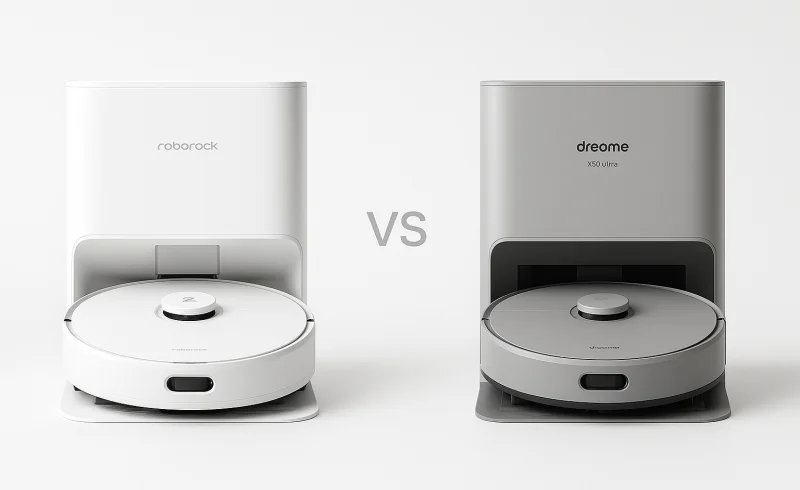
Explore the Roborock Qrevo Master and Dreame X50 Ultra, two advanced robot vacuums. Compare their features and performance to discover which model saves you more time and effort in daily cleaning routines.
TL;DR
- If you want a predictable, set-and-forget cleaner that handles tidy homes reliably → choose Roborock Qrevo Master.
- If you need a robot that navigates daily clutter, avoids rescues, and offers stronger specs for the price → choose Dreame X50 Ultra.
- If your home stays reasonably neat and you value app simplicity over maximum automation, either works well – but Dreame’s performance-per-dollar advantage is hard to ignore.
The real trade-off: Dreame delivers double the suction (20,000 Pa vs 10,000 Pa), a larger dustbin, hotter mop wash, and longer claimed runtime – yet its cautious obstacle avoidance can leave untouched margins around objects. Roborock’s consistent mapping and cleaner app experience mean fewer surprises day to day, but its lower specs and smaller bin force more frequent emptying and pre-cleaning in messy rooms.
Skip both if you expect a robot to handle extremely cluttered floors with zero prep – neither fully manages cables, toys, or low furniture without occasional manual intervention. Consider a Roborock S8 MaxV Ultra or Narwal Freo Z Ultra if avoidance or edge coverage is your top priority.
Market price overview
Roborock Qrevo Master
Dreame X50 Ultra

 re:Store
| Feature | Dreame X50 Ultra | Roborock Qrevo Master |
|---|---|---|
| Power | ||
| Battery Capacity | 6,400 mAh | 5,200 mAh |
| Runtime (Quiet Mode) | 220 min | 180 min |
| General | ||
| Product Type | Robot vacuum and mop | Robot vacuum and mop |
| Dock Dimensions | 457 × 340 × 590 mm | 340 × 487 × 521 mm |
| Robot Dimensions | 350 × 350 × 89 mm (VersaLift Sensor Retracted); 350 × 350 × 111 mm (VersaLift Sensor Lift) | 350 × 353 × 103 mm |
| Capacity | ||
| Dustbin Capacity | 395 ml | 220 ml |
| Clean Water Tank Capacity | 4.5 L | 4 L |
| Dirty/Used Water Tank Capacity | 4.0 L | 3.5 L |
| Docking Station | ||
| Auto Mop Drying | Hot air mop drying | Warm air drying |
| Auto Dust Emptying | Supported | Supported |
| Dock Self-Cleaning | AceClean DryBoard self-cleaning washboard | Dock Self-Cleaning |
| Hot Water Mop Washing | Supported | Supported |
| Auto Water Tank Refilling | Supported | Supported |
| Hands-Free Emptying Interval | Up to 100 days | Up to 7 weeks |
| Mop Washing Water Temperature | 80°C | 60°C |
| Cleaning Performance | ||
| Main Brush Type | HyperStream Detangling DuoBrush | DuoRoller Riser Brush |
| Maximum Suction | 20,000 Pa | 10,000 Pa |
| Mop Lifting Height | 10.5 mm | 10 mm |
| Edge Cleaning Extension | Extendable side brush + MopExtend RoboSwing | FlexiArm Design side brush + edge mopping system |
| Navigation & Smart Features | ||
| Wi-Fi Band | 2.4 GHz | 2.4 GHz |
| Navigation System | VersaLift DToF | PreciSense LiDAR Navigation |
| Built-in Voice Assistant | Ok, Dreame | Hello Rocky |
| Obstacle Avoidance System | AI RGB + 3D Structured Light | Reactive AI Obstacle Recognition |
| Third-Party Voice Control | Alexa, Siri, Google Assistant | Amazon Alexa, Apple Siri, Google Home |
📑 Table of Contents
Cleaning Performance
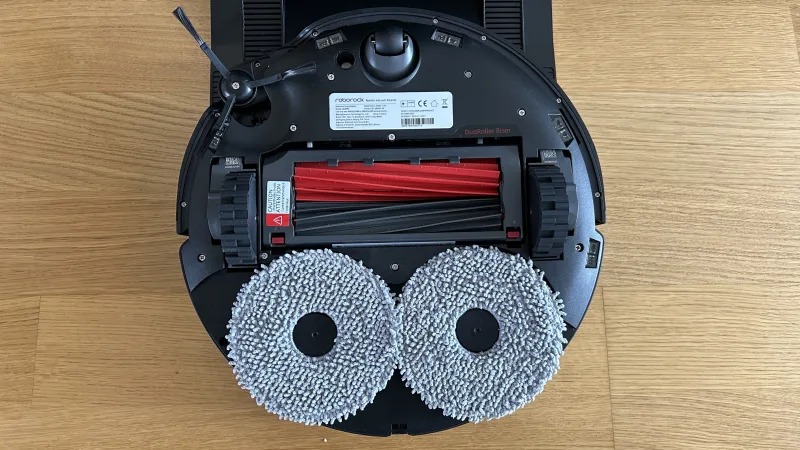
Roborock Qrevo Master is rated at 10,000 Pa of maximum suction. On paper, that’s plenty for daily pickup on hard floors and many rugs, but it leaves less headroom for heavy debris or deep carpet extraction when compared directly to today’s highest-suction flagships. In practice, its cleaning results tend to hinge more on consistent route execution than brute force.
Dreame X50 Ultra doubles that figure with 20,000 Pa maximum suction. That kind of margin generally matters most on carpet and for embedded fine dust, where higher airflow/pressure can improve how much the robot pulls from fibers in a single pass. The spec advantage is clear even before you factor in any brush or edge-cleaning differences.
Conclusion: Dreame X50 Ultra wins on raw vacuuming power with 20,000 Pa vs 10,000 Pa, a meaningful, defensible spec gap rather than a minor increment.
Roborock Qrevo Master uses a FlexiArm Design side brush + edge mopping system to reach closer to baseboards and corners than fixed hardware. That’s a practical approach for improving edge pickup without making the robot overly complex, and it should help reduce the «missed strip» effect along walls. However, the spec doesn’t indicate a fully extendable mechanism for both sweeping and mopping in the same way Dreame describes.
Dreame X50 Ultra lists Extendable side brush + MopExtend RoboSwing, explicitly calling out extension for both dry edge pickup and wet edge coverage. That combination is designed to push debris out of corners and then mop nearer to edges/furniture legs, which is where many robot mops leave an untouched margin. The edge-focused hardware stack is simply more aggressive on paper.
Conclusion: Dreame X50 Ultra has the edge for edge and corner cleaning, because it pairs an extendable side brush with an extendable mopping system, whereas Roborock’s approach is less clearly «reach-extending» across both functions.
Roborock Qrevo Master relies on the DuoRoller Riser Brush, a dual-roller design that’s typically strong for balanced pickup across mixed surfaces. Dual rollers can also help reduce hair wrap versus older single-brush layouts by spreading contact across two rollers. Still, the spec naming doesn’t emphasize detangling as explicitly as Dreame’s.
Dreame X50 Ultra uses the HyperStream Detangling DuoBrush, which is specifically positioned for hair management. While «detangling» wording alone doesn’t guarantee fewer clogs, it signals that hair handling is a core design goal rather than a side benefit. For homes with long hair or heavy shedding, that design intent can translate into fewer interruptions and more consistent pickup between maintenance cycles.
Conclusion: Dreame X50 Ultra slightly leads for hair-focused cleaning, based on the explicitly detangling dual-brush design, while Roborock’s dual roller system remains a strong all-rounder.
Roborock Qrevo Master lifts its mop by 10 mm, which is enough to help avoid lightly wetting low-pile rugs during vacuum-then-mop routines. The difference between «some contact» and «clear separation» on thicker rugs can still depend on rug pile height, but the lift spec is competitive for this class. It’s effectively a baseline expectation on modern combo bots.
Dreame X50 Ultra lifts a touch higher at 10.5 mm. That extra 0.5 mm is unlikely to change outcomes in most homes, since rug pile variance is far larger than half a millimeter. Practically, both should be treated as «mop-lifting capable,» not «rug-proof in every scenario.»
Conclusion: Tie on mop lifting—10.5 mm vs 10 mm is too small a gap to be a reliable differentiator.
Winner: Dreame X50 Ultra — It stacks multiple, meaningful cleaning-performance advantages: double the suction (20,000 Pa vs 10,000 Pa), a more assertive edge-cleaning system (extendable brush + MopExtend), and a brush design more explicitly engineered for detangling hair.
Navigation & Obstacle Avoidance
Core navigation approach (mapping consistency vs adaptability)
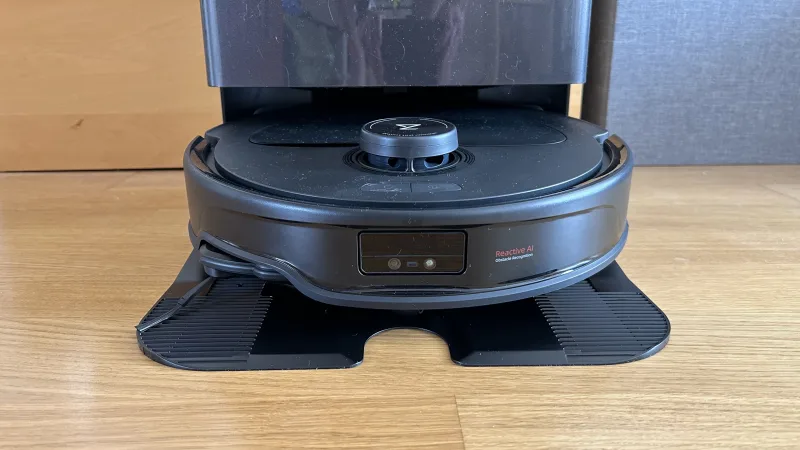
Roborock Qrevo Master uses PreciSense LiDAR Navigation, which is typically optimized for stable mapping and repeatable room-by-room routes. It also lists Multi-Level Mapping and the ability to recognize multiple floor types, supporting predictable behavior when you rely on schedules across mixed surfaces. In practice, this lines up with the «set-and-forget» positioning: consistent runs matter more than constantly adjusting settings.
Dreame X50 Ultra uses VersaLift DToF, and its robot height changes from 89 mm (sensor retracted) to 111 mm (sensor lifted), implying a more dynamic sensing posture than a fixed turret design. That lifting sensor approach is aimed at seeing and navigating around low-profile problem areas that can confuse simpler top-down scanning. The real-world trade-off is that this style often rewards homes with changing layouts, but can also push owners toward more experimentation to get the behavior they want.
Conclusion: Roborock has the edge for «predictable mapping you don’t think about,» while Dreame is better positioned for tricky, changeable layouts where extra sensing flexibility can prevent navigation failures.
Obstacle avoidance behavior (coverage vs caution)
Roborock Qrevo Master relies on Reactive AI Obstacle Recognition and, behaviorally, tends to be more willing to approach objects to finish passes close to chair legs and along clutter edges. That «less shy» approach can translate into better coverage in normal rooms, but it also means you still benefit from basic pre-clean prep in cable-heavy or toy-strewn areas. The upside is fewer untouched halos around obstacles when the floor is reasonably tidy.
Dreame X50 Ultra uses AI RGB + 3D Structured Light for obstacle avoidance, which generally signals more object-aware, caution-forward avoidance. In real use, that can reduce bumps and «rescue» events in clutter-prone rooms—but the flip side is more conservative pathing that can leave wider margins around objects. Notably, some users complain about short battery life, which can compound the coverage penalty if cautious navigation already increases time spent maneuvering.
Conclusion: Dreame has the advantage in clutter tolerance and fewer collisions, while Roborock has the advantage in close-in coverage when you care about cleaning tight around everyday obstacles.
Multi-floor handling (day-to-day usability)
Roborock Qrevo Master explicitly supports Multi-Level Mapping, and the broader emphasis is on stable room segmentation and repeatable routines—useful when you want consistent results across floors with minimal «re-learning.» Combined with its LiDAR-based approach, it’s typically the lower-friction choice for households that mostly run scheduled cleans and only occasionally intervene.
Dreame X50 Ultra also targets whole-home navigation, but its ecosystem tends to encourage more «behavior tuning» (especially around avoidance conservatism). That can be a strength for power users dialing in performance per floor, but it can also create variability if different family members expect a single mode that works everywhere. If your priority is identical, repeatable routines across floors, Dreame’s flexibility may feel like extra overhead.
Conclusion: Roborock leads on multi-floor routine consistency, while Dreame’s strength is tailoring behavior for harder floors/rooms rather than minimizing adjustments.
Winner: Tie — Roborock Qrevo Master is the more predictable, coverage-forward navigator for tidy-to-normal homes, while Dreame X50 Ultra is the more obstacle-cautious «problem-solver» for cluttered, constantly changing spaces (often at the cost of some missed margins and potential runtime frustration).
Dock & Maintenance
Mop washing & pad drying automation
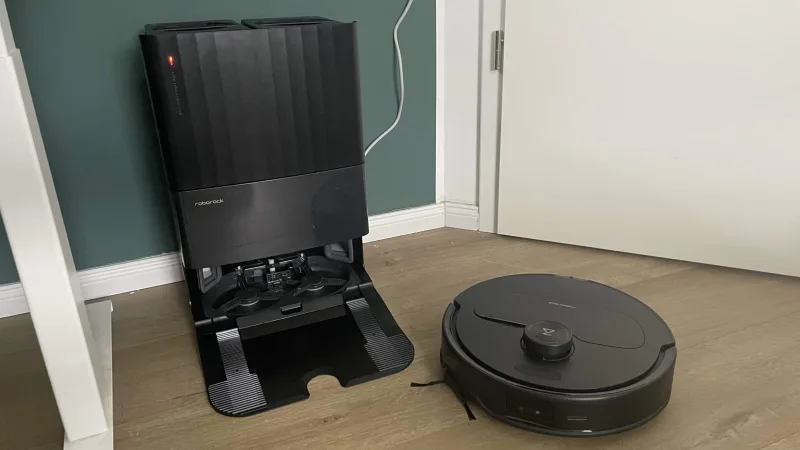
Roborock Qrevo Master supports hot-water mop washing at 60°C and warm-air mop drying. That’s enough for routine, frequent mopping, but it’s a lower wash temperature and a less aggressive drying approach than Dreame’s specs. It still reduces day-to-day labor versus manual pad rinsing, but periodic dock wipe-downs are part of long-run ownership for either system.
Dreame X50 Ultra also supports hot-water mop washing, but at a higher 80°C, and pairs it with hot-air mop drying. On paper, the hotter wash is better positioned to break down oily grime and reduce lingering pad odor, and the hotter drying is more aligned with keeping mops from staying damp between runs.
Conclusion: Dreame X50 Ultra has the clear advantage for hands-off mop hygiene: 80°C vs 60°C washing plus hot-air vs warm-air drying is a meaningful gap if you mop often.
Dock self-cleaning design
Roborock Qrevo Master lists Dock Self-Cleaning, which helps reduce manual scrubbing of the dock’s wash area over time. However, the spec sheet doesn’t indicate a dedicated self-cleaning washboard mechanism, so expectations should be that you’ll still occasionally clean residue-prone areas.
Dreame X50 Ultra specifies an AceClean DryBoard self-cleaning washboard, i.e., a more explicitly engineered «clean-the-part-that-gets-gross» approach. That design focus tends to matter in real ownership because dock grime and odor are usually what force hands-on maintenance.
Conclusion: Dreame X50 Ultra has the edge thanks to the more explicit, purpose-built AceClean DryBoard self-cleaning system, even though both docks advertise self-cleaning in some form.
Emptying interval & tank capacities
Roborock Qrevo Master supports auto dust emptying with a stated hands-free emptying interval up to 7 weeks. Its water tanks are 4.0 L clean and 3.5 L dirty, which is solid for typical schedules but can mean more frequent refills/emptying in heavy-mopping homes.
Dreame X50 Ultra also supports auto dust emptying, but claims up to 100 days hands-free, extending the time between bin-service reminders. It also has slightly larger water tanks at 4.5 L clean and 4.0 L dirty, which can reduce how often you have to interact with the dock if you run mopping frequently.
Conclusion: Dreame X50 Ultra wins for pure «set-and-forget» dock upkeep: 100 days vs 7 weeks, plus larger 4.5 L/4.0 L tanks vs 4.0 L/3.5 L.
Winner: Dreame X50 Ultra
Battery & Runtime
Roborock Qrevo Master ships with a 5,200 mAh battery and is rated for 180 minutes of runtime in Quiet Mode. On paper, that’s enough for many apartments and mid-size homes, especially if you’re running scheduled upkeep cleans rather than long, high-power sessions. The practical upside is less about peak endurance and more about predictable, repeatable cycles that don’t demand much babysitting across typical layouts.
Dreame X50 Ultra steps up to a 6,400 mAh battery with a 220-minute Quiet Mode rating. That extra 40 minutes (about 22% longer than 180 minutes) can translate into noticeably more cleaned area per charge, which matters most when you’re trying to finish larger floorplans in a single run. However, multiple reviewers report short battery life as a recurring complaint for the X50 Ultra in real-world use (forum; review), suggesting results may vary more with settings, layouts, and how aggressively you run it.
Conclusion: Spec-for-spec, Dreame X50 Ultra has the clear endurance advantage (6,400 mAh / 220 min vs 5,200 mAh / 180 min), making it the stronger pick for homes around ~2,000 sq ft+ or anyone prioritizing fewer mid-clean recharges—though reported variability means it’s worth monitoring your real runtime after setup.
Winner: Dreame X50 Ultra
Software & User Experience
Roborock Qrevo Master tends to deliver a more prescriptive, routine-first app flow: map once, assign rooms, and lean on schedules for repeatable results. The provided SoT also explicitly calls out Multi-Level Mapping support, which aligns with Roborock’s reputation for stable room-by-room routine building and multi-floor handling. In day-to-day use, the emphasis is on predictability—less time spent revisiting settings after the first week.
Dreame X50 Ultra leans the other direction: a more feature-rich experience with more behavioral toggles, which can help you tailor cleaning to tricky rooms. It also advertises five cleaning modes, reinforcing that it’s designed for users who want to customize how it behaves rather than lock in a single routine. The trade-off is complexity—owners are more likely to «tune» avoidance and coverage settings to match the home.
Conclusion: Roborock Qrevo Master has the edge for most people because its software experience is typically more straightforward for building stable, repeatable routines, while Dreame X50 Ultra better suits power users willing to adjust settings for edge-case rooms.
Roborock Qrevo Master supports the major voice ecosystems—Amazon Alexa, Apple Siri, and Google Home—plus its built-in assistant «Hello Rocky.» In practice, that combination covers the common hands-free actions (start/stop, dock), and the overall UX goal remains «set it and forget it» once schedules are in place. It’s a clean fit for households where multiple people may use the app and consistency matters more than deep customization.
Dreame X50 Ultra matches the same third-party voice coverage—Alexa, Siri, and Google Assistant—and includes its own built-in assistant «Ok, Dreame.» Where it differs is orientation: more control options can translate into more voice/app actions for enthusiasts, but it also increases the chance that different household members run it with different modes (and get different results). Also note that the model is reported as discontinued and replaced by the X60 Ultra, which may matter for long-term software cadence and product focus.
Conclusion: Voice control is effectively a tie on ecosystem support, but Roborock Qrevo Master still feels simpler to live with, while Dreame X50 Ultra is better if you’ll actually use the extra modes and controls.
Winner: Roborock Qrevo Master
Long-Term Ownership
Ongoing maintenance load (dust, water, dock cleanup)
Roborock Qrevo Master has a smaller onboard dustbin at 220 ml, which can translate to more frequent dock empty cycles and a slightly higher chance of mid-run bin packing in high-debris homes. Its dock automation is strong—auto dust emptying, hot-water mop washing, and warm air drying—but you should still plan for periodic brush dehairing, filter changes, and dock wipe-downs over months of use.
Dreame X50 Ultra is set up to stretch routine intervals further, led by a notably larger dustbin (395 ml vs 220 ml) and larger water tanks (4.5 L clean / 4.0 L dirty vs 4.0 L / 3.5 L on Roborock). It also specifies a longer hands-free emptying interval (up to 100 days vs up to 7 weeks) and higher-temperature mop-wash water (80°C vs 60°C), which can help reduce pad funk and residue between deep cleans depending on your floors and detergent habits.
Conclusion: Dreame X50 Ultra has the edge for lower day-to-day maintenance frequency on paper (bigger 395 ml bin, bigger tanks, and 100 days vs 7 weeks hands-free emptying), though both still require regular consumables and occasional dock/sensor cleaning.
Reliability over months: «predictable routines» vs «problem-solving in chaos»
Roborock Qrevo Master tends to reward «robot-friendly» homes because predictable navigation and repeatable room-by-room routines reduce the need for ongoing intervention once schedules are set. In practice, that consistency can feel like long-term reliability: fewer behavioral surprises, fewer setting changes, and steady results across mixed floorplans when the environment doesn’t change much.
Dreame X50 Ultra is better positioned for homes that change daily—moved chairs, clutter-prone rooms, tighter pathways—thanks to its more aggressive obstacle tech stack (AI RGB + 3D Structured Light vs Roborock’s Reactive AI Obstacle Recognition). The trade-off is that long-term satisfaction can hinge on «behavior tuning»: higher avoidance caution can prevent mishaps but may leave more untouched margins near objects unless you adjust settings over time.
Conclusion: Neither is a universal long-term reliability winner—Roborock is typically the «no surprises» pick for tidy homes and stable routines, while Dreame is better when the priority is completing runs in clutter and avoiding rescues.
Battery longevity in real use (specs vs reported experience)
Roborock Qrevo Master is rated at 180 minutes runtime in quiet mode with a 5,200 mAh battery, which is generally sufficient for many single-floor maps without frequent recharge-resume cycles. That said, its troubleshooting documentation explicitly covers power/docking/charging problems; multiple issues are listed in the manual as common failure modes (power-on, charging, docking, slow charging, cleaning noise), which is useful for long-term ownership expectations and DIY fixes even if it doesn’t quantify incidence.
Dreame X50 Ultra has the larger battery at 6,400 mAh and a longer quiet-mode runtime spec (220 min vs 180 min), which should reduce partial-run charging in larger spaces. However, a common complaint is short battery life in real-world ownership reports, which can undercut the on-paper advantage—especially if you run higher suction, heavy obstacle avoidance, or frequent mop washing.
Conclusion: Dreame wins on stated capacity and rated runtime (6,400 mAh / 220 min vs 5,200 mAh / 180 min), but reported battery dissatisfaction introduces uncertainty; Roborock’s lower spec can still feel «more reliable» if your use is routine-focused and consistent.
Winner: Tie — Dreame X50 Ultra offers clearly stronger «maintenance interval» and runtime specs (bigger 395 ml bin, 100 days vs 7 weeks hands-free emptying, 220 min vs 180 min), while Roborock Qrevo Master is the safer long-haul choice for owners who value predictable routines and minimal ongoing tuning.
Pricing & Value
Roborock Qrevo Master pricing is split between an aggressive $550 (Black) and a premium $1,300 (White)—but both variants are listed as out of stock in the provided pricing notes. Practically, that means the «headline» low price may not be a real option when you’re ready to buy, and the only higher-priced configuration also isn’t available.
Dreame X50 Ultra is currently listed at $900 (Black, in stock) and $1,000 (Default, in stock), with a higher $1,616 option marked out of stock. Because Dreame’s lowest price is also in stock, it’s the more actionable entry point if you’re shopping now rather than waiting on restocks.
Conclusion: On availability-adjusted price, Dreame has the clearer advantage—$900 in stock is meaningfully more attainable than Roborock’s $1,300 out-of-stock configuration, and Roborock’s $550 out-of-stock listing doesn’t help most buyers.
Roborock Qrevo Master delivers strong core flagship features, but its value case is harder to justify at $1,300 when you look at raw hardware metrics: 10,000 Pa suction, 5,200 mAh battery, and 180 min rated quiet-mode runtime. On the dock side, it offers 60°C mop washing and warm air drying, plus a hands-free emptying interval rated up to 7 weeks.
Dreame X50 Ultra, at $900, stacks several spec wins that usually correlate with less day-to-day compromise: 20,000 Pa suction (double Roborock), 6,400 mAh battery, and 220 min quiet-mode runtime. Its dock specs are also stronger on paper—80°C mop washing, hot air drying, and a longer claimed hands-free interval (up to 100 days), alongside larger onboard/dock capacities like a 395 ml dustbin vs Roborock’s 220 ml.
Conclusion: If you’re comparing what you get per dollar at prices you can actually buy today, Dreame offers more performance and dock automation per $ (notably 20,000 Pa vs 10,000 Pa, 220 min vs 180 min, 80°C vs 60°C), making it the more defensible value pick on specs alone.
Winner: Dreame X50 Ultra
The Bottom Line
After digging into cleaning, navigation, dock automation, software, and real-world value, the choice comes down to whether you want maximum hands-off performance or maximum day-to-day predictability.
For tidy homes with minimal clutter: Choose the Roborock Qrevo Master, since its LiDAR-driven, routine-first approach and mature app deliver the most «set-and-forget» consistency when floors are already robot-friendly.
For cluttered, dynamic homes: Choose the Dreame X50 Ultra, because its more cautious obstacle avoidance is better at finishing runs without rescues, and it pairs that with stronger raw cleaning specs.
For budget-minded buyers seeking best specs: Choose the Dreame X50 Ultra, as its in-stock pricing aligns with the biggest hardware wins—higher suction, larger battery, and a more automated dock—without paying Roborock’s harder-to-justify available pricing.
For users who value app simplicity and reliability: Choose the Roborock Qrevo Master, since it’s the clearer pick if you don’t want to tweak modes, avoidance behavior, or settings to get repeatable results.
Overall,
—it wins on raw vacuuming power, edge-focused hardware, dock hygiene (hotter washing and stronger drying), and lower-maintenance intervals, while also offering the more compelling «what you get for the money» package. The trade-off is that Roborock Qrevo Master remains the calmer, more straightforward robot to live with if your priority is stable routines over tuning and feature depth.If your home is busy and you want the most capability per run, go Dreame; if your home is tidy and you want the least friction from day one, go Roborock—then set schedules that match your clutter level and let the robot do the rest.
FAQ
Which has better suction, Roborock Qrevo Master or Dreame X50 Ultra?
How long does each robot run on a single charge?
Which robot vacuum is easier to use daily?
Is Dreame X50 Ultra worth the higher price?
Which robot cleans edges better?
Are there any common complaints about Dreame X50 Ultra?
📄 Used Manuals & Documentation
Roborock Qrevo Master
"Images are used for editorial and informational purposes only. All trademarks and images belong to their respective owners."