
RainPoint HTV245FRF + HWG023WBRF vs B-hyve Smart Hose Timer: Included Gateway or Bluetooth-First Simplicity?
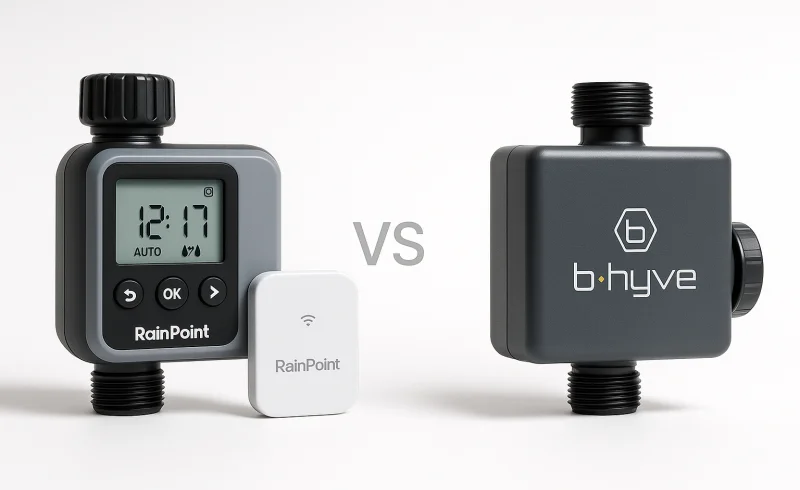
Explore the differences between RainPoint's gateway-powered remote control and B-hyve's simple Bluetooth automation. Discover which model provides better connectivity, ease of setup, and overall value for efficient garden watering.
TL;DR
- RainPoint HTV245FRF + HWG023WBRF fits yards where one faucet needs to feed two independently scheduled watering lines, or where remote app control away from home is an important requirement. The Wi-Fi gateway is included in this bundle.
- B-hyve Smart Hose Timer fits a single watering line and can operate as a simpler Bluetooth-based system without a hub. Remote access requires the compatible Gen 2 Wi-Fi hub, which is not included with the timer considered here.
- Both support programmable watering, manual operation at the timer, and water-flow monitoring. The more important difference is system architecture: two outlets plus an included gateway on RainPoint versus one outlet and optional Wi-Fi expansion on B-hyve.
- For several permanent irrigation zones or in-ground valves, neither is a substitute for a dedicated multi-zone irrigation controller.
| Feature | B-hyve Smart Hose Timer | RainPoint HTV245FRF + HWG023WBRF |
|---|---|---|
| Power | ||
| Battery requirement | 2 × AA batteries (not included) | 4 × AA alkaline batteries (not included) |
| General | ||
| Independent watering outlets | 1 | 2 |
| Protection | ||
| Water resistance rating | IPX-5 | IP65 |
| Scheduling | ||
| Manual watering at device | Yes | Yes |
| Programmable watering schedules | Yes | Yes |
| Connectivity | ||
| Included hub / gateway | Not included | Included (HWG023WBRF) |
| Primary wireless control | Bluetooth out of box; Wi-Fi available with optional Gen 2 hub | 2.4GHz Wi-Fi via included HWG023WBRF gateway |
| Remote control away from device | Requires Gen 2 Wi-Fi hub | Supported |
| Water Management | ||
| Built-in flow meter | Yes | Yes |
📑 Table of Contents
- The Real Decision Starts With Your Yard Layout
- Connectivity & Remote Control
- Setup & Installation
- Watering Flexibility
- Daily Use: Local Simplicity vs Remote Adjustments
- Flow Monitoring and Manual Control
- Weather Resistance
- Batteries and Routine Maintenance
- Software & System Design
- Which Setup Fits Which Scenario?
- The Bottom Line
- FAQ
The Real Decision Starts With Your Yard Layout
The largest difference between these timers is not the app. It is the plumbing.
RainPoint HTV245FRF + HWG023WBRF has two independent outlets. One outdoor faucet can therefore feed two watering circuits with separate schedules. A common example would be a drip line for raised beds on one outlet and a sprinkler or soaker hose on the other.
B-hyve Smart Hose Timer has one outlet. For a single drip line, hose, or sprinkler zone, that is often all that is needed. But the one-outlet design cannot independently automate two lines from the same timer.
That distinction matters more in everyday use than many secondary software features. If the yard already requires two independently timed lines from one faucet, RainPoint solves that directly. If there is only one line, much of RainPoint's additional hardware may go unused.
Connectivity & Remote Control
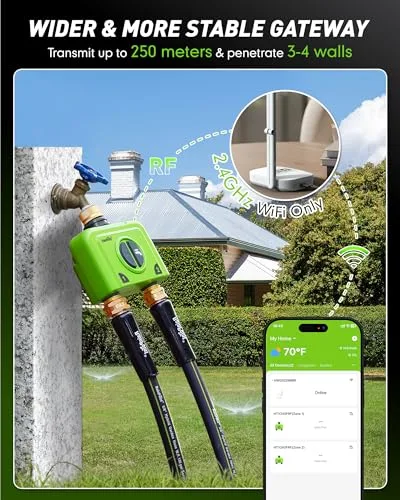
The two systems take different paths to app connectivity.
With RainPoint, the outdoor timer pairs with the included HWG023WBRF gateway, while the gateway connects to a 2.4GHz Wi-Fi network. This gives the RainPoint system remote app access without requiring another hub beyond the components already included in this specific bundle.
That architecture is useful when the timer is mounted outside but the best network connection is indoors. It also means there are several links involved: the timer must communicate with the gateway, and the gateway must remain powered and connected to the home network.
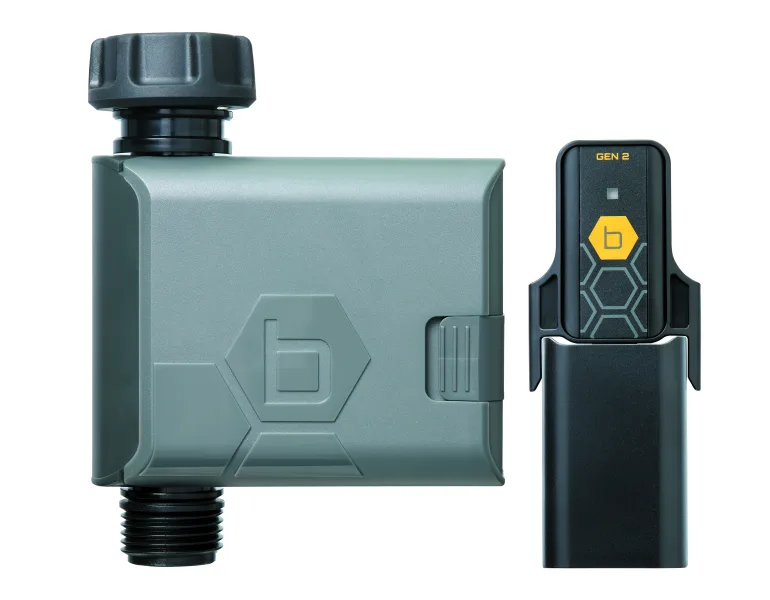
B-hyve takes a more modular approach. The timer can be configured and controlled locally through Bluetooth without a Wi-Fi hub. That keeps the basic system independent of the home network when remote access is unnecessary.
The limitation appears when the user is away from Bluetooth range. For this version of the B-hyve timer, remote access requires the compatible Gen 2 Wi-Fi hub. Without it, the phone cannot simply reach the timer through the internet.
This distinction is easy to misunderstand because both products are described as smart hose timers. Both automate watering, but only the RainPoint bundle includes the network bridge required for away-from-home control.
It is also worth separating remote control from scheduled automation. A Bluetooth-first timer can still run programmed watering without a phone sitting beside it. What Bluetooth limits is the ability to inspect or change the timer from outside local wireless range.
Setup & Installation
RainPoint requires more initial configuration because it is a two-device system.
The HTV245FRF attaches to the outdoor faucet and powers its two valves from AA batteries. The HWG023WBRF gateway needs power indoors, must join a 2.4GHz Wi-Fi network, and then must be paired with the timer.
Gateway placement therefore matters. It needs a dependable connection to the home network while also maintaining communication with the outdoor timer. Walls, distance, and other physical obstructions can affect wireless links, so installation involves more than simply attaching the valve to a faucet.
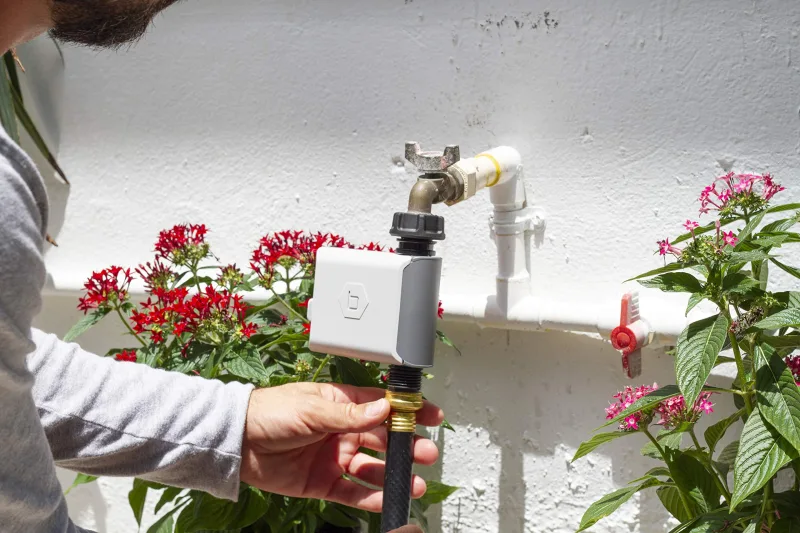
B-hyve is simpler when used in Bluetooth mode. Attach the single-outlet timer, pair it with the B-hyve app, configure the watering program, and there is no separate network bridge to position.
That simplicity changes if remote access is added later. At that point B-hyve also becomes a timer-plus-hub system, and hub placement becomes part of the installation.
So the setup advantage depends on how the system will actually be used:
- B-hyve without a hub: fewer components and the simpler network configuration.
- RainPoint: more initial steps, but the remote-access hardware is already part of the system.
- B-hyve with a Gen 2 hub: closer to RainPoint in overall connectivity complexity.
Watering Flexibility
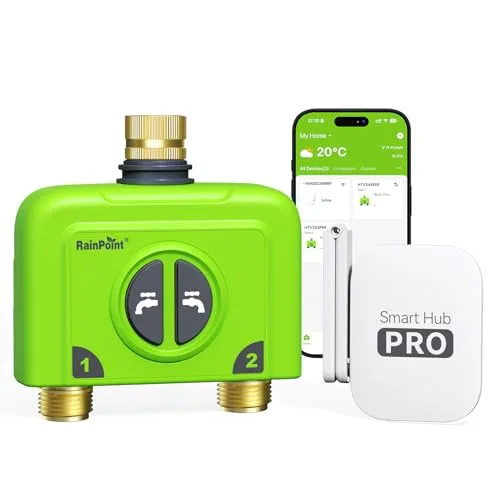
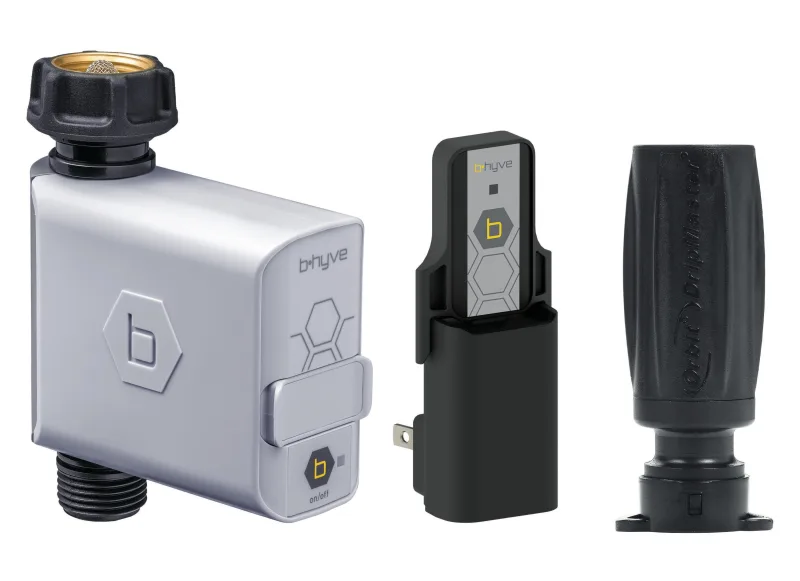
RainPoint's two independently controlled outlets are its most consequential functional advantage.
Separate scheduling allows two areas with different watering needs to share one faucet without requiring the same timing. A vegetable bed and a lawn sprinkler, for example, generally should not be treated as one irrigation zone simply because they happen to use the same water source.
B-hyve's single outlet is less flexible in that situation, but it is not inherently a disadvantage for a one-zone yard. Additional valves and configuration provide little benefit when every plant connected to the faucet belongs on the same watering schedule.
Both timers cover the core functions expected in this category:
- programmable watering schedules;
- manual watering directly at the timer;
- a built-in flow meter for tracking water use.
RainPoint therefore does not separate itself by having basic automation that B-hyve lacks. Its advantage is the ability to apply that automation independently to two outlets from one device.
That can also reduce physical intervention. With two permanently connected watering lines, there is less reason to move hoses between uses or add a separate mechanical splitter simply to keep both lines attached.
Daily Use: Local Simplicity vs Remote Adjustments
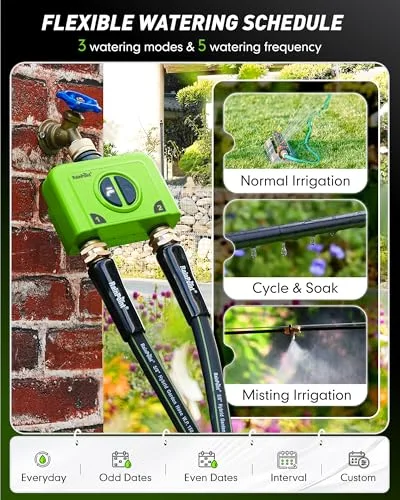
The practical value of remote access depends heavily on how watering schedules are managed.
If a schedule is rarely changed, B-hyve's Bluetooth model is less restrictive than it first appears. Once automation is configured, routine watering does not require repeatedly interacting with the phone. Manual watering is also available at the timer itself.
Bluetooth becomes inconvenient when something changes while nobody is near the property. A schedule adjustment, unexpected watering stop, or other remote intervention cannot be handled through the timer alone without the optional Wi-Fi hub.
RainPoint is designed around that remote-access scenario from the beginning. With the gateway online, app interaction is not limited by physical proximity to the faucet.
Its two outlets also make the app more useful in a multi-area yard because there are two independent schedules to inspect and adjust.
The tradeoff is dependency. RainPoint's remote path relies on both the outdoor timer's connection to the gateway and the gateway's connection to the network. A system with more wireless components naturally has more links to inspect when remote communication is unavailable.
That does not establish that either timer is more reliable in practice. It simply reflects the difference in architecture.
Flow Monitoring and Manual Control
Both products include flow monitoring, which is more useful than it may sound on a specification sheet.
A watering duration tells you how long a valve stayed open. Flow data adds information about how much water actually passed through the timer. That can help distinguish a short drip-irrigation cycle from a much higher-flow sprinkler run even when both operate for similar lengths of time.
Neither flow meter should be treated as a substitute for a dedicated leak-detection or whole-home water-monitoring system. Here, the feature is primarily part of irrigation tracking.
Manual control is similarly important because smart watering systems still need to behave like ordinary faucets from time to time.
RainPoint provides manual operation for each of its two zones. B-hyve also allows manual watering at the timer. That means opening the app is unnecessary for basic tasks such as briefly running a hose or starting an unscheduled watering session.
Weather Resistance
RainPoint is specified at IP65, while B-hyve is rated IPX5.
Those codes are easy to overinterpret.
The 5 at the end of each rating describes protection against water jets. RainPoint's additional 6 is a formal dust-ingress rating, indicating a dust-tight enclosure. The X in B-hyve's IPX5 rating means that no dust-protection level is specified by that rating.
So the defensible distinction is narrow but useful: RainPoint has a documented dust-ingress rating that B-hyve's IPX5 designation does not provide.
That does not mean RainPoint is generally impervious to outdoor conditions or that B-hyve cannot remain outdoors during normal watering-season use. Neither rating indicates protection against submersion, and an IP rating by itself says nothing about resistance to freezing water inside a valve.
For a dusty, exposed installation, RainPoint's formal dust rating is meaningful. For ordinary rain and irrigation spray, both devices carry a level-5 water-ingress rating.
Batteries and Routine Maintenance
RainPoint uses four AA batteries, while B-hyve uses two AA batteries.
The immediate difference is simply the number of cells required when batteries are replaced. It is not valid to conclude from battery count alone that RainPoint consumes more power or that B-hyve will run longer between replacements.
Battery life depends on valve operation, radio activity, temperature, battery chemistry, signal conditions, and firmware behavior. Without comparable controlled runtime measurements, claims about which timer needs more frequent battery changes would be speculation.
What can be said confidently is that B-hyve requires fewer cells per replacement, while RainPoint powers two independently controlled valves from its four-cell battery pack.
Software & System Design
The software comparison is better understood as a difference in dependency model than as a simple ranking of the two apps.
RainPoint's normal connected configuration includes the gateway. That makes remote access part of the intended system but also means the gateway is a required component of that experience.
B-hyve can remain a Bluetooth-only device. For someone who wants app-based programming while physically near the timer, the home network does not need to be involved. The Gen 2 hub becomes relevant when remote control is required.
That modularity gives B-hyve two distinct operating models:
Bluetooth only
- local app connection;
- programmed watering;
- manual operation at the timer;
- no away-from-home app control.
Bluetooth plus Gen 2 Wi-Fi hub
- adds the network bridge required for remote access.
RainPoint effectively starts from the second model: its gateway is already part of the HTV245FRF + HWG023WBRF bundle.
Claims that one platform is automatically more polished, more reliable, or more future-proof would require stronger comparative evidence than specifications and support documentation provide. The concrete difference is simpler: RainPoint includes the infrastructure for remote connectivity, while B-hyve makes that infrastructure optional.
Which Setup Fits Which Scenario?
Two watering lines from one faucet
RainPoint HTV245FRF + HWG023WBRF is the more appropriate architecture. Its two valves can run independently, so a drip line and sprinkler do not have to share one schedule.
One simple watering zone
B-hyve Smart Hose Timer keeps the hardware arrangement simpler. A second valve and permanent gateway provide limited benefit when there is only one watering circuit and remote intervention is not important.
Frequent changes while away from home
RainPoint provides the required gateway as part of this configuration. Remote control is therefore part of the system without another connectivity component.
Mostly scheduled watering with occasional local adjustments
B-hyve in Bluetooth mode is a sensible fit. The timer can handle the automation while Bluetooth is used when settings need to be changed nearby.
Exposed or dusty faucet location
RainPoint's IP65 rating provides a documented dust-protection level in addition to its level-5 water-ingress rating. B-hyve's IPX5 rating specifies water protection but does not assign a dust-ingress level.
Several irrigation zones or permanent in-ground valves
Neither design scales as cleanly as a purpose-built multi-zone irrigation controller. Hose-end timers are most useful when the watering system genuinely begins at an outdoor faucet.
The Bottom Line
This comparison does not produce a meaningful universal winner because the two timers are optimized around different system layouts.
RainPoint HTV245FRF + HWG023WBRF is the more capable self-contained configuration when the requirement is two independently scheduled outlets plus remote app access. Those are substantial differences, not minor extras. The cost is additional setup complexity and dependence on an indoor gateway.
B-hyve Smart Hose Timer is the cleaner single-zone, local-first system. Bluetooth allows it to operate without adding network hardware, while the compatible Gen 2 hub remains available when remote access is needed. Its one-outlet design is the main limitation for yards that need two separate watering schedules from the same faucet.
The practical decision therefore comes down to two questions: Does one faucet need to serve one independently controlled watering line or two, and does the timer need to be reachable when nobody is nearby? Those answers separate these products more clearly than a generic feature count.
FAQ
Can I control the B-hyve Smart Hose Timer from anywhere without the hub?
Does the RainPoint timer require a subscription?
Which timer is easier to install?
Can both timers be used with drip irrigation or soaker hoses?
Is the B-hyve hose timer waterproof?
Does the RainPoint timer work with 5GHz WiFi?
How do I reset an unresponsive B-hyve timer?
"Images are used for editorial and informational purposes only. All trademarks and images belong to their respective owners."