
Potensic ATOM 2 vs HOVERAir X1 PROMAX: Pilot-Led Camera Drone vs Self-Flying Camera
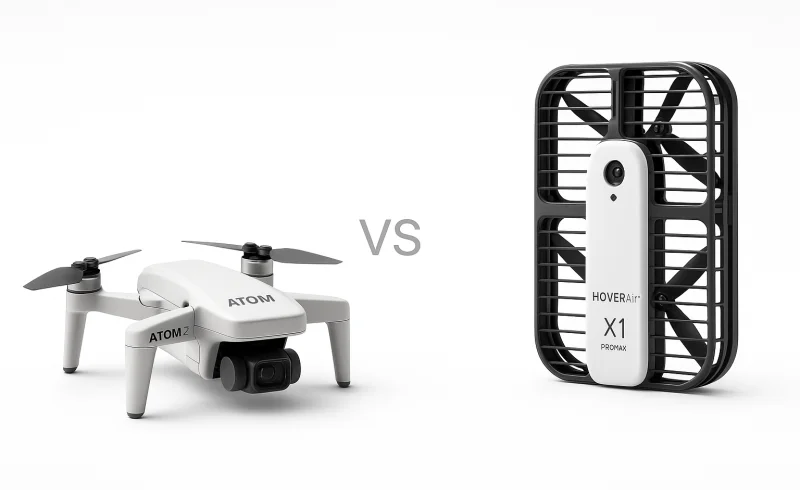
Explore the differences between the Potensic ATOM 2 and HOVERAir X1 PROMAX drones. Learn about their flight capabilities, video quality, and user experience to help you choose the right drone for traditional piloting or autonomous filming.
TL;DR
- For deliberate aerial framing and longer flights: the Potensic ATOM 2 is the stronger fit. It is a conventional GNSS camera drone with a dedicated controller, a 3-axis gimbal, up to 32 minutes of rated flight time, and far more transmission headroom.
- For filming yourself with minimal setup: the HOVERAir X1 PROMAX is built around that job. It can launch from your hand, follow a subject without a conventional controller, records up to 8K/30 or 4K/120, and adds rear collision-detection hardware.
- The distinction is not simply manual versus automatic. ATOM 2 has AI tracking and automated camera moves; X1 PROMAX can also be flown manually through the app or the optional Beacon and JoySticks. The difference is which workflow each design treats as the default.
- Neither provides comprehensive obstacle avoidance. ATOM 2 has downward vision positioning but no obstacle-avoidance system. X1 PROMAX adds rear sensing, but not omnidirectional protection.
- For mixed use, decide which compromise matters more: ATOM 2 asks you to carry and operate a conventional drone setup; X1 PROMAX gives up roughly half the rated airtime and much of the long-range camera-drone operating envelope in exchange for faster deployment and stronger self-filming tools.
Firmware matters with both models. Features added after launch include P-Log and other flight functions on ATOM 2, while X1 PROMAX has also gained expanded color and RAW capabilities. Older reviews may therefore describe a more limited feature set than current software provides.
| Feature | Potensic ATOM 2 | HOVERAir X1 PROMAX |
|---|---|---|
| Power | ||
| Battery Capacity | 2230 mAh | 1920 mAh |
| Battery Operating Temperature | 0°C to 40°C | -5°C to 45°C |
| Camera | ||
| Aperture | f/1.8 | f/2.55 |
| Image Sensor | 1/2-inch CMOS | 1/1.3-inch CMOS |
| Field of View | 79.4° | 107° |
| Max Video Bitrate | 80 Mbps | 160 Mbps |
| Vertical Shooting | Supported | Supported |
| Max Video Resolution | 4K 3840×2160 @24/25/30fps | 8K/30fps; 4K/120fps |
| Flight | ||
| Max Hover Time | 29 min | 15 min |
| Max Flight Time | 32 min | 16 min |
| Transmission Range | 10 km | Phone/App: up to 500 m; Beacon: up to 1 km |
| Max Wind Resistance | 38 km/h (Level 5) | Level 5 (10.7 m/s) |
| General | ||
| Takeoff Weight | < 249 g | 192 g |
| Unfolded Dimensions | 300 x 242 x 58 mm | 173 mm x 149 mm x 39 mm |
| Storage | ||
| Expandable Storage | microSD card (U3 or V30 minimum) | microSD up to 1 TB |
| Stabilization & Safety | ||
| Obstacle Detection | Absent | Rear proximity sensors; extra visual sensor |
| Camera Stabilization | 3-axis gimbal | 2-axis gimbal with SmoothCapture 2.0 and AI-assisted horizon leveling |
📑 Table of Contents
- The Real Difference: Who Is Operating the Shot?
- Flight Time and Control
- Camera Quality: Resolution Is Only Part of the Story
- Tracking and Automation
- Safety: Rear Sensing Is Not Omnidirectional Avoidance
- Portability and Setup
- Sub-250 g Does Not Mean Regulation-Free
- Which One Fits Which Kind of Filming?
- The Bottom Line
- FAQ
The Real Difference: Who Is Operating the Shot?
On a specification sheet, these two drones overlap more than their shapes suggest. Both weigh less than 250 g, both can track a moving subject, both record stabilized video, both offer vertical capture, and both can be controlled manually.
But they are built around opposite assumptions.
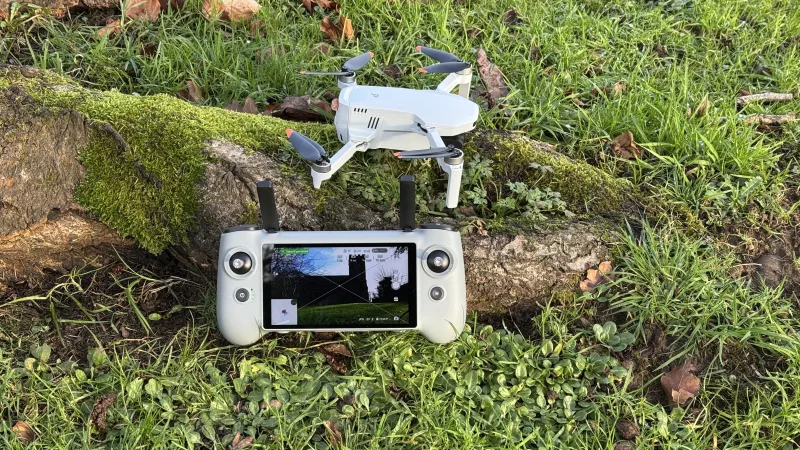
The Potensic ATOM 2 is a camera drone first. Its normal workflow starts with a remote controller, GNSS positioning, manual stick input, gimbal control, and deliberate placement of the aircraft. AI Track, QuickShots, Cruise Control, and automated flight features reduce the workload when useful, but the pilot remains at the center of the experience.
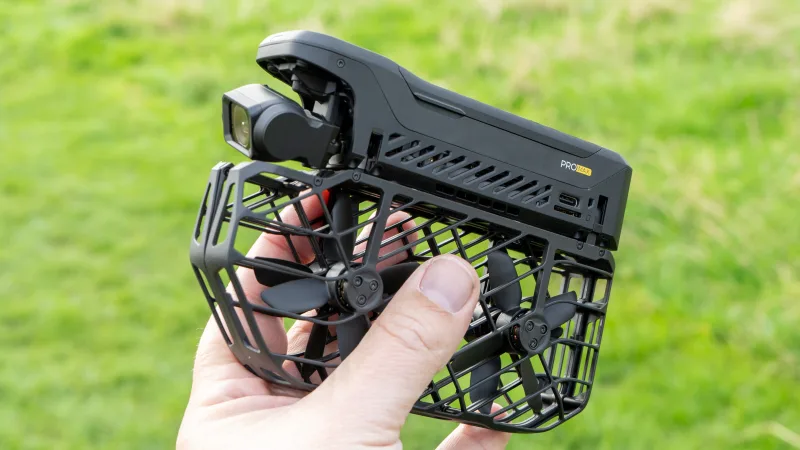
The HOVERAir X1 PROMAX is a self-filming camera first. Its defining workflow is closer to an action camera that happens to fly: select a flight mode, launch it from your hand, let it frame and follow the subject, then bring it back. A phone or the optional Beacon and JoySticks can provide manual control, but neither is required for many of its signature shooting modes.
That distinction matters more than the headline difference between 4K and 8K.
Flight Time and Control
32 minutes versus 16 minutes is a major practical difference
Potensic rates the ATOM 2 for up to 32 minutes of flight and 29 minutes of hovering. HOVERAir rates the X1 PROMAX for up to 16 minutes of flight and 15 minutes of hovering.
Those are laboratory-style maximums rather than guaranteed shooting times. Wind, temperature, speed, battery condition, recording settings, and the need to land with reserve power all shorten a real session. Even so, the two-to-one difference is large enough to change how each drone is used.
With ATOM 2, there is more room to scout a location, make a pass, adjust the gimbal, repeat the move, and still have useful battery time remaining. X1 PROMAX makes more sense in shorter bursts: launch, record an automated follow or reveal, land, then redeploy later.
For a five-minute hiking clip or a short cycling sequence, that may be entirely adequate. For a longer sequence in which the aircraft stays airborne while the operator experiments with several compositions, the shorter battery becomes much harder to ignore.
Transmission distance describes the radio system, not a sensible flight radius
Potensic specifies up to 10 km for ATOM 2 under its stated FCC test conditions. The company also notes that this figure comes from an open, interference-free test and represents the farthest communication distance for a one-way, non-return flight.
HOVERAir specifies up to 500 m through the phone app and up to 1 km with the Beacon under favorable conditions. Its own specifications show considerably shorter expected distances in environments with significant radio interference.
The raw numbers make ATOM 2's radio system much more capable, but a 10 km specification should not be interpreted as an invitation to operate the drone 10 km away. Visual-line-of-sight and local airspace rules constrain actual operations in the United States and many other jurisdictions.
The practical advantage is therefore link margin and freedom of positioning, not the ability to exploit the full advertised distance. ATOM 2 is designed for a much larger operating envelope; X1 PROMAX is designed primarily to remain relatively close to the person or activity it is filming.
Wind ratings are the same on paper
Both manufacturers specify Level 5 wind resistance at 10.7 m/s, roughly 24 mph or 38.5 km/h.
That does not mean the two aircraft will behave identically in every gust. They have different masses, shapes, propulsion systems, stabilization strategies, and flight-control logic. The defensible conclusion is simply that their manufacturer wind-resistance ratings are equivalent.
Flight and control advantage: Potensic ATOM 2. The longer endurance, conventional controller, GNSS-centered flight workflow, and substantially greater radio headroom make it much better suited to sustained pilot-directed flying.
Camera Quality: Resolution Is Only Part of the Story
X1 PROMAX has substantially more video headroom
The ATOM 2 records up to 4K at 24/25/30 fps. It can reach 50 or 60 fps at Full HD and provides separate Full HD slow-motion modes.
The X1 PROMAX reaches 8K at up to 30 fps and 4K at up to 120 fps. That gives it two capabilities the ATOM 2 cannot match: very high-resolution capture for reframing and high-resolution slow motion for action.
The 8K mode is most relevant when there is a real reason to retain extra spatial resolution—for example, cropping a wider self-filming shot into multiple compositions. The more broadly useful difference may be 4K/120, because it allows fast motion to be slowed substantially while retaining 4K output.
X1 PROMAX also specifies a maximum video bitrate of 160 Mbps at 8K/30, while ATOM 2 tops out at 80 Mbps. That does not mean the HOVERAir image is automatically twice as good. Bitrate comparisons across different resolutions, codecs, processing pipelines, and frame rates do not work that way. It does show that the X1 PROMAX recording pipeline is built to handle considerably more video data at its highest settings.
The lenses produce very different perspectives
ATOM 2 uses a 1/2-inch CMOS sensor, an f/1.8 lens, and a 79.4° field of view.
X1 PROMAX uses a larger 1/1.3-inch CMOS sensor, an f/2.55 lens, and a much wider 107° field of view.
The larger HOVERAir sensor provides a stronger imaging foundation, but the field-of-view difference is just as important in daily use.
The X1 PROMAX's wide view gives its tracking system more room to keep a moving person and the surrounding environment inside the frame. That makes sense for cycling, skiing, running, or walking shots where the camera is constantly repositioning itself.
ATOM 2's tighter view looks more like a conventional aerial camera. A landscape feature or distant subject occupies more of the frame without requiring such close positioning, and controlled camera moves are less dominated by the ultra-wide perspective associated with action cameras.
The aperture numbers should not be used by themselves to declare a low-light winner. ATOM 2 has the numerically faster lens, while X1 PROMAX has the larger sensor and a different image-processing pipeline. Without matched testing, the specifications alone do not establish which produces cleaner footage in a particular night scene.
Stabilization favors different kinds of movement
ATOM 2 uses a 3-axis mechanical gimbal. Pitch, roll, and yaw stabilization are handled mechanically, which is the conventional arrangement for pilot-directed aerial cinematography.
X1 PROMAX combines a 2-axis mechanical gimbal with electronic stabilization and horizon leveling under HOVERAir's SmoothCapture 2.0 system.
For a drone flying an intentionally slow orbit, pan, or reveal, ATOM 2's full 3-axis mechanical system is the more conventional tool. For a camera rapidly repositioning itself around a runner or cyclist, HOVERAir's combination of mechanical and electronic stabilization is designed around that more dynamic movement.
Neither specification alone proves that every ATOM 2 clip will look smoother than every X1 PROMAX clip. The stabilization systems are solving somewhat different problems.
X1 PROMAX has the stronger current color and slow-motion toolkit
Current X1 PROMAX specifications include 10-bit HLG and H-Log, in addition to standard recording modes. That matters for footage intended for more substantial color work because 10-bit recording contains far more tonal steps than conventional 8-bit video.
Potensic added P-Log to ATOM 2 through firmware, and the drone also provides HDR recording. That is a meaningful upgrade from its launch feature set. Potensic's current consumer specifications, however, do not make the same explicit 10-bit recording claim HOVERAir makes for HLG and H-Log, so the two systems should not be treated as equivalent simply because both now have a log-named profile.
For straightforward footage requiring little post-production, this distinction may not matter. For a workflow built around grading, HDR delivery, or high-frame-rate action, the X1 PROMAX has substantially more room to work.
Vertical video is not an equal tie
Both drones can record vertically, but their maximum vertical modes differ.
X1 PROMAX supports vertical 4K at up to 30 fps.
ATOM 2's higher-resolution native 9:16 mode reaches 1696 × 3000 at up to 30 fps, with Full HD vertical recording also available.
So both avoid relying entirely on a crop from horizontal footage, but X1 PROMAX preserves more resolution in its highest-quality portrait-oriented mode.
Still photography has changed with firmware
ATOM 2 can produce 48MP JPEGs and supports RAW/DNG capture at lower resolution, alongside bracketing, burst, interval, and panorama modes.
Current X1 PROMAX software supports up to 48MP JPEG and DNG/RAW capture, a notable expansion from its earlier still-photo capabilities.
That narrows what was once a clearer still-photography distinction between these two products. ATOM 2 still has the more traditional aerial-photography workflow; X1 PROMAX now offers much more editing latitude than its original launch specifications suggested.
Camera advantage: HOVERAir X1 PROMAX for video flexibility. Its 1/1.3-inch sensor, 8K recording, 4K/120 slow motion, 10-bit HLG/H-Log, 4K vertical mode, and current RAW support give it considerably more format headroom. ATOM 2 counters with the tighter lens perspective and 3-axis mechanical gimbal that better suit conventional aerial composition.
Tracking and Automation
The original framing of these drones as "manual ATOM 2 versus automated X1 PROMAX" is too simple.
ATOM 2 is not a manual-only drone
Potensic provides AI Spotlight, AI Follow, and AI Parallel tracking modes, along with automated QuickShots such as Pull-Away, Rocket, Circle, Spiral, Boomerang, and Dolly Zoom. Current software also expands the drone's automated-flight toolkit beyond what was available at launch.
That means a solo operator can still ask ATOM 2 to keep a subject framed rather than manually controlling every second of every flight.
The difference is that automation feels like a feature layered onto a conventional camera drone rather than the organizing principle of the entire product.
X1 PROMAX makes automation the starting point
HOVERAir builds the X1 PROMAX around automated subject capture. Its flight modes can be selected directly on the aircraft, and the drone can launch from a hand without first assembling a traditional controller setup.
HOVERAir specifies a maximum auto-follow speed of 42 km/h (26 mph) under its test conditions, reflecting the emphasis on activities such as cycling and skiing rather than slow aerial sightseeing alone.
The important limitation is not that the X1 PROMAX lacks manual control. It does not. Manual flight is available through the app, and the optional Beacon and JoySticks can turn it into a more conventional two-stick system.
The limitation is that adding those controls does not transform it into an ATOM 2 equivalent. Its battery endurance, radio envelope, stabilization architecture, and basic design remain those of a compact self-flying camera.
For someone who occasionally wants to reposition a self-filming camera manually, that flexibility is useful. For someone whose normal process involves flying a carefully planned path while controlling aircraft and gimbal simultaneously, ATOM 2 remains the more natural tool.
Safety: Rear Sensing Is Not Omnidirectional Avoidance
This is one of the areas where the original comparison needs the most qualification.
ATOM 2 has positioning sensors, not obstacle avoidance
ATOM 2 includes a downward vision system that helps with low-altitude positioning and hovering. That should not be confused with forward, rear, or omnidirectional obstacle detection.
Potensic explicitly states that ATOM 2 does not have obstacle-avoidance capability. Trees, wires, walls, branches, poles, and other hazards remain the operator's responsibility, including during automated tracking and camera moves.
The safest interpretation of its AI features is therefore: automation can control the flight path, but it cannot guarantee that the path is clear.
X1 PROMAX's safety advantage is real but limited
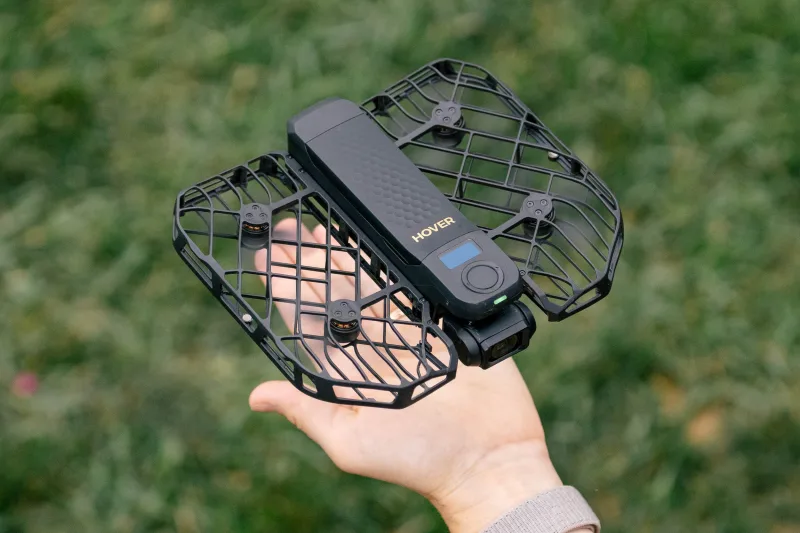
X1 PROMAX adds rear proximity sensing and a rear vision sensor, plus downward sensing for positioning. Its enclosed propeller structure is also better suited to close-in use than an open-propeller camera drone.
But this is not comprehensive obstacle avoidance.
HOVERAir specifies rear collision detection for particular autonomous modes, including Zoom Out, Dolly Track, and Dolly Zoom, and lists detection support up to 3 m/s for X1 PROMAX. It does not provide equivalent front and side sensing around the entire aircraft.
That matters because an autonomous camera can still encounter thin branches, cables, obstacles outside the sensor coverage, or objects approached in a direction the rear system is not monitoring.
So the defensible conclusion is narrower than "X1 PROMAX has obstacle avoidance." It has useful rear collision-detection hardware tailored to several self-filming maneuvers.
For the intended close-follow workflow, that is a meaningful advantage over ATOM 2. It is not a substitute for choosing a clear flight path.
Portability and Setup
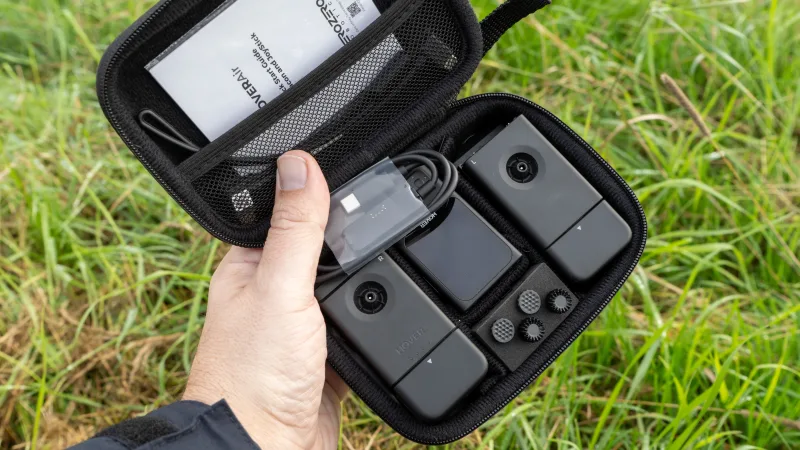
ATOM 2 weighs about 245 g in its standard configuration and folds to roughly 88 × 143 × 58 mm.
X1 PROMAX weighs about 192 g and folds to roughly 105 × 149 × 34 mm.
The dimensions reveal something the unfolded measurements obscure: ATOM 2 itself is already quite compact. X1 PROMAX is not dramatically shorter in every direction; its advantage is that it is lighter and substantially flatter.
The larger practical difference is everything around the aircraft.
ATOM 2 normally travels with a remote controller, because piloting is central to the experience. X1 PROMAX can perform many of its defining self-filming modes without a conventional controller at all. For a short walk, run, ride, or other activity where the camera is secondary to what the person is doing, leaving extra controls behind changes how likely the device is to come along.
If the Beacon and dual JoySticks become part of the normal X1 PROMAX setup, that simplicity advantage narrows. The drone remains lighter, but the overall workflow begins to resemble the camera-drone kit it was designed to avoid.
Portability advantage: HOVERAir X1 PROMAX, especially when used in its controller-free automated modes.
Sub-250 g Does Not Mean Regulation-Free
Both aircraft fall below 250 g in their standard configurations, but the significance of that number depends on where and how the drone is operated.
In the United States, drones weighing less than 250 g are generally exempt from FAA registration only when flown exclusively under the recreational exception. Operations under Part 107 require registration regardless of weight. Registered drones are also subject to Remote ID requirements unless an applicable exception applies.
Both manufacturers have added or advertised Remote ID support for these models, but firmware, region, and regulatory status should be confirmed before relying on that feature for a specific operation.
And regardless of registration status, sub-250 g aircraft are still subject to airspace restrictions, visual-line-of-sight requirements, operational rules around people and aircraft, and other applicable regulations.
Most importantly for this comparison, the 10 km ATOM 2 transmission specification does not override those operating rules.
Which One Fits Which Kind of Filming?
Deliberate aerial landscapes, architecture, and controlled camera moves
Potensic ATOM 2 fits this workflow better.
The combination of a dedicated controller, GNSS-based flight, a 3-axis gimbal, a tighter field of view, and twice the rated flight time gives the operator more time and direct control to build a shot rather than accept the framing selected by an autonomous mode.
Its AI features are useful additions, but they do not have to define the session.
Running, cycling, skiing, hiking, and solo self-filming
HOVERAir X1 PROMAX fits this workflow better.
Its strongest feature is not 8K. It is the ability to become the camera operator when the subject cannot reasonably pilot a conventional drone at the same time. Palm deployment, subject tracking, automated flight modes, enclosed propellers, and rear sensing are all aligned around that problem.
The larger sensor, 4K/120 recording, and wide lens then make more sense because they support the same action-oriented role.
Vertical-first video and high-frame-rate action
The X1 PROMAX has the technical advantage. Its 4K vertical recording and 4K/120 slow motion provide substantially more flexibility than ATOM 2's current vertical and frame-rate limits.
Long sessions and repeated takes
The ATOM 2 has the advantage. A rated 32-minute battery changes the rhythm of a session compared with 16 minutes, particularly when the operator needs several attempts at the same movement.
Tight spaces and obstacle-heavy environments
Neither should be treated as a comprehensive obstacle-avoiding drone.
X1 PROMAX is better equipped for close-proximity self-filming because of its enclosed propellers and rear collision detection, but its sensing has directional and mode-specific limitations. ATOM 2 has no obstacle-avoidance system at all.
If the intended route depends on the aircraft autonomously recognizing obstacles from multiple directions, this comparison is pointing at the wrong class of hardware.
The Bottom Line
The Potensic ATOM 2 and HOVERAir X1 PROMAX are not two versions of the same idea.
ATOM 2 is the better fit when the operator wants to control the aircraft and compose the image. Its major advantages are not flashy: more time in the air, a conventional controller, a 3-axis gimbal, GNSS-centered flight, and substantially greater transmission headroom. Those are the qualities that make repeated, intentional aerial camera work easier.
X1 PROMAX is the better fit when the person in the frame cannot also be a full-time pilot. Its wide camera, autonomous modes, fast tracking, compact body, rear sensing, high-frame-rate recording, and hand-launch workflow all reduce the amount of attention that has to be diverted from the activity being filmed.
Its 8K specification is useful, but it is not the reason these products feel different. The decisive question is simpler:
Do you want to operate the flying camera, or do you want the flying camera to operate around you?
For pilot-directed aerial work, ATOM 2 is the more coherent tool. For autonomous self-filming and action footage, X1 PROMAX is the more coherent tool.
FAQ
Which drone has better flight time?
Do I need FAA registration for either drone?
Which drone is better for self-filming?
Can the Potensic ATOM 2 shoot 8K video?
Does the HOVERAir X1 PROMAX have connection issues?
Can I fly the Potensic ATOM 2 in cold weather?
Which drone has better wind resistance?
Does the Potensic ATOM 2 have intelligent flight modes?
"Images are used for editorial and informational purposes only. All trademarks and images belong to their respective owners."