
Philips Hue R578096-4 vs WiZ Connected R603449: Whole-Home System vs Room-by-Room Simplicity
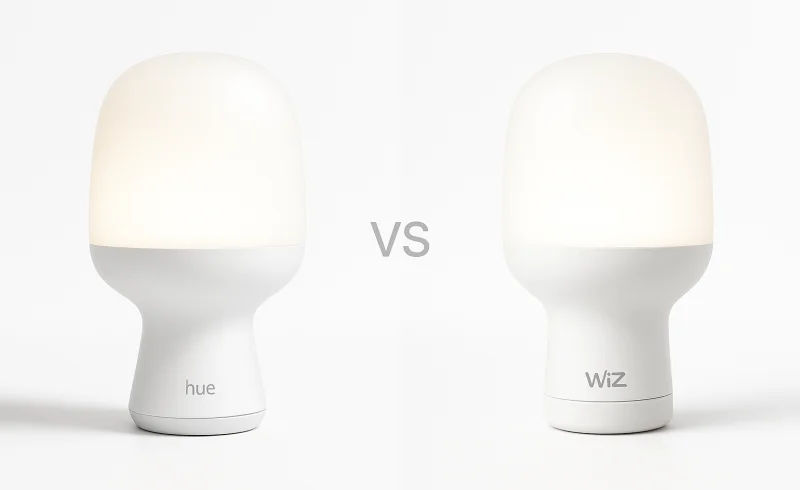
Explore the differences between Philips Hue and WiZ Connected smart lighting solutions. Understand their connectivity options, brightness levels, and long-term reliability to determine which system best fits your whole-home or room-by-room lighting needs.
TL;DR
- If you want a rock-solid, scalable lighting system that stays responsive even when your Wi‑Fi wobbles → choose Philips Hue R578096-4 (ideally with the Bridge)
- If you want the fastest, hub-free upgrade for a couple of rooms with minimal upfront commitment → choose WiZ Connected R603449
- If you’re building a multi-room setup and care about consistent scenes and future expansion → both can work, but Hue’s architecture pulls ahead as you grow
Key differentiators: Hue is much brighter (1,200 vs 800 lumens) and uses Zigbee to keep lighting traffic off your Wi‑Fi, making it feel like infrastructure that scales predictably. WiZ is easier to start with—no extra hub, just app and bulb—but ties every light to your home network’s quality; the higher CRI (≥90 vs ≥80) gives WiZ slightly better color accuracy, but it gives up brightness and offline resilience.
Who should skip both: If you need the absolute lowest entry price or plan to stay in a rental for only a few months, consider a simpler Bluetooth-only smart bulb instead—neither Hue nor WiZ is worth the ecosystem or network commitment for a temporary setup.
| Feature | Philips Hue R578096-4 | WiZ Connected R603449 |
|---|---|---|
| General | ||
| Bulb shape | BR30 | A19 |
| Product type | Smart LED bulb | Smart LED bulb |
| Base / socket | E26 | E26 |
| Pack quantity | 4 bulbs | 6 bulbs |
| Lighting | ||
| Dimmable | Yes | Yes |
| Rated power | 12.5 W | 8.8 W |
| Brightness (max) | 1,200 lm (at 4000K) | 800 lm |
| Wattage equivalent | 85 W | 60 W |
| Light color category | White and color light | Full color |
| Color temperature range | 2000-6500 K | 2200-6500 K |
| Color rendering index (CRI) | ≥80 | ≥90 |
| Dimensions | ||
| Height | 5-1/8 inch | 4-11/16 inch |
| Width / diameter | 3-3/4 inch diameter | 2-3/8 inch width |
| Durability | ||
| Switch cycles | 50,000 | 50,000 |
| Rated lifetime | 25,000 hours | 25,000 hours |
| Electrical | ||
| Power factor | 0.8 | 0.7 |
| Input voltage | 110V-130V | 120 V |
| Connectivity | ||
| Native Wi-Fi | No | Yes (2.4GHz) |
| Matter support | Yes | Yes |
| Works without Wi-Fi | Yes | No |
| Voice and app control | Yes | Yes |
| Communication protocol | Bluetooth, Zigbee | Bluetooth, Wi-Fi (2.4GHz) |
| Hub / gateway requirement | Optional Hue Bridge for full features | No hub or gateway required |
📑 Table of Contents
Connectivity & Ecosystem
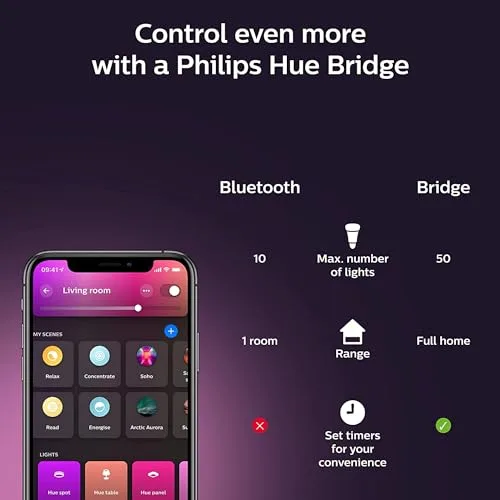
Philips Hue R578096-4 uses Bluetooth + Zigbee, with the Hue Bridge listed as optional for full features. In practice, that Zigbee/bridge path is what lets Hue keep lighting traffic off your general Wi‑Fi and, per spec, work without Wi‑Fi = Yes. Hue also has a defined Bluetooth scaling limit—one spec callout notes up to 10 lights via the Bluetooth app—which is a strong hint that Hue expects larger installs to move to the bridge.
WiZ Connected R603449 uses Bluetooth + native Wi‑Fi (2.4GHz) and explicitly does not work without Wi‑Fi. WiZ also documents that it operates only on 2.4GHz b/g/n Wi‑Fi and supports WPA-2/WPA-3 Personal (WiZ docs), which is fine for most homes but rules out 5GHz-only setups. The upside is simplicity: no hub/gateway required, so you can add bulbs room by room without buying or placing a bridge.
Conclusion: For networking architecture and resilience, Hue has the edge because Zigbee + (optional) Bridge reduces dependence on Wi‑Fi and is explicitly designed to scale beyond Bluetooth-only control.
Philips Hue R578096-4 and WiZ Connected R603449 both list Matter support = Yes, so either can plug into a modern smart-home controller ecosystem. Hue’s practical advantage is that, when you choose the bridge route, day-to-day control can stay more «local» and insulated from router churn—useful if you want lighting to behave like infrastructure as you add rooms and accessories. That said, some users report Hue can still run into connectivity hiccups that require resets, so «bridge-based» doesn’t mean «never troubleshoot.»
WiZ Connected R603449 gains Matter compatibility without adding a hub, but it remains fundamentally tied to Wi‑Fi quality because Native Wi‑Fi = Yes (2.4GHz) and Works without Wi‑Fi = No. A common failure mode for Wi‑Fi bulbs is «offline» behavior when networks get congested or devices move out of range; WiZ’s own guidance notes lights may appear offline with network failures/out-of-range and may fail to reconnect without a stable network (WiZ support). That’s not a dealbreaker in stable networks, but it’s a real ecosystem constraint if you’re planning to expand.
Conclusion: Matter is a wash on paper, but Hue’s bridge-based ecosystem typically provides more predictable whole-home behavior, while WiZ is more dependent on Wi‑Fi stability and router changes.
Winner: Philips Hue R578096-4
Brightness & Light Quality
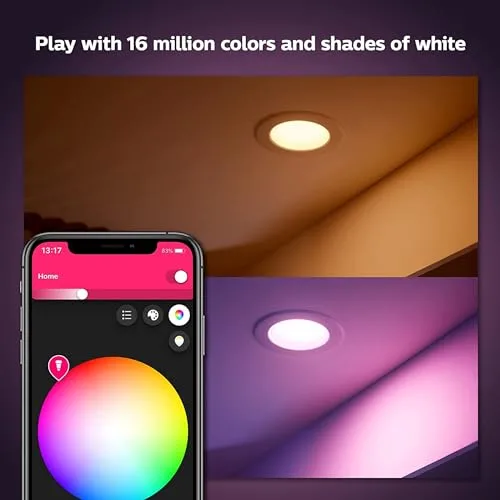
Philips Hue R578096-4 is the clearly brighter option on paper, rated at 1,200 lumens (at 4000K) and positioned as an 85W equivalent bulb. That extra output is especially relevant for its BR30 form factor, which is commonly used in recessed cans where you often want more punch to fill a space.
WiZ Connected R603449 is rated at 800 lumens and a 60W equivalent, which is a more typical brightness level for an A19 general-purpose bulb. It can still be plenty for bedside lamps and many ceiling fixtures, but it gives up 400 lumens versus Hue at comparable «maximum output» marketing.
Conclusion: For maximum brightness headroom, Philips Hue R578096-4 wins (1,200 lm vs 800 lm).
Philips Hue R578096-4 covers a broad white range at 2000–6500K, letting you go from warm, cozy tones to daylight whites. Its CRI is ≥80, which is serviceable but not «color-critical» if you care about accurate reds and skin tones.
WiZ Connected R603449 is very close on white tuning at 2200–6500K, only giving up the warmest 200K at the bottom end compared with Hue. Where it differentiates is color fidelity, with a higher stated CRI of ≥90 for more natural-looking colors under white light.
Conclusion: On tunable white range it’s effectively a wash (2000–6500K vs 2200–6500K), but for color accuracy WiZ Connected R603449 has the edge (CRI ≥90 vs ≥80).
Winner: Tie — Hue is meaningfully brighter, while WiZ has the stronger CRI spec for more accurate whites; the better choice depends on whether you prioritize output or color fidelity.
Setup & Onboarding
Philips Hue R578096-4 doesn’t have native Wi‑Fi (No) and instead relies on Bluetooth + Zigbee. That gives you a «quick start» path via Bluetooth, but it’s explicitly a smaller-scale setup—control is capped at up to 10 lights via the Bluetooth app per provided SoT spec. For the fuller experience, the specs call out an optional Hue Bridge for full features, which adds an extra device and an extra decision during onboarding.
WiZ Connected R603449 is built around native Wi‑Fi (Yes, 2.4GHz) plus Bluetooth, with no hub or gateway required—so initial setup is typically just bulb → app → Wi‑Fi credentials. WiZ is also explicitly limited to 2.4GHz b/g/n Wi‑Fi and supports WPA‑2/WPA‑3 Personal per documentation, which can simplify compatibility expectations but can be a constraint on networks that are heavily 5GHz-focused. The manual also notes a firmware update after pairing that may take 1–5 minutes, which can add a small delay when onboarding multiple bulbs.
Conclusion: WiZ Connected R603449 is generally faster and simpler to get running because it’s hubless Wi‑Fi out of the box, while Hue R578096-4 is more likely to push you toward a Bridge once you move beyond basic Bluetooth control (notably the 10-light limit).
Philips Hue R578096-4 has an onboarding advantage when you care about stability at scale because its primary «full-feature» path is Zigbee with an optional Hue Bridge, keeping lighting traffic off your general Wi‑Fi. That architecture is designed to reduce dependence on router behavior and Wi‑Fi congestion, which is why Hue setups often feel more «lighting-system-like» once the Bridge is in place. The trade-off is that you may need to commit to that ecosystem earlier than expected to avoid feature boundaries and rethinking your setup later.
WiZ Connected R603449, by contrast, puts your lighting directly on the home network, so the experience depends more on Wi‑Fi quality and coverage. The manufacturer notes that lights may appear offline during network failures or when out of range, and that devices can fail to reconnect if moved out of Wi‑Fi range—issues that can turn onboarding into troubleshooting in congested apartments or weak-coverage rooms. Some users also suggest higher failure rates, but that claim is forum-sourced and not as well-substantiated as the manufacturer’s connectivity guidance.
Conclusion: For «set it up once, then expand reliably,» Philips Hue R578096-4 (with Bridge) has the more robust onboarding path; for «get smart lighting into one room quickly with minimal extra hardware,» WiZ Connected R603449 is the more direct approach.
Winner: WiZ Connected R603449
Long-Term Reliability
Rated lifespan vs. real-world «staying connected»
Philips Hue R578096-4 is rated for 25,000 hours and 50,000 switch cycles, which sets expectations for long service life when the bulbs are powered and used normally. Reliability-wise, Hue’s key advantage is its Zigbee/Bluetooth approach and the fact it works without Wi‑Fi, so day-to-day control can remain stable even if the home network is congested. Still, some users note Hue can flicker or buzz, and an incompatible dimmer can trigger flickering/shutoffs or heat stress (Some users note dimmer-related flicker/shutoffs).
WiZ Connected R603449 matches the same 25,000-hour and 50,000-cycle ratings, so on paper the LED longevity is equally strong. The difference is operational resilience: WiZ relies on native Wi‑Fi (2.4GHz) and does not work without Wi‑Fi, so long-term «reliability» is more tied to router stability, coverage, and interference than the bulb hardware itself. The manufacturer explicitly notes bulbs may appear offline with network failures or if they’re out of range, and they can fail to reconnect after leaving Wi‑Fi range (Some users note offline/out-of-range behavior).
Conclusion: Both look equal on lifespan specs, but Hue has the more reliable control path over time because it can stay responsive without depending on your Wi‑Fi.
Scaling up: predictable whole-home behavior vs. Wi‑Fi dependency
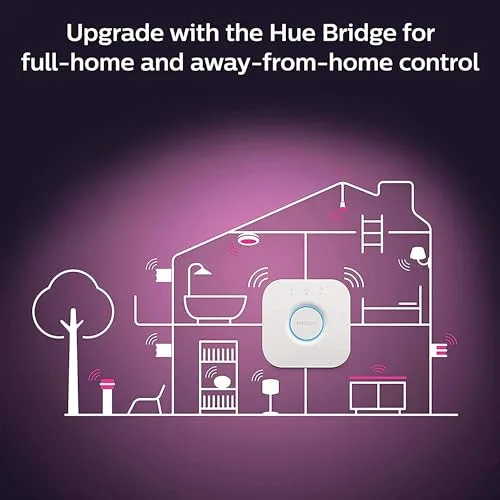
Philips Hue R578096-4 is structurally built for expansion because Zigbee lighting traffic can be kept separate from general home Wi‑Fi usage—especially once you add the optional Hue Bridge for full features. In practice, that means adding more rooms tends to preserve consistent group behavior and scene sync, aligning with Hue’s «system-like» design intent. The trade-off is ecosystem commitment: the most seamless long-term experience often assumes you’ll eventually adopt the Bridge and possibly Hue accessories.
WiZ Connected R603449 is optimized for quick, hub-free growth—just add more bulbs to the same network—but scaling can become less predictable because every additional light remains part of the Wi‑Fi dependency chain. WiZ is explicitly 2.4GHz b/g/n only (WPA2/WPA3 Personal), which can be fine in stable networks but more fragile in crowded RF environments or after router/SSID changes (Multiple reviewers report that stable Wi‑Fi is required and reconnection can fail after range/network changes). There’s also a lower-trust claim of a high failure rate from a forum source (Isolated reports suggest higher failure rates), but it’s not as well supported as the connectivity-related limitations.
Conclusion: Hue scales more predictably for multi-room deployments, while WiZ can be reliable but is more sensitive to Wi‑Fi quality and changes—a meaningful long-term reliability trade-off.
Winner: Philips Hue R578096-4
Smart Features & Control

Philips Hue R578096-4 is built around a deeper control stack: it supports Bluetooth + Zigbee and can run without Wi‑Fi (per specs), which is a meaningful resilience advantage when the network is congested or down. A key scaling detail is that Hue’s Bluetooth control is commonly capped—one listing specifies up to 10 lights via the Bluetooth app—which is where the optional Hue Bridge becomes the «full features» path. In practice, this aligns with Hue feeling more like infrastructure: rooms/zones/scenes stay consistent as you expand, but the best experience often assumes you’ll commit to the ecosystem.
WiZ Connected R603449 goes the opposite direction: it has native Wi‑Fi (2.4GHz) plus Bluetooth (specs) and requires no hub/gateway, which reduces upfront decisions and makes it easy to add bulbs quickly. WiZ’s own documentation is explicit that it operates only on 2.4GHz b/g/n and that bulbs may appear offline or fail to reconnect if they’re out of range or the network is unstable (Some users note offline behavior tied to network conditions). That trade-off makes WiZ feel straightforward for a few rooms, but more dependent on Wi‑Fi «hygiene» over time.
Conclusion: Hue has the stronger smart control ceiling and offline resilience (Zigbee + works without Wi‑Fi), while WiZ wins on hub-free simplicity (native 2.4GHz Wi‑Fi). If you expect to scale beyond a handful of lights and want consistent whole-home behavior, Hue’s approach is the more defensible advantage here.
Winner: Philips Hue R578096-4
The Bottom Line
After digging into connectivity, light performance, setup, and long-term behavior, the choice comes down to whether you want a scalable lighting system or an inexpensive, room-by-room upgrade.
Best for Whole-Home Smart Lighting: The Philips Hue R578096-4 is the better pick because its Zigbee/Bridge path is built to scale beyond Bluetooth’s limits and stay consistent across multiple rooms.
Best for Budget Single-Room Upgrades: The WiZ Connected R603449 makes more sense since it delivers solid smart features with a hub-free, lower-cost entry point for a single space.
Best for Renters: The WiZ Connected R603449 wins because it avoids a hub commitment and is designed around quick Wi‑Fi pairing when you move.
Best for Reliability-Focused Users: The Philips Hue R578096-4 is the clear choice thanks to its ability to remain responsive without Wi‑Fi when run as a bridge-based Zigbee setup.
Overall,
: while WiZ Connected R603449 is the value play for simple, hubless installs (and it posts the stronger CRI spec), Hue is the more future-proof ecosystem with brighter output and more resilient, whole-home-friendly control.If you’re building smart lighting you’ll expand over time, invest in Hue; if you just want an affordable smart bulb or two and your Wi‑Fi is stable, WiZ is the practical buy.
FAQ
Can I use Philips Hue without a bridge?
Do WiZ bulbs work without internet?
Which bulb is brighter, Hue or WiZ?
Are both bulbs Matter compatible?
What Wi-Fi band do WiZ bulbs require?
Do WiZ bulbs require a firmware update after setup?
How long do Philips Hue bulbs last?
Are there any common issues with Philips Hue bulbs?
📄 Used Manuals & Documentation
Philips Hue R578096-4
"Images are used for editorial and informational purposes only. All trademarks and images belong to their respective owners."